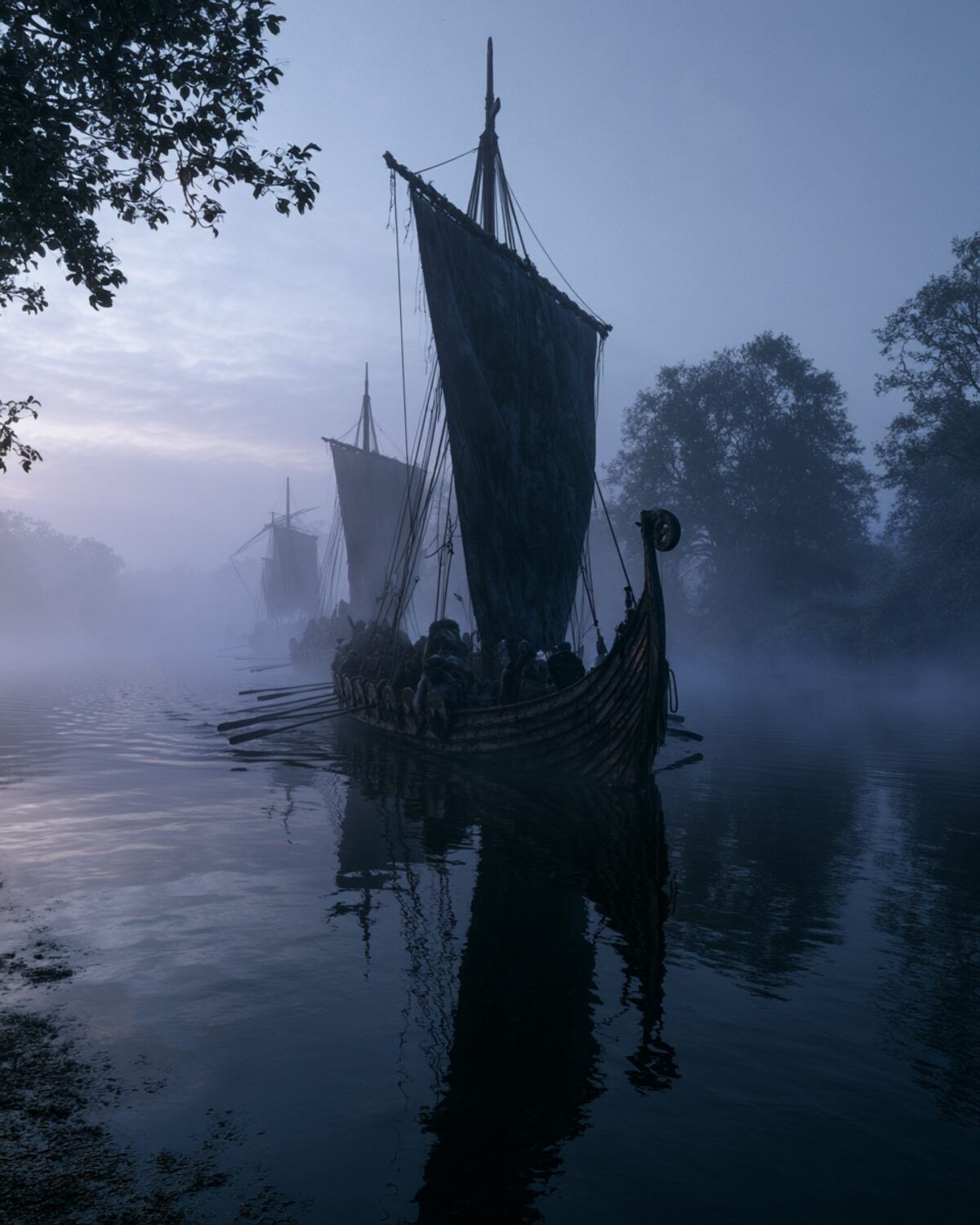
“Viking” sounds like the name of a people, but it did not start out as one. In Old Norse, a víkingr was a man who went raiding or fighting overseas, and víking was the expedition itself. Where the word comes from is still unresolved: a bay, a district on the Oslofjord, a shift at the oars or an English trading place – each explanation has supporters and weak points. This article follows the evidence, from rune stones and Old English glosses, through the names that Franks, Irish, Arabs and Byzantines gave to the Northmen, to the nineteenth-century poets who turned the sea-robber into a hero and his name into an era.
Ask what “Viking” means and you get an easy answer and a hard one. The easy one: in medieval sources a Viking is a sea-robber, a warrior out for plunder, whatever his origin. The word describes what someone did, not where he came from. A farmer from Jutland who sailed off in spring and came home in autumn was a Viking for those months and a farmer again afterwards; the merchant in the market at Hedeby never needed to be one.
The hard answer concerns the origin of the word, which is still unresolved. What is certain is that the word occurs in both Old Norse and Old English, that it means a sea-robber in both languages, and that some of the English evidence is older than the Scandinavian.
Speaking of “the Vikings” as a people, and calling a whole period the “Viking Age”, is a modern habit. It arose in Scandinavia in the early nineteenth century. The article Vikings, Normans, Varangians, Rus has already sketched the basics; this one goes deeper into the evidence.
Old Norse, the language of Scandinavia in the Viking Age and the High Middle Ages, has two closely related words. Víkingr is masculine and refers to a person. Víking is feminine and refers to an undertaking: the voyage overseas on which people raided, fought and often traded as well. The fixed phrase is fara í víking, literally “to go into víking”, roughly “to go raiding”. A man killed on such a voyage died í víkingu, “on víking”.
So the word names an activity one took part in, like a campaign. In the Icelandic sagas of the thirteenth and fourteenth centuries young men often spend a few summers “in víking” before settling on a farm; yet just as often the víkingar are robbers whom the hero fights. Whether this reflects the Viking Age or a later storytelling pattern is hard to say case by case. See also the Sagas of Icelanders.
The oldest Scandinavian evidence for the word is not in books but on stones. Rune stones are memorials, mostly from the late tenth and the eleventh century, raised by relatives for the dead. The sigla refer to the standard editions: DR for Denmark, U, Sm, Vg and G for the Swedish provinces of Uppland, Småland, Västergötland and Gotland. For the script itself, see the article on runes. Several stones use the word:
Víking is a voyage on which one might die and for which one is praised. Víkingar are men one travels with, but also men against whom one guards the coast. On the Bro stone a nobleman wins esteem because he fought Vikings off: here the word signals danger.
What is missing is just as telling. The many stones for men who went to England, to Greece or east with Ingvar mostly manage without the word; they say “he travelled west” or “he died in Serkland” (see the Ingvar stones).
The etymology, the derivation of a word from older stages of the language, is an open question. The word looks like a formation with the suffix -ing, which expresses belonging in the Germanic languages: a víkingr would be “one who belongs to a vík” or “one who has to do with vík-”. What that vík- is has produced four main explanations.
The bay. Old Norse vík means “bay, inlet”. A Viking would be someone who attacks from inlets. The idea is old and vivid, but bays were everywhere, and traders and fishermen used them as much as robbers did.
The district of Viken. Víkin, “the bay”, was the medieval name for the area around the Oslofjord. A víkingr would originally be “a man from Viken”, as a Londoner is someone from London. The article on Vestfold describes the western shore of that fjord. Against this theory: the word was just as common in Denmark, Sweden and England, and is never tied to Viken there.
The trading place. Latin vicus means “village, settlement”. From it came Old English wīc, with similar forms in Frisian and Old Saxon, for a settlement, camp or trading place; think of Hamwic (Southampton). A Viking would then be someone who frequents trading places, or who lies in camp. That fits the early English evidence and the fact that trading towns such as Dorestad or Quentovic were targets of raids. Many linguists find it difficult. Other proposals, such as a link with víg, “fight”, have fewer supporters; none of the theories is proven.
The rowing shift. Old Norse vika means not only “week” but, in the phrase vika sjóvar, a distance at sea, a kind of sea mile. The week, vika, also appears in the old Norse reckoning of time described in the article on Viking timekeeping; both senses probably rest on the idea of change and succession. The most recent theory builds on this.
In 1983 the Swedish researcher Bertil Daggfeldt proposed connecting víking with an Old Swedish word vika meaning “turn, shift”. The shift is the change of rowers: one crew rowed a set distance, then the next took over, and the distance between changes, the vika, became a measure at sea.
The Norwegian philologist Eldar Heide took up the idea in 2005 in an article in Arkiv för nordisk filologi. He found the usual derivations unsatisfactory and refined Daggfeldt’s proposal. On this reading, víking would originally have been a voyage rowed in shifts, a long rowing journey, and a víkingr someone taking part in one.
The theory has strengths. It explains why the word denotes an activity rather than a people. Warships were rowed when the wind failed, and long distances required relief crews. And it fits another name: the name of the Rus is commonly traced, via Finnish Ruotsi, to a Norse root for “rowing, rowers”, as the article on Kievan Rus explains.
The weakness: the theory cannot account for the older English evidence without additional assumptions. Some accounts call it the best-founded explanation linguistically; that does not make it proven.
The greatest puzzle lies in England. There wīcing is attested earlier than in Scandinavia, and in glossaries. Glossaries are word lists in which monks explained Latin words in the vernacular.
In the Épinal Glossary, a manuscript from the early eighth century, Latin piraticum, “piracy”, is glossed with Old English uuicingsceadan. The younger Erfurt Glossary, from the late eighth or early ninth century, has uuicingsceadae at the same point. The second element, sceaþa, means “harmer, robber”. These manuscripts are older than the rune stones and probably older than the raid on Lindisfarne in 793. At the end of the tenth century Abbot Ælfric, in his Latin grammar, explains pirata as wicing oððe scegðman, “Viking or warship-man”.
Poetry adds more. Widsith, a catalogue of peoples and rulers, names a wicinga cynn, a “race of Vikings”. The biblical poem Exodus calls the Israelites crossing the Red Sea sǣwīcingas, “sea-Vikings”. Both poems are hard to date, but the Exodus example shows that the word could mean seafaring warriors with no reference to Scandinavia.
The Anglo-Saxon Chronicle uses the word rarely. Under 879 it records that on hloþ wicenga, “a band of Vikings”, gathered and camped at Fulham on the Thames; under 885 it mentions sixteen Viking ships. The poem on the Battle of Maldon (991) has a wicinga ar, a “messenger of the Vikings”, and Archbishop Wulfstan, in his sermon to the English around 1014, laments that a runaway slave might “become a Viking”.
How are the English and the Norse words related? Three possibilities are considered: both may descend from a common older word; Old English may have borrowed from Norse; or Norse took the word from English or Frisian. The sources do not allow a decision.
In 2012 the Danish historian John Lind, writing in the journal Kuml, summed up what the early evidence has in common: from the seventh to roughly the thirteenth century the word means pirates, not Scandinavians. A Viking did not have to be a Scandinavian. Lind also brings a Slavic word into the discussion: Proto-Slavic *vitędzь, which gave Czech vítěz, “victor”, and Serbo-Croatian vitez, “knight, hero”, is often regarded as an early loan from a Germanic form of “Viking”. If so, the word took on an honourable ring among the Slavs; this is not settled.
A second witness comes from northern Germany. Adam of Bremen, master of the cathedral school in Bremen, wrote a history of the archbishopric of Hamburg-Bremen around 1075, including a description of the Danish islands. Of Zealand he reports in his fourth book that much gold lies there, gathered by piracy. Then comes the sentence: Ipsi vero pyratae, quos illi Wichingos appellant, nostri Ascomannos, regi Danico tributum solvunt – “These pirates, whom they call Wichingi and our people Ascomanni, pay tribute to the Danish king.” Adam adds that they also preyed on their own people.
For Adam, then, “Viking” was a Danish word for a particular group of pirates, not for the Danes as a whole. His own word, Ascomanni, is usually explained as “ash-men”, after the ash wood used for ships or spears; this explanation is common but not beyond doubt.
The neighbours of the Scandinavians used names of their own, and hardly any of them was “Viking”.
Anglo-Saxons: The Anglo-Saxon Chronicle mostly speaks of Dene, “Danes”, whether the men came from Denmark, Norway or elsewhere, or of the hǣþen here, the “heathen army”. Norþmenn, “Northmen”, also appear. More in the article on the Vikings in England.
Franks: Frankish annals write Nordmanni or Normanni, “north people”, a compass direction rather than an ethnic name, alongside Dani and, from the church’s point of view, pagani, “heathens”. Normanni later became the name of the Normans of Normandy, who in turn reached southern Italy (Normans in southern Italy).
Irish: Irish annals say Gaill, “foreigners”, or gennti, “heathens”, and from the mid-ninth century distinguish Finngaill and Dubgaill, “fair” and “dark foreigners”. What exactly that meant is disputed. For mixed Norse-Gaelic groups the name Gall-Goídil arose (Gall-Goídil).
Arabs in al-Andalus: Sources from the Iberian Peninsula call the raiders of 844 al-Madjus, originally a word for the Zoroastrian priests of Persia, later for heathens in general (Madjus).
The East: Arab geographers, Byzantine authors and East Slavic chronicles speak of the Rus or Rhos. In Byzantium the term Varangoi appears later, Old Norse Væringjar, usually linked with várar, “pledge, oath”, and used above all for the mercenaries of the imperial guard (Miklagard and the Varangians). The Arab envoy Ibn Fadlan describes a group on the Volga in 921/922 whom he calls Rusiyya (Ibn Fadlan).
Contemporaries classified the Northmen by compass direction, religion, country or foreignness. For them “Viking” was a word for a certain kind of violence at sea, not for a people. The first encounter in Wessex shows this.
“And in his days came first three ships of the Northmen from the land of robbers. The reve then rode thereto, and would drive them to the king’s town; for he knew not what they were; and there was he slain. These were the first ships of the Danish men that sought the land of the English nation.”Anglo-Saxon Chronicle, entry for 787, translated by James Ingram (1823)
Three details deserve attention. First, the same entry calls the newcomers “Northmen” and “Danish men” in one breath: for the chronicler these were synonyms. Second, the word “Viking” does not occur. Third, “land of robbers” is a peculiarity of Ingram’s translation; some manuscripts give a place name that scholars now identify with Hordaland in western Norway. The date is also uncertain; the incident is usually placed in 789.
In England wīcing disappeared from the language after the Norman Conquest of 1066. In the north víkingr lived on in the sagas in its old sense of “sea-robber”, often with a negative ring. In the Danish and Swedish vernaculars of the early modern period it was a rare, learned word.
How unfamiliar it had become is shown by a detail John Lind points out: when a Danish translation of Snorri’s royal history Heimskringla appeared in print in 1633, the translator added an explanation almost every time the word occurred. Readers evidently no longer knew it.
Danish and Swedish scholars of the seventeenth and eighteenth centuries competed over the more glorious past, drawing on the sagas. Romanticism took the last step.
In 1811 a group of young men in Stockholm founded the Geatish Society (Götiska förbundet), which set out to cultivate Norse antiquity as a model for the present. The first issue of its journal Iduna, published that same year, carried Erik Gustaf Geijer’s poem Vikingen, “The Viking”. It portrays the Viking as a free, fearless seafarer and gave the word a positive ring in Sweden. Esaias Tegnér, also a member of the society, published Frithiof’s Saga in 1825, a reworking of an Icelandic saga that was read across Europe and translated many times.
The Viking was no longer the robber of the Bro stone but the embodiment of Nordic freedom. And because this figure stood for the past of whole nations, the word became a collective name for the Scandinavians of that time. The images that followed are discussed in Typically Viking?.
In English the path can be traced quite precisely. In 1801 a review of Sharon Turner’s History of the Anglo-Saxons used the Norse form vikingr; in 1807 George Chalmers wrote in Caledonia that a certain Torfin “commenced his career as a vikingr”; in 1816 a Scottish magazine has the English plural Vikings. The modern English word is thus a fresh borrowing from Norse, not a survival of wīcing.
For German I do not know of a precise first attestation of Wikinger. The word took hold over the nineteenth century, together with the enthusiasm for Norse subjects that Tegnér’s work in German translation also spread. The rarer singular Wiking still exists alongside it.
Building on the three-age system of the Dane Christian Jürgensen Thomsen (Stone, Bronze, Iron Age), his pupil Jens Jacob Asmussen Worsaae is often named as the one who introduced the Viking Age as a separate period between the Iron Age and the Middle Ages. I could not establish when and where the term first appears; it was established in Scandinavian scholarship by the second half of the nineteenth century.
The familiar dates 793 and 1066 are a convention, not a fact of nature. 793 stands for the raid on the monastery of Lindisfarne, the first attack widely documented in England. 1066 stands for the Battle of Stamford Bridge, where the Norwegian king Harald Hardrada fell, and for the Norman conquest of England a few weeks later.
Seen from elsewhere, the boundaries look different. The incident in Wessex that the Chronicle records under 787 (probably 789) predates Lindisfarne. At Salme on the Estonian island of Saaremaa, two ship burials with Scandinavian warriors have been excavated and are usually dated to around 750. John Lind suggests starting the period in the early eighth century. In Scandinavia itself the Viking Age ends, depending on country and perspective, between the mid-eleventh and the early twelfth century, with the consolidation of kingship and church.
The label names three hundred years of history after an activity practised by a minority, yet it captures something real: voyages overseas, whether for plunder, trade or settlement, were what set this period apart from the preceding Vendel Period.
Many historians now draw a strict line: “Vikings” for the men on raiding voyages, “Scandinavians” or “Norse” for the population as a whole. Others use “Viking” as an established name in the wider sense.
The wider usage becomes a problem when it leads to false conclusions: that all Scandinavians were warriors, that there was a “Viking people” with a shared identity, or that the Germanic peoples of the Roman period and the Vikings were the same. The last point is covered in Germanic peoples and Vikings. Further technical terms are explained in the glossary of terms.
What does “Viking” mean literally? There is no literal translation, because the origin is unresolved. In substance, Old Norse víkingr means “sea-warrior, sea-robber”, and víking the voyage itself.
Where does the word “Viking” come from? From Old Norse víkingr, which has a counterpart in Old English wīcing. It entered modern English and German only in the nineteenth century.
Were all Scandinavians Vikings? No. In the original sense only those who went raiding or fighting overseas were Vikings, and they were a minority.
What is the difference between Vikings and Normans? “Normans” comes from Latin Normanni, “north people”, the Frankish name for Scandinavians. Later it became the name of the inhabitants of Normandy. More in Vikings, Normans, Varangians, Rus.
Since when has there been a “Viking Age”? The term comes from nineteenth-century Scandinavian archaeology. The dates 793 and 1066 are a later convention.

Vikings, Normans, Northmen, Varangians, Rus: What Is the Difference? · Germanic Peoples & Vikings · Typically Viking? · The Lindisfarne Raid of 793 · The Madjus in al-Andalus.
All History & Finds articles →
Two early medieval peoples called themselves Croats — one on the Adriatic coast, one deep inland between the Vistula …
Read more →Westphalia is a regional name everyone knows and a tribal name hardly anyone can explain. The Westphalians, Latin …
Read more →"Visigoths" sounds like a people that crossed the Danube in 376 and perished in Spain 335 years later. The sources tell …
Read more →A name that outlasted three decades of war: Widukind was the most famous leader of Saxon resistance against …
Read more →