"Visigoths" sounds like a people that crossed the Danube in 376 and perished in Spain 335 years later. The sources tell it differently: a Roman scholar uses the name "Visigothae" only around 507, the group itself took shape inside the empire from refugees, soldiers and allies, and its kingdom had its centre first in Toulouse, then in Toledo. This article goes through the evidence in order, separates record from interpretation and legend from finding, and says openly what I read in the original wording and what only through summaries.
In school books the Visigoths sit between the Hunnic storm and the Frankish kingdom: they came to the Danube in 376, sacked Rome in 410, settled in south-west Gaul, lost most of it to Clovis in 507 and moved to Spain, where the Arabs ended them in 711. As a framework that holds. But each of these points has its own source situation that needs checking, and the name under which we file these people is younger than most of the events.
A note on scope: for the Goths as a whole, their origin story and the Wulfila Bible, see The Goths. The Thervingi on the Dniester and the Danube crossing of 376 are covered in the article on the Thervingi, the other side in the one on the Greuthungi, and Theoderic's Italian kingdom belongs to the Ostrogoths. This article begins where the Thervingi disappear as a name, inside the empire after 382, and ends with the collapse of the Toledan kingdom in 711.
From the Visigoths themselves we have not a single word from the early period. Everything we know about the decades until about 500 comes from Roman or romanised authors writing about the Goths, often with an agenda.
Orosius, a presbyter from Hispania, wrote seven books "Against the Pagans" around 417/418 to show that the disasters of the age were not the fault of Christianity. The scene with the Gothic king Athaulf comes from him (see below); Orosius says he knew it only second-hand.
Hydatius, probably bishop of Aquae Flaviae (Chaves, Portugal), continued the chronicle of Jerome (379 to about 468; from 427 as a contemporary). He is the main source for fifth-century Spain, but a gloomy witness.
Jordanes wrote the Getica around 551, by his own account based on the lost work of Cassiodorus, probably in Constantinople and in hindsight. He supplies the Visigothic royal line from Alaric onwards and tells of Alaric's burial in the Busento (§ 158), which cannot be checked.
Procopius of Caesarea reports on Rome in 410 in his "Vandalic War" (III,2) and himself gives two stories of how the Goths got through the gate.
Gregory of Tours (died 594) writes as a Catholic bishop in the Frankish kingdom; the Visigoths are Arian opponents of Clovis in his work. Vouillé (II,37) and Hermenegild are his contributions, both from the Frankish side.
Isidore of Seville (about 560 to 636) wrote the Historia de regibus Gothorum, Vandalorum et Suevorum around 619, in a longer version around 624; for the period after 590 it is our main source. In the prologue ("Laus Spaniae") he praises Spain and the Goths; scholars see in it the defence of a Gothic-led, unified Spain. Alongside him stand the chronicle of John of Biclaro (to 589) and, for the end, the Chronicle of 754, whose origin is disputed (Toledo, Córdoba or Syria).
Then there are the council acts of Toledo (preserved for 589 as the Synodus Toletana tertia), the laws, the slate tablets with tax and rent notes that show Roman administration carried on, and archaeology. None of these groups carries ethnic names. I read the texts only in excerpts and through querying evaluation of the pages; the breakdown is at the end.
"The Visigoths are the Thervingi" appears in many books. It is an interpretation, not a finding. The sources show three things side by side.
First: the name Vesi is older than the sixth century. Sidonius Apollinaris, a Gallic bishop of the fifth century, knows it; the Notitia Dignitatum, a late Roman list of offices and units, lists "Vesi" and "Tervingi". Herwig Wolfram reads this as an equation; Christensen has read it as separate units. Peter Heather calls Wolfram's reading "entirely arguable, but so is the opposite".
Second: the word "Visigothae" comes, according to the summary I saw, from Cassiodorus and from around 507, formed on the model of "Ostrogothae". Jordanes adopts the division: "But the rest were called Visigoths, that is, the Goths of the western country" (Getica XIV, 82, in Mierow's English translation of 1915).
Third: the group that took Rome in 410 was no longer the one that crossed the Danube. Heather and others see Visigothic identity forming inside the Roman Empire; Roger Collins ties it to the Gothic War of 376 to 382, in which Thervingi, Greuthungi and other groups came together as federates. Wolfram instead stresses a core of tradition that came across the Danube. That is the Heather-Wolfram debate; I do not decide it.
For this page the rule is: up to about 418 I say "Alaric's Goths", afterwards "Visigoths" as a collective name for the kingdom of Toulouse and Toledo. The label is modern, the substance is not.
The Goths who asked for admission in 376 were badly treated; revolt followed, and on 9 August 378 the eastern army under Emperor Valens died at Adrianople. Whether Valens fell on the battlefield is unresolved. The course of events up to the peace of 3 October 382 is covered in the article on the Thervingi. What counts for Visigothic history is the outcome: the Goths stayed in the empire, as federates under their own leaders, neither dissolved nor defeated. Land and pay in exchange for service remain the framework for everything that follows; whether 382 was a treaty or a surrender, the sources leave open.
Alaric appears in the service of Theodosius: in 394 Goths fight at the Frigidus, thousands fall, the reward is small. After the emperor's death in January 395, modern accounts see in Alaric the "king of the Visigoths"; when his leadership began, the sources do not say. In 397 the East made him magister militum per Illyricum, a field marshal for Illyria; in 399 he lost the post. In 401/402 he invaded Italy and was stopped by Stilicho at Pollentia and Verona. After Stilicho's fall in 408 he marched on Rome, had himself paid off, failed in negotiations in 409, and set up and then removed the rival emperor Priscus Attalus.
On 24 August 410 his troops entered Rome through the Porta Salaria. Procopius tells two versions: in one, Alaric presents the senators with about three hundred young men of Gothic origin who pass as slaves and open the gate at noon; in the other, the noblewoman Proba has her servants open the gates. He writes around 550, some 140 years later, and does not decide. The sack lasted three days; the mausoleums of Augustus and Hadrian were plundered, the basilicas of Peter and Paul spared. By the standards of the time the sack counts as relatively restrained, but its effect was not: Jerome is reported to have written that if Rome could perish, nothing was safe, and Augustine wrote "The City of God" in response.
The Goths moved south. A storm destroyed the ships Alaric had gathered at Messina for the crossing to Sicily and Africa; in the same year he died at Consentia (Cosenza), probably of fever. His aims are disputed: land, pay and a Roman office are considered likely, and Patrick Geary also thinks North Africa as a settlement plan possible.
According to Jordanes, a kinsman, Athaulf, followed Alaric; modern literature mostly dates his rule from 411. In 412 he led the Goths to Gaul, with Galla Placidia, half-sister of Emperor Honorius, who had fallen into Gothic hands in Rome in 410. In January 414 he married her at Narbo (Narbonne). Jordanes moves the wedding to Italy: Mierow's translation reads "Forum Julii, a city of Aemilia", probably meaning Forlì. In 415 Athaulf was murdered in Barcelona; his successor Sigeric ruled about a week, then came Wallia.
Orosius puts a speech in Athaulf's mouth: he had first wanted "Romania" to become "Gothia", then realised the Goths would not submit to law, and resolved to renew Rome's name with Gothic strength. The chain of informants (a man from Narbonne, a soldier of Theodosius, Jerome in Bethlehem) is long, and Orosius wrote with a purpose; whether the words are Athaulf's remains open. Marchetta considers them genuine but the marriage hard-headed politics.
Wallia was chosen because he was expected to break off the peace talks. Instead he fought in Hispania as a federate against Alans and Vandals; Hydatius notes that he cut down the "barbarians" in Rome's name. Placidia went back to Ravenna and in 417 married the general Constantius. In 418 the Goths were settled in Aquitaine, with Toulouse as its centre; Halsall, following Prosper, dates this more likely to 419.
What the settlement meant is disputed. The older picture saw transfers of land from Roman owners; the later Lex Visigothorum knows a division of two thirds for Goths and one third for Romans, whose validity in Spain after 507 Javier Arce doubts. More recent readings expect tax shares rather than estates. What is certain is that the Goths still counted as federates: in 451 they fought with Aëtius against Attila on the Catalaunian Fields, where King Theoderid I fell. In 456 Theoderic II marched to Hispania in agreement with Emperor Avitus, defeated the Suevi king Rechiar on the Órbigo and sacked Braga; Hydatius was a witness.
Under Euric (466 to 484) the federate kingdom becomes a de facto independent monarchy. According to the accounts I saw, he took Mérida in 469 and the Tarraconensis in 472 and by 476 held most of southern Gaul; in 475 Emperor Julius Nepos recognised his Gallic territories. How far his power reached in Hispania is disputed: Arce considers the idea of rule over all Spain exaggerated.
Under Euric the first written Gothic law was produced, the Codex Euricianus ("before 480", Toulouse or Arles; the Roman jurist Leo is named as adviser). Isidore records that under Euric the Goths began to keep their statutes in writing (wording below). The code survives only in fragments; it is strongly shaped by Roman law. How much customary law it contains is disputed.
Euric's son Alaric II (484 to 507) had the Breviarium Alarici compiled for his Roman subjects, an abstract of the Theodosian Code and other legal texts, headed by the referendary Anianus (the dating to 506 is not universal). In 506 he permitted the Catholics to hold the Council of Agde. Around 502, according to Gregory, Alaric and Clovis met on a Loire island near Amboise and made peace; Clovis broke it, despite the mediation of Theoderic the Great.
In 507 the battle took place at Vouillé near Poitiers (campus Vogladensis). Gregory has Clovis say beforehand that it troubled him that Arians held part of Gaul, and reports that the Goths fled and their king fell; the summaries make Clovis the killer of Alaric, which I could not check. The year is certain, the season varies between spring and summer, the place is contested. The kingdom lost Aquitaine and the treasure of Toulouse but kept Septimania. Alaric's illegitimate son Gesalec failed at Narbonne; for the grandson Amalaric, Theoderic the Great acted as guardian until 526, and Amalaric died in 531.
After 507 the centre of gravity shifted to the Iberian Peninsula; the court went to Barcelona, later to Toledo (a footnote dates Toledo's role as capital to the end of Athanagild's reign). Around 552 Athanagild called on Emperor Justinian in a civil war against Agila; the Byzantine troops stayed and formed the province of Spania in the south.
Leovigild (568/569 to 586) made up for lost time: he retook Córdoba and Málaga, subdued Cantabria, put down revolts and wiped out the Suevic kingdom in 585. He appeared in a purple mantle on a throne, took the title Flavius and had gold coins struck in his own name, which scholars read as imitation of Byzantine models. Reccopolis, named after his son Reccared, he had founded after 577 (datings vary); Arce considers it more a fiscal or commemorative site than a capital. Isidore calls Leovigild "irreligiosus" and very resolute in war.
In religion he failed: his attempt to bring Arians and Catholics closer (baptism in the Catholic rite, tolerance of the veneration of saints) had no success. His son Hermenegild, married to the Frankish princess Ingund, became Catholic and rose in revolt in Baetica in 579; Leovigild took Seville, exiled him to Valencia, and in 585 Hermenegild was murdered. Gregory of Tours and Isidore show little sympathy for the rebel; Pope Gregory the Great held Leovigild responsible. That Leovigild turned Catholic on his deathbed is reported only by Gregory of Tours.
Reccared succeeded his father on 21 April 586. In January 587, according to the account I follow, he renounced Arianism; it became public at the Third Council of Toledo, which opened on 4 May 589. Leander of Seville, Hermenegild's convert, back from exile, organised it and gave the closing homily. Reccared's confession accepted the councils of Nicaea, Constantinople, Ephesus and Chalcedon; the council pronounced 23 anathemas against Arius, and eight Arian bishops with their clergy and the Gothic nobility renounced the heresy. The second canon added the filioque to the creed, which the Eastern Church never accepted. The 14th canon restricted the rights of Jews: no Christian wives, concubines or slaves, no office with power to punish Christians.
The conversion had opponents. In Septimania Arian leaders rose, among them Bishop Athaloc, and called on King Guntram of Burgundy; Reccared's army defeated them. In Lusitania Sunna of Mérida rebelled, and in 588 a plot by the queen dowager Goiswintha and Bishop Uldila was uncovered. Reccared died of natural causes in Toledo in December 601.
Suintila was the first to hold the whole peninsula, after the Byzantines were driven out around 624/625. The council of 633 gave bishops a role in choosing the king. Chindasuinth (642 to 653) and his son Reccesuinth (653 to 672) gave the kingdom a single law. Wamba (672 to 680) put down the revolt of Paul in Septimania and had to step down in 680; how, is unclear: the Chronicle of Alfonso III speaks of poison, and the history of Julian of Toledo tells everything from Wamba's side. Under Egica (687 to 702) measures against Jews were sharpened; whether the alleged conspiracy with Muslims and Byzantium ever existed is open. After Wittiza's death Roderic seized Toledo.
In 711 an Arab-Berber army under Tariq ibn Ziyad landed. Roderic fell in the battle, traditionally at the Guadalete; the main source is the Chronicle of 754. The site is unknown, with Medina Sidonia, the Laguna de la Janda, Jerez and others proposed; even the year is uncertain, as the chronicle seems to mean 712. Army sizes vary: Collins reckons about 2,500 Goths against 1,900 Muslims, Lewis 33,000 against 12,000; the Arabic figure of 100,000 Goths is regarded as implausible. The "sons of Wittiza" as traitors appear only in later Christian sources, and the story of Count Julian and his daughter Florinda (La Cava) counts as legend. The older explanation of "decadence" is no longer supported by current scholarship. Arce reads the defeat as a military miscalculation; the collapse followed because the king, the heir and the bishop of Toledo on whom legitimacy rested were gone.
Three legal texts frame the story: the Code of Euric (before 480), the Breviary of Alaric for the Romans (about 506) and the Liber Iudiciorum. Chindasuinth began it in his second year (642/643); his son Reccesuinth published it enlarged in 654. It is divided into twelve books, from the law in general to the suppression of abuse and heresy. According to the account I follow, it abolished the separate laws for Goths and Romans, subjects now being called hispani, and combined Roman law with church law. Women could inherit and manage property. Later kings, Wamba, Erwig and Egica, added laws; at the Twelfth Council of Toledo in 681 Erwig had the text revised, with 28 new laws on Jews. The names vary: Liber Iudiciorum, Forum Iudicum, Lex Visigothorum; the Spanish version is the Fuero Juzgo. Whether and when the ban on marriage between Goths and Romans fell is not reported uniformly; the summary on Leovigild credits him, other accounts Reccesuinth.
"Sub hoc rege Gothi legum statuta in scriptis habere coeperunt."
"Under this king the Goths began to keep their legal statutes in writing."Isidore of Seville, Historia de regibus Gothorum, ch. 35 (on Euric), Latin text after Migne, Patrologia Latina 83, col. 1057 (Paris 1844 to 1855), in the digitisation of the Corpus CIRP (corpus.cirp.es). The text is in the public domain; the English translation is mine. Read through a page query that returned the sentence as wording; I did not see the rest of the chapter, and a check against Mommsen's edition is outstanding.
On religion: "Arian" is the label of their opponents. The Goths followed the Homoian creed that Wulfila had transmitted, and the same holds as for the Vandals: we know it almost only from the viewpoint of Catholic authors. The conversion of 589 bound the Gothic elite to the Roman population and made the bishops pillars of the kingdom. Arce writes that without the Church the kingdom was unthinkable. The kings' policy toward Jews grew harsher in the seventh century; how far forced baptisms were actually enforced and who held the initiative is judged differently, with Bachrach seeing long tolerance and others a programme from Sisebut onwards.
The Visigoths seldom fought Rome as a people, more often as an army in the service of, or in negotiation with, Rome. Alaric used siege and blockade (Rome in 408 and 409), had himself paid off and negotiated; the army he led consisted, according to Wikipedia, partly of defected federates. Wallia fought as a federate against Alans and Vandals in 416 to 418. In 456 Theoderic II marched to Spain with an army of Visigoths, Burgundian and Frankish auxiliaries and Roman units. At Vouillé men of the Auvergne under Apollinaris stood beside the Goths. In the seventh century Wamba's law ordered that all, including clergy, must defend the kingdom against invasion, and it provides for freeing slaves to fill the army; Arce reads this as routine precaution, not a sign of decline.
The most famous find is the treasure of Guarrazar at Guadamur near Toledo, discovered between 1858 and 1861. According to the accounts I saw, it comprised 26 votive crowns and gold crosses of the seventh century, set with sapphires, pearls and other stones. The most valuable crown bears the name of Reccesuinth, the second royal one that of Suintila; it was stolen in 1921 and is missing. The pieces were votive gifts hung above the altar, not regalia for wearing. Why they were buried is open; the assumption that they were hidden before the Arab conquest is not proven.
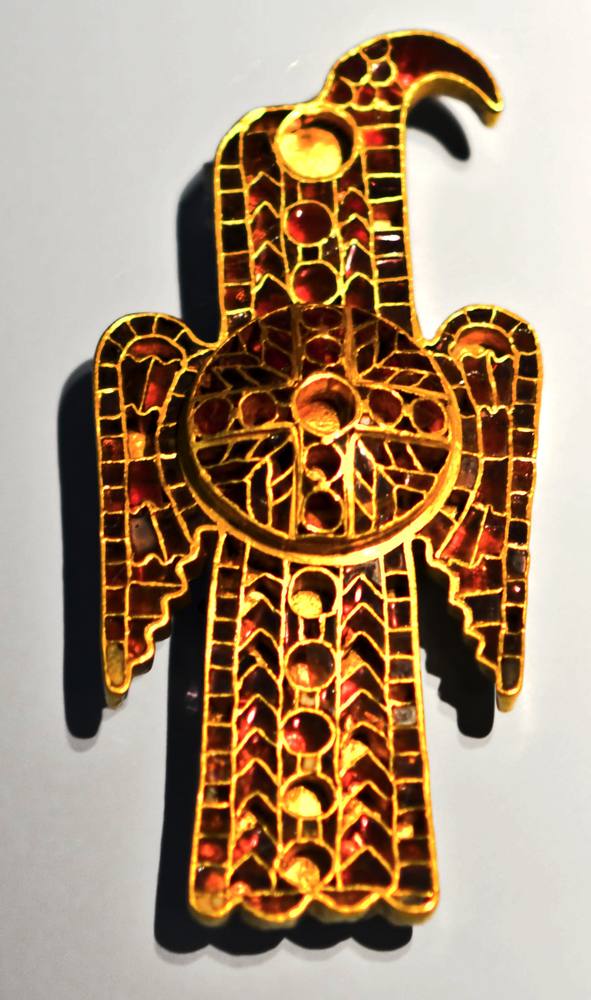
Women on the Meseta wore, according to graves in the Duero basin, two brooches at the shoulders that held the garment; eagle-shaped brooches from Duratón, Madrona and Castiltierra near Segovia are taken as a sign of Gothic presence. Weapons are rare (fewer than twenty known). Since the 1930s the cemeteries have been classed as "Visigothic". In a 2011 paper Carlos Tejerizo García summarises the criticism: the dating rests on typology and political events, and over 2,000 burials have no reliable radiocarbon date; Gisela Ripoll defends the label, Collins, Halsall, Brather and others object. Finds carry no ethnic names. Arce does not consider the Meseta necropolises reliably Gothic. A genetic study (Olalde 2019) found in sixth-century individuals from Pla de l'Horta predominantly local and partly central and northern European ancestry; I know it only from a summary.
A direct link between the Visigoths and Aachen is not attested, and I do not construct one. The palace there arises centuries after the end of the Toledan kingdom. A connection runs through Brunichild (Brunhild): the daughter of the Visigothic king Athanagild married Sigibert I of Austrasia in 567, moved to Metz and, according to Gregory of Tours (IV,27), became Catholic; her sister Galswintha married his brother Chilperic and was strangled in 568. Austrasia extended to the Rhineland. That Brunichild was ever in Aachen is not attested; the summary names only Metz as her residence. Through Clovis, who defeated the Visigoths in 507 and, according to Gregory, fought the Alamanni at Zülpich, a second line leads to the Rhineland: Zülpich.
The best-known legend is Alaric's grave. Jordanes tells (Getica XXX, 157 to 158) that after Alaric's death the river Busentus near Consentia was diverted, the king laid in the riverbed with many treasures and the river restored; the captives who dug the grave were killed. Nothing has been found. August von Platen turned it into the poem "Das Grab im Busento" in 1820.
More important for the afterlife was the Spanish self-image. Isidore sketched the picture of a Gothic-led Spain; after 711 resistance gathered in Asturias (Pelayo, Covadonga 718), which counts as the beginning of the Reconquista. The Liber Iudiciorum was translated into Spanish in the thirteenth century under Ferdinand III as the Fuero Juzgo. What is attested is a legal tradition, not unbroken Gothic continuity. In the word "Gothic" the Gothic name lives on as a style term, as the article The Goths explains.
The name. Whether the Thervingi were the core, and whether "Vesi" was a self-name or an ascription, is unresolved.
The settlement of 418/419. Land or tax rights, year, extent: not certain.
The Code of Euric. Date, place, Germanic share: disputed.
The graves. Who lies in the Meseta necropolises, archaeology cannot say.
711. Year, place, army sizes and cause are open.
Related articles: Goths, Thervingi, Greuthungi, Ostrogoths, Vandals, Suebi, Burgundians, Franks, Lombards, Christianisation of the Germanic peoples, Germanic tribal laws, Legend studies, Germanic peoples in the Rhineland and Zülpich.

The Goths · The Tervingi · The Ostrogoths · The Franks · Battle of Zülpich.
All History & Finds articles →
A name that outlasted three decades of war: Widukind was the most famous leader of Saxon resistance against …
Read more →Yes, the Vikings really did reach Aachen: in late autumn 881 a Danish army under the kings Godfrid and Sigfrid raided …
Read more →The axe is the most honest tool of the Viking Age. It split firewood, built ships, cut paths through the forest - and …
Read more →The core Viking-Age customs were rituals of community: the sacrificial feast called blót, toasts to gods and the dead …
Read more →