The name "Ostrogoths" sounds like an ancient people that parted from the Visigoths on the Black Sea. The sources show something else: a body that grew together in the fifth century under Hunnic rule and in Roman service, a king, Theoderic, born in Pannonia, who conquered Italy, and a chronicler, Jordanes, who drew on a lost work of Cassiodorus. This article sets the testimonies side by side, separates evidence, interpretation and legend, and says where something stays open.
The Ostrogoths ruled Italy from 493 into the middle of the sixth century, with Ravenna as their capital and Theoderic the Great as their most famous king. The name "Ostrogoths", meaning a fixed and nameable body of people, is on a widespread reading a product of the fifth century, shaped under Hunnic overlordship and in the service of the Roman Empire. The school formula that the Goths split neatly into West and East Goths on the Black Sea goes back chiefly to one author of the sixth century. The frame is given in the overview of the Goths, and the groups of the fourth century are described in the articles on the Greuthungi and the Tervingi. This page starts where the name "Ostrogoths" itself becomes a problem and follows it through Pannonia and Italy to the end. I keep written sources, archaeology, later interpretation and legend apart, and I say where something is only an interpretation.
The tradition is rich but almost always filtered through other hands. Jordanes wrote his history of the Goths, the Getica, around 551. In the preface he says how he worked: he was asked to condense the twelve books of "the Senator" on the origin and deeds of the Goths into a small volume, and he had held the original only once, for three days, on loan through the Senator's steward (so the English translation by Mierow). The Senator is Cassiodorus, Theoderic's minister; his Gothic history, written roughly 526 to 533, is lost. The Getica is therefore an excerpt from a lost work, assembled from memory with additions of Jordanes' own. How faithful it is cannot be tested.
Cassiodorus is also a source in his own right, through the Variae: twelve books of official letters and formulae, published around 537. Books I to V give letters in Theoderic's name, VI and VII model formulae for offices, VIII and IX letters in Athalaric's name, X those of Amalasuntha, Theodahad and Witigis, XI and XII letters from Cassiodorus' own time in office (arranged as in Hodgkin's table of contents of 1886; I have read that, not the letters themselves). Scholars stress that the collection leaves out what was unpleasant. It is a letter book meant to display a style of government.
For the war the chief witness is Procopius of Caesarea, a Byzantine author whose Gothic War runs to 552/553; Agathias continues it. The Anonymus Valesianus (second part), a terse Latin chronicle from Zeno to Theoderic's death, was probably composed between 540 and 550 by an unknown author, and its outlook is described as Catholic and rooted near Ravenna. Add to these the Edictum Theoderici and fragments of Malchus.
On method: of the primary texts I have read only extracts, namely single sentences from the preface of Mierow's Getica and from sections 79 to 82, and Hodgkin's table of contents. Procopius, Agathias, the Anonymus Valesianus, Ammianus and the Historia Augusta I know only from summaries, mainly the German and English Wikipedia. The source list keeps the two apart.
The earliest secure form is Austrogoti in the Historia Augusta (Life of Claudius 6,2), a late antique collection of imperial biographies. According to the German Wikipedia it goes back to Gothic Austra-gutans; whether the name meant "shining" or "eastern" cannot be proved. Herwig Wolfram sees in it perhaps a boastful self-description at first (English Wikipedia). Jordanes reads it by the compass: "eastern Goths", the Visigoths being "Goths of the western country" (Getica 82).
Beside it stands Greuthungi (also Greutungi), the name Ammianus Marcellinus uses in the late fourth century for Goths north of the Black Sea, as opposed to the Tervingi. Jordanes equates Greuthungi and Ostrogoths and makes Ermanaric the ancestor of the Ostrogothic kings. Scholarship thinks this too smooth. The Tervingi were not simply the later Visigoths, nor the Greuthungi simply the later Ostrogoths (German Wikipedia). Wolfram treats both names as one people; Peter Heather has the Ostrogoths emerge later from several groups. Part of the Greuthungi joined the Tervingi in 376, others stayed under the Huns, still others were scattered as soldiers across the empire. The body that Theoderic led to Italy in 488 would then be a union that grew together in the fifth century, more political than genealogical. The equation Greuthungi equals Ostrogoths is therefore an interpretation drawn from Jordanes' hindsight, not evidence of unbroken continuity. Archaeology does not settle it: whether the shift from the Wielbark to the Chernyakhov culture was a migration is disputed, and Jordanes' origin from "Scandza" counts as a literary topos.
The royal family is called the Amals (Amali). Their ancestry stands in the Getica and shows how much of this tradition is constructed. It begins with Gapt, who begat Hulmul; Hulmul begat Augis, and Augis him who was called Amal, from whom the Amals are named (Getica 79). Across many generations, Ermanaric among them, it runs to Vandalarius and his three sons Thiudimer, Valamir and Vidimer, and from there to Theoderic, Amalasuntha and her children (Getica 80, from a summary of the section).
The line gives a king born in Pannonia, whose power rested on fortune in war, a descent from an age of heroes. Scholarship mostly takes it as a construction meant to legitimise; whether Cassiodorus already arranged it so at the court's behest or only Jordanes did, I cannot say. Even early Gothic kingship itself is disputed (German Wikipedia). On Ermanaric see the Greuthungi.
"Now the first of these heroes, as they themselves relate in their legends, was Gapt, who begat Hulmul."
"Der erste dieser Helden war, wie sie selbst in ihren Sagen erzählen, Gapt, der Hulmul zeugte."Jordanes, Getica 79 (Mierow 1915, English translation, public domain in the USA, quoted here briefly). I read the sentence through a querying read of the page, not in full text; the German line is my own translation. Jordanes here passes on what the Goths told, not a checked genealogy.
After 375 a large part of the Goths north of the Danube lived under Hunnic rule; according to the German Wikipedia Gothic was an important lingua franca in Attila's realm. For the fifth century we depend almost wholly on Jordanes for the Goths. According to him the three brothers Valamir, Theodemir (Gothic Thiudimer) and Vidimer served Attila as trusted retainers. The English Wikipedia calls Valamir a reliable vassal who took part in raids on the Danube provinces in 447 and led a Gothic contingent on the Catalaunian Plains in 451, and it adds that the sources exaggerate the Gothic part there.
Attila died in 453. His sons' rule collapsed; the decision fell, according to Jordanes, at a river called the Nedao in Pannonia, where the Gepids under Ardaric beat the Huns and Attila's eldest son Ellac was killed. The date is 454; István Bóna and others say 455. Between 454 and 455 is the honest statement. More contested is whether the Goths were there: Jordanes lets them share the victory, Wolfram denies it, Hyun Jin Kim calls the story an invention and Valamir an ally of the Huns, Martindale and Altheim accept participation on the winning side, Maenchen-Helfen thinks they took no part (all after the English Wikipedia on the battle). What is certain is the end of Hunnic great power in those years, not the Gothic share in it.
It is established that groups under Valamir and his brothers afterwards lived in Pannonia, south and west of the middle Danube, as allies (foederati) of the emperor with annual payments. The English Wikipedia reports fighting with Attila's sons in 456/457 and raids into Illyricum from 459 to 462 after payments had lapsed; Emperor Leo I then paid 300 pounds of gold a year. In 468 the Goths beat Huns under Dengizich at Bassianae. Valamir fell in 469 in a Scirian raid, shortly before the battle of Bolia against a league under the Suebian Hunimund. Theodemir, Theoderic's father, succeeded him. For the neighbours there are pages on the Gepids, Sciri, Heruli and Rugii.
Around 473/474 Theodemir's following moved into eastern Roman territory in the Balkans. Theoderic was born between 451 and 456 in Pannonia (scholars disagree on the year) and probably grew up from about 459 to 469 as a hostage in Constantinople, where he will have come to know Roman administration. In 474 he succeeded his father as rex, in 481 became magister militum and in 484 consul, after the Thracian Goth Theoderic Strabo and his son were out of the way.
In 488 Emperor Zeno commissioned Theoderic to remove Odoacer, ruler of Italy since 476. Whether this was Theoderic's own plan or imperial pressure is disputed. About 100,000 people are said to have gone along, around 20,000 of them warriors; that is an estimate. The Goths reached Italy in 489, won at Verona and on the Adda (490), and then besieged Odoacer for about two years in Ravenna. A settlement was agreed, and a few days later Odoacer was dead, by the usual account at a banquet and, according to the German Wikipedia, struck down by Theoderic himself; the page on the Ostrogoths gives 5 March 493 as the day. The official reason, revenge for the Rugian royal house, is regarded as unconvincing.
How Theoderic understood his position remains a debate. He stayed formally the emperor's deputy and kept the title rex; Emperor Anastasius recognised him around 497/498, but personally, not necessarily for successors. He tied himself to other royal houses by marriage and alliance, among them Audofleda of the Merovingian family, which made him Clovis's brother-in-law, and in 507, after the defeat of Alaric II, he became guardian of the Visigoths. He died on 30 August 526 in Ravenna without a son; his daughter Amalasuntha ruled for Athalaric. Boethius and Symmachus were executed by a senatorial court in the years around 524 to 526; the Anonymus Valesianus and Procopius reproach Theoderic for not preventing it.
Theoderic's Italy was a dual state. Romans ran the civil administration with senate and prefecture, Goths supplied the army and lived under their own law; Romans were not to bear arms, and Goths settled mostly in the north. As the emperor's subordinate Theoderic could issue edicts but not full laws (English Wikipedia). How the settlement worked is open: Walter Goffart argues that the Goths received tax shares and uncultivated land rather than confiscated estates, and the German Wikipedia calls the question unresolved.
How the realm was administered is shown by the Variae. Cassiodorus was quaestor around 507 to 511, consul in 514, master of offices around 523 and later praetorian prefect. Two letter titles in Hodgkin's table of contents, "Mosaics for Ravenna" (I.6) and "Marbles for Ravenna" (III.9), show what was promoted; the texts themselves I do not know. Hodgkin sums up the programme as an effort for civilitas, Roman civic order. That is the court's self-portrait.
On religion: the Goths were mostly Arians, Christians who did not share the creed of Nicaea, the Romans Catholics. Theoderic tolerated both, wrote in effect to the Jews that faith cannot be compelled, and had Arian churches built; in Ravenna Sant'Apollinare Nuovo survives. The Codex Argenteus, the splendid manuscript of the Gothic Bible in silver on purple parchment, was made in Italy according to the German Wikipedia and lies today in Uppsala. On warfare before Italy my material says little; for the Gothic War Procopius shows horsemen and foot soldiers, and the cavalry lost to the eastern Roman archers at Taginae.
Archaeology finds it hard to separate "Ostrogoths" from other groups. A find carries no ethnic label; grave goods and dress are now read rather as signs of rank and milieu, and that graves without weapons were once held "Gothic" is, according to the German Wikipedia, now disputed.
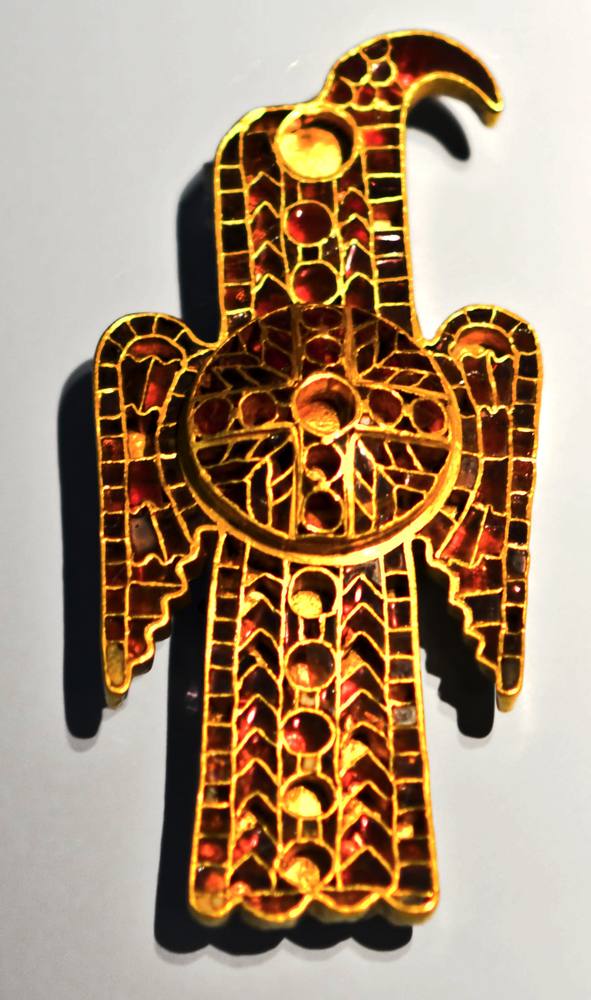
The best known example is the Domagnano treasure in San Marino, found in 1892/93: gold jewellery of the late fifth or early sixth century with brooches, earrings, pendants, a ring, a hairpin and fittings. Most lies in the British Museum, with pieces in Nuremberg, the Louvre Abu Dhabi, the Metropolitan Museum and San Marino. Famous are the eagle brooches, bird-shaped dress fasteners set with stones, the Nuremberg one about twelve centimetres long. It is assumed to be the jewellery of a noblewoman in the circle of the Ostrogothic court; a cross on one brooch is taken as a sign of Christian, perhaps Arian, faith. Both are interpretations: the find context is unclear, the hoard probably comes from one or more graves, and the design mixes Christian, Byzantine and Gothic-period fashions. The find shows a style of the age, not a passport.
Miren in western Slovenia shows the same limits: there nine graves on the road between Aquileia and Emona were examined in 2009 to 2013, late fifth and early sixth century, with East Germanic elements of dress and artificially deformed skulls. The authors consider an Ostrogothic presence the most likely reading (Tratnik and Karo 2023; I read only the abstract).
The mausoleum of Theoderic at Ravenna was built around 520 of Istrian limestone in two decagonal storeys, with a roof of a single block about ten metres across (the weight of about 230 tonnes often quoted is unsourced in my material). A Roman porphyry tub in the upper floor probably served as the sarcophagus. It is built in Roman ashlar (opus quadratum); the verdict of the UNESCO evaluators that the form is neither Roman nor Byzantine is one expert opinion, not a closed debate. The remains were removed under Byzantine rule; when and where to, my source does not say. Since 1996 the monument has been a UNESCO World Heritage site.
After Theoderic's death the realm fell into succession disputes. Athalaric died in 534, Theodahad had Amalasuntha confined, and she was killed in early 535; Procopius writes that Justinian entered the war when he learned of it. What follows gives Procopius as relayed by Wikipedia pages; I have not read the texts themselves.
535 to 540. Belisarius landed in 535 with some 7,500 men on Sicily. In 536 Naples and Rome fell, Theodahad was deposed and Witigis became king. The first siege of Rome (537/538) failed for the Goths, in 539 Milan was destroyed. In May 540 Ravenna surrendered and Witigis was taken to Constantinople.
541 to 552: Totila. At the end of 541 (some sources: early 542) Totila became king. He profited from the plague from 542, the Persian war and quarrels among the eastern Roman commanders, took Naples in 543 and spared its people. On 17 December 546 Rome fell through the betrayal of Isaurian guards, Belisarius took it back in 547, and on 16 January 550 Totila took it again. He formed a mixed senate and struck coins with his image; Justinian did not recognise him. Procopius praises him as wise and moderate, yet records a massacre at Tivoli. In 552 Narses came with 20,000 to 25,000 men. In July the decision fell at Taginae (also Busta Gallorum): Totila's cavalry failed against the archers, and some 6,000 Goths are said to have fallen. For Totila's death Procopius gives two versions, an arrow early in the battle or a Gepid's spear thrust as he fled.
Teia and Mons Lactarius. The survivors chose Teia as king, at Pavia according to the English Wikipedia. He marched south with the treasure to relieve Cumae, where Totila's war chest lay under his brother Aligern. Narses confronted him at Vesuvius; for two months the armies faced each other across the Sarno. When the Gothic admiral handed the fleet to the Byzantines and supplies were cut, Teia withdrew to Mons Lactarius. Both sides fought on foot in dense ranks. Teia fell, struck by a javelin, his head was set on a pole, and the Goths fought on for two more days. Procopius is said to have written that one man's courage was inferior to that of no hero of legend (in Dewing's translation; I know the sentence only from the English Wikipedia). The survivors then negotiated free departure; according to Procopius they had to leave Italy, according to Agathias they were to stay as subjects. Which version is right is open.
The date also wavers: 552 according to the German page on the Ostrogoths and the page on the battle (1 or 30 October; Agnellus is said to give the 1st, Bury thinks that wrong), October 553 according to the English page on the Gothic War. The place lies at Vesuvius or in the Monti Lattari. Afterwards Aligern still held Cumae, Verona and Brescia fell only in 561/562, and Compsa capitulated in 555 according to the English Wikipedia. A Frankish-Alemannic army was destroyed at the Volturnus around 553/554. In 554 Justinian reorganised Italy with the Pragmatic Sanction.
Italy lay devastated; the English Wikipedia calls the war a Pyrrhic victory. In 568 the Lombards invaded. The Ostrogoths did not vanish in one act; they merged into the Italian population, perhaps partly among the Lombards. Gothic language and Gothic separateness did not survive; Gothic remains tangible in the Bible manuscripts.
A link of the Ostrogoths to Alsdorf is not attested. Three threads lead to the Rhineland, of unequal strength.
First the letter to Clovis. According to the English Wikipedia on Tolbiac, a letter of Theoderic from 506/507, preserved in the Variae, is the main indirect evidence for Frankish fighting with the Alamanni: he asks his brother-in-law to temper his anger and punish only the faithless; Alamanni had fled to Raetia and sought his protection. Tolbiac is usually identified with Zülpich, but that is convention, and the date wavers between 496 and 506.
Second Aachen, and here the footing is thin. According to the English Wikipedia on Aachen Cathedral, Charlemagne had spolia, reused building parts, brought from Rome and Ravenna; the page gives no source and does not name Einhard, and it traces the octagon's columns also to Trier and Cologne. I have not read Einhard. For the equestrian statue of Theoderic I rely on a review by Matthias Tischler of Tino Licht's 2020 edition of Walahfrid Strabo's poem De imagine Tetrici: according to it Charlemagne, after his imperial coronation, probably in April 801, had a late antique equestrian statue of Theoderic brought from Ravenna to Aachen, and it still stood before the palace under Louis the Pious when Walahfrid described it in spring 829. An older view (Dehio 1873) lets it get only as far as Pavia. What Agnellus of Ravenna writes about it I could not establish. The statue is lost. The link is thus tangible in a poem of 829, but I have not checked it in detail.
Third a side note: a leaf of the Codex Argenteus was found at Speyer in 1970 (German Wikipedia on the Goths, unchecked). More on the region in Germanic peoples in the Rhineland.
Theoderic lived on as Dietrich von Bern, and the legend has little in common with the history. "Bern" is the German name of Verona, where Theoderic won against Odoacer in 489/490; Dietrich's father is called Dietmar, Theoderic's Thiudimir, and the saga's "Amelungs" are equated with the Amals. Otherwise the differences prevail: Theoderic was not born in Verona, never went into exile and had no band of twelve; Attila died before he was born, Ermanaric long before, yet the saga makes them contemporaries. Early witnesses are the Hildebrandslied (ninth century), the Rök stone (early ninth century), "Deor" and "Waldere", the Quedlinburg Annals (around 1000), later the Nibelungenlied (around 1200), the Dietrich epics and the Thidreks saga (all dates approximate, after the German Wikipedia on Dietrich von Bern). Frutolf of Michelsberg noticed the chronological error around 1100, Otto of Freising rejected the saga chronology, the Kaiserchronik calls the saga a lie.
Beside it runs a darker afterlife: Gregory the Great writes (593/594) that Theoderic's soul was hurled into the volcano of Lipari, and on the portal of San Zeno at Verona (around 1140) a "foolish king" follows a stag to the gate of hell. How Theoderic and Dietrich came together is disputed: Walter Haug thought of a recurring situational pattern, Norbert Wagner of a Lombard reworking, Joachim Heinzle and Elisabeth Lienert of collective memory. There is no majority view.
It is unsettled whether the Ostrogoths of Italy were a people kept going from the Black Sea or a body formed in the fifth century that gave itself a history. Open are the Gothic role at the Nedao and the year 454 or 455, the age and author of the Amal line, the path of the equestrian statue to Aachen, the place and date of Mons Lactarius, the terms of the last capitulation, the number of Goths, and what graves mean ethnically.
Related articles: Goths, Greuthungi, Tervingi, Gepids, Heruli, Sciri, Rugii, Lombards, Vandals, Burgundians, Franks, Alamanni, Zülpich, Christianisation of the Germanic peoples and Germanic peoples in the Rhineland.

The Goths · The Greuthungi · The Tervingi · The Gepids · The Lombards.
All History & Finds articles →
Before the Vikings, Ireland had no towns. It had monasteries, royal seats and ringforts, but no place where thousands …
Read more →Most people of the Viking Age are known to us only through the eyes of others. Ohthere is an exception. At some point …
Read more →South-west of Lake Balaton, where the Zala winds through reeds and marsh towards the Little Balaton, lies the village …
Read more →The Parisii were a Celtic people on the middle Seine. Their capital Lutetia lay conveniently at a river crossing …
Read more →