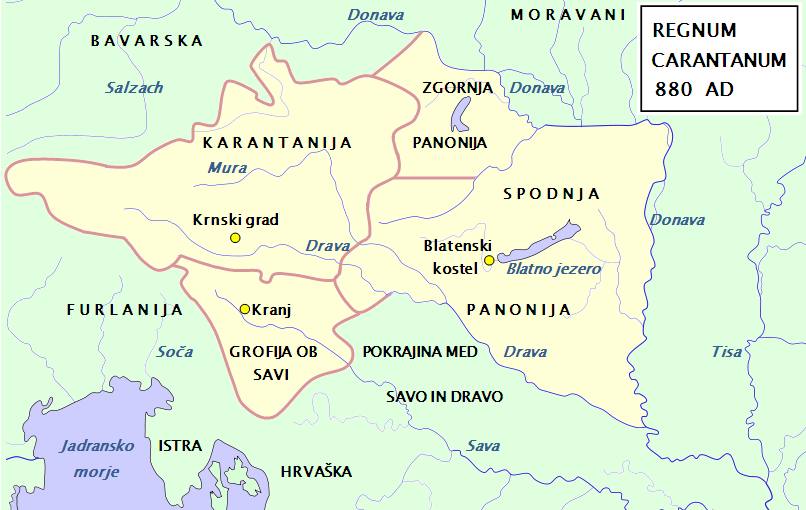
South-west of Lake Balaton, where the Zala winds through reeds and marsh towards the Little Balaton, lies the village of Zalavár. On a flat island in the former swamp stood, in the ninth century, a stronghold the sources call Mosapurc, "Moosburg". Here sat the Slavic prince Pribina and his son Kocel, here archbishops of Salzburg consecrated churches, and here Constantine, later Cyril, and his brother Methodius stopped in 867. This article collects what the texts say about the land, separates it from later interpretation and says openly where we could read only secondary literature.
No ninth-century text we know speaks of a people called the "Pannonian Slavs". The Latin sources say Sclavi, Slavs, and name them after the land or after their prince. The term is a collective label of modern research for the Slavic-speaking people in the western part of the Carpathian Basin, above all for the territory that Pribina and Kocel ruled from Mosaburg between about 840 and 876. German scholarship speaks of the Plattenseefürstentum (Balaton Principality), Slovak scholarship of Blatnohrad (from Slavic blato, "swamp", "mire"), Hungarian scholarship of Mosaburg or Zalavár.
A few terms first. Pannonia was the name of a Roman province between the eastern Alps, the Danube and the Sava; in the ninth century it was a learned name for the land, and the Frankish sources distinguish an upper and a lower Pannonia. Lower Pannonia (Pannonia inferior) in the texts discussed here roughly means the land east and south of the Rába as far as the Drava and the Danube; how far it reached exactly is disputed. A dux in Frankish texts is a prince or war leader, a comes a count, that is, an official of the king. A beneficium (benefice, fief) is land someone receives for use as long as he serves his lord faithfully; property (proprietas), by contrast, he can bequeath and give away. An archpriest (archipresbyter) leads the priests of an area on the bishop's behalf, a chorbishop is an auxiliary bishop without a see of his own. Glagolitic is the name of the oldest Slavic script, attributed to Constantine-Cyril; it is not identical with the later Cyrillic script.
Until the end of the eighth century the Avars, a horse-riding people from the steppe, dominated the Carpathian Basin. Charlemagne made war on them from 788. The Royal Frankish Annals (Annales regni Francorum) report under 788 that Charles came to Regensburg and there arranged the borders of Bavaria against the Avars; he then celebrated Christmas and Easter in the palace at Aachen (in Aquis palatio). Aachen was thus, already in the first years of this conflict, the place where the king wintered: a piece of regional history for anyone writing, as we do, from the Aachen area, but no more than that. The palace had to do with Pannonia only through the king.
After a failed campaign in 791 (an epidemic killed most of the Frankish horses), men of Eric of Friuli, together with the Slav Woynimir, plundered the "Ring", the khagan's residence, in 795 or 796 and sent the treasure to Charles, who passed part of it to the pope. In 796, according to the Royal Frankish Annals, an Avar dignitary, the tudun, came to the king "with a large part of the Avars", submitted and was baptised; in the same year Charles's son Pippin destroyed the Ring for good. According to the German Wikipedia, a dependent Avar khaganate still existed from about 805 to 828. In the following decades the Avars disappear as a political power; individual groups are still mentioned.
The Salzburg Conversio (more on it shortly) tells this period from the Church's point of view. According to its tenth chapter, the Emperor Charles entrusted the church of Salzburg with the pastoral care of the defeated Avars and their land; Slavs and Bavarians moved into the emptied land. The east was administered at first by Frankish counts and Slavic princes, later by Bavarian counts (Helmwin, Albgar and Pabo are named), finally by Ratbod, who was in charge of frontier defence. How many people of Avar origin stayed in the land, the text does not say.
Older layers in the region must not be confused with this. Around Keszthely at the western end of Lake Balaton, archaeology knows the so-called Keszthely culture of the sixth and early seventh centuries, with the late Roman fort of Fenékpuszta, a basilica and cemeteries with Christian features. Who these people were is disputed: Romanised locals, Germanic groups under Avar rule, or a fashion in the west of the khaganate. It is not to be equated with Pribina's Slavs, who appear two centuries later. A continuous Christian tradition from the sixth to the ninth century cannot be derived from it.
The main source for Pribina is the Conversio Bagoariorum et Carantanorum, "The Conversion of the Bavarians and Carantanians". It was written in Salzburg, probably on the commission or under the rule of Archbishop Adalwin. Its date can be derived from the text itself: in the fourteenth chapter it says that seventy-five years had passed since Charles placed eastern Pannonia under the church of Salzburg. Counting from 796, that gives 870/871. The text is therefore not a chronicle written from a great distance but a piece from the dispute over Methodius's mission (see below).
According to chapter 10, "a certain Priwina", driven across the Danube by Moimar, duke of the Moravians, came to Ratbod. Ratbod presented him to King Louis the German, and on the king's order Pribina was baptised in St Martin's church at Traismauer, a Salzburg estate on the Danube. His earlier history at Nitra, Archbishop Adalram's famous consecration of a church at Nitrava, and the question whether Pribina was a prince in his own right or a subordinate of Mojmír, we treat in the articles on the Nitrians and the Moravians. Here it is enough to say that textual scholarship regards the sentence on Nitrava as a marginal note that migrated into the text; Fritz Lošek (edition of 1997) and Miroslav Lysý (2025) nevertheless consider it credible.
Pribina then fell out with Ratbod. According to the Conversio he fled "with his people and his son Chezil" to the Bulgars, then to Ratimar, a prince in southern Pannonia. When Louis's army drove Ratimar out (scholars usually date this to 838), Pribina crossed the Sava, was received by Count Salacho, and Salacho reconciled him with Ratbod. The Conversio does not give the date on which Pribina received his new land. The literature wavers between 838, 839 and 840.
Chapter 11 of the Conversio describes the new beginning briefly. Seizing the opportunity, the king granted Pribina part of Lower Pannonia around the river Sala (the Zala) as a benefice. Pribina settled there and began to build a fortification in a wooded and marshy area on the Zala, and gathered settlers around him. From this fortification grew the stronghold that the source later calls Mosapurc; other forms are civitas Priwinae ("Pribina's city") and castrum Chezilonis ("Kocel's castle"). The Hungarian archaeologist Béla Miklós Szőke reads the term civitas cautiously: it might point to a town-like place, but its character remains hard to grasp.
On 24 January 850 Archbishop Liupram of Salzburg consecrated a church in honour of the Mother of God, Mary, in the stronghold; the Conversio names the witnesses, with Slavic and Germanic names. Pribina's priest Dominicus was placed under Salzburg's authority. Kocel, together with Liupram, consecrated the churches of the priests Sandrat and Ermperht and confirmed their landholdings. Earlier, Pribina had handed over to the church of Salzburg a church dedicated to St Rupert at Salapiugin (at the "bend of the Zala"); according to Szőke, a large Salzburg estate grew from it.
Afterwards, the source says, Liupram at Pribina's request sent master craftsmen from Salzburg, "masons and painters, smiths and carpenters", who built a fine church in Pribina's city, in which the martyr Hadrian lies buried. A church of John the Baptist was added. Outside the city the Conversio names churches at about thirteen places, among them Dudleipin, Ussitin, Businiza, Bettobia, Stepiliperc, Keisi and Quinque Basilicae, "Five Churches", today's Pécs. Several of these names combine a Germanic personal name with the word "church". On Dudleipin and the Dudleben see our article on the Dulebians; the location of most of these places is not secure.
Pribina's legal position changed too. According to chapter 12, King Louis confirmed Pribina's holdings as property on 12 October 848 at an assembly in Regensburg, except for the possessions of the church of Salzburg. The English Wikipedia, by contrast, names a charter of 10 January 846 on land on the Zala and gives 847 for the conversion into property; the German one gives 846 for a grant "iuxta fluvium Valchau" and 848 for the conversion. The dates of the charters should be checked against the originals. Also documented, according to the English Wikipedia, is a gift by Pribina to the monastery of Niederaltaich, confirmed in 860. Pribina was thus part of the Bavarian world of nobles and monasteries, not a ruler outside the Frankish realm.
The Conversio is a list of consecrations, names and responsibilities, and deliberately so. According to chapter 9, the chorbishop Osbald led the people of the Slavs under Liupram and Adalwin. After Dominicus's death, Liupram sent the priest Swarnagal, then Altfrid; Adalwin made Altfrid archpriest and, after his death, Rihpald. Chapter 14 closes with the claim that in all those years no outside bishop had held authority in eastern Pannonia, and no outside priest had been allowed to serve for more than three months without showing his papers to the bishop, until the "new teaching of the philosopher Methodius" arose.
This order is a programme. The German Wikipedia points out that the Conversio stresses Salzburg's role, passes over the mission of the diocese of Passau in silence and alters details in Salzburg's favour. According to the common interpretation, it was written for King Louis the German when action against Methodius was at issue. Whoever reads it as a neutral history of the Pannonian Slavs overlooks that every consecration in it is also a legal claim. For the Bavarian side of this mission see our article on the Bavarians, for the history of the mission in the eastern Alps the one on the Carantanians, who take up the larger part of the Conversio.
Pribina's death appears only in a subordinate clause. Chapter 13 reports that in the year 865 Archbishop Adalwin celebrated Christmas in Kocel's stronghold, "newly called Moosburg"; Kocel had succeeded his father Pribina, "whom the Moravians killed". When and how this happened, the source does not say. Scholars usually date the death to 860/861 and link it to the fighting around Louis's son Carloman, who rose against his father with Moravian support; whether Pribina fell in battle or was handed over remains open. Because the year in the Conversio may be counted from a Christmas year-start, some accounts place Adalwin's visit at Christmas 864.
Kocel (in the sources Chozil, Chezil, Chezilo) took over around 861; besides 861 the English Wikipedia also gives 864 for his installation by Louis. He bore the title comes, so he was a count of the king, not an independent prince. During Adalwin's visit the archbishop consecrated a series of churches over several days, among them St Stephen on the estate of a certain Wittimar, St Michael at Ortahu, St Paul at Weride and St Margaret at Spizzun; each received its own priest. According to the German Wikipedia, Kocel gave a farmstead on the Rába to the monastery of St Emmeram in Regensburg in 853; the English one names a significant gift to Freising in 861. Like his father, Kocel moved in a network of Bavarian churches and monasteries.
In 863 the brothers Constantine and Methodius came from Byzantium to Moravia at the call of Prince Rastislav. They translated liturgical texts into Slavic, using the Glagolitic script. In 867 they travelled with disciples from Moravia towards Rome. Their way led through Pannonia, where Kocel received them. The Life of Constantine (Vita Constantini), a Church Slavonic text that according to Ševčenko existed by 882 at the latest, reports according to the secondary literature that Kocel valued the Slavic books and entrusted disciples to them; the German Wikipedia speaks of up to fifty pupils trained at Mosaburg. We have not seen the wording of the Vita.
In Rome the brothers were received warmly in 868; Pope Hadrian II had Methodius ordained priest, together with several of their Slavic disciples. Constantine entered a monastery, took the name Cyril and died in Rome on 14 February 869. The next step was decisive for Pannonia: according to the Life of Methodius (Vita Methodii), Kocel asked the pope to send Methodius to him and then sent him back to Rome with twenty men to be consecrated bishop. According to the Vita, Hadrian II wrote to Rastislav, Svatopluk and Kocel and permitted the Slavic liturgy on condition that the Epistle and Gospel first be read in Latin. This letter, too, we know only at second hand.
Methodius became archbishop with his see at ancient Sirmium (today Sremska Mitrovica in Serbia), a place none of the princes involved controlled; the title harked back to the late antique church order. The sources contradict each other on the date of his consecration: according to the English Wikipedia, the Vita places his consecration as bishop in 870 and his elevation to archbishop later, while a letter of Pope John VIII of June 879 says that Hadrian had already consecrated Methodius archbishop. For Salzburg this was an intrusion into a territory it had regarded as its own since Charlemagne.
At this point the Conversio itself becomes partisan, and almost says so openly. It reports of the archpriest Rihpald at Mosaburg that he held his office there until a Greek named Methodius came with new Slavic letters:
… until Methodius, with newly invented Slavic letters, made the Latin language and Roman doctrine … contemptible to the whole people, and in part also the masses and gospels and the church service of those who celebrated this in Latin.Conversio Bagoariorum et Carantanorum, ch. 12 (Salzburg, c. 870/871); own translation from the Latin phrases given by Ihor Ševčenko, "Three Paradoxes of the Cyrillo-Methodian Mission", Slavic Review 23 (1964), n. 7, after the edition of Milko Kos (Ljubljana 1936): "Methodius … noviter inventis Sclavinis litteris linguam Latinam doctrinamque Romanam … vilescere fecit cuncto populo, ex parte missas et evangelia ecclesiasticumque officium illorum qui hoc Latine celebraverunt." The omissions come from that source; we have read the full sentence only in the English translation by Jonathan Couser (after Lošek 1997).
Rihpald, the Conversio continues, could do nothing against it and returned to the see of Salzburg. It is remarkable to whom the text attributes the script: it makes Methodius the inventor of the letters, while the papal letter Industriae tuae of 880 attributes them to Constantine the Philosopher. The reproach is therefore meant not only linguistically but legally: a foreign archbishop had intruded into Salzburg's mission field.
The consequences were concrete. In 870 Methodius was deposed by East Frankish and Bavarian bishops and held in a monastery for about two and a half years. The Vita Methodii does not name the place; because of entries in the confraternity book, scholars think of Reichenau. In 873 Pope John VIII obtained his release but, according to Goldberg, at first forbade the Slavic liturgy. Methodius then went to Moravia and worked there until his death on 6 April 885. The history of those years belongs to the Moravians; for Pannonia the point is that the Slavic liturgy was tolerated there for only a few years.
Kocel disappears from the sources after 874. According to the German Wikipedia, he still had a church at Pettau (Ptuj) consecrated by Archbishop Theotmar in 874. How he ended is open. Charles Bowlus considers him dead or removed around 876, certainly dead by 880. Ferdinand Šišić (1917) assumed that Kocel fell in 876 on a failed campaign of Carloman against the Dalmatian Croats. Others link him to a Frankish commander Kotzil who, according to the Byzantine work De administrando imperio, was killed by rebellious Croats; Neven Budak (2018) rejects that link. The sources do not allow a decision. On the Croats see our article on the Croats.
Mosaburg remained a seat of power. According to the Hungarian excavators it was a seat of King Arnulf of Carinthia from the late ninth century, and on the castle island they found foundation walls they attribute to his palace. Arnulf, East Frankish king from 887, relied in the south-east on the Slavic prince Braslav, who ruled between the Drava and the Sava. According to the Annals of Fulda (Annales Fuldenses), which we know only from the literature, Arnulf entrusted Pannonia together with Mosapurc to Braslav in 895 or 896; Herwig Wolfram (2001) gives 896. In Latin texts the place also appears as urbs Paludarum, "city of the marshes".
The end came from the east. After the death of Svatopluk of Moravia in 894, Magyar horsemen ravaged Pannonia, according to Wolfram. In 900 Archbishop Theotmar of Salzburg complained in a letter to the pope (Epistola Theotmari) of an alliance of the Moravians with the Hungarians; Wolfram considers the letter genuine, against earlier suspicions of forgery. From about 900 the Magyars conquered Pannonia. Braslav is last mentioned in 898; a later Hungarian tradition has him fall in 900. In 907 a Bavarian army under Margrave Luitpold was defeated at Brezalauspurc, which is usually identified with Bratislava; a minority looks for the place near Zalavár, relying on its identification with Braslav's stronghold. The only near-contemporary source for this, the Salzburg annals (Annales Iuvavenses maximi), survives only in twelfth-century copies.
What happened to the people, no text says. According to the excavators, the cemeteries around the churches on the castle island were used from the middle of the ninth to the end of the eleventh century; that argues against a complete break in settlement. In 1019 King Stephen I of Hungary founded a Benedictine abbey on the island dedicated to Saint Hadrian (Hungarian Adorján). Maxim Mordovin (2006) calls this dedication "the main sign of continuity": the saint whose relics the Conversio already mentions in Pribina's city remained the patron of the place. Whether memory, chance or a deliberate link lies behind it cannot be decided.
Zalavár is among the longest-studied early medieval sites in Hungary. Systematic excavations began in the early 1950s under Géza Fehér (1952 to 1954); Ágnes Cs. Sós led the work from 1963 to 1992, and since 1994 Béla Miklós Szőke and Ágnes Ritoók have been in charge. On the castle island (Hungarian Vársziget), a fortification ditch of the early 840s marks off the area the excavators attribute to the manor houses of Pribina and Kocel; the church of Mary consecrated in 850 was built later within this area. In the middle of the island a large Carolingian pilgrimage basilica was found, almost 50 metres long and 25 metres wide, with a crypt, probably built under Pribina or Kocel; the excavators speak of the Hadrian pilgrimage church and thereby link it with the church of the Conversio. According to the German Wikipedia, about 1,500 graves were uncovered around this church between 1980 and 2010.
On the neighbouring island of Récéskút, Aladár Radnóti excavated a three-aisled stone basilica of about 20 by 12 metres between 1946 and 1953. According to Mordovin, a first church was built there in the ninth century, as the evaluation of the cemetery shows. Supposed older "wooden churches" beneath the building turned out, in re-excavations from 1961 to 1963, to be traces of scaffolding or rebuilding. Szőke regards the Récéskút basilica as a nobleman's proprietary church that cannot be securely assigned to any church in the Conversio. At Zalaszabar-Borjúállás Róbert Müller excavated in the early 1980s a timber hall church with a narthex beside a fenced manor; Müller connects it with the church of St Stephen on Wittimar's estate, consecrated by Adalwin in 865. Szőke notes that the same argument could apply to Récéskút.
Who lived at Mosaburg, the finds answer only in part. Szőke describes settlers "from half of Europe" who followed Pribina's call: Danube Bulgars, Croats, Moravians and other West Slavs, Bavarians, Alemanni, along with local Slavs and a late Avar population. That is an interpretation from grave goods and names, not a statement of a source. How the people spoke is also disputed: Eugene Helimski (1988) thought of a koine within a West–South Slavic dialect continuum; according to Wikipedia, Alexei Kassian (2024) regards the donor language of the earliest Slavic loanwords in Hungarian as West Slavic. We have not checked the wording of these studies.
The Pannonian Slavs are not a "tribe" of their own with a fixed name but a population that becomes visible only through a lordship. That distinguishes them from the Carantanians in the eastern Alps, whom the Conversio describes as a people with its own line of princes, and from the Moravians north of the Danube, who under Mojmír, Rastislav and Svatopluk formed an independent centre of power. In the south, between the Drava and the Sava, ruled Ljudevit, Ratimar and later Braslav; this area is often called "Pannonian Croatia", a term Hrvoje Gračanin considers a construct of historiography. Whoever assigns Pribina and Kocel to one of these neighbours decides an open question according to modern borders.
Established, as far as our sources reach, are Pribina's expulsion and baptism, his settlement on the Zala, the consecration of the church of Mary in 850, the confirmation of his property in 848, Kocel's succession, the stay of Constantine and Methodius in 867 and Methodius's detention in 870. Plausible, but without the wording of the source in our hands, are the number of disciples at Mosaburg, the content of the papal letter to Kocel, the year of Pribina's installation and the handing of Mosaburg to Braslav in 895/896. Interpreted are the origin of the settlers, the language of the population, the identification of excavated buildings with individual churches of the Conversio, Kocel's end and the question whether Brezalauspurc lay at Bratislava or Zalavár. Wherever a sentence about the Pannonian Slavs stands, it is worth asking which of the three levels it belongs to.

The Nitrans · The Moravians · The Carantanians · The Baiounitai · The Slavs of Bulgaria.
All History & Finds articles →
The Parisii were a Celtic people on the middle Seine. Their capital Lutetia lay conveniently at a river crossing …
Read more →When a find comes out of the ground, the archaeologist faces one plain question: how old is it, and where does it …
Read more →The Pictones were a Celtic people on the Gaulish Atlantic coast, around today's Poitiers. Their land is still known as …
Read more →