A prince who died in exile, a church that appears in a text as one of the first in the Slavic lands north of the Danube, and a source written down in Salzburg only decades later: very little about the Nitrans is certain. Yet so much has been argued over their name that the history of the research has become a subject in its own right.
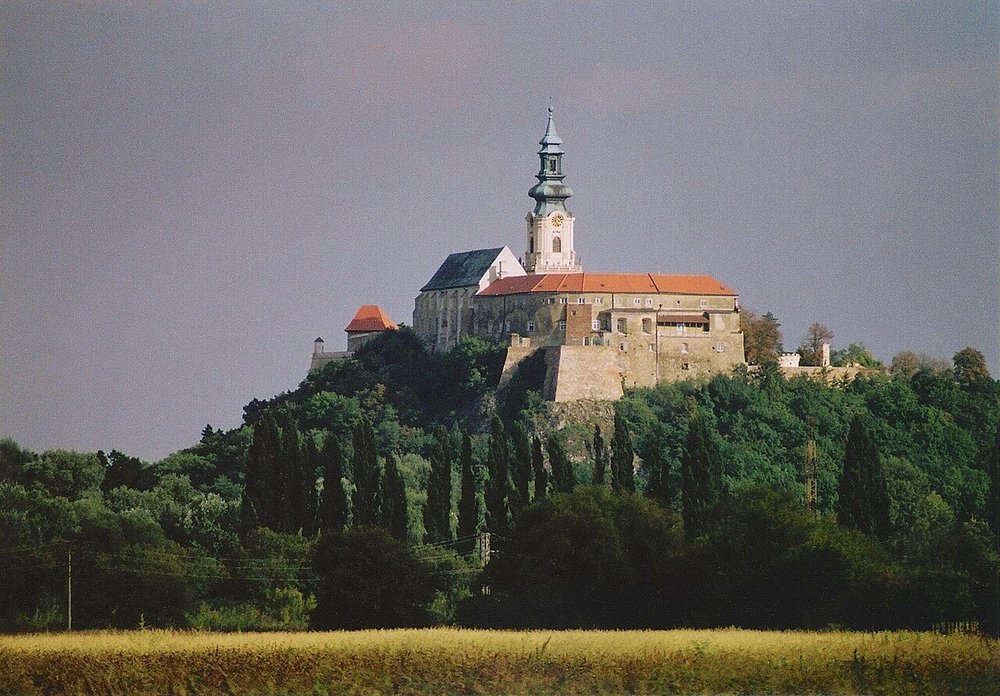
The Nitra rises in the mountains of present-day western Slovakia and flows toward the Váh before both join the Danube. On the southern edge of the uplands, where the river enters the fertile plain, a rocky castle hill rises; at its foot lies the modern town of Nitra. This is the area scholars mean when they speak of the Nitrans – the inhabitants of a West Slavic settlement region on the northern rim of the Carpathian Basin, who in the 9th century stood under the influence of their neighbours: the Moravians to the west, the Franks to the south and west, and the Bulgars to the south-east.
Caution begins right here. The contemporary sources do not name a people called "Nitrans"; they know a place, Nitrava, and a man, Priwina. The word "Nitrans" is a modern ordering label, convenient because it links a region with its people. Whether the people understood themselves that way cannot be said.
A second warning concerns the concept of a principality. A principality in the sense of a bounded domain with a central place, an administration and its own dynasty is a model that historians lay over several pieces of evidence. No source describes the land of Nitra as such for the period around 830.
What we know about Pribina stands in a single text: the Conversio Bagoariorum et Carantanorum, the "Conversion of the Bavarians and Carantanians." It was written down in Salzburg around 870, probably in the circle of Archbishop Adalwin, and it pursued a clear purpose. The Salzburg church wanted to prove to King Louis the German that Pannonia had long been its mission field, and it had to defend itself against the claim of Methodius, who worked there on the pope's behalf. The text is therefore a case for the defence, not a neutral chronicle. That does not mean it lies, but it does select: whatever estates, consecrations and donations Salzburg could show stands well in front.
The second great witness is an annal, the Annales Fuldenses, the East Frankish imperial annals. Under 846 they report that Louis the German marched against the Moravian Slavs, deposed their prince Mojmir and installed Rastislav in his place. This is the only contemporary report of the fall of the first known Moravian dynasty, and it names neither Pribina nor Nitra.
The chapter of the Conversio that tells the story begins unobtrusively. Priwina is introduced as quidam, "a certain man," driven out by Duke Moimar of the Moravians "beyond the Danube" and fled to Ratpot, the Frankish prefect of the Eastern March. The word quidam matters. An author who wished to describe a prince would probably have given him a title; the Salzburg scribe calls Moimar dux but not Priwina. Several scholars read this as a hint that Priwina was a retainer or governor, not a sovereign lord; others see in the silence only the author's interest in leaving a man without a title in memory who became a patron of Salzburg. The question cannot be decided.
The year of the expulsion is usually given as 833. The Conversio names no year; the date is a back-calculation from other events and therefore an assumption of research, though a widely shared one. The reasons, too, remain obscure. That Mojmir asserted his power against a neighbour is the common interpretation; what lay behind it, a dispute over land, over loyalty or over closeness to the Franks, no source says.
A certain Priwina, driven out by Duke Moimar from Moravia beyond the Danube, came to Ratpot.Conversio Bagoariorum et Carantanorum, ch. 10; own paraphrase after an English translation, not a verbatim quotation
In the same context the Conversio mentions something central to the Nitra question: Archbishop Adalram of Salzburg, in office from 821 to 836, consecrated a church at Nitrava, on Pribina's property. When exactly, the text does not say; the bracket results only from Adalram's term of office. Dates around 828 or 830 appear in the literature and should be understood as approximations. The saint to whom the church was dedicated is occasionally given as Emmeram; whether that follows from the source itself or was added later cannot be settled here.
If the report is right, this is the first church building attested in writing on Slavic ground north of the Danube. That is a very large claim resting on a single half-sentence, and scholars have indeed shaken it. Two questions are in play. First: does Nitrava mean modern Nitra at all? Many accept the identification on linguistic grounds, but Imre Boba rejected it, and other authors think of entirely different places, as far as the area around Bratislava. Second: does the mention belong to the original text of the Conversio? Individual voices regard the Nitrava passage as a later insertion because it fits the context poorly and older manuscripts allegedly lack it. The majority view assumes a genuine component; the dispute shows how thin the ground is.
According to the Conversio, Pribina came to Ratpot, was presented to the king and baptised at Traismauer on the Danube. After that his situation changed several times. The literature lists further stations: a stay among the Bulgars and a refuge with Ratimar, a Slavic prince in Pannonia; how long he stayed in each place and in what order is only patchily gleaned from the source. This fits a border region in which loyalties shifted fast. On the Bulgars and their Slavic neighbours see also Bulgars and Slavs.
Around 840 King Louis the German granted him land on the Zala in Lower Pannonia, that part of old Roman Pannonia lying south of the Danube and west of Lake Balaton. The Conversio speaks of an estate "around the river called the Sala." Louis confirmed the holding to him at Regensburg in 848; the text mentions this charter expressly, excepting the estates that belonged to Salzburg itself.
Pribina built a fortified settlement on the river which he called Mosapurc, in Slavic Blatnohrad, "marsh fortress"; in German it is Moosburg. The site lies near present-day Zalavár in western Hungary, at the edge of Lake Balaton, in a landscape of water, riverside forest and fen that offered natural protection. The Conversio reports that Archbishop Liupramm of Salzburg consecrated Pribina's main church to the Mother of God in 850, in the presence of his son Kocel. Pribina gave Salzburg estates and priests; in return church order by Salzburg rite was preserved. In all, the source says, he had numerous churches built; the literature gives the number as about fifteen, without finds that could prove it.
Archaeologically Zalavár is easier to grasp than Nitra. Excavations on the peninsula and its surroundings have brought to light remains of a fortification and of several churches from the 9th century. Which of them correspond to the buildings named in the Conversio is debated in the specialist literature.
In 861 Pribina's story ends: the Conversio says the Moravians killed him. Whether he fell in battle or was betrayed in the struggles between Carloman and Rastislav is left open by research. He was succeeded by his son Kocel, who took over Moosburg. Kocel later supported the missionary Methodius, which the Salzburg church felt as an intrusion into its territory; this explains in part the tone of the Conversio, written in that tension. Whoever wants to see how power shifted in the same century elsewhere in the Alpine region will find a related example among the Carantanians: there too Salzburg relied on church organisation to gain influence.
What happened in Nitra itself after 833 is again a field of assumptions. According to a widespread view the land fell under Moravian rule and the Mojmirids incorporated it into their realm. Some authors, by contrast, consider it possible that Nitra passed fully into the Moravian realm only later, under Rastislav or his nephew Svatopluk, and that its seat of power played a role of its own until then.
What is certain is that Nitra later played a church role. Around 880 Pope John VIII installed the priest Wiching as bishop of Nitra, within the Moravian church dispute between Methodius and his opponents; this is known from papal letters. That places the site in the time when the Moravian realm stood at the height of its power. How far that realm reached is itself disputed: whether it extended into the Carpathian Basin or was confined to Moravia and western Slovakia, historians answer differently.
Archaeology has uncovered on Nitra's castle hill a fortification whose wall consisted of dry-laid stones with a clay rampart and timber reinforcement. According to excavation reports it belongs mostly to the second half of the 9th century, though settlement is attested from the early 9th century. Inside the walls were workshops for metal and jewellery, storage pits and pottery. A stone church building with frescoes is also mentioned; whether it has anything to do with the Conversio's reports is open, since the present chapel of the 11th and 12th centuries stands over an older cemetery.
In the hill country north of Nitra lie further hillforts, such as Bojná, whose dating is being refined with scientific methods; how far these sites correspond to a coherent domain and to which phase they belong is a matter of ongoing work. A look to the west helps as well: the Moravian centres Mikulčice and Břeclav-Pohansko show what a fortified centre of power of the 9th century with manor, churches and workshops could look like. Pohansko, however, belongs to Mojmir's Moravia, not to Pribina's Nitra; it serves comparison, not proof.
Hardly any man of the 9th century is claimed from so many sides. In Slovak accounts Pribina counts as the first known ruler on the soil of present-day Slovakia, and the Nitra principality is read as early statehood. Hungarian scholarship stresses instead that his main political work, Mosapurc, lies in present-day Hungary and that the churches and settlements at Lake Balaton open a history of the region of their own. Austrian accounts emphasise Traismauer, the baptism and the Salzburg mission history. In Slovene historiography it is above all Kocel who matters, because his territory reaches into the prehistory of the Slovenes. Czech and British historians tend to see Pribina as a Moravian vassal, while Slovak scholars more strongly emphasise an independent principality before 833. All these readings work with the same narrow body of sources, and none can be decided by a quotation from the 9th century.
That the sources give little opens the door to every interpretation. For the West Slavs as a whole, not only the Nitrans, the same holds as for the Czechs and the Croats: early groups were often made ancestors of modern nations in the modern era, although nobody in the 9th century thought in national categories.
Established, as far as a single main source allows, is the figure of a man named Priwina who was driven out of the Moravian sphere of power around 833, found refuge with Ratpot, was baptised at Traismauer and later, under the East Frankish king, built a fortress with churches on the Zala. It is equally certain that his son Kocel succeeded him, that Archbishop Liupramm consecrated the church in 850 and that Pribina died in 861 at the hands of the Moravians. Disputed remain whether the church of Nitra is historical as a building, where Nitrava lay, whether Pribina was a prince or a governor, and whether the "Principality of Nitra" may be called a state. Whoever tells of the Nitrans therefore tells of a landscape, a man and a church – and of a debate older than some of the ruins over which it is waged.

The Moravians · The Carantanians · The Slavs of Bulgaria · The Czechs & Bohemians · The Croats.
All History & Finds articles →
An Old Norse name is not a word but a kit of parts. Two elements from a fixed stock, often handed down from a dead …
Read more →When we speak of "Viking kings" today, we quickly picture a single mighty ruler on a throne of dragon-carved wood …
Read more →