Five names stand in the catalogue of the Slavs who attacked Thessalonica around 615: Drugubites, Sagudates, Belegezites, Baiunites, Berzites. We have already covered four of them in this series. The Baiunites are the last – and the one about whom the source itself says least. No leader, no homeland, no deed of their own. And yet scholarship has built from this single word a story that reaches over half a millennium to the coast of Epirus. This article tests how much of that story holds.
With the Baiunites (Greek Βαϊουνῆται, also transcribed Baiunetai, Baiounitai or Vajunites) we complete the list with which Book II of the Miracula Sancti Demetrii opens the account of a siege of Thessalonica. The other four names each have an article of their own on our site: the Drugubites, the Sagudates, the Belegezites and the Berzites. For each of those groups there was at least one second point of reference – a grain delivery, a lead seal, a mention in a later chronicle, a bishopric.
With the Baiunites the situation is different. In the Miracles of Saint Demetrius they occur exactly once, and only as a name. Everything else written about them rests on an inference: that a regional name appearing centuries later on the coast of Epirus derives from them. That inference is seriously held and by no means far-fetched. But it is an inference, not evidence. That is what this article is about.
The Miracles of Saint Demetrius survive in two collections. The first was written by John, archbishop of Thessalonica, in the early seventh century; the second by an unknown author in the late seventh century. The standard edition and commentary remain those of Paul Lemerle (1979/1981). Both collections are edifying literature: they set out to show that the city's patron saint protected Thessalonica in every emergency.
That has consequences for how we read the text. The city's neighbours appear as a threat, their numbers are large, their intentions sinister, their failure a miracle. Anyone trying to extract facts about the attackers is reading against the author's purpose. What remains most useful is what the author mentions in passing, without trying to prove anything by it – and a list of names belongs precisely in that category.
The list stands in the first miracle of Book II (Miracula II 1, page 175 in Lemerle's edition). It narrates an attack on Thessalonica that Lemerle places around 615; the text itself gives no year, so the date is inferred. The Slavic groups are said to have united under a leader called Chatzon, built dugout boats and raided Thessaly, the islands, Achaia and other coasts before advancing on the city with their women and children – intending to settle there.
The attack failed. Chatzon, the text relates, ended up inside the city and was killed there. In this account the Baiunites appear only in the list of participants. They are singled out neither in the boat-building nor in the assault, and in the second great siege of 676 to 678, in which the Rhynchines, the Sagudates and the Strymonites act, they do not appear at all.
The sentence on which everything rests is short. It lists the groups that make up the "people of the Sclavenes" and adds an "and the rest":
τὸ τῶν Σκλαβίνων ἔθνος … τῶν τε Δρουγουβιτῶν, Σαγουδατῶν, Βελεγεζιτῶν, Βαϊουνητῶν, Βερζητῶν καὶ λοιπῶν ἐθνῶν
"the people of the Sclavenes … namely the Drugubites, Sagudates, Belegezites, Baiunites, Berzites and the remaining peoples"
Miracula S. Demetrii II 1 (ed. Lemerle, vol. 1, 1979, p. 175); the spelling of the names varies in the manuscript tradition; our own translation. Lemerle's French translation and modern English translations are under copyright and have not been used.
That is the entire early medieval record of the Baiunites under this name. The text does not say where they lived, how numerous they were, who led them or how they related to the other four groups. It says only that they existed and that, from Thessalonica's point of view, they were among the attackers.
One often reads that the Baiunites settled "west of Thessalonica". That statement is not in the Miracles of Saint Demetrius. It comes from more recent handbook and textbook literature, which likes to distribute the five groups evenly on a map. The only groups the Miracula locate firmly are the Belegezites – near Thebes and Demetrias in Thessaly – and, through their names, the Strymonites and the Rhynchines on their rivers.
Nor does the list imply any ranking. That the Baiunites stand fourth does not mean they were the fourth-largest group. The term "Sclavinia", which some accounts apply to their territory, does not occur in the Miracula either; the text speaks of ἔθνη, "peoples", and of places, not of lands. We showed this at length in the article on the Belegezites, and it applies here just the same.
The second trail leads far to the west. Medieval Epirus had a region called Vagenetia (Greek Βαγενετία or Βαγενιτία). According to the Tabula Imperii Byzantini (Soustal and Koder, volume 3, "Nikopolis und Kephallenia", 1981, p. 119), following Stojan Novaković, in the later Middle Ages it covered the coastal strip between the Ionian Sea and the Pindus, roughly from Himara in the north to Margariti in the south – broadly modern Thesprotia and adjoining parts of southern Albania.
Scholars have long derived this name from the Baiunites. Phonetically that is possible: Greek beta was pronounced "v" in the Middle Ages, and a form Vagen- can arise from Baiun- through intermediate stages. The derivation is not certain; it rests on the similarity of the names, not on any source linking the two. Not a single source says that the Baiunites moved from the area of Thessalonica to Epirus. That migration is inferred from the name.
The region's borders are disputed as well. Predrag Komatina (Zbornik radova Vizantološkog instituta 53, 2016) regards the wide borders of the Tabula as a picture of the thirteenth and fourteenth centuries, when the province of the Despotate of Epirus also included the district of Glyky north of Arta. The original Vagenetia, he argues, was considerably smaller: the area John Apokaukos in the thirteenth century calls "Lesser Vagenetia", around the valley of the Aoös and Himara with its hinterland, which later corresponded to the Ottoman province centred on Delvina.
This matters for a simple reason: the region lies on the coast opposite Corfu, in today's border zone between Greece and Albania – not, as is sometimes claimed, near Ioannina. A village called Vagenetion south of Ioannina is a late survival of the name, not the core of the region.
The earliest evidence for Vagenetia consists not of texts but of lead seals. A seal of the seventh or eighth century names a Theodoros, imperial spatharios and archon of Vagenetia; according to Curta (2006) it was found in the Lower Danube region, and the reading of the place name is not regarded as fully certain. More secure is a second seal from around 900 naming a Hilarion as imperial protospatharios and archon of Vagenetia.
These seals show the same pattern we know from the Belegezites and their archon Tichomiros: a district with a Slavic name is administered by an archon who bears a court title and corresponds with the imperial administration. What they do not show is the origin of the population. The name of an administrative district tells us how it was named, not who the people living there descended from.
At the Council of Constantinople in 879/880 a certain Stephen signs as bishop of Vagenetia. It is the first and at the same time the only mention of such a bishopric. Komatina interprets it as an "ethnic" bishopric for the Baiunites with a Greek-language liturgy, later replaced by the Slavic-language episcopate of Clement of Ohrid (893–916), which was organised by population groups rather than by cities. Most of Vagenetia eventually belonged to the bishopric of Himara, which a patriarchal document of 1315 names as responsible.
That is a well-argued thesis, but a thesis nonetheless. The source names a bishop and a place name; that this bishop served a group of a particular origin does not follow from the council record, but from the assumed equation of the Baiunites with Vagenetia.
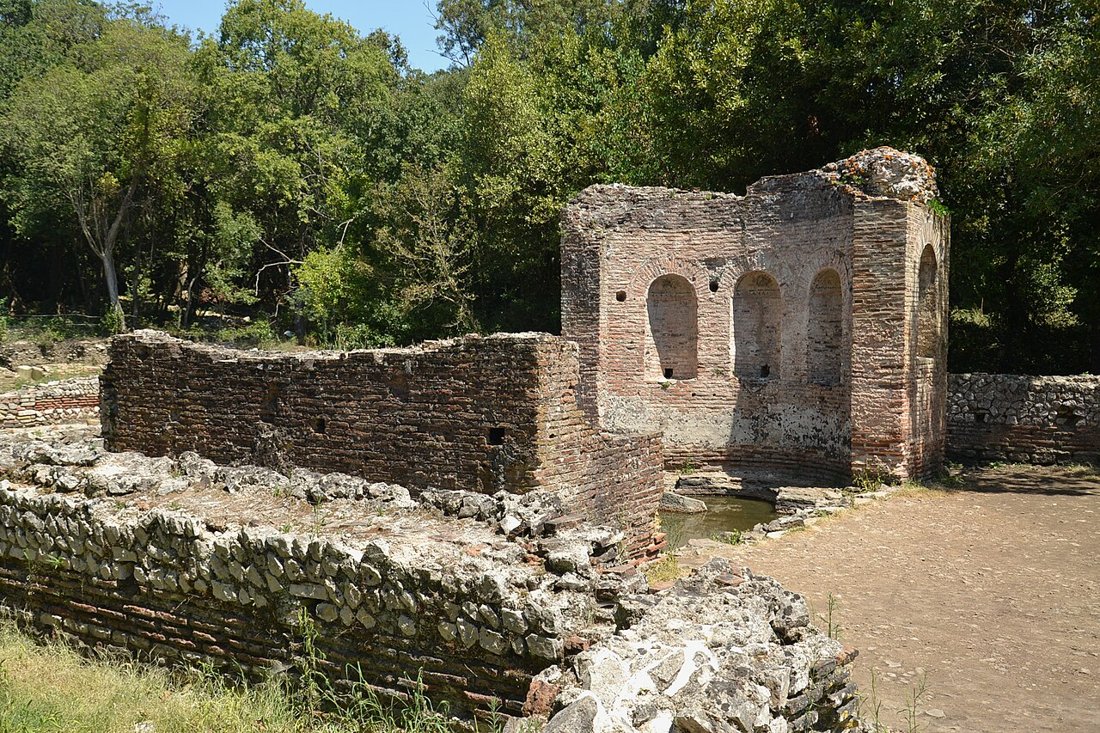
At Butrint, the ancient port of Buthrotum in modern southern Albania, excavations by the Butrint Foundation uncovered two towers of the western city wall that burned down in the late eighth or early ninth century. Beneath the burnt layer lay glass goblets, amphorae from southern Italy, the Crimea and the Aegean, pottery from Constantinople and handmade local vessels (Hodges et al., Antiquity 2009). It is the property of a wealthy household with connections across the empire.
The excavators cautiously link the fire to the question of whether the population of Vagenetia rose against Byzantine administration – much as Slavs attacked Patras in 805. They themselves put it as an open question. Anyone who attributes the destruction of Butrint to the Baiunites turns a question into a fact. No perpetrator is attested, and the radiocarbon dates scatter more widely than the ceramic dating.
There is no generally accepted etymology. In Yugoslav literature one finds a derivation from Slavic vojnici, "warriors", which would turn the Baiunites into a "tribe of warriors". This interpretation is not linguistically secured; it sounds attractive but does not account for the Greek sound pattern. Other authors equate the Baiunites with the Babuni, a name associated in the Middle Ages with the Babuna mountains and with heretics. According to other scholars there is no evidence for this equation.
The only honest statement is this: we know the Greek form of a name that Greek scribes took over from another language, in a manuscript tradition with fluctuating spelling. Nothing more can be drawn from it without speculation.
No archaeological find can be attributed to the Baiunites – neither in Macedonia nor in Epirus. The Komani-type jewellery occasionally found in southern Albania is associated with the late antique population of the interior, not with a Slavic group. Florin Curta has moreover questioned in principle whether a Slavic immigration into seventh-century Macedonia can be demonstrated archaeologically at all. One need not follow him, but one should not pretend that the evidence exists.
The written gap is just as large. Under the name Baiunites the group appears in no source after the Miracula. We have not been able to verify a mention in the writings of Constantine VII. Vagenetia itself reappears as a region only in Anna Komnene's Alexiad (under the year 1082), in the Partitio Romaniae of 1204 as a chartoularaton, and in documents of the Despotate of Epirus. Between the catalogue of around 615 and the bishop of 879 lie some 260 years without a single word.
As with the other groups of the catalogue, modern national histories have taken up the Baiunites. In accounts from Skopje they appear as part of the prehistory of a Macedonian people, in Serbian works within the framework of Slavic settlement in Albania, while from Albanian and Greek perspectives the question tends rather to be one of continuity or rupture of the older population of Epirus. These interpretations say more about the present than about the seventh century.
Early medieval groups are not early forms of today's nations. A regional name that survives into the fifteenth century attests a naming, not a descent. Vagenetia was ruled by Albanian lords in the fourteenth century, came under Ottoman rule in 1430 and disappeared as a name in the sixteenth century in favour of Delvina. None of today's states and communities in the region has a prehistory to defend here.
With this, the catalogue of Miracula II 1 is complete on our site. It shows how differently much can survive of five names standing in the same line. The Belegezites sell grain and have an archon with a seal; the Drugubites receive a bishopric and later a theme of their own; the Sagudates still appear as taxpayers in 904; the Berzites fade into a disputed chronicle passage. The Baiunites leave a name – and possibly, transformed over centuries, the name of a region on the Adriatic.
That is not nothing. But it is a hypothesis with gaps, and that is how it should be told. We cover further South Slavic groups and their source situation in our articles on the Melingoi and Ezeritai, the Serbs, the Croats and the Slavs of Bulgaria.
The Belegezites · The Berzites · The Drougoubitai · The Sagudates · The Rhynchinoi · The Strymonites · Melingoi and Ezeritai · The Serbs.
All History & Finds articles →
Of the Slavic groups that become visible around the Aegean in the seventh century, we usually know little more than …
Read more →