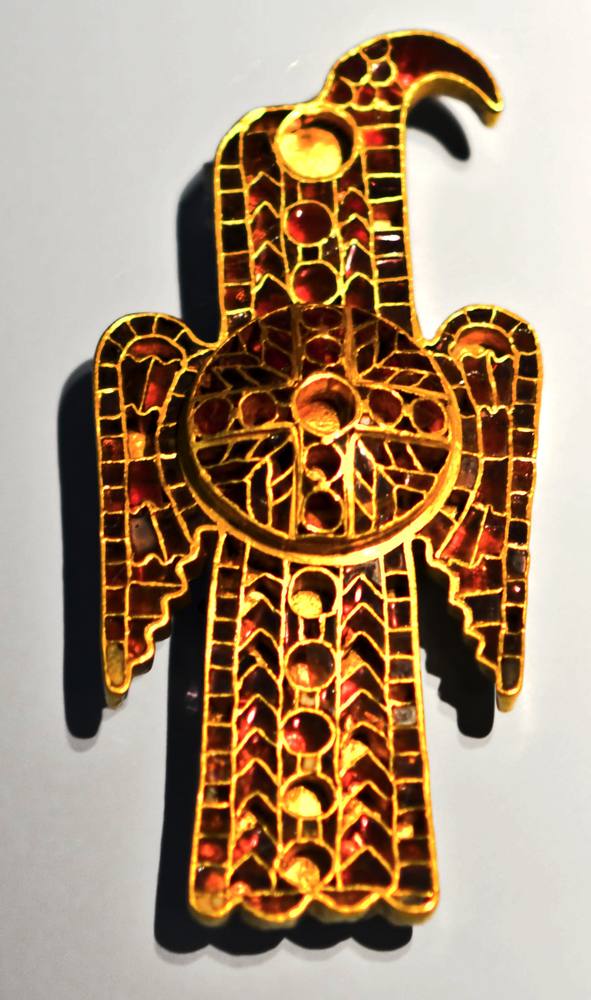
The Hasdingi are the part of the Vandals from which the kings Godigisel, Gunderic and Geiseric are said to come, and a name that stands in the sources astonishingly rarely. Cassius Dio knows “Astingi” in Dacia, Jordanes a lineage of the “Asdingi”, Hydatius in Spain writes only of Vandals. This article sets the testimonies side by side, keeps text, archaeology and interpretation apart, and says wherever a connection rests only on similarity of names that it does.
The Hasdingi are the part of the Vandals from which came the kings who led the people through Gaul and Spain to North Africa. That is how many books put it, and it is not that simple. The name alone appears in several shapes: Astingoi (Greek) in Cassius Dio, Asdingi in Jordanes, Hasdingi in later Latin texts, Hasdings, Asdings or Astings in English. Jordanes also knows Astringi elsewhere; whether the same people is meant is disputed. Anyone who writes “Hasdingi” chooses a convention, not a source form.
For the origin of the name there is a proposal, nothing more. It is regarded as Germanic and is linked with a reconstructed root that would correspond to Old Norse haddr (“women’s hair, long hair”); the Hasdingi would then be the “long-haired” or “hair-bearers”. The ending -ing in Germanic names marks belonging, often descent (“those belonging to …”). Whether the name denoted a people, a royal lineage or both is not settled even in the scholarly literature: Reichert and Castritius consider, as far as I know their position from a summary, the relation between Hasdingi and Vandals in the ancient sources “not entirely clear”. Anyone who reads “long hair” as a fact is reading a hypothesis.
The question of what the Hasdingi were in relation to the Vandals as a whole has no secure answer either. In the first century Pliny the Elder groups several peoples under the collective name Vandili, among them Burgundians, Varini, Charini and Gutones. Tacitus knows the Vandilii as an old name. The Hasdingi appear in neither list. They emerge only about a hundred years later, in one sentence of Cassius Dio.
The tradition on the Hasdingi is a patchwork of authors who lie far apart and hardly confirm one another. So, first, who supplies what.
Cassius Dio, a Roman senator who wrote in Greek, from Nicaea, composed his Roman History in the early third century. The books on Marcus Aurelius survive only in excerpts, above all in the summary of the monk John Xiphilinos from the eleventh century. What we read as “Dio” is therefore filtered twice. Jordanes, who presents himself as a descendant of Goths, wrote the Getica around the middle of the sixth century, probably in Constantinople, a summary of the lost work of Cassiodorus, and for Vandal matters he relies in between on the Greek historian Dexippus of the third century. Gregory of Tours wrote in the late sixth century and, for the events on the Rhine, quotes a lost historian of the fifth century, Renatus Profuturus Frigeridus. Hydatius, bishop at Chaves in Galicia, wrote a chronicle in the mid-fifth century that counts as the main source for Spain but looks out from the north-west of the peninsula. Procopius, secretary of Belisarius, treats the Vandals in the sixth century within his war history and writes about the early period at second hand, with some errors. To these come short passages in Jerome, Orosius and Prosper.
On method: I read these texts in English online translations, in part only in the excerpts named here (Cassius Dio in the Loeb translation by Earnest Cary, Procopius in that by H. B. Dewing, Jerome at New Advent, Jordanes in Mierow’s version, Hydatius in Latin on the Latin Library site). I have not worked through the Greek and Latin systematically; R. W. Burgess’s edition of Hydatius and the critical editions of the others were not in front of me. The list of sources states what I saw myself and what I know only through summaries.
It is striking how rarely the name Hasdingi appears in the texts of the fifth century at all. In the Latin version of Hydatius that I checked, neither Asdingi nor Hasdingi occurs; Hydatius writes Wandali throughout and distinguishes only the Silingi by their by-name. That the Vandals in Gallaecia were “the Hasdingi” is an inference of scholarship: whoever sat in Gallaecia and was not called Silingi must have been the other branch. That is plausible, but it is an inference.
The oldest passage stands in Dio’s account of the Marcomannic Wars of Marcus Aurelius. The numbering varies: the older edition counts the book as 71, the Loeb edition as 72; the passage lies in chapter 12. In the translation I read, the Astingi come to Dacia, the Roman province north of the lower Danube, under two leaders, bringing their whole households.
“The Astingi, led by their chieftains Raüs and Raptus, came into Dacia with their entire households …”Cassius Dio, Roman History 72(71).12, after the English translation by E. Cary (Loeb, public domain), read at LacusCurtius/Penelope; the Greek wording I did not consult; sentence shortened at the end
The chapter goes on, as far as I saw in the text: they left wives and children under the protection of a man named Clemens and attacked the Costoboci. The Lacringi feared that Clemens might lead the newcomers into their land, fell on the Astingi unprepared and won. After that, says Dio, the Astingi abandoned their war against Rome, received money and the right to ask for land if they harmed Rome’s enemies. That Clemens is the governor Sextus Cornelius Clemens is a modern identification. The years 171/172 are likewise a placement; Dio gives no date.
Dio says no more, and that is little. The sentence names two leaders but no king. It names neither strength nor language nor origin. Nor does it mention the Vandals: that the Astingi are to be equated with the later Hasdingi is an equation by name and approximate region, which Jordanes makes plausible (more on that below). In 73.2 Dio mentions the Vandili, but as a separate group: Emperor Commodus forbids the Marcomanni, after the peace of 180, to make war on the Iazyges, the Buri or the Vandili. Dio thus names Astingi and Vandili in two places and connects them in neither.
The link between Dio’s Astingi and the kings of the fifth century comes from Jordanes (Getica 22, sections 113 to 115). The Gothic king Geberich, son of Hilderith, wants to enlarge the narrow territory of the Goths at the expense of the Vandals, who live under their king Visimar. Visimar, we read, was “of the stock of the Asdingi”, a family that stood out among the Vandals and, Jordanes says with reference to Dexippus, counted as especially warlike. The Vandals lived, in his description, where the Gepids later dwelt, by rivers he calls Marisia, Miliare, Gilpil and Grisia. The first is usually the Mureș (Hungarian Maros); the others are debated. On the bank of the Marisia Geberich begins the war. Visimar is defeated together with a large part of his people, the survivors leave the land and ask Emperor Constantine for Pannonia. There, says Jordanes, they lived about sixty years as subjects of the emperors.
One should see what stands here and what does not. Jordanes writes a good 200 years after Constantine and gives no years. The usual dating, that the defeat on the Mureș falls in the 330s, is a back-calculation from “Constantine” and the sixty years; Geberich’s reign cannot be fixed from Jordanes alone. The passage also gives neither Gothic nor Vandal numbers, and that Constantine “gave” the land is, as far as I read, not in the sentence; it says they asked for it and lived there. Whether the Asdingi under Visimar were the same people as Dio’s Astingi 160 years earlier, Jordanes does not say. The name links the two; proof of unbroken continuity it is not. A second trail, the equation of the Vandals whom Emperor Aurelian defeated in 271 according to Dexippus, and who were to supply 2,000 horsemen, with the Hasdingi, I know only from a summary of scholarship and do not pass on as a finding.
Archaeologically, the area from which the Vandals are supposed to come is assigned to the Przeworsk culture, named after a site in south-eastern Poland. It lasts from the third century BC into the fifth century AD, has its core on the upper Oder and the Vistula and shows mostly cremation burials with deliberately bent or broken weapons. Many scholars link it with Vandals and Lugii; some regard the Vandals as only one element among several. The Wielbark culture, which is connected with the Goths, borders it to the north. The project “Migration Period between Odra and Vistula” of the University of Warsaw reads its expansion as a consequence of Gothic pressure on the Vandals and relies on the Jordanes passage for this. That is one reading among others.
For the Hasdingi in the narrow sense there is a single archaeological anchor, and it is itself interpretation. The Warsaw project says that researchers see the Hasdingi’s fight against Dacians in the Marcomannic Wars reflected in the archaeological record as the spread of Przeworsk settlement into the region of the upper Tisza. I consulted one further work, Bartosz Kontny’s 2019 article on the military ventures of Przeworsk people; in the summary I saw, the Asdingi are not connected with the Tisza in the period of the Marcomannic Wars. So here it is statement against omission, and I cannot weigh the two against each other. Anyone who reads “Hasdingi on the Tisza” is reading a widespread but not undisputed link.
The Chernyakhov culture does not belong in this story, as far as I can show. It is usually connected with the Goths in scholarship and lies further east and north. The Mureș region in which Jordanes shows the Vandals does, however, fall within the area of the Sântana de Mureș–Chernyakhov culture (named after a place on the Mureș). Whether the Vandals left traces there that one could recognise as such, I do not know, and I am not aware of any assignment of a particular site to the Hasdingi. The same holds for Pannonia: Jordanes asserts sixty years of residence; I have not come across a find that supports him. A people cannot be pinned to a find-spot archaeologically if no text says who lived there.
Between the end of the Pannonian years and the Rhine lies a gap in which the sources say astonishingly little about the Hasdingi. Procopius writes in the sixth century that the Vandals had lived “around Lake Maeotis”, that is the Sea of Azov, and, pressed by hunger, had moved into the land of the Germans, joining with themselves the Alans, a Gothic people as he calls them. That contradicts Jordanes, who sees them in Dacia and Pannonia, and it is regarded as an error or confusion; Procopius evidently knew the early history only by hearsay. The widespread explanation that the Huns drove the Vandals westwards is not in the texts I read; it is an interpretation from the general context. Likewise the role of the Roman general Stilicho, whom a summary names as the one who recruited the Hasdingi for Gaul, I could not check.
Then comes what makes the Hasdingi famous. Around the turn of the year 406/407, Vandals, Alans and Suebi cross the Rhine. The frame is supplied by late chronicling, especially Prosper of Aquitaine, who places the crossing on the last day of the year 406. The ancient historian Michael Kulikowski has proposed instead the year 405, which Anthony Birley disputes; I know both positions only from one account. I therefore give the traditional date as such and mark it as contested. A frozen Rhine, which in many books explains the crossing, is attested in no contemporary source; Gibbon formulated it as a conjecture, and later authors made a fact of it.
The Hasdingi themselves appear in a passage of Gregory of Tours (Histories 2.9), who copies out the lost Frigeridus. There, as far as I know it from an English rendering, the Vandals fought the Franks at first without the Alans and lost their king Godegisel and about 20,000 men; they would have been annihilated had not the army of the Alans, mistakenly called “Alamanni” by Frigeridus, under King Respendial come in time. Frigeridus names neither a place nor a date, and Respendial is said to have turned his people’s army away from the Rhine, which suggests that the battle took place away from the river. Figures like 20,000 are considered exaggerated. Gregory himself writes, in a brief sentence of his own, that the Vandals left their land and burst into Gaul “under King Gunderic”, without mentioning the Franks. Caution is needed here: the passage is accessible to me only through a summary, because the Brehaut edition on Gutenberg is abridged at this point; I therefore give it not as a quotation but as a report.
Who is the Frank? Frigeridus names no king. Modern scholarship thinks of several kings and of Roman federates, that is Franks in Roman pay and service, who lived on the middle Rhine and in the Belgic provinces (so a summary; I have not checked it in the original works). On the Franks themselves see the article on the Franks; on the Rhineland in Roman times the article on the Germanic peoples in the Rhineland.
No source names the place of the crossing. What remains is the trail of devastation. Jerome, who lived in Bethlehem and had the news from Gaul at second hand, lists in a letter of 409 (Letter 123, section 16) the peoples who had overrun Gaul (in the English translation by Fremantle, Lewis and Martley, my own rendering): “Quadi, Vandals, Sarmatians, Alans, Gepids, Heruli, Saxons, Burgundians, Alemanni”, and, as he continues, even Pannonians. He goes on to say that the once noble city of Mainz has been captured and destroyed, that many thousands were killed in its church; that Vangio (Worms) was wiped out after a long siege; that Reims, the Ambiani, the Atrebates, Tournai, Speyer and Strasbourg “have fallen to Germany”. Of the Hasdingi nothing stands there, nor of the Franks, nor of Cologne, Aachen or the Lower Rhine.
That allows the regional link to be stated clearly, and it is narrower than one might expect. The Rhine, where these things are supposed to have happened, flows roughly sixty to seventy kilometres (rough, as the crow flies) east of Alsdorf; the Roman capital of the area was Cologne. That Hasdingi themselves crossed the Lower Rhine or the Aachen country is attested by no source. The crossing at Mainz that is often assumed is an inference from the destruction of the city reported by Jerome; scholarship considers the Roman Rhine bridge there or boats. The date of 31 December 406 rests, as said, on Prosper and is disputed as to the year. Whoever looks for the area where the Vandals most probably came up against people from our region ends up with the Franks, who lived as Roman federates in the Belgic provinces and on the Rhine. The texts say no more.
One more source of confusion: for the Rhine crossing Gregory speaks of “Gunderic”, the summaries of “Godigisel”. According to scholarship both are Hasdingi kings, and according to Procopius they were father and son. Procopius (Vandalic War 1.3.23) names Godigisclus as father of the two brothers Gontharis (Gunderic) and Gizeric, the elder being born in wedlock, Gizeric out of it. Procopius also writes, on my reading of the passage, that Godigisclus died in Spain, which would contradict Frigeridus’s report of a death on the Rhine. I saw the word “there” only briefly in the English summary and consider it to be checked.
For the year 409 Hydatius notes the sentence on which much rests: Alani, et Wandali, et Suevi Hispanias ingressi, “Alans, Vandals and Suebi entered Spain”. Two years later, according to the same author, they divide the provinces by lot. The Vandals, whom he does not specify further, take Gallaecia in the far north-west, together with the Suebi; the Alans Lusitania and the Carthaginiensis; the Vandals with the by-name Silingi the Baetica. The article on the Silingi goes into the lot and their end in 418 in detail. For the Hasdingi only this follows: their seat is the north-west, and the source for it is a single witness.
After 418 the picture changes. Hydatius writes that the Alans, who had been powerful together with the Vandals and Suebi, were so beaten by the Goths that, after the death of their king Addax, they sought refuge under “Gunderic, king of the Vandals, who had settled in Gallaecia”. Here Hydatius gives the royal name Gunderic for the Vandals in Gallaecia. Then follows the war with the Suebi: for the year 419 Hydatius has the Suebi “besieged by the Vandals in the Nervasian mountains”, the Vandals breaking off the siege when the Roman commander Asterius intervened. That they afterwards moved to the Baetica I take from a summary; the passage itself I saw only in excerpts.
Hydatius then lines up events that lead Gunderic and his people south: in 422 a Roman army under Castinus, reinforced by Gothic auxiliaries, makes war on the Vandals in the Baetica; in 425 the Vandals plunder the Balearic Islands, and Cartagena and Seville are laid waste. In 428 Gunderic dies in Hispalis; Hydatius writes that after taking the city and entering the church there he was seized by a demon, by God’s will, and died (so the English rendering that I saw in a summary; the Latin wording of this sentence and Burgess’s translation I have not seen). Whether this was illness, accident or a pious invention is open. His successor, according to Hydatius, was his brother Geiseric. That does not contradict Procopius, who makes Geiseric Gunderic’s half-brother and portrays him as the cleverest of all men.
In May 429, says Hydatius, Geiseric crossed with all the Vandals and their families to Mauretania, from the coast of the Baetica. The number of emigrants is a story of its own. Procopius writes that Geiseric organised the Vandals and Alans in divisions under, it is said, no fewer than eighty leaders, the chiliarchs, so that the host seemed like eighty thousand men; earlier, Vandals and Alans together had been only about fifty thousand (so my reading of the summary; the wording is to be checked). Where the familiar figure “80,000 Vandals” turns up as a headcount, it goes back to this passage or to Victor of Vita, whose text I have not checked.
After 429 no source I saw speaks of Hasdingi as a people any more. Procopius writes that the names of the Alans and of all other barbarians except the Moors were merged into the name of the Vandals (Vandalic War 1.5.21). The name Hasdingi lives on instead as the name of the dynasty, as far as I take it from a summary: Cassiodorus speaks in his Variae (9.1) of the “stock of the Hasdingi”, the royal family of the Vandal kingdom in Africa. I have not seen the passage. That the kings in Africa styled themselves “kings of the Vandals and Alans” is stated in English Wikipedia; the origin of the title, probably coins and charters, I have not checked.
The kingdom that Geiseric founded in North Africa from 429 took Carthage in 439 and Rome in 455; Prosper reports that Pope Leo induced Geiseric to avoid fire and bloodshed. It ended in 533/534 with Belisarius. The Hasdingi as such appear in this part of the story only as a royal lineage. For the image of the Vandals in modern times a coinage was more consequential: Bishop Henri Grégoire introduced “vandalisme” in 1794, some 1,300 years after the events.
The Hasdingi are a name that appears in three places: in Dio, where it means a people, in Jordanes, where it means a lineage, and in Cassiodorus, where it means a royal stock. Between these places lie centuries, texts in three languages and sources that do not know one another. What happened in between, scholarship fills with name equations, and each is plausible. The picture of a continuous branch with its own kingship from 171 to 429 is therefore a construction that I consider reasonable and nevertheless label as a construction.
A core stands firm. A people called Astingi appears in Dacia around 171/172. A lineage of the Asdingi supplies, according to Jordanes, a Vandal king. A Vandal king, Godigisel, falls according to Gregory and Frigeridus in battle against Franks; Gunderic and Geiseric lead the people in Spain and in 429 to Africa. Everything else is combination.
The wider frame and neighbours: The Vandals, Silingi, Lacringi, Lugii, Goths, Franks, Gepids, Marcomanni and Germanic peoples in the Rhineland.

The Vandals · The Silingi · The Lacringi · The Goths · The Gepids.
All History & Finds articles →
In nineteen days an English king had to face down two invasions at opposite ends of his kingdom. He won the first so …
Read more →Five names stand in a single sentence of the Germania: Harii, Helvecones, Manimi, Helisii, Naharvali. Four of them come …
Read more →Five names stand in a single sentence in Tacitus, and one of them belongs to the Helvecones. After that, the record …
Read more →The Helvetii were a mighty Celtic tribe in the area of today's Switzerland. Their name lives on to this day in the …
Read more →