Masovia sounds like an ancient tribal name, evoking forests, sandy soil and a broad river. In fact the name of the Mazovians is attested surprisingly late: it first appears around the middle of the 11th century, in the middle of a war. Anyone who wants to know who these people were has to separate two questions – what the sources say, and what later ages have read into them.
Masovia (Polish Mazowsze) lies on the middle Vistula, around Płock in the west and Czersk in the south, near present-day Warsaw. Scholarship calls its inhabitants Mazovians, in Polish Mazowszanie. They are counted among the Lechitic group, the West Slavic peoples who settled in the area of later Poland, which also includes the Polans, the Vistulans and the Lendians. What exactly "Lechitic" means is itself a classification question: the term groups related languages and says nothing yet about political unity.
The name Mazovians was formed from the place name, not the other way round. Polish scholarship speaks of an "odonymic" name, that is, one derived from a landscape or place name. What the word Mazowsze originally means is unresolved. Proposals trace it to a word for "plain" or to a word for "tar, pitch" – in the second case, wood-tar production would be the background. Both are linguistic speculation, not attested explanations.
The oldest written source in which the Mazovians become tangible is the Old Russian Primary Chronicle, the "Tale of Bygone Years." It was compiled in Kyiv in the early 12th century and reports campaigns against the Mazovians in the 1040s. Latin sources add to this: the chronicler Gallus Anonymus, who wrote between 1112 and 1118, knows Masovia and a man called Masław, whom he calls Maslaus. Not much more than a land name and a ruler's name stands in the sources of the 11th century. The historian Jakub Jagodziński sums it up in an essay: of the history and identity of the Mazovians themselves, nothing is known. That is put bluntly, but it hits the core.
One reads again and again that the Mazovians already appear in the oldest list of West Slavic peoples, the Bavarian Geographer. That is not true. The Bavarian Geographer is a terse register from manuscript Clm 560 of the Bavarian State Library in Munich. It names groups north of the Danube together with the number of their civitates, fortified places or settlement districts, among them the Lendizi with 98, the Prissani with 70 and the Glopeani with 400 or more. The Uuislane, the people of the Vistula, stand in the list without a number. Mazovians are not there.
The date of the list is disputed. Bernhard Bischoff thought of a monk at Reichenau in the 830s to 850s; Aleksandr Nazarenko considers the 870s more probable. It is also possible that the text consists of two parts written at different times by different authors. Whether the Mazovians were hidden in the list under another name or did not yet exist as a group cannot be decided. Anyone who ascribes one of the listed names to the Mazovians is interpreting – and should say so.
Other early authors do not help either. In Thietmar of Merseburg, who wrote his chronicle between 1012 and 1018 and treats Bolesław the Brave, Poland's first king, at length, no passage is known that explicitly names Mazovians; this is a finding from silence and not a certainty. Bruno of Querfurt, who met his death in 1009 on the way to the Prussians on the border between Rus and Lithuania, appears in Masovian research only at the margins: no secure connection between his mission and the Mazovians exists. It is a presumption one occasionally reads and which the sources do not support.
Where writing is silent, archaeology speaks. North of the Vistula, around Płock, stand the oldest testimonies. At Szeligi near Płock there was an installation in the 7th or 8th century which excavators interpret as cultic or political rather than purely defensive. From the middle of the 9th century stronghold ramparts follow: the ring rampart of Nasielsk is dated to the 860s, measures about 80 metres across and counts as the oldest of its kind in the region. A stronghold rampart (Polish gród) is a site fortified with timber, earth and clay in which people took refuge in danger and in which a local elite often sat.
The number is remarkable: according to the figures gathered by scholarship, only about 14 such strongholds arose in the Masovian area before the middle of the 10th century. That is no dense castle landscape but a thin net. Przemysław Urbańczyk reads such sites as signs of local elites' claims to rule and as proof of their organisational ability. That is an interpretation which translates excavation results into a political picture; the findings themselves are more sober: timber-and-earth ramparts, occupation layers, pottery.
Around 977 the stronghold at Płońsk is dated, regarded as the first clearly "Piast" base; the stronghold of Płock on Cathedral Hill follows shortly after. With that the dynasty that politically penetrated the region from Greater Poland comes into play.
The rule of the Piasts, the Polish ruling dynasty, reached the middle Vistula, by a widespread view, in the second half of the 10th century under Mieszko I. The historian Aleksander Gieysztor located the oldest Masovian lands north of the Vistula and west of the Orzyc. Archaeologically there is no clear break: several strongholds continued from the pre-Piast period into the 11th century, and native elites may have kept their positions as governors. That is a model, not evidence; who subjugated whom and when, no source records.
Maciej Trzeciecki criticises scholarship for readily treating pre-Piast regions like later principalities – a back-projection. With that we reach the core of the question: was "Mazovian" a tribe in the 9th and 10th centuries, or is the name only a label for groups of settlers who were later gathered under a land name?
The name Mazovians enters history through a revolt. After the death of Mieszko II in 1034, Poland fell into a deep crisis, often called the "pagan revolt" in the literature, a term that claims more than the sources bear. In this situation a cupbearer – Gallus calls him pincerna – made himself independent in Masovia. His name is Miecław, in the Primary Chronicle Moislav, in Gallus Maslaus. Scholarship usually calls the period of his rule "Miecław's State"; the years around 1037/1038 count as the start, but the chronology is uncertain. Płock is named as the capital.
Gallus knows the conflict well, although he tells it from the distance of some seventy years. Casimir I, the "Restorer," returned from exile in 1039 and had to deal with the breakaway Masovia. As Miecław's allies, scholarly accounts name the Pomeranians, who lived on the Baltic coast, and the Yotvingians or Prussians; which of these names stands in the text and how reliable it is should be checked case by case. A first battle at Pobiedziska in 1041 was lost by Miecław, and a truce followed. In 1047 came the decisive fight, in which Casimir took the field with the support of Grand Prince Yaroslav of Kyiv, whose brother-in-law he was.
The Primary Chronicle tells the same event from the viewpoint of the Rus, and that two independently arisen traditions – one Latin-Polish, one East Slavic – report the same campaign makes it one of the better secured events of the period. Whether the two texts really arose without any connection, however, is not proven.
Yaroslav marched against the Mazovians, defeated them, killed their prince Moislav and subjected them to Casimir.Primary Chronicle, entry for 1047; paraphrase in own words, not a verbatim quotation
On details the sources diverge. Gallus reports that Miecław fell in the battle; he also gives a ratio of 30 to 3 army divisions, which one will read as narrative exaggeration rather than a count. The site of the battle, at an unnamed river, is unknown. Wincenty Kadłubek, the Kraków bishop and chronicler of the early 13th century, claims by contrast that Miecław escaped to the Prussians and was murdered there. That is a later version whose source value ranks below Gallus and the Primary Chronicle; as legend it is nevertheless telling, because it links Masovia early on with the north and north-east.
It is also open how far Miecław's power reached. Whether his domain comprised more than Masovia we do not know. The religious aspect is equally disputed: some historians assume that contact with Baltic neighbours strengthened pagan customs, others point out that Masovia was precisely a refuge for clergy and nobles fleeing uprisings in the west. Gallus describes the land as densely settled because refugees streamed into it. A unified answer is lacking.
Płock, on the high bank of the Vistula, was a Piast stronghold before it became Miecław's capital. According to tradition a Benedictine monastery is said to have stood here as early as 1009; that is a traditional claim and should be marked as such. More firmly established is that a bishopric was set up at Płock, usually dated to 1075, and that between 1079 and 1138 the city was the principal seat of the Polish rulers under Władysław I Herman and Bolesław III Wrymouth. Płock is thus a centre of power, not a tribal focus.
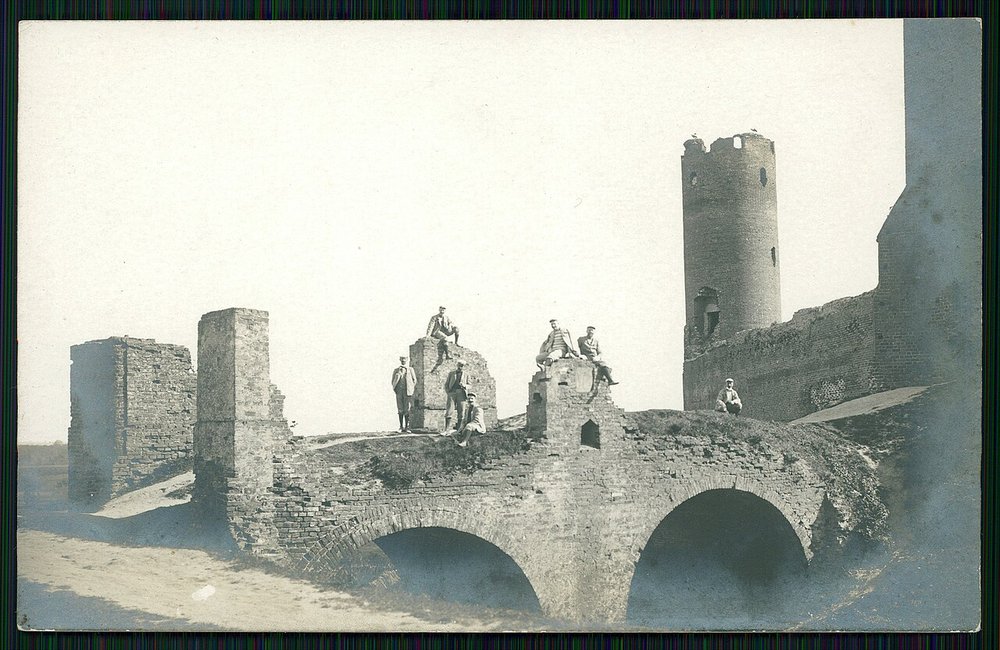
Czersk, farther south on the Vistula, has a different history. The finds point to a settlement of the 7th century at a ford; in the 11th century a stronghold rampart arose on the site. In the 12th century Czersk was the seat of a castellan, a castle administrator, which is secure for 1224. An earlier first mention in an East Slavic chronicle under 1142 is cited in the literature but cannot be reliably documented. In 1252 Czersk became the capital of a Masovian duchy, and in the late 14th century Duke Janusz I had the Gothic brick castle built whose ruin still stands. That is the Middle Ages proper, not the early Middle Ages; the castle belongs to a time when Masovia had long been a principality.
After the death of Bolesław III in 1138, Poland was divided among his sons; Masovia developed into a territory of its own, later held by a side line of the Piasts. Konrad I of Masovia called the Teutonic Order into the country in 1226 and gave it the Chełmno Land to defend himself against the Prussians in the north. A circle thus closed: the name that surfaced in the 11th century in a fight against Prussians and Pomeranians became the name of a principality on the border with them. The Pomeranians, the Kashubians and later the Prussians were neighbours about whose relations with Masovia we learn only from war reports. To the east lay Kyivan Rus, whose chronicle is the oldest surviving source naming the Mazovians; more on this in the article on the Kyivan Rus.
The Masurians, who settled in East Prussia, do carry the name on, but they are not direct descendants of an early medieval tribe. They emerged from the later settlement of southern Prussia by settlers from Masovia, above all since the late Middle Ages. Extending the name backwards in time is a widespread fallacy.
The Mazovians are a lesson in how a tribal name comes into being. What is secure is a land that is called Masovia in the 11th century and a revolt that ended in 1047. It is equally secure that the landscape on the middle Vistula was already marked by strongholds and settlements before that. Whether these settlers understood themselves as Mazovians before a prince and a war made the name political, nobody knows. Whoever speaks of "the Mazovian tribe of the 9th century" is using a modern ordering term. Much suggests that it was at first a land name and that people became "Mazovians" through it – but that remains a thesis, not a finding.

The Polans · The Vistulans · The Lendians · The Pomeranians · The Rus (Kiev).
All History & Finds articles →
To a farmer from Uppland, „the great city" was as unimaginable as another planet. Constantinople had walls that fire …
Read more →