Ask for Poland in Budapest and you hear Lengyelország; in Vilnius it is Lenkija; in Persian the country is Lahestān. Behind these widely scattered words many scholars suspect the name of a single tribe: the Lendians. Yet of them we have little more than a number in a list of peoples, an aside by a Byzantine emperor and a line in a Kyiv chronicle about captured strongholds. This article sets the three traces side by side, separates finding from interpretation and tests what is really attested in the familiar stories about the land of the Cherven Towns.
The Lendians (Latin Lendizi, Greek Lenzanenoi, Polish Lędzianie, Ukrainian Lendzjany) are regarded as a West Slavic group that lived in the 9th and 10th centuries in the borderland between the later Poland and Rus', roughly between the upper San, the Bug and the upper Dniester. The territory cannot be stated more precisely, and there the trouble begins: there are no self-testimonies, no inscription, no Lendian who tells us his name. Everything we know comes from outsiders: from a scholar in the south-west of the Frankish world, from an emperor in Constantinople and from a monk-chronicler in Kyiv.
That is exactly why these sources deserve a close look. Whoever sees how little they actually say also grasps how historical pictures come into being. Related cases are the Vistulans on the upper Vistula, the Dulebes in southern Volhynia and the White Croats, who appear in the same source landscapes and about whom handbooks likewise say much that turns out, on closer inspection, to be supposition.
The most frequently cited derivation traces the name to the Old and Proto-Slavic word lęda, meaning a piece of fallow land or land cleared by burning. The Lendians would then be "the people of the cleared land", which would suit an area where forest was being turned into fields. The explanation sounds plausible and stands in many reference works. It remains a linguistic interpretation: nothing in the sources themselves speaks of slash-and-burn farming, and the name could also come from another word stem or from outsiders who merely heard it that way.
It is also widely assumed that the Lendian name lies behind the words for Poles in many neighbouring languages. East Slavic has lyakh for a Pole, Hungarian lengyel, Lithuanian lenkas (plural lenkai), Armenian calls the country Lehastan, Persian Lahestān, older Turkish Lehistan. That these words share an origin is considered probable; that the origin was the name of the small tribe between San and Bug cannot be proved. A second possibility is that the name of a more powerful association, not clearly visible in the sources, simply prevailed and the Lendians merely shared it.
The oldest written mention stands in an unassuming Latin text called the "Bavarian Geographer" (Descriptio civitatum et regionum ad septentrionalem plagam Danubii). It enumerates peoples north of the Danube and gives for each the number of civitates, meaning fortified places or castle districts. In the second list the entry reads, in the usual reading, Lendizi habent ciuitates XCVIII: the Lendizi have 98 strongholds. Right after them come the Thafnezi with 257. That is the entire statement. The text does not say where the Lendians lived, who ruled them, what language they spoke or what a civitas was in their country: a ring-fort, a settlement with a palisade or merely an administrative district.
The origin of the text is also open. Bernhard Bischoff thought of a monk at Reichenau Abbey in the 830s to 850s, Aleksandr Nazarenko of the 870s; Henryk Łowmiański showed that the list consists of two parts which may have arisen at different times, and some scholars place the second part only in the early 10th century. Here lies a common mix-up: the "Bavarian" Geographer is not securely a Bavarian product. The only known manuscript is today in the Bavarian State Library in Munich (Clm 560), but its script points rather to a south-west German scriptorium such as Reichenau or Constance. The name comes from the place of storage, not from the author.
Whether the 98 strongholds were a count, an estimate or a rumour escapes us. The figure is high compared with the 15 strongholds of the Silesians but low against the 257 of the Thafnezi. Inferring population or power from such numbers is risky; they chiefly show that the author or his informants regarded the land as densely fortified.
The second trace leads into the 10th century. The Byzantine emperor Constantine VII Porphyrogenitus had a handbook on the empire's neighbours compiled for his son Romanos around 948 to 952, today called De administrando imperio. Chapter 9 describes how the Rus travelled each year from Kyiv in dugout boats (monoxyla) to the Black Sea and Constantinople. The boats, it says, came from Novgorod, Smolensk, Teliutza, Chernigov and Vyshgorod. They were made by the Slavic tributaries of the Rus, the "so-called Krivichians and Lenzanenoi and the rest of the Slavic regions": in winter they felled the trees in their mountains, shaped them into boats and brought them down in spring, when the ice melted, to the neighbouring lakes and rivers. This is a paraphrase after R. J. H. Jenkins's English translation; the wording is not quoted here.
What matters is what the passage says and what it does not. It names the Lenzanenoi beside the Krivichians as Slavs who paid tribute to the Rus and worked for the fleet. It does not say where they lived, how many they were or whether they saw themselves as a people. Nor does it name a Lendian prince; whoever reads in other accounts of a "prince" of the Lendians in Rus' service is drawing on later embroidery, not on these lines. That the Lendians appear here as suppliers of boats fits a land of forests and rivers leading towards the Bug and the Dnieper; beyond that plausibility the text offers nothing.
Chapter 37 names them again, this time in connection with the Pechenegs. The Pecheneg province Iabdiertim, Constantine says, borders the tributary territories of Rus, the Ulichi, the Drevlians and the Lenzenines (Lendians) and the rest of the Slavs. The sequence is not a map, but it shows that Constantine's informants placed the Lendians in the south-west of Kyiv's sphere of influence, near the Drevlians and the Ulichi. The Greek forms vary (Lenzanenoi, Lenzenines), which is no surprise when foreign names are rendered in Byzantine chancery spelling.
From these thin hints historians have drawn maps, and the maps differ greatly. The western limit is mostly sought at the Wieprz and the Wisłoka; in the east the proposals run from the upper Dniester across the Styr into the land east of Halych. The Polish historian Gerard Labuda placed the Lendians between the upper Bug, Styr and upper Dniester in the east and the Wisłoka in the west and saw in them an association on important trade routes between Prague, Kraków, Kyiv and the Khazar realm. Henryk Łowmiański looked further north, between Sandomierz and Lublin, where they would have overlapped with the White Croats, if these existed there; more on them in our article on the White Croats. The Ukrainian historian Leontii Voitovych puts them east of the Vistulans and south of the Mazovians, in the Sandomierz–Lublin area.
Archaeology helps only to a limited degree. Finds in the Carpathian foreland, for instance on the upper San, show according to Ukrainian scholars such as Mykhailo Kuchynko rather East Slavic than West Slavic settlement features; West Slavic traditions appear clearly only at the Wisłoka river. Whoever concludes that the Lendians were East Slavs over-interprets: pottery and house forms say little about the language of the inhabitants, and how West and East Slavs can be told apart at all in the 9th century is itself an open question. The Lendians remain, as the literature often calls them, a border group: between the Vistulans in the west and the Dulebes and Volhynians in the east.
A frequent mix-up concerns the chronicle we usually call the "Nestor Chronicle" or Primary Chronicle, Russian Povest vremennykh let, "Tale of Bygone Years". It arose around 1113 in Kyiv and knows no people called Lendians. Instead it speaks of the Lyakhs (Old Russian Lyakhi). In the list of peoples at the start it says, in sense, that when the Vlachs attacked the Danubian Slavs, Slavs came to the Vistula and were called Lyakhs there; of these Lyakhs some were called Polyane (Polans), others Lutichi, others Mazovians, others Pomorians. "Lyakhs" here covers West Slavic peoples from the Vistula to the Oder region, the later Poles together with the Lutici and Pomeranians. It cannot be equated with the Lendians.
The distinction matters. When the chronicle speaks of "Lyakhs", the Lendians are not automatically meant, and when a handbook lists the "Lendians" as Vladimir's opponents it translates a word the chronicle does not use. That the name lyakh arose from the Lendian name or is related to it is a widespread assumption, but it does not hold for the chronicle text itself. Perhaps the Rus transferred the name of the first West Slavic neighbours they knew to all Slavs living further west; perhaps it ran the other way round. Proof is lacking.
For the year 981 the chronicle reports a campaign by the Kyivan prince Volodymyr (Vladimir). In our own translation of the usual English version (Cross and Sherbowitz-Wetzor):
Volodymyr went against the Lyakhs and took their towns, Peremyshl, Cherven and other towns, which are under Rus' to this day.Primary Chronicle (Povest vremennykh let), annal for 981 (Old Russian 6489); translation our own, after the usual English versions (Cross/Sherbowitz-Wetzor) and the Russian edition
This is the first written mention of Przemyśl (Old Russian Peremyshl); Cherven, Polish Czerwień, also appears here for the first time. The phrase "to this day" belongs to the chronicler and shows that he wrote around 1113 in retrospect: in his time the strongholds belonged to Rus'. That Volodymyr took the strongholds stands in the text; whom they had belonged to before does not.
Whether the campaign took place in 981 at all is doubted. The Ukrainian historian Mykhailo Hrushevsky considered the 981 expedition a later insertion; Stefan Kuczyński proposed 992 or 1012. More recent work, such as the article "Чи ходив Володимир Великий на/до ляхів?", argues that the chronicle depicts a real process around the Cherven Towns in three dates (981, 1018, 1031), of which only 1018 is secure; the other two were set by the chronicler. The year 981 is therefore a marker in the transmission, not an independently confirmed event.
The term Cherven Towns (Polish Grody Czerwieńskie) designates a group of strongholds in the borderland between Poland and Rus'. The Ukrainian encyclopedia names as places Cherven, Volyn, Hrubeshiv, Suteisk and Ternava and describes the area as a row of fortresses on the left bank of the Bug. Where Cherven itself lay has been disputed for over two centuries, because several places bore this name in the Middle Ages.
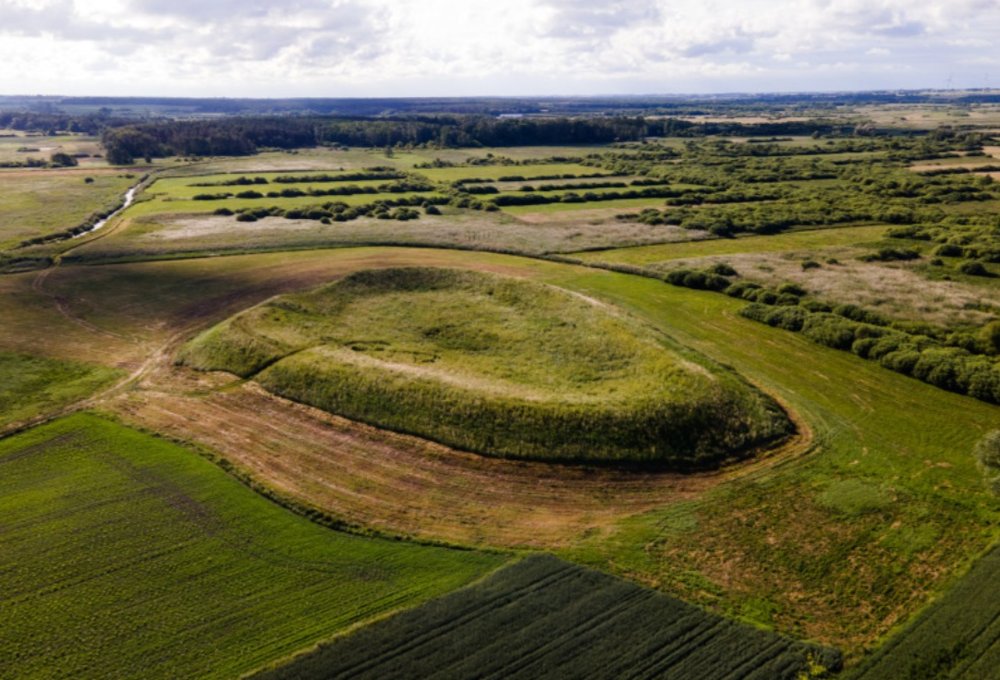
Today's most promising candidate is Czermno, a village in Tomaszów Lubelski County on the Huczwa. The site is huge, depending on the source 75 to 150 hectares, with a main stronghold, an outer bailey and a complex at the confluence of the Huczwa and Sienocha. Excavations revealed ramparts of box-like timber and earth construction with beams up to 30 centimetres thick, log roads across marshy ground, hoards with silver ornaments and beads in the ramparts from the late 10th century (after 970) and lead seals of the Drohiczyn type pointing to trade. Pollen samples show heavy oak clearance around the middle of the 9th century and again around 980. The end of the stronghold is placed in the 13th century, the time of the Mongol invasions; three skeletons found in recent excavations, one lying face down, are linked with this, which is an interpretation.
Whether Czermno really is the Cherven of the chronicle is to be clarified by a research project led by Marcin Wołoszyn (University of Rzeszów), which runs from 2022 to 2026 and works with some 200 absolute dates from radiocarbon, dendrochronology and thermoluminescence. If the ramparts could be dated to around 981, that would be a strong indication but not yet proof, since other strongholds in the area might yield similar dates. Until then, "Czermno = Cherven" is a working hypothesis with good arguments.
Przemyśl lies at a ford of the San. On Castle Hill (Wzgórze Zamkowe) a timber-and-earth stronghold of about one hectare arose in the 9th or 10th century, with ramparts roughly 20 metres wide and four to five metres high. In the early 11th century followed a rotunda of 7.6 metres in diameter and a rectangular palace building (palatium) of 33.6 by 15 metres. The attribution is disputed: a widespread interpretation sees in it a work of Bolesław I the Brave after the conquest of 1018, others consider the rotunda older than the palace. That the oldest-phase stronghold belonged to "the Lendians" is a plausible but nowhere attested attribution; the only source is the chronicle line of 981, which speaks of "their" towns.
A popular detail concerns the name Red Ruthenia (Polish Ruś Czerwona, Ukrainian Chervona Rus') for the Galician land around Przemyśl and Lviv. It is often derived from the stronghold of Cherven, whose name is said to have stuck to the region. That is a widespread derivation and an interpretation; an explanation from the word "red" itself is equally possible, and no clear evidence for either path exists.
That Volodymyr took "their" strongholds in 981 does not mean they were Polish. Depending on the school of research, the Piasts held the land, the Přemyslids of Prague, the princes of Rus', or nobody, because the Lendians and their neighbours were independent. One hint comes from Cosmas of Prague. For the year 1086 he describes an alleged charter of Emperor Henry IV confirming the boundaries of the Prague bishopric as they are said to have been in 973. It reads in Latin: Inde ad orientem hos fluvios habet terminos: Bug scilicet et Ztir cum Krakouia civitate, that is, in the east the Bug and the Styr, together with the city of Kraków, form the boundary. Whether such a charter ever existed is uncertain; it is possible that Cosmas, a Prague patriot, shaped the text himself. Whoever takes the passage as proof of a Bohemian land reaching the Bug relies on a late, contested testimony.
The sources on Kraków in the 10th century are similarly sparse, as we described in the article on the Vistulans: around 965 Ibrahim ibn Yaʿqūb names a realm of the Prague prince reaching as far as Kraków. The Czechs and the Moravians thus had an influence on the region whose reach eastwards cannot be determined exactly. How far it embraced the Lendians we do not know. The timeline sometimes printed with "833 Lendians in Great Moravia, 899 under Hungarian rule" belongs to the realm of hypotheses: none of the three main sources mentions the Lendians in connection with Mojmir, Svatopluk or the Magyars.
The chronicle returns to the Cherven Towns. For 1018 it reports that Bolesław I the Brave regained the strongholds on a campaign towards Kyiv; most accounts present it that way, without a wording being quoted here. For 1031 the chronicles report that Yaroslav the Wise and his brother Mstislav won the towns back and ravaged the land of the Lyakhs. According to the usual rendering they led many Lyakhs away, and Yaroslav settled his share on the Ros, a tributary of the Dnieper south of Kyiv. Taken literally that would be the resettlement of a population that one may interpret as a remnant of the Lendians. Whether the Lyakhs of 1031 were still the Lendians of the 9th century cannot be said; by this time the name "Lyakhs" already stands for Poles in general.
Later the rule over the land changes several times. The usual overviews give 1069 as the reconquest of Przemyśl by Bolesław II, 1085 as the emergence of a Principality of Peremyshl under rulers of the Rurikid house and 1340 as the incorporation into the Kingdom of Poland under Casimir III. Of the name "Lendians" nothing is heard in these texts any more. It disappears from the sources after the 10th century without an event ending it. Probably the group gradually merged into the East Slavic population, perhaps partly into the Polish one, through language, church affiliation and resettlement; this process, too, is not attested.
The Scandinavians too knew the western neighbours of Rus'. In Snorri Sturluson's Heimskringla, the saga of Harald Hardrada tells how the young Harald came to the court of the Kyivan prince Yaroslav. A skaldic verse by Þjóðólfr Arnórsson about Harald and his companion Eilif reads in Samuel Laing's English translation (1844):
"The eastern Vendland men they drove / Into a corner; and they move / The Lesians, although ill at ease, / To take the laws their conquerors please."
With the "Lesians" Laing renders the Old Norse name usually referred to the Lyakhs, that is the Poles; the verse would then point to fighting between Rus' and its western neighbours in the early 11th century. The exact interpretation is open, and the verse names neither the Lendians nor any places. We recall here our articles on Harald Hardrada, on the Vikings in the east and on the Varangian Route, which ran through the same part of the world. That the name of the Lyakhs reached Norse poetry shows how widely the term had spread by the 11th century.
Beside the sparse sources stands a wealth of later tales. Best known is the legend of the three brothers Lech, Čech and Rus, made the ancestors of the Poles, the Czechs and the East Slavs. Its earliest versions do not predate the late 13th and the 14th century, appearing in the Chronicle of Greater Poland and in Dalimil's rhymed chronicle of 1314. It is a founding legend meant to explain the name Lechia for Poland, not a report about the 9th century.
The link with the Lendians is a conjecture of name researchers: if lyakh and Lech derive from the same word and that word goes back to Lęd-, the legendary "Lech" would merely be the back-formation of a people's name into an ancestor. That is elegant and unprovable. At the same time the reasoning shows a familiar pattern of medieval historiography: from the name of a people an ancestral figure is made who bears it. Whoever reads the legend as a "memory of the Lendians" puts a hypothesis into the sources that they do not give.
A widespread error links the Lendians with the Lengyel culture. It is a Neolithic culture of the 5th millennium BC, named after the Hungarian village of Lengyel, and has nothing to do with Slavic tribes of the 9th century. The similarity of sound rests on the coincidence of the name form.
The Bavarian Geographer counts civitates, the chronicle speaks of "towns" (Old Russian grady), archaeology of hillforts. All three words are translations, and they do not cover the same thing. An early medieval grod (Polish) or gorod (Russian) was a fortified settlement with rampart and palisade that could be refuge, market place, seat of lordship and collection point for dues at once, and it could be small like the one-hectare Castle Hill of Przemyśl or huge like Czermno. More on this in our article on castle studies. Whoever reads "98 strongholds" as "98 towns" transfers a High Medieval picture onto a period from which we mostly know ditches, ramparts and post-holes.
Behind the name "Lendians" stands a basic question of early-medieval research: were there in the 9th century tribes at all, in the sense of capable communities that gave themselves a name? Sceptics such as Florin Curta stress that many Slavic names were fixed in writing only by outsiders and that a name can be a label for a region, a lordship association or merely a group of strongholds. For the Lendians this means: the entry in the Bavarian Geographer may denote an alliance, a territory or whatever came to an informant's mind on hearing the name. And Constantine's Lenzanenoi may not be the same people as the Lendizi of the list, since the similarity of names is an argument, not proof.
On the other side stand scholars who hold to the line from the Bavarian Geographer through Constantine to the Primary Chronicle because name, place and time agree. Both positions can be defended. What matters is that the picture of a unified group is not put into the sources without an intermediate step. Whoever lays the texts side by side sees three testimonies from three centuries looking from three directions at one area.
Gerard Labuda assumed that the Rus first used the name for certain Vistula groups and in the 11th and 12th centuries extended it to the whole population of the Piast realm because they spoke the same language. That would explain the use of lyakh for "Pole" in the East Slavic sources and fits the finding that the Primary Chronicle already knows the word as a collective name. The name of neighbours thus becomes the word by which a whole nation is designated from outside, a process common in language history (Germans are Allemands to the French, after the Alemanni, and saksalaiset to the Finns, after the Saxons). That it happened exactly so with the Lendians is the prevailing but not the only possible explanation.
As the self-designation of the inhabitants of the Piast realm, not Lendian prevailed but the name of the Polans, from which the word Poles arose; Lechia remained a learned second name. The Lendians are therefore not the ancestors of "the Poles" as a whole but at best one of the groups whose name was transferred by neighbours to the totality.
The Lendians are an example of a name that carries more weight than the sources. A number in a south-west German list, an aside in a handbook for a Byzantine prince and a chronicle entry on strongholds in the borderland are all that remains of them as a group. Added to these are hillforts, ramparts and silver jewellery that can be connected with them but need not be. Whoever stays honest records: in the area between the Wisłoka and the Dniester there was in the 9th and 10th centuries a densely fortified land with long-distance trade and frequent changes of rule; its inhabitants bore, for outsiders, a name that sounds like the later word for "Pole". Everything beyond that, the borders, the rulers, the religion, the self-designation, is inferred or not yet discovered. The excavations at Czermno run until 2026, and the new datings may shift the picture.

The Vistulans · The Dulebs · The White Croats · The Volhynians · The Polans · The Krivichs · The Drevlians · The Varangian route.
All History & Finds articles →
In the summer of 56 BC, western Gaul produced a moment that Caesar records in a single subordinate clause: the Lexovii …
Read more →A Viking army had no national flag, no passport and no uniform. It was made up of men who had joined a leader and men …
Read more →A monastery on a tidal island off the coast of Northumbria, a summer's day in 793 – and a shock that echoed all the way …
Read more →