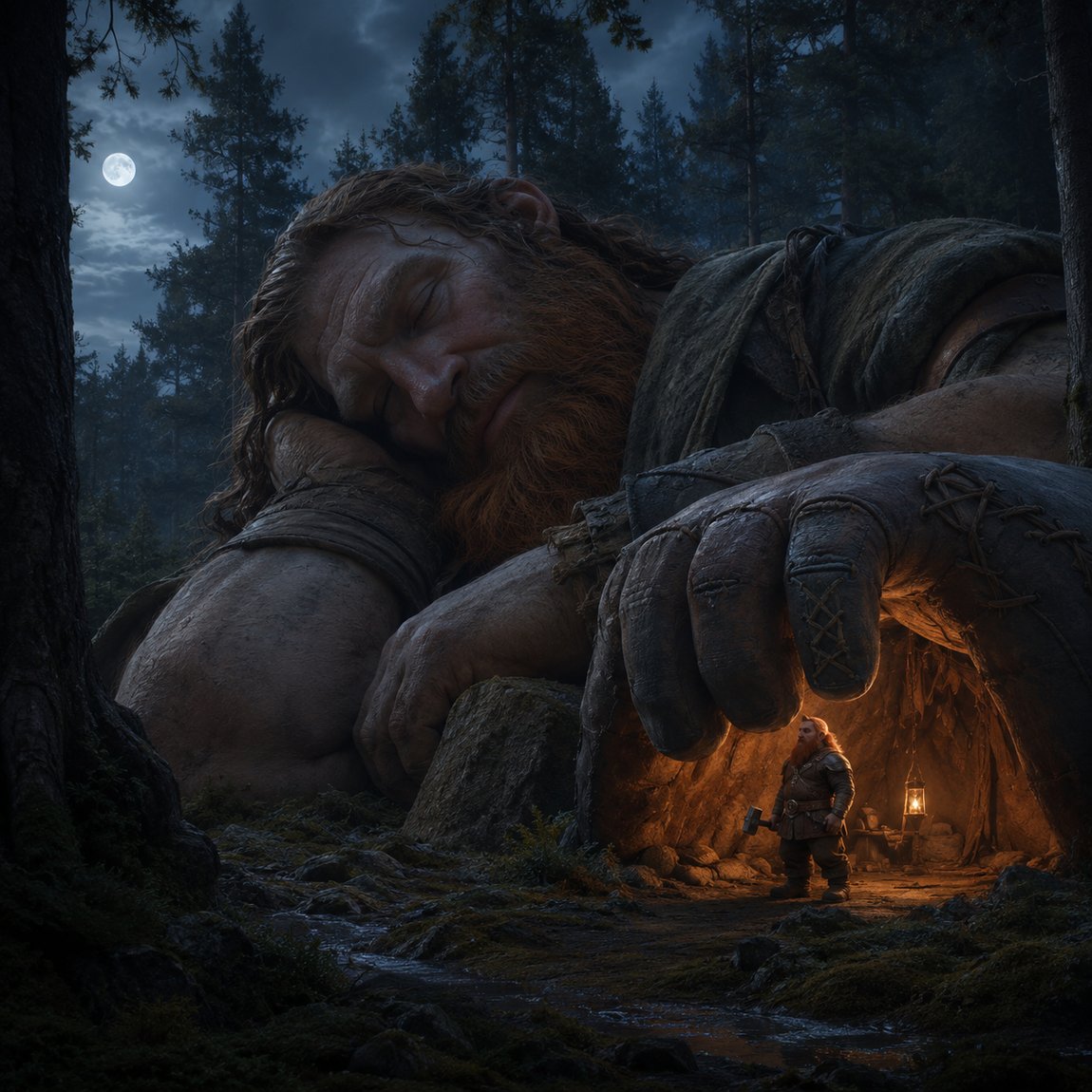
Before Thor is humbled in the stronghold of Utgard, he meets on the road a giant so vast that the gods spend the night in his glove. Thor and Skrymir is the tale in which even the strongest of gods reaches his limits – and nothing is what it seems.
Thor, Loki and two human servants journey east into the giant-land of Jötunheim. In a forest they seek shelter and find a strange hall with a side-room. Only in the morning does it show itself: it was the mitten of a giant sleeper.
The giant is called Skrymir (‘big fellow’) and offers to travel with them. He carries everyone's provisions in his bag – but when they halt, Thor cannot undo the knot. In anger he strikes the sleeping giant three times on the head with Mjölnir. Each time Skrymir only wakes and asks whether a leaf or an acorn has fallen on his head. In the morning he parts from them – and only later does Thor grasp it: the blows had not struck the giant but a mountain, into which three deep valleys were hammered. Skrymir was an illusion, worked by Utgard-Loki himself.
“Art thou awake, Thor? Did a leaf fall from the tree upon my head?”after the Prose Edda (Snorri); public-domain tradition
One of the most famous and comical stories of Norse mythology tells of Thor's journey to the giant-land Utgard. It shows the thunder god from an unusual side: outwitted, but unbroken in his strength.
On the way Thor meets the huge giant Skrymir, who is so large that Thor and his companions sleep in one of his gloves. Three times Thor strikes the sleeping giant at night with all his strength – and yet achieves nothing.
In the fortress of Utgard the giant king Utgard-Loki puts Thor and his companions to the test: a drinking horn that does not empty, a cat that cannot be lifted, and a wrestling match against an old woman that Thor loses.
In the end Utgard-Loki confesses: all was illusion. The horn reached into the sea (hence the tides), the cat was the Midgard serpent, the old woman was old age itself – which no one defeats. Thor's "defeats" were in truth superhuman feats.
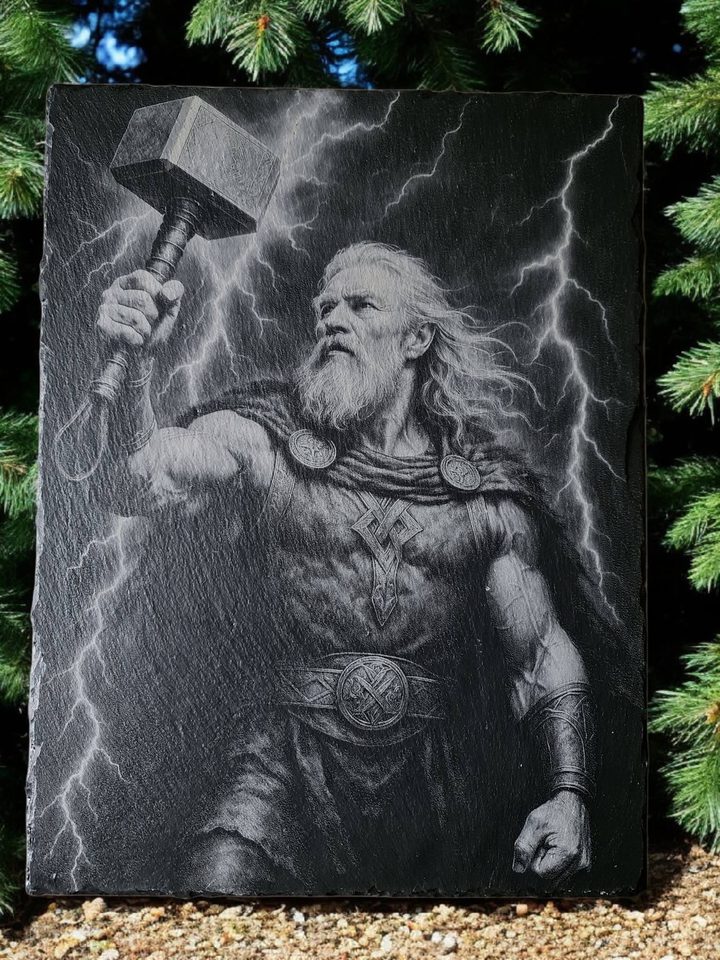
Thor · Mjölnir – Thor's hammer · Jötunheim · The Norse pantheon · Midgard.
Snorri Sturluson, Gylfaginning (c. 1220); English public-domain Edda tradition: Henry Adams Bellows / Arthur G. Brodeur. Scholarship: Rudolf Simek, Dictionary of Northern Mythology; John Lindow, Norse Mythology.
Her name is Þrúðr („strength, power") and she is the daughter of Thor and Sif. Around her turns one of the craftiest …
Read more →The funniest and at the same time most profound Thor story is a string of defeats – that are none at all. On his …
Read more →A poet who fears for his reward, and a lord who lets himself be celebrated: the Vellekla („gold-lack“) by the skald …
Read more →Valhalla is no resting-place for weary souls. It is a barracks of the fallen: a vast hall where the bravest dead fight …
Read more →