He was five when his father fell at the Battle of Clontarf, and he is said to have died in his bed as an old man. In between lies more than half a century in which the Orkney earldom reached further than it ever had before or would again. Thorfinn Sigurdsson, in Old Norse Þorfinnr inn ríki, "the Mighty", ruled Orkney, Shetland, the Hebrides and much of northern Scotland. He fought half-brothers, a nephew and a Scottish king whom perhaps nobody ever called by that name, and he travelled through Denmark and Saxony to Rome. This article separates what the sagas tell, what an eleventh-century skald sang, what Adam of Bremen reported from northern Germany, and what scholars still leave open.
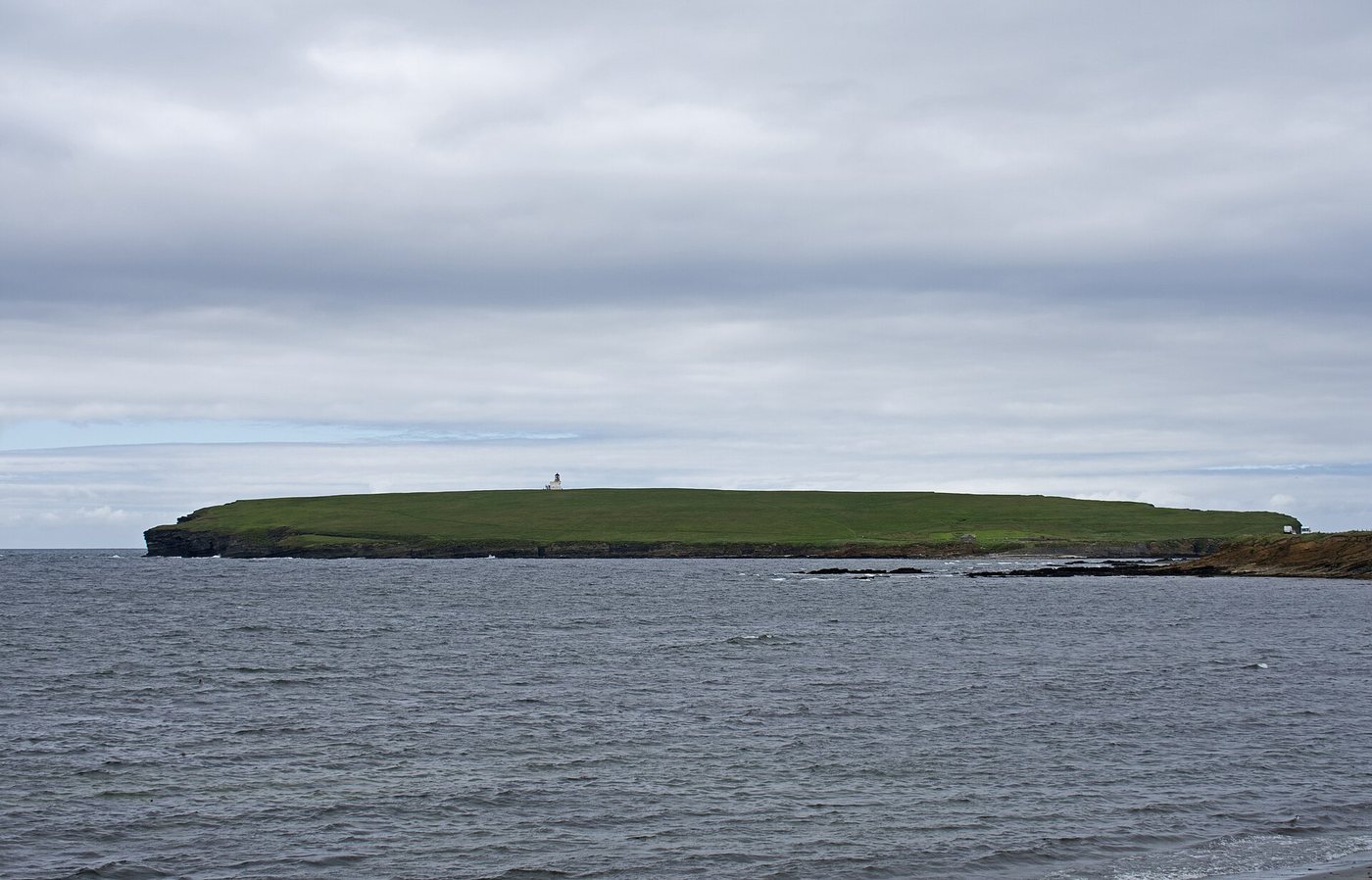
Thorfinn was a jarl, an earl or prince ruling under the overlordship of the Norwegian king, and his domain was the Orkney Islands off the northern tip of Scotland. The earls of Orkney had formed their own dynasty since the late ninth century; our overview of the Earls of Orkney tells that wider story. Within the line, Thorfinn counts as the most powerful. The ranking is medieval: in Heimskringla, Snorri Sturluson calls him the ablest earl of the islands, with the greatest dominion of all the Orkney earls.
His dates are only approximate. The one firm anchor is 1014, when his father, Earl Sigurd Hlodvisson, known as Sigurd the Stout, was killed at the Battle of Clontarf near Dublin. The sagas say Thorfinn was five at the time, which gives a birth year around 1009 – a calculation, not a record. His death date is even less certain, as discussed below. One distinction up front: the Icelander Thorfinn Karlsefni, who sailed to Vinland, shares nothing with the Orkney earl except his first name.
Nearly everything we know about Thorfinn comes from texts written some 150 years after his death. The most important is Orkneyinga saga, the "Saga of the Orkney Islanders". An anonymous Icelander wrote it around 1200; it survives chiefly in the great compilation manuscript Flateyjarbók from the late fourteenth century. It is not a chronicle but a narrative that likes to sharpen its drama. A public-domain English translation by Jón A. Hjaltalín and Gilbert Goudie, edited by Joseph Anderson, appeared in 1873; later translations, such as Alexander Burt Taylor's of 1938, are still in copyright.
The second source is Heimskringla by the Icelander Snorri Sturluson, written around 1230. In his saga of Olaf the Saint, Snorri devotes several chapters to the Orkney earls, closely related to Orkneyinga saga. Samuel Laing's English translation of 1844 is in the public domain. Where they agree, they are not necessarily independent witnesses.
Older, and therefore especially valuable, are the verses of the Icelandic skald Arnórr Þórðarson, called jarlaskáld, "the earls' poet". He lived in the eleventh century, knew Thorfinn personally and composed a praise poem for him, the Þorfinnsdrápa. Yet these verses do not survive independently; we have them only because the saga writers quote them. The prose around them is later interpretation.
Outside Scandinavia there are only a few building blocks. The Irish Annals of Ulster record Sigurd's death at Clontarf in 1014. Adam, a canon of Bremen cathedral, wrote his history of the archbishops of Hamburg around 1075 and mentions a bishop for Orkney (see our article on Adam of Bremen). Scottish sources of the eleventh century say nothing at all about Thorfinn – a silence that matters for the puzzle of "Karl Hundason".
Thorfinn's father Sigurd the Stout had several sons. According to the saga tradition they were Sumarlidi, Brusi, Einar and Hundi from earlier unions, and Thorfinn as the youngest. Hundi died young as a hostage of the Norwegian king Olaf Tryggvason. Thorfinn's mother was a daughter of the Scottish king Malcolm II (Gaelic Máel Coluim mac Cináeda), who reigned from 1005 to 1034. The sources do not give her name. Thorfinn was her only son by Sigurd.
This maternal line shaped his life. The introduction to the 1873 translation summarises the saga: when Sigurd fell, his daughter's son Thorfinn was "then only five years of age", and King Malcolm gave him Caithness, the district at the northern tip of the Scottish mainland facing Orkney. According to the saga, Thorfinn was fostered at the Scottish court and given advisers. That is plausible but attested only by the saga. Either way, Thorfinn had two faces: Norse earl of the islands and Scottish king's grandson with claims on the mainland.
Snorri remarks that Thorfinn spent most of his time in Caithness and elsewhere in Scotland and placed his own men over the islands. At first, his centre of gravity lay on the mainland.
After Sigurd's death the older half-brothers divided the islands. Sumarlidi, the saga says, soon died a natural death, leaving Einar and Brusi. Einar held two thirds and Brusi one. The saga draws them as opposites: Einar, whom it calls "Wry-Mouth", a violent lord; Brusi, a popular, peaceable man. From his mainland base Thorfinn claimed Sumarlidi's share, and Brusi mediated so that he received it.
A key figure of these years is Thorkel Amundason, called fóstri, "the Fosterer", because he is said to have raised Thorfinn. He fled from Einar to Thorfinn. Heimskringla tells how Thorkel killed the earl at a feast in his hall at Deerness on the Orkney Mainland; in Laing's translation Thorkel simply answers "Now I am ready" and strikes Einar on the head so that he falls to the floor. The usual date is around 1020. Whether Thorfinn approved is not stated; that he profited is obvious.
Now Norway stepped in. In Snorri's account, Brusi and Thorfinn travelled to King Olaf Haraldsson, later Olaf the Saint, who asserted the old overlordship over Orkney. Olaf played the brothers against each other. Laing renders his verdict that Thorfinn was "more high-minded, and less disposed to suffer subjection than Bruse". In the end the king invested Brusi and Thorfinn with one third each as a fief, kept the remaining third himself, and held Brusi's son Rögnvald as a hostage. By the saga chronology this was around 1021.
The arrangement did not last. According to Snorri, Brusi complained that he alone had to defend the islands against Viking raids while Thorfinn collected his dues and stayed in Scotland. Thorfinn offered an exchange: he would take two thirds and, with them, the defence. So it was settled when Cnut the Great won Norway and Olaf left the country, around 1028. After Olaf's death at Stiklestad in 1030 and Brusi's death some time between 1030 and 1035, Thorfinn stood effectively alone at the top.
The best-known and most puzzling episode of Thorfinn's life is his war against a "king of Scots" whom Orkneyinga saga calls Karl Hundason. In the saga, Thorfinn's grandfather Malcolm dies and Karl takes the kingship. He demands tribute for Caithness, Thorfinn refuses, and war follows. The saga tells of a sea battle off Deerness that Thorfinn won, of the killing of Karl's nephew Muddan at Thurso by Thorkel the Fosterer, and of a decisive battle at "Torfnes", usually identified with Tarbat Ness on the Dornoch Firth. Afterwards Thorfinn is said to have raided as far south as Fife.
The problem: no other source knows a Scottish king called Karl. Malcolm II was succeeded in 1034 by his grandson Duncan I, who was killed by Macbeth in 1040. Scholars have therefore proposed a whole range of solutions, which I give here as they are summarised in the secondary literature:
According to the secondary literature, the historian Alan Orr Anderson called the story "fabulous" and thought no solution justified. One point matters for any verdict: the skald Arnórr speaks in his verses of a lord of the Scots called Karl; the addition "Hundason" comes only from the saga prose. Contemporary verse therefore supports the claim that Thorfinn fought the Scots and carried his campaign far south. Who his opponent was cannot be established with certainty.
Brusi's son Rögnvald had made good use of his years as a hostage. He stood at Olaf the Saint's side, including at Stiklestad, and afterwards was in Russia with the young Magnus Olafsson, later Magnus the Good. When Magnus became king of Norway in 1035, Rögnvald returned to Orkney with royal backing, by the saga's account around 1037, and claimed his father's third. Thorfinn gave way and even let him have the king's third. For some years uncle and nephew ruled and raided together.
The break came, according to the saga, with a guest: Kalf Arnason, a Norwegian magnate who had been involved in Olaf's death and now had to flee King Magnus. Kalf was an uncle of Thorfinn's wife Ingibjorg. He brought many men who needed feeding, and Thorfinn demanded back from Rögnvald the third that had once belonged to Einar. Rögnvald refused. He lost a sea battle in the Pentland Firth, fetched ships from Magnus in Norway and came back.
What follows is among the most gripping scenes in the saga. Rögnvald surrounds Thorfinn's house and sets it on fire; Thorfinn breaks out through the wall with his wife and escapes to Caithness. Later Thorfinn in turn surprises Rögnvald on the small island of Papa Stronsay, where he has gone to fetch malt for the Christmas ale. Rögnvald slips away in the dark, but the barking of his lapdog gives him away, and Thorkel the Fosterer kills him. The saga then praises him as the most popular and gifted of all the Orkney earls. Historians such as Thomson treat the details as saga storytelling; the secure core is that Rögnvald died in his power struggle with Thorfinn. The frequently cited date of around 1046 rests on the saga chronology and is not independently confirmed.
Thorfinn's power rested on ships. Orkney sits at the crossroads of the sea routes between Norway, Shetland, Scotland's west coast with the Hebrides, the Irish Sea and Ireland. Whoever held them with enough longships controlled trade, tribute and raiding in every direction. Nearly all his reported fights are sea battles or coastal landings.
Snorri describes the extent of his power briefly. Laing translates the passage like this:
"Earl Thorfin Sigurdson has been the ablest earl of these islands … has had the greatest dominion of all the Orkney earls … he had under him Orkney, Shetland, and the Hebudes, besides very great possessions in Scotland and Ireland. … He came to the earldom at five years of age, ruled more than sixty years, … died in his bed about the last days of Harald Sigurdson."
Snorri Sturluson, Heimskringla, Saga of Olaf Haraldson, section "Of the Earls Thorfin and Bruse", translated by Samuel Laing (1844); extracts, omissions marked …
"Very great possessions in Scotland and Ireland" is deliberately vague. For Ireland there is no evidence outside the sagas of any lasting rule by Thorfinn. For the Hebrides, scholars such as Alex Woolf place a conquest around 1034, but that too is a reconstruction from saga and skaldic verse. At the end of his life Orkneyinga saga lists several earldoms in Scotland under him; Thomson reads this claim as lordship over regional chieftains rather than settled administration. What is secure is that Thorfinn was for decades the strongest sea power in northern Britain, strong enough that Norwegian kings had to bargain with him.
Power in the eleventh century meant above all being able to feed a retinue – exactly what later wrecked his relations with Rögnvald. How the Scottish side experienced these decades is covered in our article on Vikings in Scotland.
After Rögnvald's death a quarrel with Norway remained unsettled. Norway was now ruled by Harald Hardrada, first jointly with Magnus and from 1047 alone. According to Orkneyinga saga, Thorfinn went to Harald and made peace with him. From Norway he travelled on to Denmark to King Svein Estridsson, whom, in the 1873 summary, he visited at Aalborg, and then through Germany to Rome. There, the saga says, he received absolution from the pope for all his deeds.
One stage stands out for readers in Germany: on his way south, the saga has Thorfinn meet Emperor Henry III (emperor 1046–1056) in Saxony, who received him well. As far as I know, the saga does not name the exact place of the meeting; any location would be speculation. The journey is usually dated around 1048–1050. That is an inference, not a recorded date. Which pope received Thorfinn is not named in the sources I was able to consult.
Penitential journeys by great lords were common in the eleventh century. Cnut the Great had gone to Rome in 1027, and Macbeth of Scotland did so in 1050 according to the Irish chronicler Marianus Scotus. The saga says only that after his return Thorfinn turned his mind more to the government of his lands and the welfare of his people.
After his return, the saga says, Thorfinn settled permanently at Birsay in the north-west of the Orkney Mainland and built a church there dedicated to Christ, Christ Church. It became the first fixed bishop's seat in Orkney. Here, for once, the saga gets outside support. Adam of Bremen reports that Archbishop Adalbert of Hamburg-Bremen (in office 1043–1072), on the pope's instruction, consecrated a Thorolf (Turolf) for the city of "Blascona". Scholars identify Blascona with Birsay, Old Norse Birgisherað. Adam also mentions envoys from the Orcadians to the archbishop; whether Thorfinn himself was among them is a conjecture that Crawford, among others, considers.
The see was not quite as new as the saga implies. A Bishop Henry, probably from Lund, is attested for Orkney before 1035, though he may never have set foot on the islands. Thorfinn's achievement was therefore less bringing Christianity than giving it a fixed place, with a bishop beside the earl's seat. The historian Ronald Cant saw in this a deliberate plan by the earl to organise the island church.
Where Christ Church and the earl's hall stood is disputed. For a long time the favoured site was the Brough of Birsay, a tidal island reachable on foot only at low water. It holds the remains of a Romanesque church, Norse halls and older Pictish traces. More recent work, for instance by Thomson, considers a site on the Mainland opposite, near the later Earl's Palace in Birsay village, possible or more likely. None of the buildings can be securely assigned to Thorfinn archaeologically. Orphir, with its round church, is a different site from the time of Earl Håkon Paulsson in the twelfth century.
According to both Orkneyinga saga and Heimskringla, Thorfinn died a natural death "about the last days" of King Harald Hardrada and was buried in his Christ Church at Birsay. Since Harald fell at Stamford Bridge in September 1066, Thorfinn died before then. There is no exact year. The 1873 introduction gives 1064; one version of the Icelandic annals points to about 1065. Alex Woolf considers a date in the late 1050s just as credible, partly because Thorfinn's widow must have married King Malcolm III of Scotland by about 1060. The figures for the length of his rule – "more than sixty" winters in Snorri, "seventy" in Orkneyinga saga – are round saga numbers; taken literally they would run well past 1066.
That widow was Ingibjorg, a daughter of the Norwegian magnate Finn Arnason. That she married Malcolm III "Canmore" after Thorfinn's death and bore him a son Duncan, the later King Duncan II, is argued for example by the historian A. A. M. Duncan. Others think Malcolm may have married a daughter of Thorfinn of the same name; Woolf finds the evidence for the marriage to the widow "not entirely convincing". Accounts differ, and the sources do not allow a decision.
Thorfinn's sons Paul and Erlend succeeded him jointly. According to saga tradition they took part in Harald Hardrada's English expedition of 1066 and survived the defeat. Their joint rule sowed the seed for the struggles of their sons Håkon Paulsson and Magnus Erlendsson, the later saint. Snorri notes that after Thorfinn's death many of the lands the earl had subjected were lost. The size of his realm depended on the man himself.
In Orkneyinga saga Thorfinn is the high point of the early earldom, a ruler against whom later earls are measured. In the twelfth and thirteenth centuries, when the saga was written, Orkney was firmly in the hands of his descendants, and the memory of a mighty ancestor served their claims too.
Since the nineteenth century Thorfinn has drawn attention mainly because of his closeness to Macbeth. The historian William F. Skene noted that the sources never mention the two together, although both were powerful in northern Scotland at the same time. Dorothy Dunnett made this the premise of her novel "King Hereafter" (1982): Thorfinn and Macbeth as one and the same person. That is fiction, not a scholarly position. Nigel Tranter also took up the period in a Macbeth novel.
Why is Thorfinn called "the Mighty"? The Old Norse epithet inn ríki means "the mighty" or "the powerful". It reflects the reach of his rule over Orkney, Shetland, the Hebrides and parts of Scotland, which according to the sagas exceeded that of any other Orkney earl.
Was Thorfinn related to the Scottish royal house? Yes. In consistent tradition his mother was a daughter of King Malcolm II. His widow Ingibjorg is widely thought to have married Malcolm III later, though scholars do not all accept this.
Did Thorfinn really travel through Germany? Orkneyinga saga has him pass through Saxony on his way to Rome and meet Emperor Henry III. I know of no German source that confirms it. Adam of Bremen does, however, report the consecration of an Orkney bishop by the archbishop of Hamburg-Bremen in the same years.
Where is Thorfinn buried? According to Orkneyinga saga, in the Christ Church he built at Birsay. Which of the known church remains that is cannot be established with certainty.
What do Thorfinn the Mighty and Thorfinn Karlsefni have in common? Only the first name. Thorfinn Karlsefni was an Icelandic trader who, according to the Vinland sagas, tried to settle in North America; the Orkney earl lived at the same time but in a very different world.
The Earls of Orkney: the dynasty at a glance · Rögnvald Eysteinsson, ancestor of the Orkney earls · The Battle of Clontarf, 1014 · Olaf the Saint · Cnut the Great · Harald Hardrada · Stamford Bridge, 1066 · Adam of Bremen · Vikings in Scotland · Heimskringla
The Earls of Orkney · Rognvald Eysteinsson · The Battle of Clontarf 1014 · Vikings in Scotland · Norse Kings.
All History & Finds articles →
Thorfinn Karlsefni, an Icelandic merchant, and his wife Gudrid are named as the leaders of the largest recorded Norse …
Read more →In August 1009 an army lands at Sandwich that the Anglo-Saxon Chronicle simply calls "Thurkill's army". Three years …
Read more →Thor's hammer stands for protection and blessing: Mjölnir is the thunder god's weapon for smashing giants, but also the …
Read more →Thorstein the Red (Old Norse Þorsteinn rauðr) was, according to Icelandic tradition, the son of Olaf the White of …
Read more →