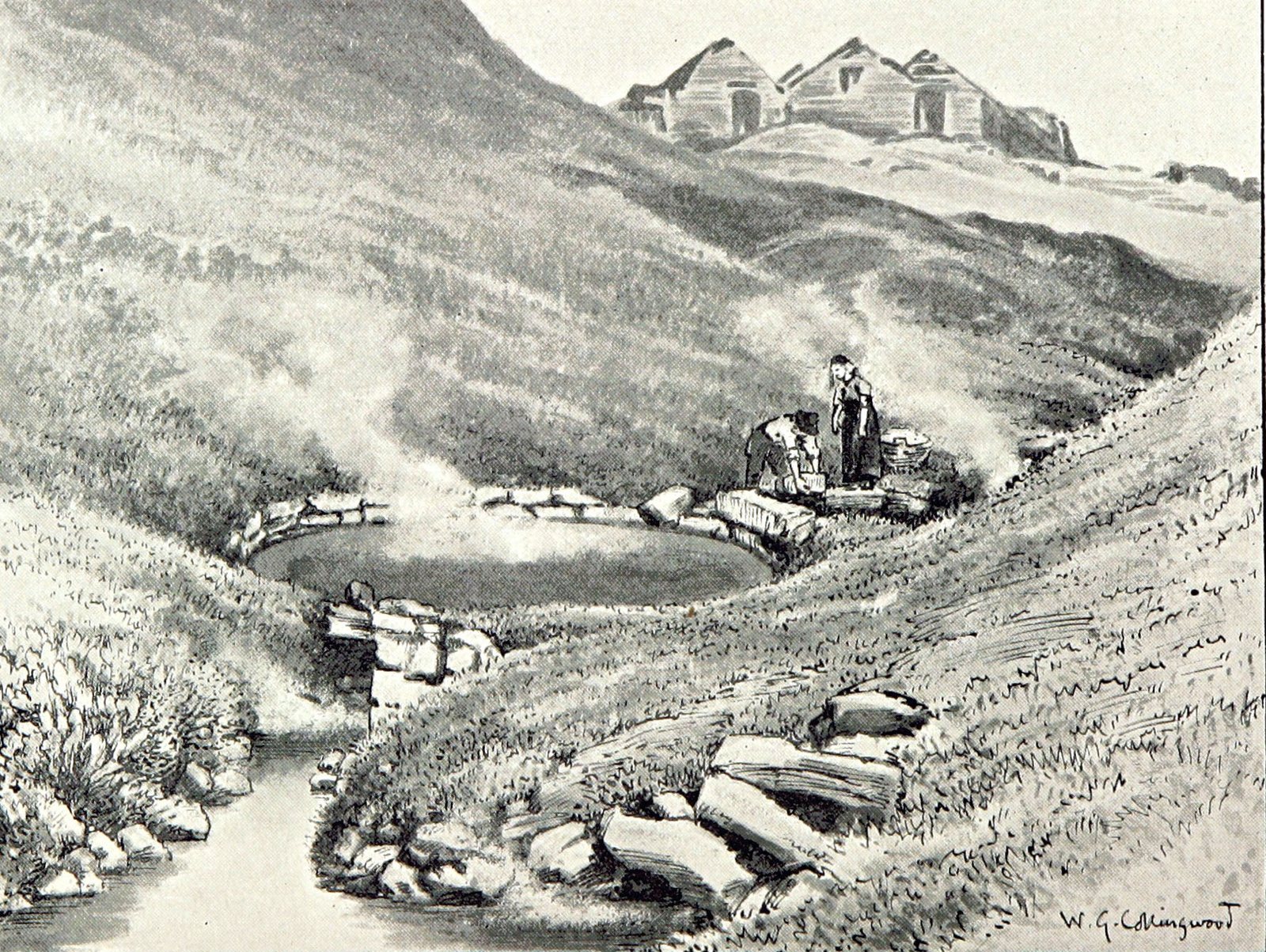
Sixteen sagas from legendary prehistory to 1177, and not one author's name on the parchment: Heimskringla is the most important medieval account of the Norwegian kings. It was written in Iceland, by common estimate around 1230. This article sets out what we actually know about its origin, structure, sources and transmission, where the attribution to Snorri Sturluson rests on inference, and why historians now use the text with care. It also lists the public-domain English translations and points out which modern editions are still under copyright.
Heimskringla is a collection of kings' sagas in Old Norse, composed in Iceland. It tells the story of the Norwegian rulers from a legendary prehistory to the late twelfth century. It is not a history book in the modern sense: it names its sources sparingly, arranges events for narrative effect, and puts speeches and motives into the mouths of its characters that no eyewitness can have handed down. Yet it is one of the few large works to describe the Viking Age from the viewpoint of descendants who still worked with poetry, genealogies and family memory.
Whoever reads Heimskringla therefore does not read an eyewitness. The author lived centuries after Harald Fairhair and about two centuries after Saint Olaf. How much of it holds up depends on the period, and that is what the following sections examine.
The Middle Ages did not call the work Heimskringla. According to the usual account the name dates from the seventeenth century and comes from the opening words of Ynglinga saga: kringla heimsins, "the circle of the world". Johan Peringskiöld used the title in his edition of 1697, which was also the first printed edition of the Old Norse text. The medieval manuscripts simply speak of the sagas of the kings. "Heimskringla" is thus a modern collective name for a series of separate texts that do not appear in every manuscript, or in the same combination.
Here is the first piece of source criticism: no manuscript names an author. As far as I could check, the attribution to Snorri Sturluson (1178/79–1241) rests on later tradition. It appears first in sixteenth-century Danish translations by Peder Claussøn Friis and Laurents Hanssøn. Modern scholars consider Snorri the probable author on grounds of style, kinship with his other works and the circumstances of his life. That is a well-founded conclusion, not documentary proof. An honest formulation is "attributed to Snorri" or "generally held to be by Snorri".
A comparison shows the situation: Egil's saga is likewise often attributed to Snorri, again for stylistic and methodological reasons (a scholarly conjecture, not separately checked here). For his person and life, see the page on Snorri Sturluson.
The usual composition date is "around 1230". The sources allow nothing more exact, and even this year is a scholarly estimate that some scholars favour, not a transmitted date. It sits within a biography that is known. Snorri was in Norway from 1218 to 1220, where he met the young King Hákon Hákonarson and his co-regent Earl Skúli and spent the winter as the earl's guest. A second stay followed in 1237–1239. On 23 September 1241 he was attacked and killed at Reykholt by men led by Gissur Þorvaldsson. Anyone attributing Heimskringla to Snorri must place it within these dates; "around 1230" is a midpoint, not evidence.
Whether Snorri wrote the sagas in one go or over several years, and whether he revised them, is not certain. This too shows how provisional any dating remains.
The standard count gives sixteen sagas. They follow the royal sequence; the narrative itself runs to 1177 (the death of the pretender Eystein Meyla), while Magnús Erlingsson died in 1184. The death years come from an overview source and are not individually checked against the manuscripts:
The count follows the usual standard list. Because the pieces are not combined identically in every manuscript, other divisions are possible. According to the common account the saga of Saint Olaf is the weightiest piece of the collection; I have not counted its length here. That fits a work that lets the royal line run towards the national saint and onward from him. Whether this was Snorri's deliberate design or follows from the size of his sources cannot be established. More on Olaf is on the page Saint Olaf.
Ynglinga saga stands at the beginning and, according to the usual scholarly account (not re-checked against the full text here), differs in character from the sagas that follow. It traces the Norwegian royal house back to the Ynglings and ties the line to gods whom it explains as former humans. This method – gods as venerated kings and sorcerers – is called euhemerism, after the ancient author Euhemerus. It is a learned medieval technique that allowed a Christian author to tell pagan lore without treating it as belief.
For readers looking for mythology, Ynglinga saga is therefore a source with its own lens. It is not a record of pagan religion but a reinterpretation from Christian times. The gods of the Prose Edda and the "kings" of Ynglinga saga are not the same material; the page on the Edda explains the difference.
Heimskringla opens with a preface in which the author explains what he works with. In Samuel Laing's English translation (1844) he says he has "had old stories written down, as I have heard them told by intelligent people". Added to this are genealogies and songs that earlier generations enjoyed. According to the same preface the verses of the skalds form the backbone of the proof: what skalds recited in the presence of princes or their sons, the author holds credible, since praise with invented deeds would have been mockery.
"In this book I have had old stories written down, as I have heard them told by intelligent people."Heimskringla, Prologue, English translation by Samuel Laing, 1844 (read only as an excerpt through the retrieval tool, not in full text)
Among the names the preface mentions are Þjóðólfr of Hvin, the skald of Harald Fairhair, and Eyvindr skáldaspillir, who reckoned up the ancestors of Earl Hákon the Great. Ari the Learned (Ari fróði) is called the first in Iceland to write down narratives of old and recent events in the Norse language; as his informants the preface names, in Laing's rendering, Hal Thorarinson, Od Kolson and Thorgeir, among others. In other words, the author places himself deliberately in a line of Icelandic scholars and invokes poetry as proof.
Skaldic poetry is the elaborate court poetry of the Norse world, with strict stanza forms and intricate circumlocutions called kennings. Stanzas could be passed on unchanged more easily than prose, because rhyme, alliteration and syllable count expose errors. That is why scholars regard many skaldic verses as the oldest tangible testimony. The preface's reasoning is therefore understandable.
It has two snags. First, a stanza proves that a skald said something about a prince, not that events happened exactly so. Praise poetry praises, and it praises what suits the patron. Second, in Heimskringla context decides: the author places stanzas where they are meant to confirm the prose, and whether he understood them in their original sense is often open in individual cases. Poetry is an anchor point, not a blank cheque. The question of when a single stanza truly dates from the time it is attributed to is a research field of its own.
Besides poetry and oral tradition, earlier histories of the kings were available to the author. According to the scholarly overview I consulted, they include:
Several works that source critics invoke are lost. They name the Hryggjarstykki of Eiríkr Oddsson (for the years 1130 to 1161), the Skjǫldunga saga and the Jarlasǫgurnar, which probably correspond to Orkneyinga saga. For lost texts every statement about their content remains reconstruction; what they contained can be inferred from their use in later works but not verified. The same holds for the relation of Heimskringla to older sagas: where both tell similar stories, dependence is possible but not always provable.
The transmission is patchy, and that affects every edition.
Kringla. Kringla was written around 1260. Only a single parchment leaf survives (Lbs fragm 82, a piece of the Olaf saga, in the National and University Library of Iceland). The rest, last held at the University Library in Copenhagen, was lost in the fire of 1728.
Jöfraskinna. This manuscript was the basis of Peder Claussøn Friis's translation of about 1600, printed in 1633. According to German Wikipedia it was likewise destroyed in the Copenhagen fire of 1728, and reliable copies survive. I found no verified information on its age.
Frísbók (Codex Frisianus). According to the description I could read, it was made in the early fourteenth century (about 1300 to 1325), has 124 leaves and contains Heimskringla without the saga of Saint Olaf, plus Hákonar saga Hákonarsonar. It was found in Bergen in 1550, reached Denmark before 1600 and belonged to the collector Otto Friis, after whom it is named. It later passed to Jens Rosenkrantz, and Árni Magnússon bought it in 1695. He bequeathed it in 1730 to the University of Copenhagen, where it is held as no. 45 fol. in the Arnamagnæan Collection. Whether it was written in Iceland or Norway is open.
Stockholm manuscript. In 1697 Johan Peringskiöld translated from a Stockholm manuscript into Swedish and Latin, producing the first printed edition of the Old Norse text.
The overall finding matters: Snorri's own original is not preserved, nor is any copy from his lifetime. All manuscripts are later copies, and they differ from one another. As with the Edda, "Snorri's text" exists only as a reconstruction from several witnesses.
Until the mid-nineteenth century historians largely followed the narrative. That changed in the early twentieth century, when Lauritz and Curt Weibull pioneered saga criticism and pointed out that the text was written centuries after most of the events. Edvard Bull went further (quoted from Wikipedia, date of the statement not checked): one must give up the illusion that the account bears any deeper resemblance to what actually happened. A further objection is that the motives the author assigns to kings reflect thirteenth-century conditions more than those of the ninth to eleventh centuries. Political intentions, negotiations and conversations at court are, in other words, mostly narrative shaping.
Today historians use the text with caution. It is considered more reliable for recent events and valuable for understanding medieval Norwegian society and politics. The gradation follows a simple rule: the closer to the author's lifetime, the better; the earlier and more legendary, the stronger the storytelling. Ynglinga saga and the story of Harald Fairhair are accordingly the weakest witnesses, the royal history of the twelfth century the strongest – although partiality towards the dynasty remains a risk there.
The story of Heimskringla does not end with Snorri. The Flateyjarbók of the late fourteenth century holds the most extensive expansion of the text. It shows how later scribes inserted, added and rearranged material. For scholarship this means that anyone attributing a statement to "Heimskringla" should say which manuscript or edition they cite. For an overview of saga genres see Sagas at a glance, and for the family sagas the page on Icelanders' sagas.
The series of editions also traces the text's journey across Europe:
The older English versions by Laing and Morris are in the public domain, since their translators died long ago. Hollander's 1964 translation, by contrast, is likely still protected by copyright; the legal position depends on the country and I have not checked it. The Finlay and Faulkes edition is open access according to the source; the exact licence should be read on the publisher's page. German translations exist according to German Wikipedia: Gustav Mohnike (1837), Felix Niedner, Snorris Königsbuch (three volumes, Sammlung Thule 14 to 16; new edition Diederichs 1965) and Hans-Jürgen Hube (Marix, 2006). I have not checked whether the older ones are in the public domain; Hube's version is probably protected.
For comparison it is best to put two translations side by side. Laing is old but readable and freely available; Finlay and Faulkes are newer and use the modern textual situation. For stanzas the Old Norse text is worth consulting, because translations often smooth out kennings.
For centuries Heimskringla was a principal source for Norwegian history. Until the mid-nineteenth century many scholars regarded its account as essentially reliable; then criticism followed. Today it stands at an intersection: it is a source for the politics, mentality and narrative art of thirteenth-century Iceland and, to a limited degree, for the period it describes. For readers who want to understand royal figures such as Harald Fairhair, Olaf Tryggvason or Harald Hardrada, this means that Heimskringla supplies the frame and the story, while hard data must come from other sources. How to handle such traditions is explained on the page Legend studies.
One example: the text treats the battle of Stamford Bridge in 1066 in the saga of Harald Hardrada; how this account relates to the English sources is described on the page Stamford Bridge. Other accounts, such as that of the Danish chronicler Saxo Grammaticus, often give different stories about the same kings.
When was Heimskringla written? Usually "around 1230" is given. That is a scholarly estimate, not a transmitted date.
How many sagas does it contain? By the usual count sixteen, from Ynglinga saga to Magnús Erlingsson. Other divisions are possible.
Is Snorri certainly the author? Not in the documentary sense. No manuscript names an author; the attribution first appears in sixteenth-century Danish translations and is regarded as well founded.
Can Heimskringla be used as a historical source? With care. For early kings it is late tradition; for more recent events it is more reliable.
Where can I read it? German editions by Niedner and Hube are in print. Older English versions such as Laing's are free online, as is the newer edition by Finlay and Faulkes.

Snorri Sturluson · Norse Kings · Haakon the Good · Olaf the Saint · The Edda.
All History & Finds articles →
Some time around 1026 the fleet of Cnut the Great met the ships of Olaf of Norway and Anund Jacob of Sweden at a water …
Read more →On an island in Lake Mälaren, a few kilometres from Stockholm, an excavation team under Wilhelm Holmqvist found a …
Read more →Five names stand in a single sentence of the Germania: Harii, Helvecones, Manimi, Helisii, Naharvali. Four of them come …
Read more →Five names stand in a single sentence in Tacitus, and one of them belongs to the Helvecones. After that, the record …
Read more →