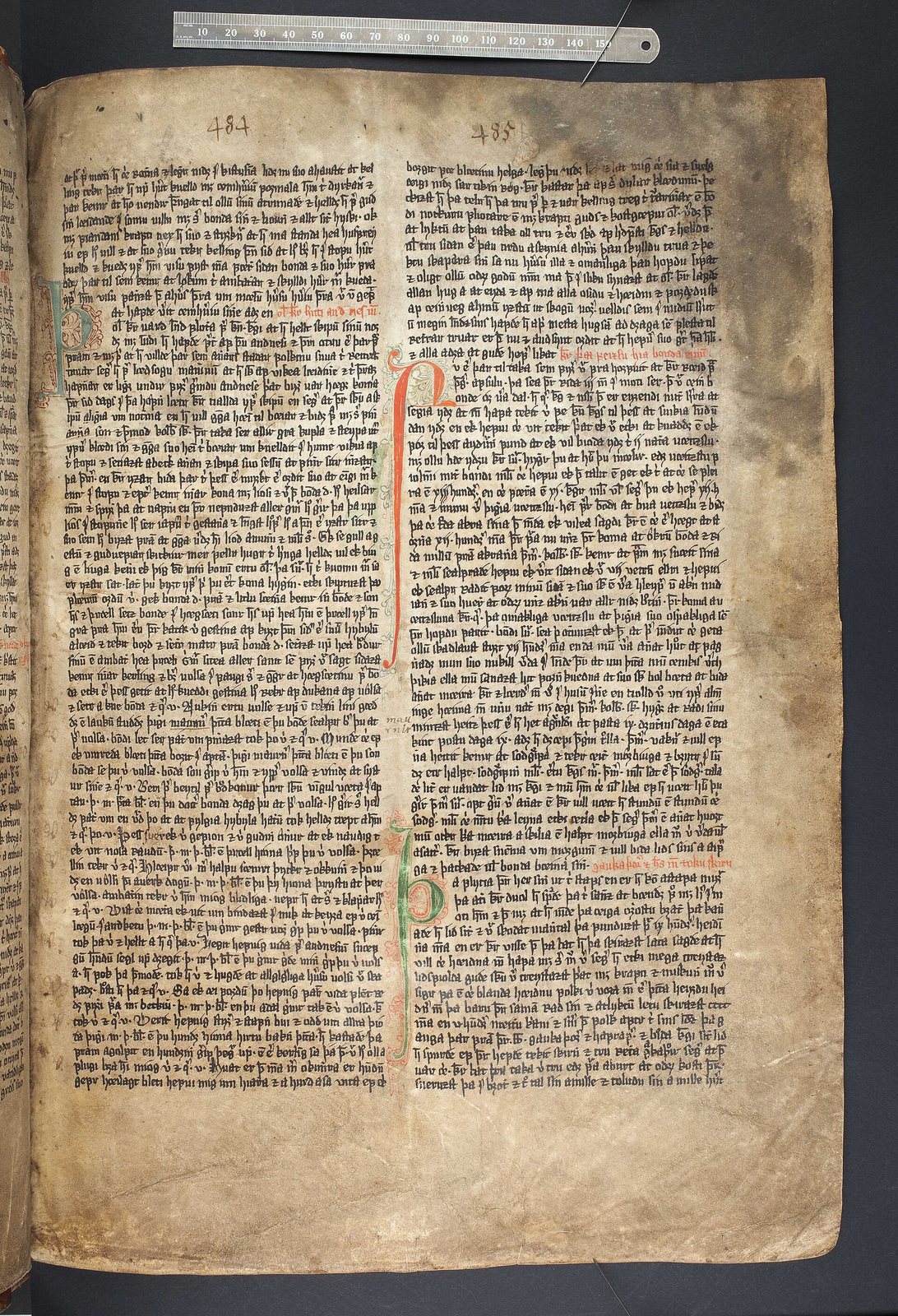
There are around forty Sagas of Icelanders, plus kings' sagas, legendary sagas and bishops' sagas, and nobody has ever counted or ranked them in any binding way. The list below is therefore not a ranking but an editorial selection under three stated criteria: what does the text tell us as a source, how easy is it to read, and is there a public-domain translation anyone may use for free? For each of the ten sagas you will find the date of writing, the plot, the historical value and an edition to begin with.
A list of the "best" sagas is always a matter of judgement, so here is what counted. There are three criteria, and every saga had to meet at least two of them clearly.
First, source value. This does not mean whether a saga is "true" but what you can learn from it: about law, belief, voyages and families in the Viking Age, or about how the Middle Ages remembered that age. A saga that is a poor historical report can still rank high if it shows how people in the thirteenth century thought about the past. Second, accessibility: a clear plot, a manageable cast, an entry that needs no background. Third, a public-domain translation, the most practical criterion for this article. We name only translations published in the nineteenth or early twentieth century, by Dasent, Morris and Magnússon, Laing, Press and others. Newer versions, such as the Penguin volumes, are well worth reading and often more precise, but they are in copyright, so we mention them only in passing.
A fourth, secondary criterion was range. The list contains seven Sagas of Icelanders (among them the Saga of Erik the Red), one collection of kings' sagas, one earls' saga and one legendary saga. Anyone who reads only family sagas gets a lopsided picture. The genres are explained in the article on the Sagas of Icelanders.
Two limits belong here. First, texts that could be named with equal right are missing, such as Hrafnkel's saga, Vatnsdæla saga or Sturlunga saga. They are not worse; they narrowly lost in our weighting, or we did not check their editions. Second, we collected translators and publication years from reference works and from our own pages, but we did not read the translations in full. Whether an edition is out of copyright depends on the translator's year of death. For translations published before 1900 that is normally unproblematic; for early twentieth-century editions you should check each case. Where a text can be read online for free, we have verified that only in a few cases.
Date: Scholars place the writing between 1270 and 1290. The saga survives in about 60 manuscripts and fragments, 21 of them medieval; no medieval vellum copy is complete, but they were copied so faithfully that a full text can be reconstructed fairly easily. The events told lie between roughly 960 and 1020.
Content: It begins with small insults, and out of them grows a feud around the families of Gunnarr and Njáll that lasts about fifty years. It is the longest of the genre, trials stand at its centre, and the burning of the farm Bergþórshvoll is its end. More on the plot is in the article on Njáls saga.
Historical value: High for the question of how Icelanders imagined law and settlement of disputes, much lower for the details of the plot. Opinions on its historicity range from pure fiction to nearly verbatim truth; a common view is that the major events have a historical core which the author shaped artistically from oral tradition. The battle of Clontarf in 1014 is known from Irish annals; the saga tells it as a side plot. For the archaeology of the burnt site see the article on the saga.
Public-domain edition: George Webbe Dasent, "The Story of Burnt Njal", Edinburgh 1861, reprinted in 1900 and 1911 according to reference works. The translations by Bayerschmidt and Hollander (1955) and by Magnusson and Pálsson (1960) are not in the public domain. Dasent is the classic starting point; because of its length, the Njála is better not read as a first saga.
Date: The saga covers roughly 850 to 1000. The oldest manuscript fragment dates from about 1250. Writing is often placed in the years around 1220 to 1240, but this is not certain. Many scholars consider Snorri Sturluson the author, chiefly because of its closeness to the Heimskringla; this is unproven, since the text names no one.
Content: It opens in Norway with Egil's grandfather Kveldúlfr and his sons, follows the family to Iceland to escape King Harald, and then tells of Egill, warrior, poet and stubborn man. He serves King Æthelstan of England, quarrels with King Eiríkr Bloodaxe and Queen Gunnhild, and saves his life with a praise poem, the Höfuðlausn, the "head ransom". In old age he hides a hoard of silver.
Historical value: Egill's life is not attested outside the saga; it is the only source for him. The English episodes are considered partly accurate: the battle in which his brother falls is widely identified with Brunanburh in 937, but an opponent called "Óláfr the Red" seems to blend two historical figures. Whether the poems embedded in the text really date from the tenth century is disputed. The article on Egill Skallagrímsson describes the debate.
Public-domain edition: W. C. Green, "The Story of Egil Skallagrimsson", London 1893. E. R. Eddison's translation (Cambridge, 1930) is in the public domain in Germany and the EU since 2016, since he died in 1945 (per Wikipedia on Eddison); Jones (1960) and other recent versions are, as far as we know, still protected, though we did not check the translators' years of death.
Date: It is assigned to the thirteenth century; internal evidence points to the years between 1230 and 1260. The author is unknown; someone from western Iceland is suspected. There are five vellum fragments, the oldest from about 1250, and the complete text in the fourteenth-century Möðruvallabók. After Njáls saga it has the most medieval manuscripts.
Content: The saga runs from the late ninth to the eleventh century. It begins in Norway with the flight of Ketill Flatnose's family from King Harald Fairhair and follows Unnr the Deep-Minded, her grandson Óláfr the Peacock and his son Kjartan. At its centre is a triangle between Guðrún Ósvífrsdóttir, Kjartan and his kinsman Bolli, which ends with Kjartan's death.
Historical value: The author cites written sources, among them Ari Þorgilsson twice, yet oral tradition is regarded as the main source, shaped by the author's taste. Its value lies less in single facts than in its view of women's roles, property and the gradual Christianisation.
"To him I was worst whom I loved best." Laxdæla saga, ch. 78, Guðrún's famous remark in old age; Old Norse "Þeim var ek verst, er ek unna mest" (normalised spelling, quoted from our page on the Laxdæla saga, not checked against an edition); own translation
Public-domain edition: Muriel Press (1867–1937), "The Laxdale Saga", London 1899, the first complete English translation according to reference works. A German translation by Rudolf Meißner appeared in 1913 in the Thule series (volume 6, Jena, Diederichs; Meißner died in 1948 according to Wikipedia, other statements there say 1941, so the work is in the public domain either way); this detail comes from our page on the Laxdæla saga ; title, year and series are confirmed by the Wikipedia bibliography on Meißner. William Morris's "The Lovers of Gudrun" is a poetic reworking, not a translation.
Date: Written in the thirteenth and fourteenth centuries, in its surviving form probably the fourteenth; the earliest manuscript dates from shortly before 1400. The author is unknown, and an earlier account by Sturla Þórðarson may lie behind it.
Content: The saga has three parts: the prehistory; Grettir's life, with the fight against the undead Glámr (chapter 35) and his death on the island of Drangey after about nineteen years as an outlaw; and finally his half-brother's revenge in Constantinople. Chapter counts differ by edition: the modern numbering has 93, while the Morris translation counts partly differently.
Historical value: Low for events, high for the question of how outlawry and loneliness were imagined. If one assumes the tales relate to reality, a common calculation puts Grettir's death between 1030 and 1040; a rule limiting outlawry to twenty years is not attested for medieval Iceland. Similarities between the Sandhaugar episode and the Old English epic Beowulf have been discussed since the nineteenth century; see the article on Grettir's saga.
Public-domain edition: Eiríkr Magnússon and William Morris, "Grettis Saga: The Story of Grettir the Strong", London 1869. George Ainslie Hight's version (London, Dent; usually dated 1914, 1913 in the archive.org catalogue) is also widespread; archive.org gives his birth year as 1851 and we found no death year, so public-domain status is very likely but not confirmed.
Date: Probably written down in the first half of the thirteenth century; most specialists name the years 1225 to 1250, though there is little hard evidence. The saga survives in 33 manuscripts and fragments. The earliest fragment is from about 1400, the first extensive text from the later fifteenth century. Three medieval versions are recognised, differing mainly in their opening; the longer one begins in Norway.
Content: The events lie between 860 and 980 and lead from Norway to the Westfjords of Iceland. Gísli Súrsson has to kill a brother-in-law to avenge the death of another man, and then lives thirteen years as an outlaw until he is tracked down and killed. The saga circles around loyalty that tears a family apart instead of uniting it.
Historical value: Low as a historical source. It is valuable as an example of an outlaw saga with psychological depth and as evidence of how strongly Icelandic storytellers used motifs from the Eddic poems; the literature sees echoes above all of the figure of Guðrún Gjúkadóttir. One peculiarity: whether Þorgrímr really stabbed Vésteinn is left open by the shorter version, not by the longer one.
Public-domain edition: George Webbe Dasent, "The Story of Gisli the Outlaw", Edinburgh 1866, with illustrations by C. E. St. John Mildmay. The translations by George Johnston (1963) and Martin S. Regal (2000) are in copyright. For a first read the Gísla saga is a good choice thanks to its brevity and its clear main character.
Date: Probably written in the middle or second half of the thirteenth century; scholars have not fixed an exact point. Parts survive in thirteenth-century fragments, and there are many fourteenth-century manuscripts. The action takes place on the Snæfellsnes peninsula in western Iceland and begins with the settlement in the ninth century; most events fall around the year 1000.
Content: At the centre are Snorri goði and his rival Arnkell, two chieftains who quarrel over wood, land and livestock. After the death of Arnkell's father Þórólfr Halt-foot he walks as an undead until Arnkell buries him and builds a high stone wall around the grave. Later comes the haunting of Fróðá, which Snorri ends with Christian rituals and Icelandic law. The article on the Thing helps to place the legal procedures.
Historical value: The saga is considered especially rich for cult, law and everyday life; according to our page on the Sagas of Icelanders its description of a temple is about two centuries younger than the period it depicts and should be treated as a projection backwards. Ghost stories are literature, not witness statements.
Public-domain edition: William Morris and Eiríkr Magnússon, "The Story of the Ere-dwellers (Eyrbyggja Saga)", together with the Heiðarvíga saga, London 1892. The editions by Schach and Hollander (1959) and by Pálsson and Edwards (1969) are in copyright.
Date: Both surviving manuscripts, the Hauksbók (fourteenth century) and the Skálholtsbók (fifteenth century), go back to a common original placed in the thirteenth century. The Hauksbók text appears to have been stylistically revised, while the Skálholtsbók is a faithful but somewhat careless copy. A second source on the same material is the Grænlendinga saga, discussed further in our article on Vinland.
Content: Despite the title it is mostly about Þorfinnr Karlsefni and his wife Guðríðr. The saga tells how Erik the Red is banished from Iceland and finds Greenland, how Leif Eriksson discovers Vinland, how Christianity comes to Greenland, and how Karlsefni meets the "Skrælingar". It knows only one major expedition, while the Grænlendinga saga reports several. Here Leif is the discoverer of Vinland, blown off course; in the Grænlendinga saga Bjarni Herjólfsson sights the land first.
Historical value: Disputed. The saga is often regarded as unreliable, though it is used for understanding Norse religion and prophecy. That Norse people were in North America around the year 1000 is archaeologically proven by the excavation at L'Anse aux Meadows; which saga reflects the voyages more closely cannot be decided clearly. For the people see Erik the Red and Þorfinnr Karlsefni.
Public-domain edition: Arthur Middleton Reeves, "The Saga of Eric the Red" in "The Finding of Wineland the Good", London 1890, based on the Hauksbók, with facsimiles of both manuscripts. Reference works also list J. Sephton, "Eirik the Red's Saga", Liverpool 1880, with a freely available text on Project Gutenberg. The translations by Magnusson and Pálsson (1965), Jones (1986) and Kunz (2001) are in copyright.
Date: No manuscript names an author. Many scholars assume Snorri Sturluson and date the work to about 1230; Snorri is first named as author in sixteenth-century Danish translations. The oldest vellum leaf, the Kringla manuscript, dates from about 1260; the rest of that manuscript burned in 1728. More on the author is in the article on Snorri Sturluson.
Content: A collection of sagas about Swedish and Norwegian kings, beginning with the Ynglinga saga on the mythical Ynglings and running to the year 1177. About a third belongs to the saga of St Olaf, its centrepiece; Harald Fairhair, Olaf Tryggvason and Harald Hardrada are among the others. On the rulers see Harald Fairhair, Olaf the Holy and Harald Hardrada.
Historical value: Until the mid-nineteenth century historians largely trusted Snorri's narrative. Since the early twentieth century, prompted by Lauritz and Curt Weibull, it has been regarded as late and literarily shaped. According to Wikipedia, the historian Edvard Bull wrote that one must give up the illusion that Snorri's epic resembles what really happened. This holds more strongly for the early parts than the later ones, since contemporary sources appear from the twelfth century. Snorri draws on older kings' sagas and on skaldic verse, which he considered especially reliable.
Public-domain edition: Samuel Laing, London 1844 (second edition 1889), and William Morris and Eiríkr Magnússon in the "Saga Library", 1891 to 1905. The translation by Alison Finlay and Anthony Faulkes (2011 to 2016, Viking Society) is freely accessible online but in copyright; Hollander (1964) and Magnusson and Pálsson (1966) are in copyright too.
Date: A prose version of the late thirteenth century whose material is considerably older. The only medieval manuscript (Ny kgl. Saml. 1824 b 4to, Copenhagen) dates from about 1400. There the saga leads straight into the saga of Ragnar Lodbrok.
Content: It tells the story of the Völsungs from Sigi, a son of Odin, through Sigmund and his son Sigurd, who kills the dragon Fáfnir and wins the cursed hoard, to Guðrún's revenge and the destruction of her sons. The saga relies largely on the heroic poems of the Poetic Edda. The article on Sigurd separates the sources in more detail.
Historical value: None as a report on the Viking Age; it belongs to the legendary sagas (fornaldarsögur), which are set before the settlement of Iceland. Single motifs probably reflect events of the Migration Period, such as the fall of the Burgundian kingdom in the fifth century; the Ramsund carving in Sweden from around the year 1000 is the oldest known depiction of the Sigurd tradition. The saga's value lies in the afterlife of Germanic heroic poetry in the North.
Public-domain edition: William Morris and Eiríkr Magnússon, "Völsunga Saga: The Story of the Volsungs and Niblungs", London 1870, described as a literal translation and listed in reference works as an e-text at Project Gutenberg. Morris's "Sigurd the Volsung" (1877) is a verse epic, not a translation. The newer editions by Byock (1990), Anderson (1982) and Crawford (2017) are in copyright.
Date: The original version was written in the late twelfth century and is lost. A new version was written by an unknown Icelander in the early thirteenth century, possibly in the circle of Oddi; Snorri used it for the Heimskringla. The oldest complete text is in the Flateyjarbók from the end of the fourteenth century.
Content: The saga runs from the ninth to the thirteenth century, from the founding of the earldom by Rognvald Eysteinsson to the murder of Jón Haraldsson in 1231. At its centre are Þorfinnr the Mighty, St Magnus, Rognvald Kali Kolsson and Sveinn Asleifarson, along with feuds between brothers and the relationship with the Norwegian crown. More background is in the article on the Orkney earls.
Historical value: Scholars dispute how much of the earlier sections is real history; Sigurd's raven banner is considered clearly legendary. The closer the narrative comes to the time of writing, the more reliable it is thought to be. According to Wikipedia, Woolf (2007) compares the compiler's task to writing the history of the Second World War from Hollywood films; we have not seen this in Woolf ourselves.
Public-domain edition: Jón A. Hjaltalín and Gilbert Goudie, "The Orkneyinga Saga", edited by Joseph Anderson, Edinburgh 1873, the first English translation according to reference works. The Penguin edition by Pálsson and Edwards (1981) is in copyright.
Which saga should you start with? For a first read, short sagas with a clear main character suit best, such as Gísla saga or Grettir's saga. Njáls saga, because of its length and its legal scenes, is more for a second or third read. This is an editorial recommendation, not a rule.
Are the sagas historical sources? Only with caution. They were written centuries after the events. For the mindset, law and everyday life of the thirteenth century they are rich; for individual deeds of the tenth century often not.
Where do I find the public-domain translations? Reference works point to Project Gutenberg, for example for the Völsunga saga and the Saga of Erik the Red. For the other titles we did not check availability individually; search by title, translator and year, and watch the legal status of editions after 1900.
Are there German translations? Yes. The Thule series published a large German run of Norse texts. Which volumes are in the public domain today depends on each translator's year of death; we checked this only for Meißner's Laxdæla translation (public domain, see above), not for the other volumes.
Why are Vatnsdæla saga, Hrafnkel's saga and Sturlunga saga missing? The selection is limited to ten titles. These sagas were left out not for lack of quality but because we did not check their public-domain editions.

The Icelandic Sagas · Njáls saga · Egill Skallagrímsson · Laxdæla saga · Grettir's saga.
All History & Finds articles →
There are peoples we know everything about, and peoples of whom we know a name. The Sagudates belong to the second …
Read more →Few names of early history are as famous and as poorly secured as that of the Salians. A Roman officer wrote it down in …
Read more →The Salluvii (Salyes) were a league of Celtic-Ligurian groups in the hinterland of Massalia, with the hill town of …
Read more →In 2008 workers digging a cable trench in the village of Salme on the Estonian island of Saaremaa hit bones and iron …
Read more →