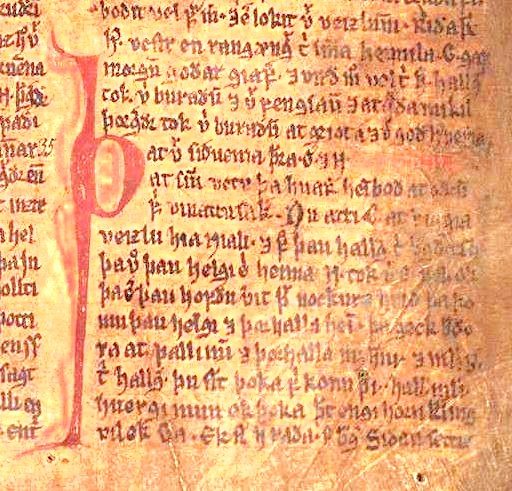
A widow who has a ship built in secret. A slave woman who stays silent for years and then reveals herself as an Irish king's daughter. And a woman who marries four times, drives the man she loves to his death and, in old age, speaks a single sentence that readers have argued over for centuries. Laxdæla saga, the "Saga of the People of Salmon River Valley", is the saga of Icelanders in which women drive the story. This article retells the plot, introduces its women, follows the thread of conversion that runs through it, and keeps apart what the saga tells, what can be shown beyond it, and what is modern interpretation.
Laxdæla saga belongs to the sagas of Icelanders, the prose narratives of the 13th and 14th centuries about the first generations in Iceland. Its setting is the west of the island, the valleys around Hvammsfjörður, an inner arm of Breiðafjörður, above all Laxárdalr, the "salmon river valley". The standard edition in the Íslenzk fornrit series (Einar Ól. Sveinsson, 1934) has 78 chapters, as does Muriel Press's English translation of 1899. The saga covers some seven generations, from the flight of Ketill Flatnose's family from King Harald Fairhair in the late 9th century to Guðrún's grandchildren in the mid-11th. In the middle lies the adoption of Christianity around 1000, which carries more weight here than in most other sagas.
The opening chapters belong to the woman the saga calls Unnr and the Landnámabók, the "Book of Settlements", calls Auðr. Her life is told in our article on Aud the Deep-Minded. After the deaths of her husband Olaf the White and her son Thorstein the Red, she has a cargo ship built secretly in Scotland, sails via Orkney and the Faroes to Iceland, marries off granddaughters along the way and takes land at Hvammsfjörður. She dies sitting upright after her grandson's wedding, and in Laxdæla she is laid in a ship inside a burial mound; Landnámabók tells of a Christian burial at the high-water mark instead.
Unnr is the ancestress of almost every later main character, and she sets a standard: a woman who acts with intelligence and a will of her own. Whether she is meant as a model for the women who follow or as an exception is disputed. Robert Cook set out the positions of Carol Clover (model) and Helga Kress (exception) in 1992.
The second defining woman is unfree. Höskuldr Dala-Kollsson, Unnr's great-grandson, attends a meeting of kings on the Brenneyjar, islands off the mouth of the Göta älv, and buys a young woman for three marks of silver from a rich merchant called Gilli the Russian. Gilli warns him that she is mute. In Iceland she bears Höskuldr a son, Óláfr. One day Höskuldr hears her by a stream, talking freely with the child. Challenged, she gives her name, Melkorka, and her father's, Mýrkjartan, a king in Ireland; she was carried off in war at fifteen. When Höskuldr's wife Jórunn strikes her with a pair of stockings, Melkorka punches her on the nose until it bleeds, and Höskuldr gives her a farm of her own.
Melkorka cannot be traced historically. "Mýrkjartan" is thought to render an Irish name such as Muirchertach, borne by several kings; I know of no Irish record of an abducted daughter. The episode does show what our article on Viking slavery describes: people from the British Isles were traded in Scandinavia, and high birth was no protection.
Melkorka's son earns the nickname pái, "peacock", for his splendid clothes. He sails to Ireland, proves his descent with his mother's ring and turns down his grandfather's offer of the succession. Back in Iceland he marries Þorgerðr, daughter of the poet Egill Skallagrímsson, and builds the farm of Hjarðarholt with a hall full of mythological pictures. Fragments of a poem about it, Úlfr Uggason's Húsdrápa, survive in Snorri's Edda. Óláfr raises Bolli, his half-brother's son, alongside his own son Kjartan. The two are cousins and foster-brothers, and how strong such a bond was is explained in our article on kin and family.
Guðrún is the daughter of Ósvífr of Laugar in Sælingsdalr, by the saga's account the most beautiful and clever woman of her time. At about fourteen she tells the wise Gestr Oddleifsson four dreams: she throws a hood into a stream, loses a silver ring in the water, sees a gold ring break on a stone and bleed, and watches a golden helmet fall into the fjord. Gestr reads them as four marriages. She will leave her first husband, the second will drown, the third will be killed when a new faith has come to the land, and the fourth, the mightiest, will find the fjord against him on his last day. Foreshadowing like this does not kill suspense; it moves the question from what will happen to how.
At fifteen Guðrún is married to Þorvaldr Halldórsson under a contract that gives her control of the money and half of the property. When he strikes her, she follows the advice of Þórðr Ingunnarson and sews him a shirt with a neck opening so wide that it counts as women's clothing, then declares a divorce; why that was enough is explained in our article on women in the Viking Age. Þórðr in turn divorces his wife Auðr for wearing breeches and marries Guðrún. Auðr then rides to Laugar at night, in breeches, and wounds him in his sleep with a sword. Þórðr drowns soon after; the saga blames the storm on the magic of a family he had taken to court.
Only as a young widow does Guðrún come to know Kjartan. People think them a good match. When Kjartan plans to sail to Norway with Bolli, she asks to come along; Judith Jesch reads this as a coded proposal of marriage. Kjartan refuses and asks her to wait three years. Guðrún will not promise.
Norway is ruled by Olaf Tryggvason, who is converting his realm with force. In the river Nid, Kjartan challenges the best swimmer, who pushes him under three times, and only afterwards learns that this was the king. When Olaf presses the Icelanders to accept baptism, Kjartan considers burning him in his hall. The king hears of it and forgives him. On the second day of Christmas, Kjartan, Bolli and their crew are baptised.
Olaf then keeps Kjartan and other high-born Icelanders as hostages until Iceland accepts the faith. Bolli sails home alone and tells Guðrún that Kjartan is very close to the king's sister Ingibjörg, and that the king would sooner give her to him than let him go. Guðrún flushes, breaks off the conversation and, after much pressing, agrees to marry Bolli. There was little affection between them, the saga says. Meanwhile the Althing adopts Christianity, in 1000 according to Ari Þorgilsson, though 999 is also argued (see our article on the Icelanders). Olaf releases the hostages, and Ingibjörg sends Kjartan off with a headdress woven with gold as a bridal gift for Guðrún. The years printed in editions for these chapters do not appear in the saga, by the way; they come from the chronology of later editors.
Kjartan comes home to find Guðrún married. He marries Hrefna, daughter of Ásgeirr, and gives her the headdress. In passing the saga notes that he was the first person in Iceland to keep the Lenten fast and that people came from far away to see it. Then comes a chain of affronts. Honour here means public standing: whoever swallows an insult loses rank before the neighbours, and with it protection.
Guðrún puts it to Bolli: leave the district with little honour, or stand up to Kjartan. When Ósvífr's sons lay an ambush for Kjartan in Svínadalr, she threatens that if Bolli stays away, their marriage is over. At first Bolli holds back. Kjartan fights long and is barely wounded. Then he throws down his weapons and tells Bolli, in effect, that he would rather receive his death from him than cause his. Bolli draws his sword Fótbítr, "Leg-biter", and kills him. Kjartan dies in Bolli's lap. Bolli regrets it at once and declares the killing as his own deed, as the law required: a concealed killing counted as murder.
At home Guðrún greets him with some of the coldest lines in saga literature. She has spun yarn for twelve ells of homespun, and he has killed Kjartan. The best of it is that Hrefna will not go to bed laughing tonight. Bolli replies that he doubts Hrefna will turn paler than Guðrún herself. Kjartan is buried at Borg, by the church Þorsteinn Egilsson had built; Hrefna, the saga says, dies of a broken heart. Óláfr pái has Ósvífr's sons exiled but spares his foster-son in return for a fine. How such settlements were reached at the Thing is explained in our article on law in the Viking Age.
After Óláfr's death his widow Þorgerðr urges her sons to take revenge. They attack Bolli at a shieling. He sends Guðrún down to the stream to wash linen and faces them alone. Helgi Harðbeinsson drives a spear through his shield and body, Steinþórr Óláfsson cuts through his neck with an axe, and Þorgerðr spurs the men on. When Guðrún comes up, Helgi wipes his spearhead on the end of her scarf. She looks at him and smiles a little. Helgi says that under this scarf lies his own death. The following winter Bolli Bollason is born.
Years later Guðrún shows her sons their father's bloodstained shirt: these clothes cry out for revenge. To lead the attack she wins Þorgils Hölluson with a promise of marriage that the chieftain Snorri goði has scripted for her: she will marry no man in this land except him. Snorri has Þorkell Eyjólfsson in mind, who is abroad at the time. Helgi is killed, Þorgils soon falls himself, and Guðrún marries Þorkell. She has already exchanged her farm with Snorri for Helgafell on Snæfellsnes. Þorkell becomes a powerful chieftain until, as Gestr foretold, the fjord stands in his way: he drowns in Breiðafjörður while bringing home timber for a church.
After that, the saga says, Guðrún became a very devout woman. She was the first woman in Iceland to know the Psalter by heart, and she prays for long hours at night in the church. Her granddaughter Herdís dreams of a woman complaining that Guðrún crawls over her every night. Beneath the church floor they find bluish bones, a brooch and a magic staff, the grave of a sorceress, people believe; who such women were is explained in our article on the völva. The new piety lies, quite literally, on top of the old religion. At the end the saga says Guðrún was the first nun and recluse in Iceland. A memorial stone set up in 1979 marks her presumed grave today.
The dates help here. Iceland's first convent, Kirkjubær, was founded in 1186. Helgafell did have a religious house, but later: Augustinian canons who had been on the island of Flatey moved there around 1184. For a 13th-century author, Helgafell was a place of monks and books, and he projects that back. Conversion shapes the whole saga: Unnr still lies in a ship grave, Kjartan learns the faith as the king's hostage, Gestr ties Guðrún's third marriage to the change of religion, and her son Gellir builds a church at Helgafell and goes on pilgrimage to Rome. According to the genealogies, Gellir's grandson was Ari Þorgilsson, author of Íslendingabók, whom the saga cites twice. A feud of the heathen past becomes the prehistory of a Christian family of scholars. The wider picture is in our article on the Christianisation of the Germanic peoples.
In the last chapter Bolli Bollason, back from Constantinople where he served in the emperor's guard (see Miklagard and the Varangians), visits his mother at Helgafell and asks which man she loved most. Guðrún runs through them: Þorkell was the mightiest chieftain, Bolli the most handsome, Þórðr the wisest and best versed in law; Þorvaldr she dismisses. Bolli says this does not answer his question. She replies that he presses her hard, but if she is to tell anyone, it will be him:
"Þeim var ek verst, er ek unna mest."
Laxdæla saga, ch. 78; Old Norse in normalised spelling (modern Icelandic: "Þeim var eg verst er eg unni mest"); English translation by Muriel A. C. Press, The Laxdale Saga, London 1899 (public domain).
"To him I was worst whom I loved best."
Verst and mest chime together; Rudolf Meißner, in the introduction to his German translation, calls it a "rhyme". The verb unna means "to be fond of, to love, to grant"; see our article on Norse words for love. The saga does not say whom she means. Kjartan is missing from the list because he was never her husband, and most readers take the line to refer to him, the man she drove to his death. It could also be Bolli, whom she forced into the killing and punished with coldness. Bolli only answers that he thinks the whole truth has now been told.
The author is unknown. The detailed knowledge of Breiðafjörður points to someone from western Iceland. Accounts of the date differ: the common range is 1230 to 1260, following Einar Ól. Sveinsson; German Wikipedia gives 1230 to 1250, Encyclopaedia Britannica "about 1245". These are estimates from internal evidence, not recorded dates. Einar Ól. Sveinsson cautiously suggested Óláfr Þórðarson hvítaskáld, a nephew of Snorri Sturluson; this cannot be proven. The author names written sources but probably drew mainly on oral tradition, and some courtly scenes recall the chivalric romances then arriving in the North. Some manuscripts append Bolla þáttr, a continuation about Bolli Bollason that is regarded as a separate work.
Because women drive the plot, it has been suggested that a woman wrote the saga; Britannica mentions this as a possibility. There is no evidence for it. More productive is the separate question of perspective. Judith Jesch (Women in the Viking Age, 1991) reads Guðrún's actions as responses to the narrow room a woman had. Loren Auerbach (Saga-Book, 1998) sees Guðrún's tragedy at the core: a strong, intelligent woman forced into a subordinate role, from which grow bitterness and destruction. Against this, the saga does not question the norms of its time. Women who goad men to revenge also appear in sagas with very different concerns, and a clerical author could create such figures just as well. The "female gaze" is a reading of the text, not a statement about how it came to be.
Some 250 years lie between Kjartan's death and the writing of the saga. Farms such as Hjarðarholt, Laugar, Hvammur and Helgafell are real, and the family lines largely match Landnámabók. The conversations, dreams and gestures, Guðrún's smile over the bloodied scarf, are narrative art. There is no contemporary record of Kjartan's death, and life dates such as "973 to 1060" for Guðrún are back-calculations from the saga.
Muriel A. C. Press translated the saga into English in 1899; her version is in the public domain. In German, Rudolf Meißner's "Die Geschichte von den Leuten aus dem Lachswassertal" appeared in 1913 as volume 6 of the Thule series; Meißner died in 1948, so it has been in the public domain since 2019. More recent versions include Heinrich Beck's (1997) and the S. Fischer "Isländersagas" edition (2011). William Morris turned the story into "The Lovers of Gudrun" (1868–1870).
In Makoto Yukimura's manga "Vinland Saga", Askeladd is the son of a Danish Viking named Olaf and a Welsh slave. According to widely repeated claims, this background is modelled on Óláfr pái and Melkorka; I could not find a statement by Yukimura himself in his own words. Askeladd is invented and shares a motif with the saga, not a life story. More in our Vinland Saga fact check.
What is Laxdæla saga about? Several generations of a family in western Iceland, from Unnr the Deep-Minded's settlement into the 11th century. At its centre are Guðrún Ósvífrsdóttir and the foster-brothers Kjartan and Bolli, whose rivalry ends in Kjartan's death and a long feud.
What does "Þeim var ek verst, er ek unna mest" mean? "To him I was worst whom I loved best." Guðrún says it in the last chapter to her son Bolli when he asks which man she loved most. Whom she means remains open.
How many times was Guðrún married? Four: to Þorvaldr Halldórsson (divorced), Þórðr Ingunnarson (drowned), Bolli Þorleiksson (killed) and Þorkell Eyjólfsson (drowned). Kjartan, probably the man she loved most, was never her husband.
When was Laxdæla saga written? In the 13th century, usually dated 1230 to 1260; some reference works say "about 1245". No exact date survives, and the author is unknown.
Is there a public-domain translation? Yes. Muriel A. C. Press's English translation (1899) is in the public domain. Rudolf Meißner's German translation (Thule, vol. 6, 1913) is too under EU rules, since Meißner died in 1948.

The Icelandic Sagas · Aud the Deep-Minded · Olaf Tryggvason – missionary king and the fall at Svolder · Grettir's saga · Njáls saga.
„Did this actually happen?" – few questions come up in the workshop more often when we engrave a dragon, a smith or a …
Read more →Lokasenna („Loki's quarrel“ or „Loki's flyting“) is a poem of the Poetic Edda in which Loki gatecrashes a feast in the …
Read more →Loki's punishment goes like this: the gods catch him while he hides as a salmon in a waterfall, bind him in a cave …
Read more →A builder offers the gods a wall that will keep every giant out, and asks Freyja, the sun and the moon as payment. The …
Read more →