He wrestles a dead man to the ground, breaks into a burial mound, cuts the paw off a bear and holds out for almost nineteen years against a whole country that wants him dead. In the end Grettir Ásmundarson dies on a rock in the sea, beaten not by a better fighter but by a cursed tree root. Grettir's Saga tells the life of Iceland's most famous outlaw, and it is also one of the youngest of the great sagas of Icelanders. This article retells the story in order, explains what full outlawry meant in law, weighs the Beowulf parallel and asks plainly what may be historical about Grettir and what storytellers of a later century made of him.
Grettis saga Ásmundarsonar, usually called Grettir's Saga, belongs to the sagas of Icelanders, the prose narratives about the families and feuds of Iceland's first generations. Its hero is Grettir Ásmundarson, called inn sterki, the Strong, from the farm of Bjarg in Miðfjörður in northern Iceland. His parents are Ásmundr and Ásdís, his full brothers Atli and Illugi, and his older half-brother in Norway is Þorsteinn drómundr.
The saga falls into three parts. Chapters 1 to 13 deal with his ancestors, above all his great-grandfather Önundr tréfótr, "Tree-foot", who lost a leg at the battle of Hafrsfjord and moved to Iceland. Chapters 14 to 85 follow Grettir's life up to his death and its aftermath. Chapters 86 to 93 follow the half-brother to Constantinople. This numbering is that of the standard Icelandic edition; the English translation by Eiríkr Magnússon and William Morris (1869) numbers some chapters differently and reaches 95.
Grettir's dates are usually given as 996 or 997 to 1031; Magnússon and Morris already wrote "997 (?)". Why this clashes with the saga's own ages is discussed below.
As a child Grettir is strong, taciturn and stubborn; his father has little love for him, his mother stands by him. At fourteen he clashes with a strong man called Auðun during a ball game in Miðfjörður, a scene discussed in the article on glíma and knattleikr. Soon afterwards, on the way to the assembly, he kills a man named Skeggi in a quarrel over a bag of provisions. The penalty is the lesser outlawry, three years of exile. Ásdís gives him an old family sword, Jökulsnautr.
In Norway Grettir makes his name. On the island of Haramsey he stays with a farmer called Þorfinnr and one night sees a fire flickering on a headland: it marks the burial mound of Þorfinnr's father, Kárr inn gamli, Kárr the Old. Grettir digs his way in, lowers himself on a rope and wrestles with the dead man, who sits on his treasure. He cuts off the head and lays it against the corpse's buttocks, the treatment that in the sagas puts revenants to rest for good. The treasure goes to the son, but Þorfinnr keeps a short sword from the mound for the time being. This short sword, Kársnautr, will matter all the way to Constantinople. More mound-dwellers: draugr.
At Yule twelve berserks land on the island while the master of the house is away. Grettir plays along, pours them drink, locks them in a storehouse and kills them as they break out. As a reward he receives the short sword. Then comes the bear. An animal is raiding the herds of a farmer called Þorkell, and its den lies in a cliff above the sea. A boastful kinsman, Björn, spitefully throws Grettir's fur cloak into the den. Grettir goes back alone, cuts off one of the bear's forepaws, seizes its head, the two of them tumble down the rocks, and at the bottom he drives the short sword into its heart.
The most famous episode begins in chapter 32 in Vatnsdalur. The farmer Þórhallr cannot find a shepherd because his farm is haunted. At the Althing the lawspeaker Skapti Þóroddsson recommends a Swede named Glámr: huge, grey-eyed, fearless, surly and a scorner of church singing. On Christmas Eve Glámr demands food although it is a fast day, goes out into a blizzard and is found dead, discoloured and swollen. The body cannot be carried to the church. Soon Glámr walks, rides the rooftops, and kills livestock and people.
Grettir rides to Þórhallsstaðir to test his strength. On the third night, in chapter 35, the two wrestle until the hall is wrecked and they crash out through the door, Glámr on his back and Grettir on top. Then the clouds part, the moon shines on Glámr's eyes and Grettir is paralysed. In the 1869 translation the dead man tells him that he has gained only half the strength that was his lot, and that he "shalt never be mightier than now thou art". Until now he has earned fame by his deeds, but "henceforth will wrongs and manslayings fall on thee"; he will be outlawed and dwell alone. He will always see Glámr's eyes, he will find it hard to be alone, "and that shall drag thee unto death."
Grettir beheads the revenant and the body is burned. The haunting stops, but Grettir becomes so afraid of the dark that he no longer goes out alone at night. The saga does not explicitly call Glámr a draugr, though the modern label fits. In narrative terms the curse is the hinge of the whole saga: every later turn can be read as one sentence of Glámr's speech coming true.
Grettir falls into full outlawry not through an act of violence but through an accident. On his second voyage to Norway his ship is stuck near Stad in late autumn, and the crew is freezing without fire. Grettir swims across a sound towards a glow and reaches a shelter where twelve men are drinking, among them the sons of the powerful Icelander Þórir of Garðr. Taking the iced-over giant for a troll, the drunk men attack him with burning logs. Grettir gets away with the fire; in the morning the house has burned down and there are bones in the ashes.
Before King Óláfr Haraldsson he offers to clear himself by carrying red-hot iron. In the church a wild-looking youth, hinted to be an unclean spirit, insults him and Grettir strikes him down. The ordeal is spoiled, and the king tells him, in the 1869 translation, that he is "far too luckless a man" to stay. It is not his strength that fails but his luck, Old Norse gæfa, the gift of having things turn out well.
Meanwhile in Iceland his brother Atli is run through with a spear at his own door by Þorbjörn öxnamegin. At the Althing Þórir of Garðr sues over his burned sons. Skapti warns that only one side has been heard, but Þórir's influence is too great: Grettir is outlawed throughout the land and Þórir puts a price on his head. Coming home, Grettir learns at once that his father is dead, his brother slain and he an outlaw.
The Icelandic Commonwealth had no king, no police and no prisons. The harshest sentence the thing could pass was therefore exclusion from the legal community. The law collection Grágás, preserved in thirteenth-century manuscripts, knows two grades. The lesser, fjörbaugsgarðr, meant three years abroad, after which one could return. The greater was skóggangr, literally "going to the woods", and its bearer a skógarmaðr, "forest man". It was in principle for life. The outlaw lost his property, could not be sheltered, fed or carried abroad, and whoever killed him committed no wrong. Anyone who helped him became liable himself. An overview is given in the article on Viking law.
Grettir's Saga shows the consequences closely: he cannot stay anywhere for long because every host puts himself at risk. One caveat: whether the rules applied around 1015 exactly as the later manuscripts record them cannot be shown with certainty. That the two grades of outlawry existed is well attested.
The long middle section is a life on the move. Grettir avenges Atli, then lives on the Arnarvatnsheiði moors, in caves and with farmers who hide him. His enemies send men who pose as companions and are meant to kill him in his sleep. Once farmers capture him and want to hang him until a respected woman buys him free. There is also a hidden valley where he winters with a half-troll being.
In the Sandhaugar episode, chapters 64 to 66, calling himself Gestr, "Guest", Grettir keeps watch on Yule Eve at a farm in Bárðardalur, wrestles a huge troll-woman and cuts off her arm, and she falls into the river gorge. Later he dives under the waterfall into a cave, kills a giant who reaches for a weapon with a wooden shaft, and finds the bones of two missing men. The priest Steinn, who was supposed to hold the rope above, sees blood in the water and goes home. Grettir climbs up alone and leaves the bones with a rune-stick in the church porch. The full scene is told in the article on the troll. Throughout, Grettir is almost invincible but cannot bear solitude. Fear of the dark drives him towards people, and being near people puts him in danger.
When nowhere is safe any more, the chieftain Guðmundr inn ríki advises him to go to an island that can only be climbed by ladders. Drangey in Skagafjörður is a steep tuff rock, the remnant of an old volcano, up to about 180 metres high, ringed by bird cliffs, with grassland on top. Grettir takes leave of his mother at Bjarg, and his youngest brother Illugi, fifteen years old according to the saga, insists on coming along. On the way they take on the servant Glaumr, a chatterbox and idler, rendered "Noise" in the 1869 translation. About eighty of the farmers' sheep graze on the island; the three live on them, on birds and eggs, and pull up the ladders at night.
Most shares in the island eventually pass to Þorbjörn öngull, "Hook", an ambitious and ruthless man. Several attempts to dislodge Grettir fail; a man called Hæringr climbs the cliff and falls to his death. When Glaumr lets the fire go out, Grettir, according to the saga, swims to the mainland to fetch embers at Reykir. A warm pool there is called Grettislaug today, and swimmers still repeat the crossing.
Meanwhile at the Althing his kinsmen argue that his outlawry has run out. The new lawspeaker Steinn counts twenty years; Þórir of Garðr shows that Grettir was free for one of them, so it is nineteen. Steinn rules that nobody should be outlawed longer than twenty winters, and the release is put off until next summer. His enemies must hurry.
Þorbjörn turns to his foster-mother Þuríðr, a very old woman once skilled in heathen arts, who curses Grettir from a boat. Grettir throws a stone at her and breaks her thigh. Barely recovered, she cuts runes into a driftwood root, reddens them with her blood, chants spells over it, walks round it backwards and against the sun, and has it pushed into the sea. The root drifts against the wind to Drangey. Grettir throws it back twice; the third time Glaumr hauls it up as firewood. Grettir's axe glances off and cuts into his leg. The saga does not say what the runes said; more on this in the article on rune magic.
The wound seems to heal, then breaks open and festers. After about two weeks Grettir is dying. Þorbjörn crosses with his men, Glaumr is asleep at his post and the ladders have not been drawn up. Illugi defends the door, Grettir fights on his knees with the short sword from Kárr's mound. When Þorbjörn strikes him from behind, he speaks a line that became a proverb: "Bare is the back of the brotherless." Then it is over. His fingers will not release the hilt, the attackers cut off his hand, and Þorbjörn takes off his head with that very sword, chipping a piece from the edge. Illugi is captured and killed because he will not renounce revenge.
The saga then sums up. In the 1869 translation Grettir "lacked but one winter of forty-five years" when he was slain, he fell into outlawry at twenty-five, and he was in outlawry "nigh nineteen winters". Þorbjörn carries the head to Bjarg, where Ásdís shames him in a verse. At the Althing he is denied the bounty, charged with sorcery and with attacking a half-dead man, and must leave Iceland for as long as Grettir's avengers live. At the same time, the saga says, a law is passed declaring all practitioners of sorcery outlaws. Whether it came about this way cannot be verified.
Þorbjörn goes to Constantinople, which the Norse called Miklagard, and joins the Varangian Guard, the emperor's Scandinavian bodyguard; background in the article on Miklagard and the Varangians. Þorsteinn drómundr follows him. At a weapons inspection Þorsteinn recognises the short sword by the notch in its blade, asks to see it and kills Þorbjörn with it. The circle that began in Kárr's mound closes on the Bosporus.
Þorsteinn is thrown into a dungeon, and now a different story begins. A noble married woman named Spes, Latin for "hope", hears him singing in prison, buys his freedom and becomes his lover. Her husband Sigurðr demands an oath of purity. On the way to church a ragged beggar carries Spes across a muddy slough, stumbles and grabs her thigh. Before the bishop she swears that no man but her husband has touched her, except "that wretched staff-carle who laid his miry hand on my thigh". The beggar was Þorsteinn. The oath is literally true, and Spes is granted a divorce.
The ambiguous oath is familiar from the Tristan legend; scholars also cite parallels in Boccaccio's Decameron. Spes and Þorsteinn marry, go to Rome in old age, confess and end their lives in separate stone cells. Long seen as a foreign body, this ending is now often read as a counter-image: Grettir had strength without luck, Þorsteinn has luck, and instead of a lonely death on the rock there is the chosen solitude of penance.
Since the nineteenth century scholars have compared the Sandhaugar episode with the Old English epic Beowulf. The similarities are striking: a hero keeps watch alone in a house haunted by a monster, wrestles it and tears or cuts off an arm; afterwards he goes down into water, finds a second monster in a cave, and those waiting above see blood in the water, give him up for dead and leave. There is also a verbal detail: the saga calls the giant's weapon a heptisax, a "hafted sax", while Beowulf calls the borrowed sword Hrunting a hæftmece, a word of similar build that, as usually stated, occurs only at this point in each literature.
Some scholars inferred a shared older story; others linked both to the folktale type of the "Bear's Son". In The Long Arm of Coincidence (1998), Magnús Fjalldal showed how thin the evidence for a direct link is and argued for coincidence and common narrative patterns. That the saga author knew Beowulf itself is considered unlikely. The question remains open.
Estimates for the date vary: the Encyclopaedia Britannica gives about 1320, the translators Denton Fox and Hermann Pálsson thought of around 1325, and the Danish reference work Den Store Danske gives the traditional dating as 1320 to 1350 while mentioning newer voices for around 1400. A range of 1310 to 1320 is one estimate among several. Either way, the saga as we read it is a fourteenth-century work, some three hundred years after Grettir's death.
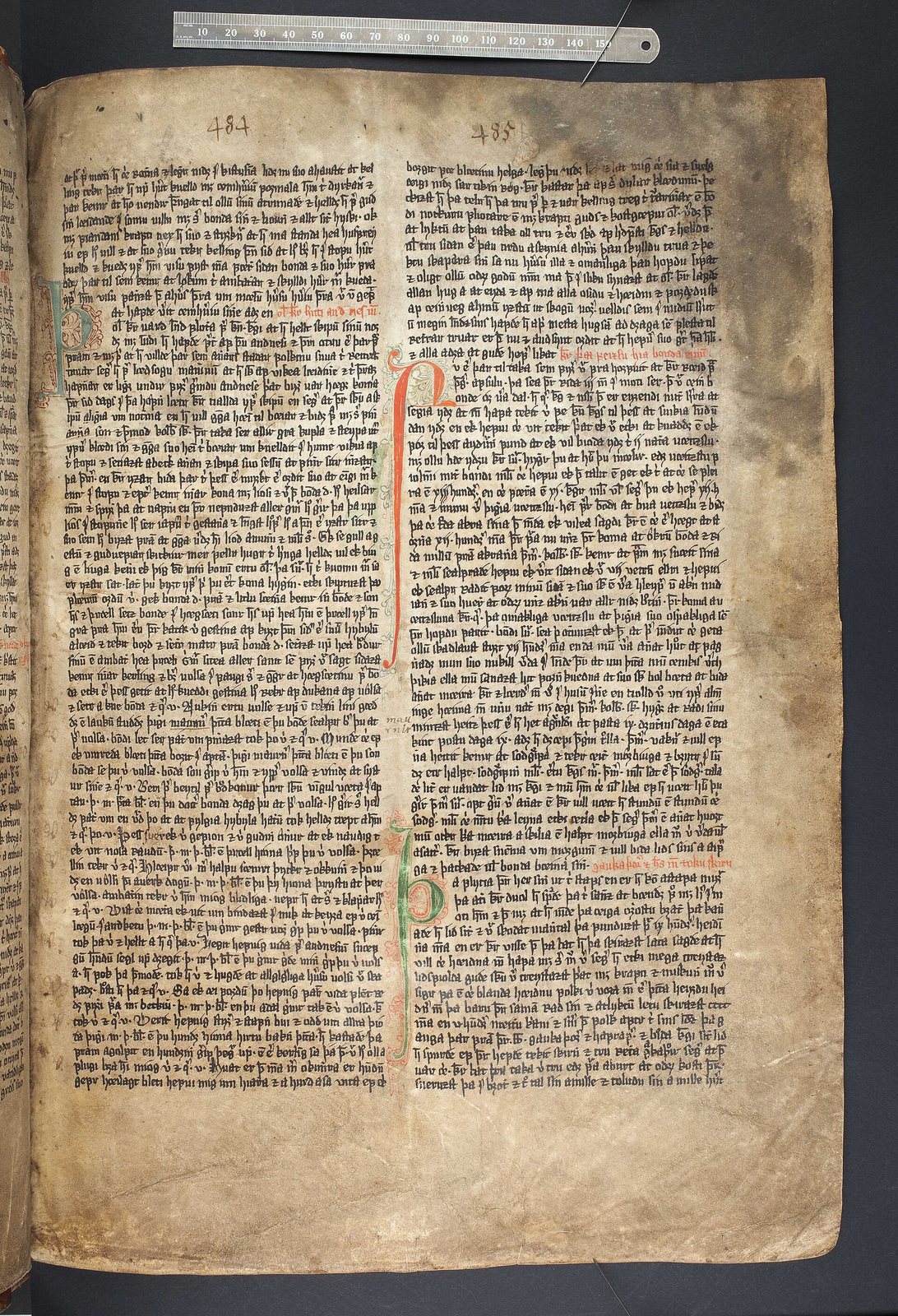
At its close the text names Sturla Þórðarson (1214–1284), lawspeaker and historian, as the authority for a verdict on Grettir. Árni Magnússon therefore suspected that Sturla wrote an older account of Grettir; Sigurður Nordal in 1938 saw a Sturla version later expanded, and Elín Bára Magnúsdóttir supported the idea in 2017 with linguistic parallels. No such older version survives. The vellum manuscripts, among them AM 551 a 4to and AM 556 a 4to, are from the fifteenth century; estimates for the oldest range from just before 1400 to the late fifteenth century.
"Now Sturla the Lawman says so much as that he deems no outlawed man ever to have been so mighty as Grettir the Strong; and thereto he puts forth three reasons-- And first in that he was the wisest of them all; for the longest in outlawry he was of any man, and was never won whiles he was hale. And again, in that he was the strongest in all the land among men of a like age; and more fitted to lay ghosts and do away with hauntings than any other. And thirdly, in that he was avenged out in Micklegarth, even as no other man of Iceland has been …"
Grettir's Saga, final chapter (chapter 95 in Magnússon/Morris); translated by Eiríkr Magnússon and William Morris, The Story of Grettir the Strong, London 1869 (public domain)
Whether Grettir lived cannot be proved, nor can it be ruled out. The saga anchors him in a web of people whose terms of office we know from other sources. According to Ari's Íslendingabók, Skapti Þóroddsson was lawspeaker from 1004 to 1030 and his successor Steinn Þorgestsson from 1031. In the saga the assembly outlaws Grettir under Skapti, while Steinn presides over the debate about the nineteen years and the case against Þorbjörn. That fits a death around 1031. The outlawry falls in the reign of King Óláfr Haraldsson, so no earlier than about 1015/16.
This is where it snags. From about 1016 to 1031 is fifteen years, not nineteen, and someone born in 997 would have been about thirty-four in 1031, not forty-four. The saga's ages and its absolute framework do not match. The usual dates are a reconstruction from external fixed points. Glámr, the troll-woman and the root belong to the storyteller's art; an outlaw who held out for years and died on Drangey may well be a historical core. More than that cannot be said.
Who was Grettir the Strong? The hero of Grettir's Saga, a farmer's son from Bjarg in northern Iceland who, according to the saga, survived nearly nineteen years as an outlaw and was killed on the island of Drangey around 1031. Whether he is historical cannot be proved.
What does skóggangr mean? Full outlawry in Icelandic law: lifelong loss of legal protection, loss of property and a ban on any help. Killing such a "forest man" went unpunished.
What did Glámr say to Grettir? He cursed him: Grettir would never grow stronger, would lose his luck, be outlawed and always see Glámr's eyes, so that he could not bear to be alone.
When was Grettir's Saga written? In the fourteenth century; estimates range from about 1310 to 1350, with some voices suggesting around 1400.
Is there a free English translation? Yes. The Story of Grettir the Strong by Eiríkr Magnússon and William Morris (1869) is in the public domain; modern translations include those by Denton Fox and Hermann Pálsson (1974) and Jesse Byock (2009).
Related articles: Sagas of Icelanders, Draugr, Troll, Rune magic, Viking law, Thing, Miklagard and the Varangians, Njáls saga, Egill Skallagrímsson, Glíma and knattleikr.

The Icelandic Sagas · The Draugr – the walking dead · Holmgang · Viking Law & Thing · Miklagard and the Varangians.
A Danish king buys two giantesses, sets them to a magic mill and has them grind gold and peace without ever letting …
Read more →Gullinbursti ("Gold-Bristle") is the golden boar of Freyr, the Norse god of fertility: according to Snorri's Prose …
Read more →Gungnir is the spear of the god Odin: according to the Prose Edda it was forged by the dwarf sons of Ívaldi and handed …
Read more →The mead of poetry turns anyone who drinks it into a skald or a scholar. It lies in the mountain Hnitbjorg, guarded by …
Read more →