A hide pegged to the ground at its corners, three shields for each fighter, hazel poles marking the boundary and a ransom of three marks of silver for the man whose blood first falls on the hide: this is how Kormáks saga describes the holmgang, the regulated duel of the Norse world. The picture is vivid and is often read as a factual report on the Viking Age. It comes, however, from texts written two to three centuries after the events they describe. This article explains the word, separates hólmganga from the free duel called einvígi, works through the best-known cases in Kormáks saga, Egils saga, Gunnlaugs saga and Grettis saga, sets out the bans in Iceland and Norway, compares the judicial duel of the early Germanic law codes, and says plainly where the evidence runs out.
According to the Icelandic sagas, the holmgang, Old Norse hólmganga, was a duel fought under fixed rules that were announced beforehand. A man who felt insulted, cheated of property or wounded in his honour could "challenge another to the holm", skora á hólm. The challenged man had to turn up or be counted a coward. On the appointed day both met at an agreed place, often in front of spectators, and fought until one was wounded, disabled or dead, or until he left the marked-out ground.
In the logic of the sagas it was an attempt to contain violence. A feud between two kin groups could cost dozens of lives over the years; more on this in the article on kinship and family. The holmgang reduced the quarrel to two men, one place and one day. A man who fell in a properly conducted holmgang had not, in the sagas' view, been murdered, and his kin had no claim to compensation or revenge. That very rule made the custom dangerous: it invited experienced fighters to strip weaker men of land, livestock or women by issuing a challenge.
Almost everything we know about the holmgang comes from the sagas of Icelanders written in the thirteenth and fourteenth centuries, plus a few passages in law books. Archaeology cannot identify a regulated duel: a skeleton with sword cuts does not reveal whether the man died in battle, in a raid or in single combat.
Hólmganga combines hólmr and ganga. Ganga means "going", and hólmr is a small island, especially an islet in a river or just off the coast. The word survives in place names such as Stockholm and Bornholm and is related to the English "holm", still used in some regions for a river islet. Hólmganga literally means "going to the island".
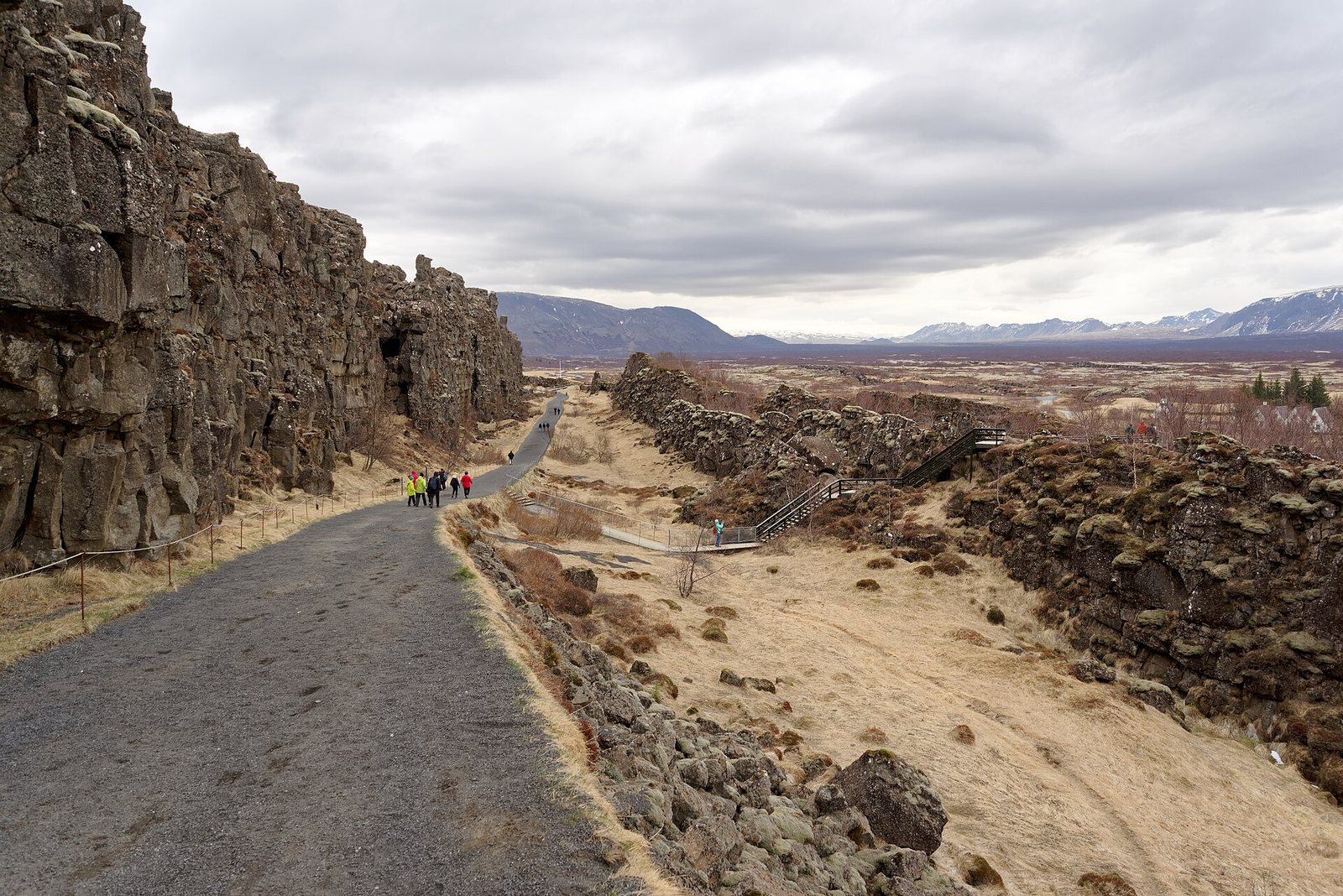
The name fits several saga scenes. Gunnlaugr and Hrafn fight on a holm in the river Öxará at the assembly site of the Althing, and Kormákr and Bersi meet on Leiðarhólmr. An island limited the space and made escape difficult. In many stories, though, the fighting ground is a meadow or a place marked by a ring of stones. Scholars therefore assume that "holm" came early on to mean any marked-out duelling ground, whether or not water surrounded it.
Related terms include hólmgöngulög, the rules of the holmgang, hólmlausn, the loser's ransom, and hólmgöngumaðr, a habitual duellist, as in the nickname of Hólmgöngu-Bersi.
Besides hólmganga the sources use einvígi, "single combat", a word with relatives such as Old High German einwīg. Scholarship, notably Gwyn Jones in the 1930s, Marlene Ciklamini (1963) and Olav Bø (1969), has drawn a distinction: the hólmganga was the formal duel with a challenge, marked ground, fixed rules and ransom, while einvígi was a free fight in which weapons, place and outcome were open. After a holmgang the matter was meant to be settled; after an einvígi the dead man's kin could still sue, demand compensation or take revenge.
The texts do not keep the words neatly apart, and later sagas sometimes write einvígi where a holmgang is clearly meant. In 2022 Oren Falk returned to both terms in a short note titled "Did Norsemen Duel?", asking how far the image of the regulated Norse duel owes to the literary shaping of the sagas. The sharp distinction, then, is a scholarly attempt to impose order that does not fit every passage.
The fullest description of the rules is found in Kormáks saga, the story of the skald Kormákr Ögmundarson, who is supposed to have lived in the tenth century. The saga is regarded as one of the earliest sagas of Icelanders and is usually dated to the first half of the thirteenth century; it survives complete only in the fourteenth-century manuscript Möðruvallabók. In chapter ten Kormákr fights Hólmgöngu-Bersi on Leiðarhólmr. Bersi is the man whom Kormákr's great love Steingerðr has married. Before the fight, the saga explains the rules.
"It was the law of the holmgang that the hide should be five ells long, with loops at its corners. Into these should be driven certain pins with heads to them, called tjosnur. [...] Three squares should be marked round the hide, each one foot broad. At the outermost corners of the squares should be four poles, called hazels; when this is done, it is a hazelled field. Each man should have three shields [...]. He who had been challenged should strike the first stroke. If one was wounded so that blood fell upon the hide, he should fight no longer. [...] The one who was wounded should pay three marks of silver to be set free."
Kormáks saga, ch. 10, in: The Life and Death of Cormac the Skald, translated by W. G. Collingwood and Jón Stefánsson, Ulverston 1902 (public domain)
The man who laid out the hide was to approach the pins so that he could see the sky between his legs, holding the lobes of his ears and speaking the words that belonged to a rite called tjösnublót, "the sacrifice of the pins". Whether this preserves a pre-Christian rite or is an antiquarian flourish by a Christian author cannot be decided.
The other provisions are sober. Each fighter had a man to hold his shield. Once all three shields were hacked to pieces, he had to return to the hide if he had left it and defend himself with his weapon alone. A man who set one foot outside the hazel poles "went on his heel"; with both feet outside, he "ran", that is, he counted as having fled. Where the English translation says "hide", other accounts speak of a cloak (Old Norse feldr); the spread-out piece is the same, and I have not checked the Old Norse wording myself. Five ells are roughly two and a half metres; modern accounts give differing measurements.
For Kormákr the fight goes badly. He wields the famous sword Sköfnungr without observing the rules that came with it. Bersi parries with his sword Hvítingr, Sköfnungr cuts off its point, the point flies up and wounds Kormákr's thumb. Blood falls on the hide, the bystanders part the two men, and Bersi claims the ransom. Kormákr calls it a mean victory and agrees to pay. Where the first-blood rule applies, a scratch is enough. In later chapters Kormákr kills a bull as a sacrifice after winning fights against a man named Þorvarðr, and a seeress advises the wounded man to redden a hill inhabited by elves with the bull's blood. This, too, is a thirteenth-century narrative, not an eyewitness account.
From scattered saga passages a procedure emerges that recurs in broad outline. It begins with the challenge, often issued in public at a thing assembly or at a feast. A few days pass between challenge and fight; for Gunnlaugr and Hrafn it is three nights. If the challenged man failed to appear, the challenger was held to be in the right. If the challenger stayed away, he was branded a níðingr, a man without honour.
Before the fight the rules were spoken aloud: which weapons, how many shields, who struck first, what the winner would receive. The sagas themselves show that they varied from case to case. Svarfdæla saga has each opponent stand on his own spread cloak, while Egils saga describes a ring of stones. Most fights were with sword and shield; see the articles on the Viking sword, the Viking shield and Viking weapons.
A man did not have to fight in person. The sagas repeatedly tell of an experienced fighter standing in for a younger, weaker or elderly relative or friend. The best-known case is Egill Skallagrímsson.
Egill Skallagrímsson, skald, farmer and fighter, is the hero of Egils saga, usually dated to around 1220–1240 and often attributed to Snorri Sturluson, an attribution that is widespread but not proven. In an episode found in chapter 67 of W. C. Green's 1893 translation and in chapter 64 of the standard Icelandic editions, Egill comes to a farm on the island of Höð in Norway. There young Friðgeirr lives with his mother Gyða, a kinswoman of Egill's friend Arinbjörn. Ljótr the Pale, according to the saga a berserk of Swedish origin and a feared duellist, has asked for Friðgeirr's sister in marriage and, on being refused, challenges Friðgeirr to a holmgang.
Gyða asks Egill to fight in her son's place. The ground lies on a plain by the sea and is marked out by a ring of stones. Ljótr falls into a berserk rage but in the first bout retreats behind the boundary stones, and the saga notes that whoever did so was to be called a coward ever after. In the second bout Ljótr's shield slips, Egill strikes him above the knee, and Ljótr dies.
The legal side of the episode is striking. The saga lists the terms: the winner takes what was fought over, the loser may ransom himself, and the property of a man killed passes to the man who killed him. Because Ljótr was a foreigner without heirs in the land, his estate was to go to the king. This link between duel and inheritance shows how the saga writers understood the holmgang: as a way of transferring property.
Ljótr is not alone. In a striking number of sagas a berserk challenges a farmer to a duel in order to take his daughter, wife or farm, and a hero passing through fights on the threatened man's behalf. Benjamin Blaney described this pattern in 1982 as "The Berserk Suitor". It is so stable that it has to be treated as a narrative building block that lets the hero appear as the protector of the weak.
A literary pattern does not rule out a historical basis: Landnámabók, the Book of Settlements, tells of land disputes among early settlers supposedly decided by duels, though whether that reflects the period around 900 cannot be tested.
Grettis saga, from the early fourteenth century, links the motif directly to the end of the holmgang. In chapter 19 Grettir kills two berserk brothers, Þórir Paunch and Ögmundr the Bad, together with their men on the island of Haramarsey. In the same context the saga says it was considered a scandal that pirates and berserks could come into the country and challenge people to duels. Earl Eiríkr therefore abolished all holmgang in Norway and declared outlaws all robbers and berserks who disturbed the peace.
In Iceland, tradition ties the end of the holmgang to a love story. Gunnlaugs saga ormstungu, the saga of Gunnlaugr Serpent-Tongue, is usually dated to the late thirteenth century. Two skalds, Gunnlaugr Illugason and Hrafn Önundarson, court the beautiful Helga. Gunnlaugr is abroad when Helga is married to Hrafn. Back in Iceland, he challenges Hrafn at the Althing.
The fight takes place three nights later on the holm in the Öxará, in the middle of the assembly site. As the challenged man, Hrafn strikes first and hits Gunnlaugr's shield so hard that his sword breaks below the hilt. The blade flies up and grazes Gunnlaugr's cheek. Their fathers and other men step between them. Gunnlaugr claims victory because Hrafn has no weapon left; Hrafn replies that Gunnlaugr has lost because he is bleeding.
Then comes the sentence quoted in almost every account. In the translation by Eiríkr Magnússon and William Morris (1875, chapter 14 there), on the second day afterwards it was made law in the law court, the Lögrétta, that all holmgangs should henceforth be forbidden, on the counsel of the wisest men at the Thing, and this fight between Gunnlaugr and Hrafn was the last holmgang fought in Iceland.
The saga gives no year. The widely quoted date of 1006 is derived from the story's internal chronology and its links to known figures such as Earl Eiríkr and the English king Æthelred. It is more accurate to say "according to Gunnlaugs saga shortly after 1000, often dated to about 1006". No independent witness exists. I know of no holmgang ban in Ari Þorgilsson's Íslendingabók (c. 1120–1130), which does mention legal reforms after the conversion such as the Fifth Court, and I know of no procedure in Grágás, the recorded law of the Icelandic Commonwealth, that treats the holmgang as a legal remedy. That is consistent with an early ban but does not prove it. For the wider legal setting see the article on law in the Viking Age.
The story ends in Norway. At Dinganes, a headland in central Norway, the two men meet with companions. Gunnlaugr cuts off Hrafn's leg; Hrafn asks for water, Gunnlaugr brings it in his helmet, and Hrafn strikes him on the head. Gunnlaugr kills Hrafn and dies of his own wound three nights later. This is no longer a holmgang but a fight without rules, and the narrator's message is plain: banning the regulated form does not end the violence, it moves it elsewhere.
For Norway, Grettis saga names Earl Eiríkr Hákonarson. After King Óláfr Tryggvason fell at the battle of Svolder (around 1000), Eiríkr ruled much of Norway together with his brother Sveinn until he left for England around 1014/1015. The often-quoted year 1014 is not in the saga; it is a date inferred from the earl's rule, and nothing more precise than "under Earl Eiríkr, roughly between 1000 and 1015" can be said.
Gunnlaugs saga agrees: there too Earl Eiríkr has forbidden fights in his realm, which is why Gunnlaugr and Hrafn go to a remote spot. I know of no evidence outside the sagas; the surviving Norwegian provincial laws are later and Christian in character. Grettis saga justifies the ban by public order, not religion. A connection with the conversion is plausible in time but remains interpretation.
The Older Västgöta Law, the thirteenth-century law of the Swedish province of Västergötland, regulates a duel after insulting words. The two men are to meet where three roads join. Whoever fails to appear loses standing and rights; if the insulted man falls, half a wergild is due, if the insulter falls, nothing. I know these provisions only from secondary accounts.
On the Continent, judicial combat is firmly established in the written laws of the Burgundians, Alemanni, Bavarians and Lombards; see the article on the Germanic law codes. It belongs among the ordeals, procedures in which God was expected to give victory to the just cause. The eighth-century Lex Baiuvariorum, the law of the Bavarians, knows the campio, a fighter acting for a party; one passage (tit. XVI, 11) rules that a confirmed transfer cannot be reversed unless the plaintiff's champion wins.
Among the Lombards, unease shows early. King Liutprand (r. 712–744) wrote in one of his laws that "incerti sumus de iudicio Dei", we are uncertain about the judgement of God, and that many had lost their case through combat without a just cause. Yet because of the custom of the Lombard people he could not forbid the law. The passage is usually cited as Liutprand c. 118; numbering varies between editions.
Both worlds share the idea that a fight under rules can end a dispute, and both allow champions. The setting differs: continental judicial combat was ordered by a court and read as a judgement of God, while the saga holmgang appears as a private challenge between two men that follows public rules.
All the major holmgang stories stand in texts written between about 1200 and 1320. The events they describe take place between about 930 and 1015. Two to three centuries of oral transmission, change and embellishment lie in between. The authors were Christians writing about a pagan past they both admired and regarded as overcome.
Three caveats follow. First, the precise rules, such as three shields and three marks of silver, may be reconstructions or inventions that lend a scene credibility; Marlene Ciklamini showed in 1963 and 1965 how strongly the figure of the duellist is shaped by literary convention. Second, patterns such as the berserk suitor recur so regularly that they must be read as narrative building blocks. Third, each saga explains the ban with a good story: in Iceland the tragic fight of two skalds, in Norway a plague of berserks.
Against pure invention stand the appearance of the holmgang in sagas of different dates and regions, a Swedish law book with a related form of duel, and the well-attested judicial duel of Germanic law in general. The cautious answer is that a custom of regulated duelling very probably existed in the North, but we know its exact forms only as thirteenth-century Icelanders imagined them.
What does holmgang mean? Old Norse hólmganga literally means "going to the island", from hólmr, "small island". It refers to a duel under fixed rules that, according to the sagas, was often fought on an island or a marked-out ground.
How did holmgang differ from einvígi? Scholars use hólmganga for the formal duel with rules and ransom and einvígi for a free single combat after which the feud could continue. The sagas do not always keep the words apart.
When was the holmgang banned? In Iceland, according to Gunnlaugs saga, shortly after 1000, usually dated to about 1006; in Norway, according to Grettis saga, under Earl Eiríkr, often dated to 1014. Both years are calculated; the sagas give none.
Did a man have to fight in person? No. The sagas tell of experienced fighters standing in for weaker men, such as Egill Skallagrímsson for young Friðgeirr.
How reliable are the rules in Kormáks saga? They are the fullest description we have, but they come from a thirteenth-century text about the tenth century. They show how the holmgang was imagined in medieval Iceland; that they applied everywhere in exactly this form cannot be shown.

Viking Law & Thing · The Thing · Berserkers · Egill Skallagrímsson · Weapon Lore.
All Everyday Life & Craft articles →
Yule (Old Norse jól) was the great midwinter feast of the pre-Christian North: three nights of ale, sacrificial meat …
Read more →Viking comb makers were specialist craftworkers who turned deer antler, and occasionally bone, into composite combs …
Read more →Viking carnelian beads were imports from the East: these red, often faceted stone beads and their clear cousins in rock …
Read more →The Vikings healed with herbs, leeks and onions, with bandages and hard-won experience – and almost always with words …
Read more →