Few names of early history are as famous and as poorly secured as that of the Salians. A Roman officer wrote it down in 358, a law code still carries it in its title, and the royal family that founded the Frankish kingdom is usually counted among them. Whether a people, a war-band federation or merely a Roman habit of speech lies behind it has been argued for a quarter of a century. This article sets the testimonies side by side, separates evidence from interpretation, and says plainly what I read myself and what only through summaries.
"Salian Franks" (Latin Franci Salii, or just Salii) is the name given to one section of the Franks that becomes visible in the fourth century in the lower Rhine country and in what is now the Netherlands and Belgium, and from whose circle the Merovingian royal house emerged. That is what the standard handbooks say. The sentence hides three assumptions that need checking one by one: that there was a sub-tribe, that it was called Salian because it called itself so, and that the Merovingians belonged to it.
A distinction first, because it causes constant confusion. The Salians who ruled as kings and emperors in the high Middle Ages (1024 to 1125) are a different story and do not belong here. The name is the same, but German Wikipedia stresses for the Franks that they have little to do with the medieval dynasty. No attested line of descent runs from the fourth century to the eleventh. Whoever reads "Salian" in this article is reading about Franks.
This site already has detailed pieces on the Franks as a whole, on the Toxandri (where Julian's campaign and the land itself are the focus), the Chamavi, the Chattuarii and the Batavi. Here the question is specific to the Salians: what do we actually know about this one name, and how far does it carry?
The honest answer is that nobody knows. English Wikipedia, drawing on the research literature, lists several proposals, and none has won.
The oldest idea looks for the name in the landscape. Salland, a region on the river IJssel in the present-day Netherlands, bears a related name, and German Wikipedia names it as a possible area of origin. That does not say whether the region took its name from the people or the people from the region. Others thought of "island dwellers", salt or Latin salire, "to leap"; none is considered viable.
The more interesting reading is recent. The linguist Matthias Springer asked in 1997, in an essay titled "Gab es ein Volk der Salier?" ("Was there a people of the Salians?"), whether the word might be Germanic and mean something like "companion", related to the word for a hall: the Salians would then be "hall companions", members of a retinue, rather than a people in the sense of shared descent. English Wikipedia calls Springer's further claim, that Salii was a Germanic word for all Franks, poorly accepted. I have not read Springer's essay; I know the idea only from these summaries and from a study by Patrick Périn and Alain Dierkens, who follow him.
Périn and Dierkens go a step further. In their study of Belgica II in the fifth century they drop the label "Salian" for the western Franks altogether. As they report Springer, the name had no ethnic or geographical basis: it arose in Julian's entourage, Ammianus took it over as a synonym for Franci, and the adjective salicus meant roughly "living under Salic law" and could apply to any Frank. That is one position, not a consensus. German Wikipedia likewise holds it possible that the term meant "followers of Frankish retinues" and was misread as ethnic. Anyone who picks a side is picking a hypothesis.
All the material on the Salians falls into a few groups. As in every article here, I separate what I have seen in the wording from what I know only through summaries.
Ammianus Marcellinus (Res gestae, book 17, chapter 8) is the closest source in time. He wrote toward the end of the fourth century, about three decades after the events of 358, and he wrote kindly of the Caesar Julian. I consulted John C. Rolfe's English Loeb translation of 17.8.3 to 5, but no Latin text. The passage says explicitly that Julian first turned against the Franks, "those namely whom custom calls the Salii" (that is Rolfe's wording). That "custom calls" matters for the name question: Ammianus uses the name as something people say, not as something the people concerned gave themselves.
Zosimus (around 500) tells the same story with additions: the Salians had been driven out by Saxons and moved to Batavia, a report that cannot be checked against anything else. Libanius, an orator at court and a contemporary of Julian, describes according to English Wikipedia's summary the same lightning strike and says the Salians asked for land and got it. I have not read either in the original wording.
The Panegyrici Latini, speeches in praise of emperors, belong to the prehistory: they speak of Franks resettled on Roman soil in the 290s, without using the name "Salian". Some scholars see these groups as ancestors of the later Salians; the link is inferred, not stated. The Notitia dignitatum, a register of Roman offices and units that English Wikipedia says reached its present form probably in the early fifth century, lists, according to another summary, units called Salii seniores, Salii iuniores Gallicani and a numerus Saliorum. To infer a unit's make-up from its name is risky: the soldiers need not have been Salians.
Claudian (around 400) and Sidonius Apollinaris (456 and 458) mention Salians, English Wikipedia says, only as a rhetorical figure in praise poems and tell nothing about them. Gregory of Tours, bishop and historian, wrote his Historiae around 590, over a century after Childeric. I consulted Gregory's second book in excerpts (sentence segments of chapters 9, 12, 27, 30, 31 and 37 on thelatinlibrary.com). In the parts queried the word Salii did not turn up, but the page broke off in the middle of chapter 37, so I do not claim that Gregory never uses it. The Pactus legis Salicae, the law code, is the only source with the name in its title and at the same time the youngest of these groups in its surviving form: no Merovingian manuscript exists, and the oldest date from the second half of the eighth century, according to merovingianworld.com. In archaeology the grave of Childeric at Tournai and the row-grave cemeteries (burials laid out in rows, with grave goods) matter most; more on both below.
"Secure" here means attested by a text or a find in a way that the specialist literature does not seriously dispute.
357/358. Julian moves against the Salians, who according to Ammianus had settled on Roman soil near Toxandria, receives their embassy at Tongeren, has them attacked by the general Severus and accepts their surrender together with property and children. This is the only moment in early history when the Salians appear by name as an acting group. The land, the sources and the question whether one may speak of "federates" are treated at length in the article on the Toxandri.
Roughly 359 to 440. A gap of nearly a hundred years. The name "Salian" appears only in the Notitia and in praise poems; the legendary king Faramund, whom German Wikipedia lists for this period, is not historically secure.
Around 445 to 450. A king Chlodio (Gregory writes Chlogio) attacks Cambrai from a place called Dispargum and extends his territory to the Somme (Gregory II,9). Lanting and van der Plicht place these advances in 445 to 450. In his praise poem for Emperor Majorian of 458, Sidonius describes an ambush on Franks at a place called Vicus Helena, with Aetius in command and Majorian leading the cavalry; the battle is dated to about 448, the site is uncertain (Hélesmes is one proposal, with at least four others). Sidonius says "Franks", not "Salians". Chlodio is never explicitly called a Salian in the sources, as English Wikipedia stresses. Where Dispargum lay is unresolved: Duisburg on the Rhine, Duisburg near Tervuren in Brabant and Diest have all been named.
463. Childeric appears in a fight against the Visigoths at Orléans, according to German Wikipedia probably the first secure attestation of him. Around 469/470 follows Angers. In 481 or 482 he dies and is buried at Tournai; the date is calculated, not transmitted.
486/487. Clovis defeats Syagrius, son of Aegidius, who held a Roman remnant at Soissons. In 507 he beats the Visigoths at Vouillé. The bishops met at Orléans in July 511, the last document that names Clovis alive.
English Wikipedia says bluntly that Gregory's chronology for Clovis is "almost certainly fabricated". That concerns above all the baptism and Tolbiacum, with which Gregory tells the road to Catholicism. The baptism at Reims is traditionally put at Christmas 496; proposals range from 498 to 506 and, going by letters to Avitus of Vienne, 508.
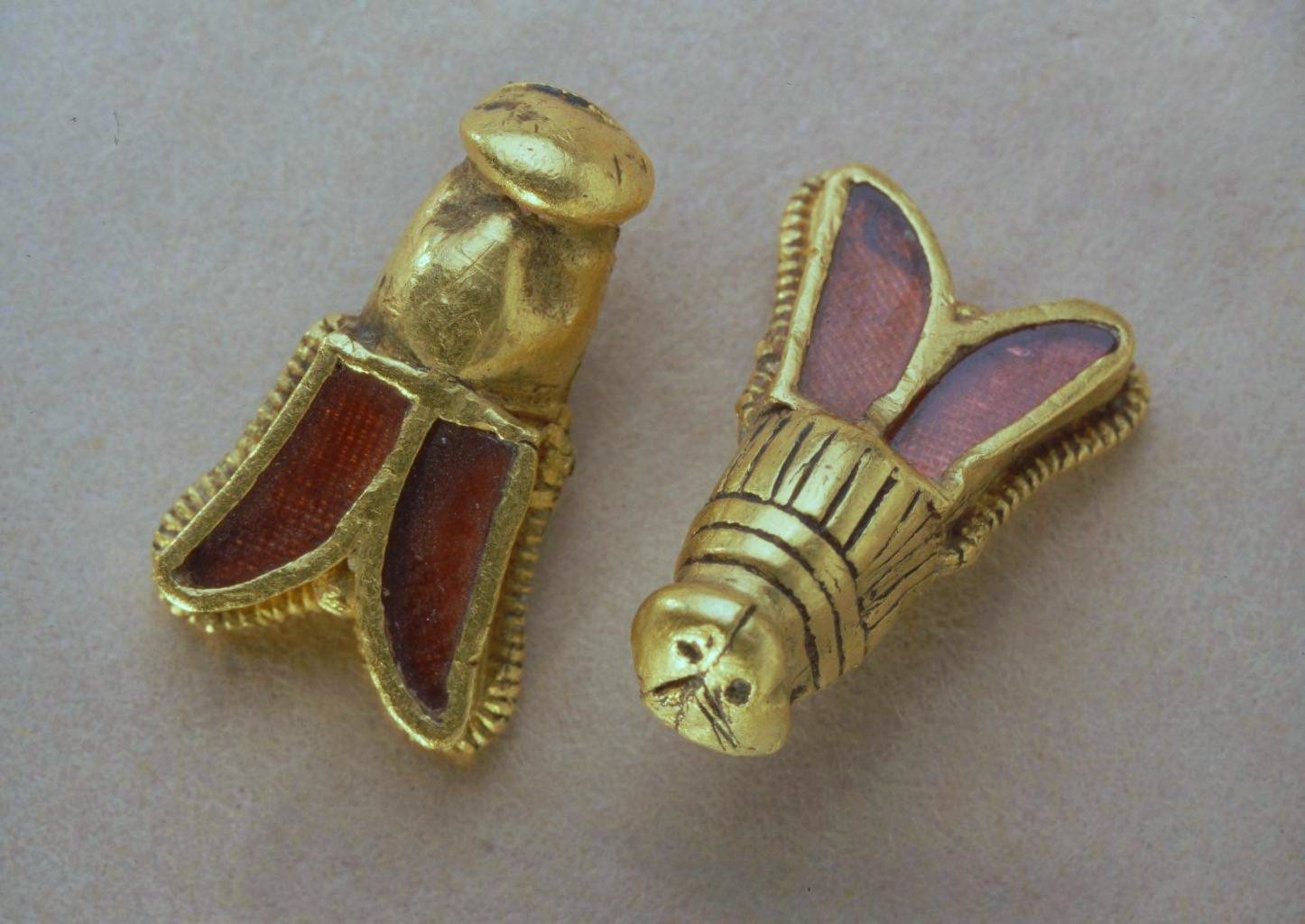
On 27 May 1653, during building work near the church of Saint-Brice in Tournai, a grave came to light that ranks among the most famous of the early Middle Ages. According to German Wikipedia it held a spatha (a double-edged long sword) with a gold hilt, a sax (the single-edged short sword), a lance, a throwing axe, a shield boss, a golden onion-knob brooch, a gold arm ring, gold and silver coins and about three hundred golden bee ornaments said to belong to a garment. The signet ring bore the legend CHILDIRICI REGIS, "of King Childeric", and gives the find its name. The latest coins date from the reign of Emperor Zeno (474 to 491); they give the earliest possible time of burial, in keeping with 481/482.
The treasure is no longer complete. On the night of 5 to 6 November 1831 it was stolen from the Bibliothèque nationale in Paris, the thieves melted down part of it, and only a fraction survives, among it two bees. We know the find largely from the drawings and descriptions that Jean-Jacques Chifflet published in 1655 (Anastasis Childerici). Later excavators found 21 sacrificed horses nearby, according to German Wikipedia; horse sacrifice counts as non-Christian. Whether all the finds belong to one burial is disputed.
More important than any object is what the grave does not answer. It names no tribe: the ring says "king", not "Salian". No text I have seen explicitly calls Childeric a Salian; Gregory speaks of a king of the Franks. That the handbooks count the Merovingians among the Salians is a convention. Whether Childeric was a dynastically legitimate king or an elected war leader with Roman backing, and whether he acted only locally as a "city king" of Tournai, is open according to German Wikipedia. A hint of his Roman side is a letter from Bishop Remigius of Reims to Clovis: he had heard, Remigius writes, that Clovis had taken over the administration of Belgica secunda, the Roman province with Reims as its capital. That suggests the father held a double role, Roman official and Frankish leader.
One sometimes reads that the row graves, the cemeteries of the fifth to seventh centuries with weapons for men and jewellery for women, show the Salian land-taking. That says too much. Périn and Dierkens stress that they do not identify "Salians" but use the distribution of objects to follow Frankish movements; the same sword types also occur among the Alamanni. A grave reveals rank, fashion and burial custom, not the name of a group.
The Lex Salica, in its oldest form the Pactus legis Salicae ("pact of the Salic law"), is the most important written legacy to bear the name. The usual dating puts its recording in the time of Clovis, 507 to 511. Karl Ubl, by contrast, as German Wikipedia reports, holds the core to be as early as the mid-fifth century, when the Franks were still federates of the empire; individual titles belong, by the same article, only in the later sixth. No Merovingian manuscript exists; the oldest copies are Carolingian or date from the late eighth century. The earliest scribes, it adds, spoke Romance and no longer understood the Germanic words scattered through the text. These words, the Malberg glosses (after mallobergo, roughly "court place"), show early Dutch in a Latin setting and are valuable to linguists because little else survives.
In content the Lex Salica is not a law book in the modern sense but a catalogue of fines. According to the German summary the amount depends on rank and victim: a killed Gallo-Roman with 100 solidi (gold coins), a free Frank with 200, a table companion of the king with 300 and a warrior of the royal retinue with 600. A person's monetary value is called wergild; it was meant to replace blood feud with compensation. A third of the fines went to the count. Whether such sums applied in practice or served rather as a scale of how offences related to each other is itself debated, and Hermann Nehlsen, according to merovingianworld.com, saw a gap between practised and written law. For a first overview of early legal ideas see our article on Germanic tribal law.
One half-sentence on inheritance became famous. According to German Wikipedia it reads De terra autem Salica nulla in muliere hereditas est, "of Salic land no inheritance shall go to a woman". It means a particular kind of land, probably holdings connected with royal administration, not the throne. Around 570 Chilperic I softened the rule. When the succession of Louis X was at stake in France in 1316/17, the Lex Salica was not yet explicitly cited, according to English Wikipedia; only in 1358 did Richard Lescot appeal to it. The "Salic law" of royal succession is thus a late reading of a clause about farmland.
A footnote for the Aachen region: the Lex Salica was revised under Charlemagne. English Wikipedia lists the Lex Salica Emendata under the year 798, with additions from the laws of the Ripuarians, Alamanni and Suebi.
Few warriors of the early period can be tied to a name. Roman sources show them as part of a system: Rome needed soldiers, the Salians needed land. According to English Wikipedia, Julian demanded soldiers of Salians and Chamavi, and the Notitia lists units with the Salians' name. That shows Romans treating Frankish groups as contingents; how the Salians themselves fought cannot be read from it.
Weapons are somewhat more concrete: Childeric's grave held spatha, sax, lance, throwing axe and shield. But a single royal grave is a thin basis as a pattern for "the" Frankish kit. The Lex Salica knows antrustiones, men of the king's retinue whose killing costs 600 solidi: that points to a warrior class bound closely to the king. How large it was is not in the texts I have seen. Gregory says that after Clovis's baptism "more than three thousand" of his army were baptised (II,31: "amplius tria milia"); that says nothing about the size of the army. For the basics of warfare see Germanic warfare and, for the Carolingian period, the Carolingian army.
Gregory tells the baptism at Reims as a key scene, with Remigius's cry "Mitis depone colla, Sigamber" ("Bow your neck gently, Sigamber", II,31, my English): a literary scene by a bishop writing a century later.
For the Rhineland and the Aachen area the Salians are a neighbour's story. The land where Ammianus locates them, Toxiandria, lies in the Kempen between the Meuse and the Scheldt. Tongeren, where Julian received the envoys, lies in Belgian Limburg, a good forty kilometres from Aachen as the crow flies. More than that proximity cannot be claimed; the meeting did not take place in Aachen.
Tournai (Turnacum), in present-day Wallonia, is the first place where a Frankish ruling family can be pinned down, because Childeric lies buried there. For Clovis's road eastward Cologne matters, where a sub-king sat whom English Wikipedia, following Gregory, calls Sigibert "the Lame": he is said to have been wounded at Tolbiacum and was killed around 509 by assassins acting for his son Chloderic; Clovis then had Chloderic killed too and was raised king by the people of Cologne. I know this only from summaries. Whether Tolbiacum can be equated with Zülpich remains disputed; more in the article on Zülpich.
Aachen enters the story later. The Carolingians, who built their power in the Meuse-Moselle area, were not Merovingians; Charlemagne developed Aachen into a palace three centuries after Childeric. How the Vikings later reached this area is told in Vikings in Aachen, and for the peoples on the spot see Germanic peoples in the Rhineland.
For a long time it was taken as settled that the Franks fell into two tribes: Salians in the west, between the Loire and the Coal Forest, and Ripuarians on the Rhine, roughly from Mainz to Duisburg, with Cologne as centre. The foundation of this view was two law codes, the Lex Salica and the Lex Ribuaria. English Wikipedia calls this picture of a split largely abandoned today. The Lex Ribuaria is mostly seen as a law for the Cologne Rhineland and dated to the first half of the seventh century; the suggestion to place it as late as the early eighth century comes from Springer. The name Ripuarii has also not counted as a tribal name since the 1950s; candidate derivations are Latin ripa ("bank"), a Romance root or a Roman frontier unit, and the first clear narrative use of ribuarius for the people around Cologne stands in the Liber Historiae Francorum of about 726/27.
Both names belong to law, and both were turned into tribes by historians. Whoever says "the western Frankish" and "the Rhine tribe" reads too much into two book titles.
The Franks looked early for an origin story, and the Salians got a place in it. Gregory of Tours reports in II,9 that many tell of the Franks coming from Pannonia, crossing the Rhine and, in the passage as I saw it in segments, creating long-haired kings for themselves "by districts or cities" (regis crinitos; I saw only these sentence parts, not the context). Gregory passes it on as hearsay.
“De huius stirpe quidam Merovechum regem fuisse adserunt, cuius fuit filius Childericus.”
“From his stock, some assert, came King Merovech, whose son was Childeric.”Gregory of Tours, Historiae II,9; Latin sentence after thelatinlibrary.com, read in an excerpt query. The English version is my own translation. “Huius” refers to Chlodio.
The sentence is small and carries a lot. It is the only place in Gregory that mentions Merovech, and it hangs on a "quidam adserunt": some claim it. English Wikipedia leaves open whether Merovech was a son of Chlodio, and even whether he was a historical figure. The legend came in the seventh century: the Chronicle of Fredegar (III,9) tells that Chlodio's wife met a sea creature while bathing, and it was unclear who the father was, the creature or the king. The descent of the Merovingians from a sea monster is therefore no knowledge about the Salians but a family legend.
Fredegar also knows the Trojan origin: the Franks descended from fled Trojans, and a city on the Rhine is called Troy, probably Xanten. The Liber Historiae Francorum builds this out about a century later. Both are learned foundation stories; the Salians do not appear in them as a group of their own, only the Franks as a whole.
In modern times the clause on farmland became the "Salic law" of succession; German Wikipedia cites it still in the separation of Great Britain from Hanover in 1837 and of the Netherlands from Luxembourg in 1890. That shows how far a name can carry.
Was there a people of the Salians? Springer and the archaeologists who follow him say no; the handbooks say yes. No decision is in sight.
Origin. Whether the Salians came from Batavia, as Zosimus tells, from Salland, or from groups Rome settled around 293/294 cannot be decided.
The Merovingians. That they were Salians is a convention. No text I consulted calls Childeric or Clovis that.
Chlodio's setting. Dispargum, the role of Tournai and Vicus Helena are unresolved, as is whether those involved were Salians.
The law. The dating of the Lex Salica runs, depending on the scholar, from the mid-fifth century to the late sixth; the meaning of the name in the title is open.
What remains is little and yet much: a sentence in Ammianus, a grave at Tournai, a law code with a name that may come from Romans or from the people concerned themselves.
Related articles: Franks, Toxandri, Chamavi, Chattuarii, Batavi, Saxons, Alamanni, Thuringians, Zülpich, Germanic tribal law, Germanic warfare, The Carolingian army, Germanic peoples in the Rhineland and Vikings in Aachen.

The Franks · The Texuandri · The Chamavi · The Saxons · The Carolingian Military System.
All History & Finds articles →
The Salluvii (Salyes) were a league of Celtic-Ligurian groups in the hinterland of Massalia, with the hill town of …
Read more →In 2008 workers digging a cable trench in the village of Salme on the Estonian island of Saaremaa hit bones and iron …
Read more →In almost every book about the Vikings they turn up at some point, usually in a subordinate clause: the "Finns" of the …
Read more →The Santones lived on the Gallic Atlantic coast around present-day Saintes. Their name turns up at the very start of …
Read more →