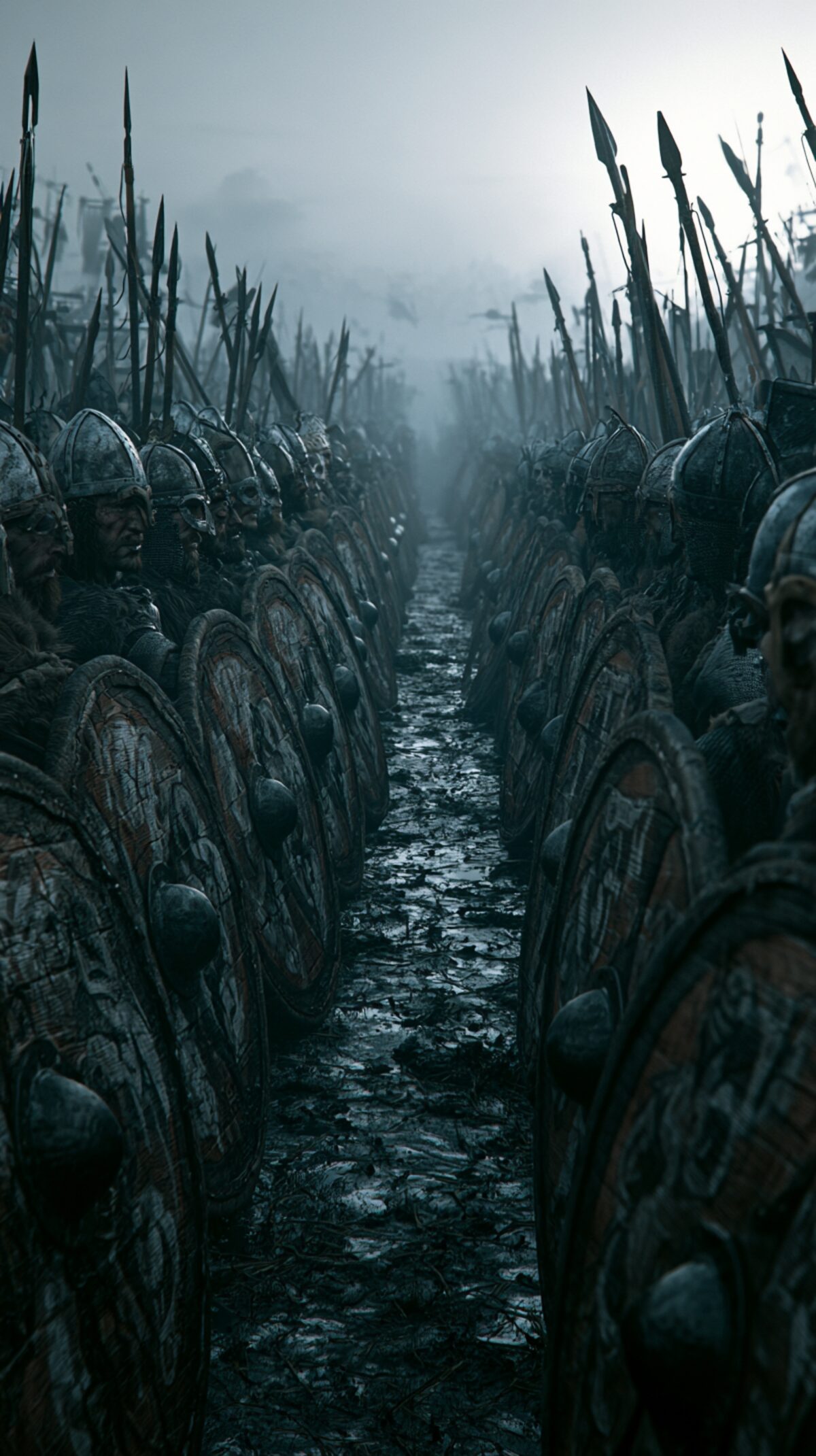
Haakon Haraldsson, youngest son of Harald Fairhair, is said to have been sent as a boy to the English king Æthelstan, to have won Norway back after his father's death, given laws, set up a naval levy and beaten the sons of Eric several times, until an arrow struck him at Fitjar around 960/961. Almost all of this stands in sagas of the 12th and 13th centuries. The one text from his own lifetime is a funeral poem by his court poet. This article separates what skaldic verse and neighbouring sources support from what Snorri and others narrate, and from what later tellers made of it.
Hákon Haraldsson was born, by the usual reckoning, around 920 in Hordaland on Norway's west coast, at a headland the sagas call Hákonarhella, "Hákon's rock shelf". His father was Harald Fairhair; his mother, in the sagas, was Tora, nicknamed Mosterstang, whom the Store norske leksikon calls a servant woman. Both his birth year and his death year are approximate. He died, in the common reckoning, in 961; some accounts say 960, as discussed below.
Two additions to his name follow him. Aðalsteinsfóstri means "Æthelstan's foster-son", and it is attested in the poetry of the 11th century. "The Good" (inn góði) also appears early; the Norwegian encyclopedia notes it is already found in skaldic verse, though I could not check the line. Snorri links the name to Hákon's dealings with the farmers, and the 19th-century retelling by Thomas Carlyle sums him up as a king who "on the whole gained for himself the name of Hakon the Good". Where the epithet really comes from cannot be settled. A link with lawgiving, as the sagas draw it, is a possibility and no more.
According to the sagas Hákon ruled from about 934 until his death, more than a quarter of a century, and with almost no rivals at home. His power base was western Norway; a Norway in modern borders belongs to a later age. Theodoricus Monachus, writing between about 1177 and 1187, gives him 25 years, 19 of them in peace. The sagas agree that he had a daughter and no sons. His father and half-brother have their own articles, Harald Fairhair and Eric Bloodaxe. This one is about the man between and after them.
No contemporary narrative exists. No Anglo-Saxon chronicle mentions Hákon, nor does William of Malmesbury, who wrote at length about Æthelstan in the 12th century. For the fostering in England we therefore rely on Norse texts that tell it more than two hundred years later.
The Hákonarmál. The oldest and closest witness is a poem by Eyvindr skáldaspillir ("plagiarist of skalds", the nickname is unexplained), the Hákonarmál. It has 21 stanzas in the metre ljóðaháttr, was composed after Hákon's death, probably soon after, and survives complete in Fagrskinna and Heimskringla. Eyvindr was Hákon's court poet and later served, the sagas say, Harald Greycloak and then Earl Hákon Sigurdsson of Lade. The poem imitates, scholars say, the older Eiríksmál on Eric Bloodaxe, composed about seven years earlier; more on poet and poem in the article on Eyvindr skáldaspillir. A praise poem is not a report, and what it leaves out is not thereby refuted. But it comes from Hákon's own time.
Later skalds. The Store norske leksikon cites verses by Sigvatr Þórðarson from the mid-1030s. The article on Rastarkalv and Fitjar on this website says Sigvatr calls Hákon Æthelstan's foster-son and a man who gave "laws". I have not read these lines myself; the page on Sigvatr's Bersöglisvísur that I consulted does not mention Hákon. The encyclopedia reads the word "laws" as pointing to Hákon's cooperation with the farmers, not to lawgiving in a narrow sense.
Historia Norwegiae, Theodoricus, Ágrip. The Historia Norwegiae is an anonymous Latin history of Norway, usually dated between about 1170 and 1220 and preserved in one manuscript of around 1500 to 1510. It calls Hákon, in the wording quoted by Wikipedia and on this website, an apostate who observed "pagan as well as Christian rites". I have not read the text. Theodoricus Monachus, probably a Norwegian Benedictine from Nidarholm, dedicated his Latin work to Archbishop Eysteinn Erlendsson. In the Viking Society translation (McDougall, Foote), which I saw in extracts, Hákon is handsome and much loved, and the Norwegians recalled him because of the cruelty of Eric and especially of Gunnhild. That is a different motive from Snorri's. Ágrip, around 1190, is the first royal history in the vernacular and runs from Halfdan the Black to 1136; I have not read its passages on Hákon.
Fagrskinna and Heimskringla. Fagrskinna ("fair parchment", after its manuscript) dates to about 1220, its author is unknown, and Snorri used it directly. Snorri Sturluson wrote the Hákonar saga góða as part of the Heimskringla around 1230, some 270 years after the events (see Snorri Sturluson). He drew on skaldic verse, older royal histories and oral tradition and arranged them into a readable course. Where Fagrskinna and Heimskringla agree, the picture is most solid; what only Snorri tells, such as conversations before a battle or Hákon's last words, belongs to narrative art.
Morkinskinna and Adam of Bremen. Two names one expects in such a list are missing for good reason. Morkinskinna, written in Iceland around 1220 and preserved in a manuscript of about 1275, begins in its surviving form around 1025/26; Hákon does not appear in it. Adam of Bremen wrote his history of the Hamburg church between 1073 and 1076 (see Adam of Bremen). For the 10th century he knows a Norwegian ruler "Haccon", but according to a study from the Austrian Academy of Sciences he means Hákon Sigurdsson, Earl of Lade, not King Hákon the Good. I found no entry by Adam on Hákon the Good, though I did not read Adam in full.
Here again two columns are needed. First what can be grasped outside the sagas or in neighbouring sources:
And the sequence as the sagas tell it (the years are mostly modern assignments, not statements of the texts): born about 920; taken to England as a child; father's death, in the handbooks usually 934; return, acclamation as king; disputes over sacrificial feasts around 950; fight at Ogvaldsnes, in Wikipedia 953; Rastarkalv around 954/955; Fitjar around 960/961; Harald Greycloak as successor; his death around 970 at the Limfjord. Even the start is loose: Eric's reign is given as 931 to 933 or 932 to 934, and when Harald Fairhair died is uncertain.
The return. According to Heimskringla, Harald had his son brought to England by the messenger Hauk Håbrok. Hauk set the child on the king's knees, in the old custom of knésetja, which made him a foster-child. There was a catch, since a foster-father then stood in a kind of subordination to the natural father. Æthelstan is said to have noticed only when it was too late. In Laing's translation (Harald's saga, not Hákon's) Æthelstan has Hákon baptised and raised in the right faith. English sources say nothing, and the detail reads like an origin story that explains Hákon's Christianity.
After Harald Fairhair's death Hákon sailed to Norway, the sagas say, with ships and men supplied by Æthelstan. In Heimskringla the key figure is Sigurd, Earl of Lade, said to have poured water over the newborn at his naming and now Hákon's political backing; at an assembly in Trondheim Hákon is acclaimed king, at fifteen according to Snorri, at twenty according to other sagas. To win the farmers he is said to have given back their óðal, the inherited family land weighed down by the levies Harald had introduced. Theodoricus tells it differently: the great men called him because they feared Eric and Gunnhild. Both appear only in texts of the 12th and 13th centuries. Eric fled, the sagas say, by way of Orkney to England, where he gained a foothold in York. On the earls of Lade see The Trønder and the Earls of Lade.
Law and assembly. Heimskringla says Hákon drew up the Gulathing law with the advice of Thorleif the Wise and the Frostathing law with Earl Sigurd and other wise men of Trondheim. A thing is the legal assembly of free men; the Gulathing, named after Gulen north of Bergen, met from the early 10th century. Scholars see the king's part more cautiously. The fullest manuscript of the older Gulathing law dates to about 1260, the origin of the text is placed partly in the time of Olaf the Peaceful (1066 to 1093), and parts may preserve older oral tradition. The statement that Hákon gave the Frostathing law with Sigurd is treated in the literature as an origin story, not a record. What can be said with some confidence is that Hákon worked with the farmers and with the thing as a place of agreement, which the encyclopedia stresses, and that this set his rule apart from his father's, which leaned on force.
The levy. The leiðangr, the naval levy in which coastal districts each supplied a manned ship, Snorri credits to Hákon: he divided the coastal land into ship districts (skipreiða), fixed the number and size of ships to be supplied and had beacons built on the hills, so that a warning could run from the southernmost to the northernmost thing-site in seven days. The battle accounts mention the watch in passing: the fires were not lit when Eric's sons landed, and the watchmen before Fitjar hesitated to give the alarm because Hákon punished false alarms. The earliest testimony for a Norwegian levy comes from skaldic verse on the earls of Lade, 985. The fixed districts and numbers of the 13th century are regarded as back-projection. More in Lið, Félag, Hird, Leiðangr.
Faith. According to Snorri Hákon had priests brought from England and wanted to introduce Sunday and Christian feasts, but did not attempt a general baptism. The scenes that follow are among the most famous in the saga. At the Frostathing Ásbjörn of Medalhus tells him the farmers will follow him only if he does not force them to change faith; Earl Sigurd mediates. At the autumn feast at Hlaðir the farmers are said to have demanded that he eat horse-flesh; he refused, and Sigurd saved the situation by having Hákon only pretend to taste the steam over the cauldron. At the Yule feast at Mære, however, farmer leaders forced him to eat a piece of horse-liver and drink the toasts without the sign of the cross; three priests were killed, three churches burned, and Hákon left Trondheim in anger. I do not know the sources of these dense scenes from Snorri's pen. The encyclopedia assumes Hákon did not want to force a general conversion because it would have brought strife. In favour of some missionary activity speaks a later English list that names a "Bishop Sigfrid" as norwegensis episcopus, though his role is disputed; that heathen burials grow rarer on the coast around the mid-10th century fits the timing. The Historia Norwegiae speaks of an apostate who kept both rites. For the wider frame see Christianisation of the Germanic peoples.
Wars against Danes and the sons of Eric. Heimskringla has Hákon pursue Danish raiders early on as far as Jutland and plunder Zealand, Scania and Götaland; a blog post by the author Eric Schumacher places these expeditions somewhere between 950 and 960, and the saga itself gives no years. Things grew serious once Gunnhild and her sons had found refuge in Denmark after Eric's death. King Harald Bluetooth gave them fiefs, the saga says, and for years they sailed against Hákon (see Harald Bluetooth). At Ogvaldsnes (Avaldsnes), by modern reckoning about 953, Guthorm Ericsson fell. At Rastarkalv, around 954/955, a ruse with ten banners is said to have decided the day; in Heimskringla the idea belongs to Egill Ullserk, who died in the fight, not to Hákon. A full account is in the article on Rastarkalv and Fitjar.
Fitjar. The last act opens at a feast on Stord. Watchmen see many ships approaching from the south and hesitate to wake the king. They fetch Eyvindr Finnsson, who urges him to fight rather than flee. Hákon decides to fight. The enemy is said to have outnumbered him about six to one, a figure found only in the saga. Hákon wore a gold-gleaming helmet that drew blow after blow, and in Heimskringla Eyvindr lays a hat over it to hide it. Hákon killed Eyvind the Screamer (skreyja), uncle of Eric's sons; he himself was hit by an arrow in the arm. According to the sagas the bleeding could not be stopped, and he died on the way back at the hill Hákonarhella, where he was born. He is said to have ordered the kingdom offered to the sons of Eric and to have spoken of penance had he lived longer; whether he did cannot be checked. In the Hákonarmál he dies as a warrior.
After his death Harald Greycloak, a son of Eric, became king. According to Wikipedia his rule and his brothers' reached little beyond western Norway. Around 970 Harald was lured to Denmark and killed at Hals on the Limfjord; the plot is ascribed to Hákon Sigurdsson, who was allied with Harald Bluetooth. With Hákon the Good ended an order built on cooperation with the farmers and the earls; what followed is told in the article on Olaf Tryggvason.
Hákon's grave is said to lie in a mound at Seim in Nordhordland, today's Håkonshaugen in Alver municipality. Heimskringla has him buried there with his armour but no other goods. According to the Store norske leksikon, digs in the so-called King's Mound found nothing that supports the tradition; whether the grave lies elsewhere or can no longer be found stays open. The University of Oslo's coin cabinet dates Norwegian minting to Olaf Tryggvason, shortly after he took power in the summer of 995, a generation after Hákon. Place names such as Hákonarhella and Fitjar carry the memory of the sagas but prove no event; a statue by Anne Grimdalen, unveiled at Fitjar in 1961, marks the thousand years.
A connection between Hákon and the Rhineland, Aachen or northern Germany is not attested in any source I read. Neither the sagas nor the neighbouring texts say that he or his men ever came to that region. Adam of Bremen, chronicler of the Hamburg church, claims Norway for Hamburg-Bremen, but for the 10th century, as far as I can see, he names the earl Hákon, not the king. A Bremen missionary at Hákon's court has not turned up; his priests came, Snorri says, from England.
An indirect backdrop can be named, nothing more. Æthelstan's court, where Hákon is supposed to have grown up, was a junction of European politics. One half-sister married Otto, son of Henry the Fowler and later emperor, in 929 or 930; another married Hugh the Great, duke of the Franks; Æthelstan sent fleets to help Alan II of Brittany and Louis IV of West Francia. That Hákon heard of any of it is conceivable but nowhere stated. The Vikings who sailed the Rhine belong to an earlier time; the article on Vikings in Aachen, 881 is one example, and it has nothing to do with Hákon. This is the finding, not an omission.
The Hákonarmál. The poem opens on the battlefield. Odin sends valkyries to choose among the kings; Hákon's army falls. Then the scene shifts: the king is led to the hall of the gods, where, in the poem, Hermóðr and Bragi receive him. Hákon fears Odin's intentions, and Bragi reassures him that he stands well with the gods. Hákon says he will keep his armour on, since a warrior must always be ready. The gods thank him for having respected their sanctuaries. The penultimate stanza has the wolf Fenrir run loose through human settlements sooner than a king as good as Hákon take his place. The same scene turns up in the article on Valhalla. The poem does not call Hákon a Christian and speaks of neither baptism nor church; that he was Christian is stated in Historia Norwegiae and Heimskringla. The reading that the Christian king was fetched home by the old gods is a gloss by retellers, not by the poet. The poet wrote a praise poem for a protector of heathen shrines.
The burial. According to Heimskringla, Hákon was laid to rest in armour and his companions spoke over the mound in heathen manner. That fits the picture of the poem but is saga; no grave find confirms the custom. See also the article on burial customs.
"… he was lamented both by friends and enemies; and they said that never again would Norway see such a king."
"… er wurde von Freunden und Feinden beklagt, und sie sagten, nie wieder werde Norwegen einen solchen König sehen."Thomas Carlyle, The Early Kings of Norway (1875), ch. 3 "Hakon the Good", after Snorri's Heimskringla; read through a retrieval tool that summarised the page and gave this line as wording; whether Carlyle quotes Laing's translation here or retells is unclear; German version my own translation
The name. That the epithet "the Good" means the Christian is an assumption. In the sagas it describes a ruler who got on well with the farmers. "Æthelstan's foster-son" is already usual in 11th-century poetry. According to Wikipedia the Norwegians knew Æthelstan too as "the Good"; the page rests on later Scandinavian texts I could not check. The sources show a king who came to terms with the thing and with the earls of Lade.
Open are Hákon's years of birth and death (960 or 961), his age at accession (fifteen or twenty), the length of Eric's reign and the year of Harald's death. Open is whether the fostering with Æthelstan happened as told, whether he was baptised in England and how he came to the throne: through the farmers, through the earl of Lade, through a call of the great men, through English ships. Open is how far the levy already existed in his day, what lies behind the scenes at Hlaðir and Mære, and where he lies. An English charter or a dated excavation at the Seim mound could clarify some of this. So far both are missing.
Who was Haakon the Good? Hákon Haraldsson, born around 920 and dead around 960/961 after Fitjar, youngest son of Harald Fairhair and, according to the sagas, raised at the court of King Æthelstan. He was king from the 930s, chiefly in western Norway.
Why is he called "the Good"? The sagas tie the epithet to his good terms with the farmers and to lawgiving. It is attested early, but nobody knows for sure where it came from.
Was he a Christian? By tradition he was baptised or raised Christian in England. The Historia Norwegiae calls him an apostate who observed both rites, and the Hákonarmál shows him as protector of the old sanctuaries.
How did Haakon the Good die? According to Heimskringla and Fagrskinna an arrow hit him in the arm at Fitjar on the island of Stord; he died on the way back and was buried at Seim. The year is 960 or 961.
Is there a link to Aachen or the Rhineland? No attested one. There is only the background of Æthelstan's court, whose family reached as far as Otto the Great and the duke of the Franks.
Related articles: Harald Fairhair, Eric Bloodaxe, Rastarkalv and Fitjar, Eyvindr skáldaspillir, The Earls of Lade, Lið, Hird, Leiðangr, Olaf Tryggvason, Harald Bluetooth, Nordic Kings and Valhalla.

Harald Fairhair – the first king of all Norway · Erik Bloodaxe · Norse Kings · The Earls of Lade · Olaf Tryggvason – missionary king and the fall at Svolder.
All History & Finds articles →
Hedeby was not a fortress and not a royal seat. It was a place where goods changed hands – the most important one in …
Read more →Halfdan is one of the best-known names of the Great Heathen Army, and yet he is surprisingly hard to pin down in the …
Read more →Harald Bluetooth (Old Norse Haraldr Gormsson, Danish Harald Blåtand) was king of the Danes from about 958 until 986/87 …
Read more →Harald Hardrada (Old Norse Haraldr harðráði, "hard ruler", properly Harald Sigurðarson) was a Norwegian prince who fled …
Read more →