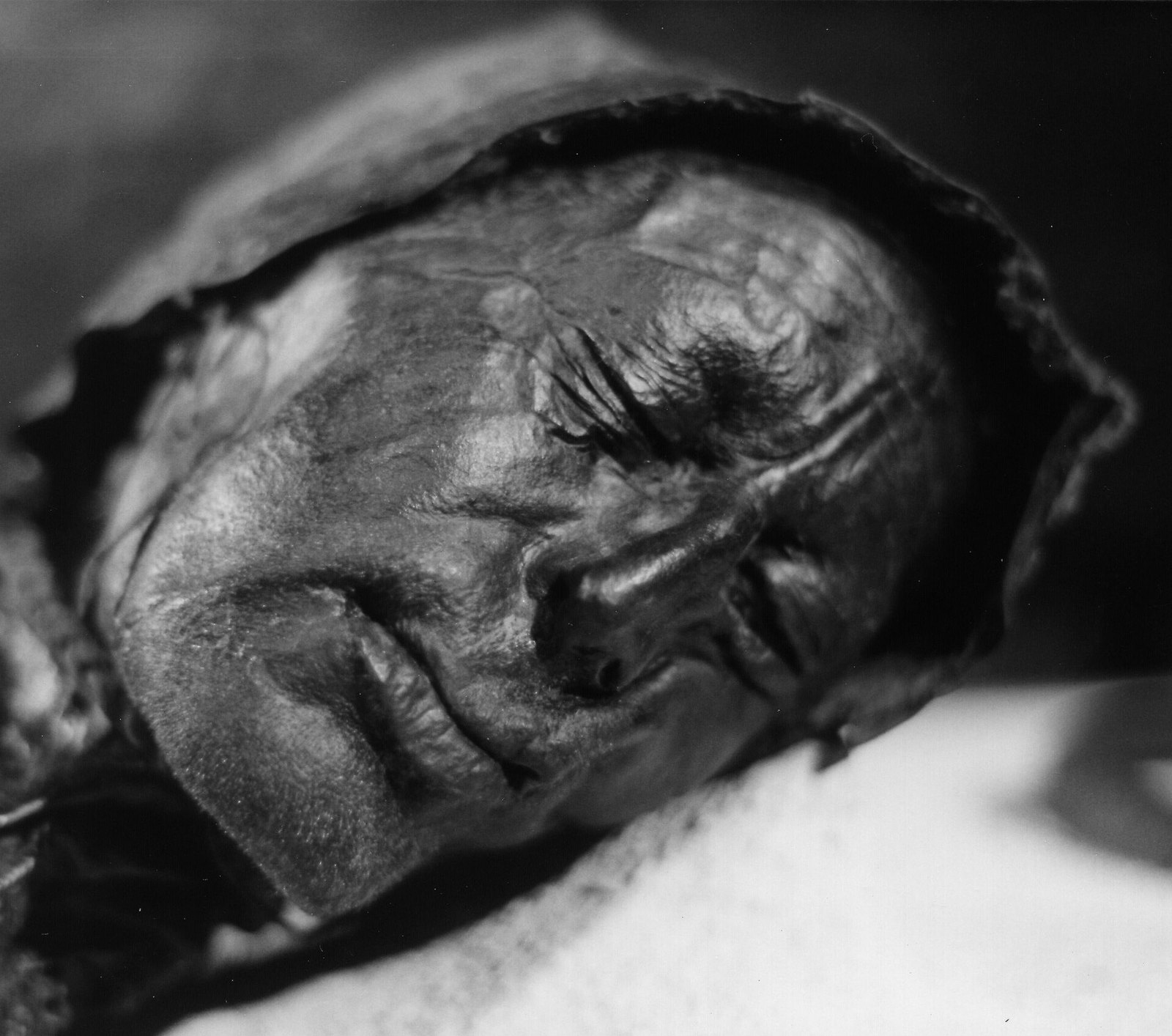
He lies on his right side with his knees drawn up and his eyes closed, a skin cap on his head and a plaited leather rope around his neck. When peat cutters came upon Tollund Man in a Jutland bog in May 1950, they called the police, convinced they had found the victim of a recent crime. In fact the man had been dead for about 2,400 years. He died in the pre-Roman Iron Age, more than eleven centuries before the first Viking ships put to sea. This article sorts out what is secure about the find, what laboratories have learned since 1950, and where interpretation begins: with the question of why.
Bjældskovdal is a boggy valley about ten kilometres west of Silkeborg in central Jutland. In the spring of 1950 a family from the nearby village of Tollund was cutting peat there for fuel: the brothers Viggo and Emil Højgaard and Viggo's wife Grethe. According to Museum Silkeborg it was Grethe Højgaard who noticed something odd in the peat. Her son John Kauslund, eleven years old at the time, later recalled that she kept digging and slid her fingers between the dead man's forehead and his cap. The brothers did not believe her at first.
Sources disagree on the date, and the disagreement has a simple explanation. Museum Silkeborg gives Saturday, 6 May 1950, as the day of discovery. The police in Silkeborg received the report on Monday morning, 8 May. Some accounts, the English Wikipedia article among them, therefore give 8 May as the date of the find.
The museum says the body lay about two and a half metres down in the peat and some 60 metres from firm ground. The police were told there was no sign of recent digging, and they took museum staff with them to the bog. That was no accident. An older find from the same bog was already known: a bog body had turned up there in 1938 and is now known as Elling Woman.
The police called in the archaeologist Peter Vilhelm Glob, then a professor at Aarhus. Standing at the site, Glob put the dead man's age at around 2,000 years. The name probably goes back to him as well: Tollund Man, after the finders' village rather than the bog. Glob made sure the body was not uncovered on the spot. It was lifted together with the surrounding peat and taken by horse-drawn cart and railway to the National Museum in Copenhagen, where the conservator Knud Thorvildsen excavated it.
The examination of 1950 was thorough by the standards of the day. There was an autopsy, and X-rays were taken. The brain had shrunk but was recognisable. Heart, lungs and liver had survived. The neck vertebrae were not fractured. Stomach and intestines were removed and their contents passed to a botanist. Almost everything known about the body as a whole dates from those few weeks, because as a whole it did not survive the years that followed.
Visitors to Silkeborg today see a complete human being who appears to be asleep. What is original is, above all, the head. In 1950 no method existed for reliably preserving an entire bog body, so the decision was taken to conserve selected parts only. For the head, conservators replaced the water in the tissue step by step – via alcohol, toluene and liquid paraffin – with warm beeswax. The head came out of the wax shortly before Christmas 1951 and returned to Silkeborg in June 1952.
The rest of the body dried out untreated and shrank. Parts were dispersed among several institutions. Both feet and the right thumb were placed in formalin after the examination. Only in the 1980s did Christian Fischer of Museum Silkeborg track most of the pieces down again. The body visitors see today is a reconstruction based on the excavation photographs: a wax model served as the master for a silicone mould, the cast is epoxy resin, and the real head sits on the replica. The English Wikipedia article, citing a paper of 1990, dates this reconstruction to 1986; 1987 is sometimes quoted as well. The museum's page on the conservation gives no year, so the date is not securely documented.
In 1976 the Danish police took a usable fingerprint from the thumb. In 2016 the right big toe came back after the daughter of a conservator got in touch; a CT scan confirmed that it belongs to the right foot. The internal organs, by contrast, are still missing.
Raised bogs are poor places for decay. The water is acidic, cold and almost free of oxygen, and peat moss (Sphagnum) releases substances that alter skin in a way similar to tanning. That is why Tollund Man kept his lips, nose, eyelids, eyebrows, wrinkles and stubble. The same acid attacks bone. Much of his skeleton had been decalcified and dissolved while skin and organs endured.
The reddish colour of his hair and beard is also the bog's doing and says nothing about his hair colour in life. How bogs preserve wood, leather, butter and whole arsenals is explained in our overview of sacrificial bogs; the curious lumps of fat buried in peat are the subject of our piece on bog butter.
Radiocarbon dating (C14) measures how much radioactive carbon is left in organic material and calculates the time of death from that. It has been applied to Tollund Man more than once. Older museum texts still say “about 350 BC”. The figure in general use today is death between 405 and 380 BC. It comes from the paper “Diet and Radiocarbon Dating of Tollund Man” by Nina H. Nielsen, Bente Philippsen, Marie Kanstrup and Jesper Olsen, published in the journal Radiocarbon in 2018. According to the abstract, the authors combined two new measurements on the thigh bone and a rib with an earlier one on the skin and arrived at 405–380 BC (calibrated, 95.4 per cent probability). The English Wikipedia article credits the range to a paper of 2004, which does not match that abstract. I have not read the full text.
The order of magnitude is secure. The man died in the early fourth century BC, in the pre-Roman Iron Age. In northern Europe that is the name for the stretch from roughly 500 BC to the turn of the era, when iron replaced bronze for tools and Rome meant nothing yet to people in Jutland. For orientation: when the Roman author Tacitus wrote his account of the Germanic peoples around AD 98, the dead man had already been in the peat for almost 500 years. Another 700 years passed before the raid on Lindisfarne in 793, the conventional start of the Viking Age.
So Tollund Man was not a Viking, nor was he “Germanic” in the sense of the Roman reports, which begin centuries later. Nobody wrote down what language he spoke or which gods he knew. There was no writing in his world. Our article on Germanic peoples and Vikings compared shows how far apart those terms lie.
The examination of 1950 put him at about 30 to 40 years old. Museum Silkeborg points to X-rays showing that his wisdom teeth had come through, and says his appearance fits a man of forty. The preserved body measured 161 centimetres. Because bog bodies shrink, the museum estimates his living height at about 164 to 167 centimetres.
His hair was cropped very short and almost entirely hidden under the cap. He was shaven. The stubble visible in every close-up is about a millimetre long, from which it is inferred that he had not shaved on the day he died; part of the effect is due to shrunken skin. There were scars on the soles of his feet. A study by Charlier, Nielsen and Lowenstein in 2017 described two small raised lesions consistent with plantar warts and a healed scar four millimetres long on the right sole. The authors themselves considered a definite diagnosis impossible.
Where did he live? According to a 2017 report in Smithsonian Magazine, strontium isotope analysis of his thigh bone and hair showed that he spent his final year within what is now Denmark and moved at least 32 kilometres during his last six months. Strontium enters the body through water and food and reflects the geology of a region. I know this result only from that report.
The dead man was naked apart from two things. On his head he wore a pointed cap of sheepskin and wool, tied under the chin with a hide thong. Round his waist was a smooth hide belt. The third item is the rope: a cord plaited from strips of hide, drawn tight around the neck as a noose. It had left deep furrows in the skin.
Why was there no other clothing? There is no secure answer. He may have been stripped before he was laid down. He may equally have worn clothes of plant fibre, linen for instance, which dissolved in the acidic bog while leather and wool survived. The find itself cannot settle the matter.
The autopsy of 1950 concluded that the man had been hanged rather than strangled. More than fifty years later the finding was re-examined with CT scanning and confirmed: the neck vertebrae were intact, but the tongue was swollen, as happens in hanging.
What happened afterwards matters more for interpretation. Someone took the dead man down, closed his eyes and mouth – so the museum judges – and laid him in a sleeping posture in an old peat cutting, with the rope still round his neck. Iron Age people were already digging peat for fuel, so the man was placed in a pit others had dug before him. Nor was it a funeral in the usual sense: in the early Iron Age the dead in Jutland were, as a rule, cremated. An unburnt body in a bog is the exception, and that departure from the norm is what calls for an explanation.
The gut contents were examined in 1950 by the botanist Hans Helbæk, whose study appeared in Aarbøger for Nordisk Oldkyndighed og Historie. He found the remains of a gruel of seeds and grains, chiefly barley, linseed, gold-of-pleasure and knotweed, along with seeds of other wild plants. Judging by the stage of digestion, the meal had been eaten twelve to twenty-four hours before death. Helbæk found no meat, and so the idea took hold that the condemned man's meal had been purely vegetarian, perhaps a special ritual dish of laboriously gathered wild seeds.
Seventy years on, a team led by Nina H. Nielsen of Museum Silkeborg went back to the stored samples. Their paper, “The last meal of Tollund Man: new analyses of his gut content”, appeared in Antiquity in 2021 (vol. 95, issue 383, pp. 1195–1212). This time the researchers looked not only at well-preserved grains but at plant fragments under the microscope, pollen and other microfossils, chemical markers and proteins. The result, according to the authors' summary: a grain-based porridge of barley, seeds of pale persicaria and flax, probably with some fish. The barley was six-rowed barley, an old cultivated form. Mixed in were black-bindweed, fat hen, hemp-nettle, gold-of-pleasure, corn spurrey and field pansy – and sand.
Three details bring the study to life. First, there were charred food crusts of the kind that form when porridge catches in a clay pot. Second, the porridge contained threshing waste: weed seeds and barley rachis segments that are normally removed in threshing and sieving. Third, eggs and proteins pointed to intestinal parasites – according to the summaries I have, whipworm, roundworm and tapeworm. Such infections come from contaminated water or undercooked meat.
What follows from this? The authors think it possible that the meal was simply ordinary Iron Age food. According to press coverage they found no trace of intoxicating or pain-relieving additives. The threshing waste, on the other hand, might be connected with ritual practice, as an ingredient for special occasions. The researchers say the data are too thin to decide. What people in the North were eating more than a thousand years later is covered in our article on the Viking diet – barley porridge was still on the menu.
There are two camps on this question and good reason to join neither completely. Museum Silkeborg leans towards sacrifice: the man was offered to a deity, perhaps one thought to dwell in the bog. The arguments are the careful deposition, the closed eyes, the departure from cremation, and the place. In the Iron Age bogs were where people sank vessels, wagons, jewellery and, later, entire sets of weapons.
The opposing view reads the rope as the mark of a punishment. Hanging is a classic method of execution, and Tacitus names it explicitly as the penalty for traitors and deserters. On this argument Tollund Man was a condemned man whose corpse was excluded from the company of the properly buried.
The body itself cannot tell the two apart. A rope looks the same on a sacrificial victim as on a hanged criminal. Nor is it certain that Iron Age people drew the line where we do. A condemned man may have been handed over to a deity; a victim may have been chosen from among the guilty or the unfree. Anyone who calls Tollund Man a “human sacrifice” is stating the interpretation specialists find most likely, not a finding. The full range of evidence – from the bogs to the medieval reports about Uppsala – is set out in our articles on Germanic sacrifices and on human sacrifice among the Vikings.
Two passages from Tacitus's Germania are quoted for almost every bog body. Chapter 12 deals with punishments decided in the assembly:
“Traitors and deserters are hanged on trees; the coward, the unwarlike, the man stained with abominable vices, is plunged into the mire of the morass, with a hurdle put over him.”Tacitus, Germania, ch. 12, translated by A. J. Church and W. J. Brodribb (London 1877)
In chapter 40 Tacitus describes the cult of the goddess Nerthus. After her procession the wagon and, as he adds with audible reserve, the deity herself are washed in a secluded lake; the slaves who perform the service are then swallowed by that same lake.
Both passages fit temptingly well, and on closer inspection both fit badly. Tacitus wrote around AD 98, almost half a millennium after Tollund Man died. As far as is known he never travelled in Germania himself and relied on the reports of others. Chapter 12, moreover, keeps apart what the find combines: hanging happens on a tree, sinking happens in the swamp. Tollund Man was hanged and lies in a bog. He matches neither penalty exactly. And in chapter 40 the slaves are drowned, not hanged.
Tacitus therefore shows that an educated Roman around AD 100 had heard of executions in swamps and of ritual killings among northern peoples. He shows nothing about a deed in Bjældskovdal around 400 BC. As a frame that indicates which possibilities deserve consideration at all, he remains useful. More on the goddess and her lake in our article on Nerthus.
Tollund Man was not alone in Bjældskovdal. Twelve years before him, in 1938, Elling Woman had been found there, only about 50 metres away according to Museum Silkeborg. She too was hanged, and she dates from roughly the same period. The museum displays the two together and considers sacrifice likely in her case as well. Two hanged people of the same era in the same bog: that can be read as a repeated act at a particular place. Whether days or decades separated the two deaths is something radiocarbon dating cannot resolve at this level of precision.
The third well-known body from the region is Grauballe Man, found in 1952 and now in Moesgaard Museum near Aarhus. His throat was cut. Unlike Tollund Man, his entire body was conserved, as far as I am aware. His story, and that of the “Windeby Girl”, who on re-examination proved to be probably an adolescent boy with no clear signs of violence, is told in the bog-body section of our article on sacrifices.
Bogs in Jutland were used for depositions over many centuries, but not always for the same kind. The great weapon sacrifices, in which the equipment of defeated armies was destroyed and sunk, belong mostly to the Roman Iron Age, centuries after Tollund Man; see army sacrifices in the bog and Illerup Ådal. An example of a cult site with a long life on German soil is the sacrificial bog of Oberdorla.
Tollund Man's head has been on show at Museum Silkeborg since 1952, today alongside Elling Woman in an Iron Age exhibition that also includes replica clothing, hairstyles and iron-smelting furnaces. It was P. V. Glob himself who made him known internationally, with his book “Mosefolket” of 1965 (in English as “The Bog People”, 1969), which was translated into many languages and popularised the sacrifice interpretation.
Through that book the Irish poet Seamus Heaney came to write “The Tollund Man”, published in the collection “Wintering Out”. Heaney sets the dead man from Jutland beside the victims of violence in the Northern Ireland of his own day. In 1973 he visited Silkeborg and wrote an excerpt in the exhibition's guest book.
How old is Tollund Man? Radiocarbon dating puts his death between 405 and 380 BC, so he lay in the bog for about 2,400 years. He was roughly 30 to 40 years old when he died.
Where can you see him? At Museum Silkeborg in central Jutland, Denmark. The head and a few smaller parts are original; the body was recreated in the 1980s.
What did he die of? He was hanged. The plaited hide noose was still around his neck, and the medical examinations of 1950 and after 2000 agree on this.
Was he a human sacrifice? Probably, but it is not proven. The careful deposition in the bog and the departure from the usual cremation speak for sacrifice. An execution cannot be ruled out, and the two need not be mutually exclusive.
What does Tollund Man have to do with the Vikings? In terms of time, nothing. He lived in the pre-Roman Iron Age, almost 1,200 years before the Viking Age began. All they share is the landscape – and the fact that bogs and waters in the North remained places for depositions over a very long time.
Sacrificial Bogs & Bog Finds · Germanic Sacrifice & Sanctuaries · Nerthus – the earth goddess · The bog army-offerings · Bog Butter – Storage Pit or Votive Gift? What the Finds Say and What They Do Not.
All History & Finds articles →
The Torslunda plates are four cast bronze dies from the 6th to 7th century, found in 1870 at Björnhovda in Torslunda …
Read more →The Toxandrians are a tribe about whom we know almost nothing, attached to a landscape about which we know a surprising …
Read more →Almost everything we know about Travunia comes from a single chapter of a Byzantine emperor's handbook for his son — …
Read more →The Trebovane are a name between two commas. It stands in the list of peoples along the northern edge of the diocese of …
Read more →