The Breisgau in south-west Germany still bears their name, yet the Brisigavi themselves are hard to pin down. No ancient author tells their story. Their name appears in a Roman register of offices, as the title of two infantry units. This article examines what follows from that, why the frequently repeated claim that Ammianus Marcellinus names them is wrong, and what the Zähringer Burgberg reveals about the people of the Upper Rhine in the fourth and fifth centuries.
Handbooks and encyclopaedias call the Brisigavi an Alamannic sub-group, settled in what is now the Breisgau, the strip of land between the Rhine and the Black Forest around Freiburg. The Alamanni of the third and fourth centuries were not a single kingdom but a network of groups with their own kings. Roman writers named some of them. The Lentienses near Lake Constance, the Bucinobantes opposite Mainz and the Iuthungi on the Raetian frontier all appear in narrative texts. The Brisigavi do not.
That is exactly what makes the subject interesting. Writing about the Brisigavi means writing about a gap. The written evidence essentially consists of one text, the Notitia Dignitatum, and there the name appears not as a people but as the name of soldiers serving Rome. Everything else is combination: a later regional name, a king whom Ammianus Marcellinus locates roughly, and hilltop sites on the Black Forest edge. These pieces fit together, but they are not an account of the Brisigavi.
A second problem: English Wikipedia and some regional publications state that Ammianus names the Brisigavi and that their king was Vadomarius. Checked against the full Latin text, this is not correct.
The Notitia Dignitatum is a list of the senior civil and military offices of the Roman Empire, divided into eastern and western halves, with the troops under each command. Its western part is usually dated to the early fifth century. It survives only in Renaissance copies that go back to a lost Carolingian manuscript from Speyer. The lists give no troop strengths and contain several duplicates, units that appear in two places.
The list includes two units called Brisigavi (spelled Brisigaui in the manuscripts): the Brisigavi seniores and the Brisigavi iuniores. Both belong to the auxilia palatina, a class of elite infantry in the late Roman field army. They served not on the frontier but with the mobile field armies.
The units appear in two chapters of the western section. One is the chapter on the magister peditum praesentalis, the senior infantry commander in the West, to whom the troops formally belonged. The other is the so-called Distributio, a breakdown showing which command actually held each unit. There the Brisigavi iuniores are listed under the heading Intra Italiam, with the field army in Italy, while the Brisigavi seniores sit under the comes Hispaniarum in Spain. The exact references that circulate in the literature (Occ. V.52–53 and 201–202, Occ. VII.25 and 128) I have not checked against Otto Seeck's edition myself; I have seen them only in secondary sources.
The Notitia also gives a painted shield design for each unit. For the Brisigavi seniores it is a white field with a red rim and coloured rings around the boss; the manuscripts differ in detail. Whether such images faithfully reproduce late Roman shields is disputed, since the Renaissance painters were copying a copy.
Many Notitia units come in pairs, with the epithets seniores ("the elder") and iuniores ("the younger"). A widespread explanation links this to the division of the army between the imperial brothers Valentinian I and Valens in 364: the senior half of a divided unit stayed with the higher-ranking emperor, the junior half went to the other. The model is associated above all with Dietrich Hoffmann's study of the late Roman field army (1969); I know it only at second hand, and it remains disputed. For the Brisigavi it tells us only this much: at some point before the list was compiled there were at least two units of that name.
A more important question is what a unit name says about the soldiers' origins. In late antiquity Rome named many units after peoples from whom they had originally been recruited. The Batavi, the Heruli, the Mattiaci and the Brisigavi stand in the same lists. Such a name attests a founding moment, when men from a group of that name were enlisted. It does not mean that men from the Breisgau still served in it around 400; units recruited from anywhere, and the name stayed.
When the Brisigavi units were raised is not recorded. The Notitia gives no founding date. Anyone who suspects Valentinian I, who fought and built intensively on the Upper Rhine between 364 and 375, has a plausible argument but no proof. The same applies to earlier dates under Constantius II or Julian. This cannot be firmly established.
A comparison: after their defeat in 378 the Lentienses had to hand over recruits to be mixed in with Roman troops (Ammianus 31.10.17). The Brisigavi units may go back to a similar arrangement. That is not attested.
Ammianus Marcellinus is the principal narrator of the Alamannic wars of the fourth century. A former officer from the eastern empire, he wrote in Rome around 390; his surviving books 14 to 31 cover the years 353 to 378.
Because several accounts claim that Ammianus names the Brisigavi, I searched the Latin text of books 14 to 31 in a complete digital edition for every spelling: Brisigavi, Brisgavi, Brisigaui and related forms. The result is clear. The name does not occur in Ammianus. The only word beginning with "Bris-" is a Persian river called Brisoana in his description of Persia.
What Ammianus does name are the Lentienses (15.4.1 for the year 355 and 31.10 for 378), the Bucinobantes, "an Alamannic people opposite Mainz" (29.4.7), and the Iuthungi, "a part of the Alamanni bordering on Italy" (17.6.1). He speaks of pagi, a Latin word for districts or cantons, meaning Alamannic territories. The Brisigavi do not belong to this list. Anyone who includes them as an Ammianean group is probably confusing the modern location of a king in the Breisgau with an actual mention of the name.
That king is Vadomarius, in German usually Vadomar. His link to the Breisgau is a modern inference, not a statement of the text. It rests on a single half-sentence, which is also the most important geographical clue antiquity offers for this area.
"And immediately after them King Vadomarius also came, whose abode was opposite Augst: and having produced some letters of the Emperor Constantius, in which he was strictly recommended to the protection of the Romans, he was courteously received, as became one who had been admitted by the emperor as a client of the Roman empire."Ammianus Marcellinus, Res gestae 18.2.16 (year 359), translated by C. D. Yonge (Bohn's Classical Library), Perseus digital edition; Latin: "cuius erat domicilium contra Rauracos"
"Opposite Augst" translates the Latin contra Rauracos, "opposite the Rauraci": on the right bank of the Rhine facing the territory of Augusta Raurica, today Augst and Kaiseraugst east of Basel. That covers the Markgräflerland and the southern Breisgau but leaves open how far north Vadomarius' territory reached. Freiburg lies a good sixty kilometres north of Augst as the crow flies. Ammianus does not say whether Vadomarius' people called themselves Brisigavi. The identification is natural but unproven.
Vadomarius is the best-documented Alaman of this region, and his career shows how closely the frontier society of the Upper Rhine was bound up with Rome. Ammianus first mentions him under the year 354. Emperor Constantius II marched from Arles against the brothers Gundomadus and Vadomarius, "kings of the Alamanni", whose raids were devastating the Gallic border lands (14.10.1). Near Rauracum, that is Augst, the Romans tried to build a pontoon bridge across the Rhine and were prevented by a crowd of Alamanni (14.10.6). The campaign ended in a treaty concluded "according to the customs of the Alamanni" (14.10.16).
Three years later, in 357, the Caesar Julian fought the great battle of Strasbourg against a coalition of Alamannic kings under Chnodomarius. Gundomadus had shortly before been killed by treachery; his people then joined Rome's enemies, and Vadomarius' plebs, his followers, did the same, against his will, as he claimed (16.12.17). Ammianus does not say whether Vadomarius himself fought at Strasbourg.
In 359 Vadomarius appears during Julian's campaign as a petitioner for himself and an intercessor for other kings (18.2.16–18). Two years later, in 361, Alamanni from "the district of Vadomarius" raided Raetian territory (21.3.1), and a Roman count named Libino was killed. Rumour, which Ammianus reports as such, had it that Constantius had secretly ordered the raids. Julian had the king arrested at a banquet on the left bank of the Rhine and sent to Spain (21.4.1–6).
Then comes a turn that says much about the age. Vadomarius made a Roman career. Ammianus later calls him a former dux of Phoenice in today's Lebanon, the commander of a frontier province (21.3.5). In 365 Emperor Valens sent him against the usurper Procopius to besiege Nicaea (26.8.2), and in the early 370s he led troops against the Persians together with Count Traianus (29.1.2). The Upper Rhine king ended as an Eastern officer.
His son Vithicabius stayed at home and kept fighting Rome. Ammianus describes him as bold and warlike, though sickly in appearance. Since he could be neither defeated nor betrayed, a Roman bribed his closest servant, who killed him (27.10.3–4). Elsewhere Ammianus attributes this murder to Valentinian I (30.7.7). By the arrangement of the work it falls around 368. The claim sometimes found that Vadomarius himself was murdered by his own people in 368 confuses father and son and cannot be reconciled with Ammianus.
That Ammianus names some groups and identifies others only through their kings is no accident: Rome negotiated with kings, not peoples. That is why Ammianus records many royal names, among them Chnodomarius, Serapio, Hortarius, Suomarius, Macrianus, Hariobaudus, Urius, Ursicinus and Vestralpus, but few group names.
The group names he does give share one feature: they describe people with a fixed position relative to the frontier. The Bucinobantes sit "opposite Mainz", the Lentienses border Raetia, the Iuthungi border Italy. A name like Brisigavi, if it was already in use in the fourth century, would be of the same kind: a name taken from a landscape. Notably, groups with such names also appear as unit names in the Notitia. For the Bucinobantes it lists a unit in the eastern empire, for the Brisigavi two in the West.
A group called the Raetovarii is occasionally mentioned as well. Ammianus does not name them; I could not check the rest of their source basis.
The northern border belongs in the picture too. For 359 Ammianus describes boundary stones at a place called Capellatum or Palas, marking off the territory of the Alamanni from that of the Burgundians (18.2.15). So the Alamanni were organised territorially towards their neighbours. Whether individual Alamannic districts had equally fixed borders among themselves remains open.
The name Brisigavi is usually split into two parts. The second, "-gavi", corresponds to the Germanic word for a district or region, which appears in Old High German as gewi or gouwi and survives in modern German Gau. The Brisigavi would then be "the people of the Brisi district". The first part is harder. The usual interpretation connects it with Breisach, the Roman Mons Brisiacus on a volcanic rock above the Rhine. The Breisgau would be the district around Breisach, and its inhabitants would have been named after that prominent landmark.
This derivation is obvious but not the only one. Place-name scholars have discussed a Celtic element brisi(o)-, which might also lie behind Brisiacum itself; the Breisach name would then be older than the Alamanni and taken over from the pre-Roman population. A further interpretation reported in English Wikipedia, "place of the leftovers of pressed grapes", looks to me like an individual proposal whose basis I could not check. Only the similarity of the names is certain. Which name produced which cannot be firmly established.
It is equally unclear when the group name became a regional name. The region appears as "Brisgau" and similar forms in early medieval charters; I have not verified the date of the first mention. Several centuries lie between the Notitia and those charters.
For the people of the Breisgau in the fourth century, the Rhine was the border with the Roman Empire. After the Upper German-Raetian limes was given up in the second half of the third century, Roman defence fell back to the Rhine, Lake Constance, the Iller and the Danube. The land east of the Rhine now belonged to Alamannic groups, the west bank remained Roman. Yet the frontier was no wall. Ammianus describes bridge-building, embassies and banquets on the other side. Vadomarius crossed the river in 361 to dine with a Roman officer and was arrested there.
Breisach itself was a Roman post on the Rhine, named as a station in ancient road itineraries. How exactly the river ran around the hill of Breisach in Roman times is debated; I have not looked into that here. A memorial plaque in Breisach records that Emperor Valentinian I was there on 30 August 369 and signed a law whose closing formula gives the place and date. Which constitution of the Theodosian Code this is, I know only from the plaque and have not checked against the Code itself.
For 374 Ammianus reports that Valentinian, after laying waste some Alamannic districts, "was building a fortress near Basle, which the natives of the country call Robur" (30.3.1, Yonge). The emperor was building directly opposite the territory associated with Vadomarius and his son. In these years the Upper Rhine between Basel and Breisach was one of the most heavily fortified stretches of the imperial frontier. That is the attested core of the regional story: the river was contact zone and military frontier at once. The article on Germanic peoples in the Rhineland takes another look at the Rhine as a border between peoples.
When the written sources fall silent, the ground sometimes speaks. In the Breisgau the key site is the Zähringer Burgberg north of Freiburg, best known today as the site of the medieval castle of Zähringen. Freiburg archaeologists around Heiko Steuer and Michael Hoeper investigated Migration Period hilltop settlements there and on other hills along the western edge of the Black Forest. Photo captions in a regional publication date excavations on the Zähringer Burgberg to 1989; later campaigns are likely, but I have not checked their dates.
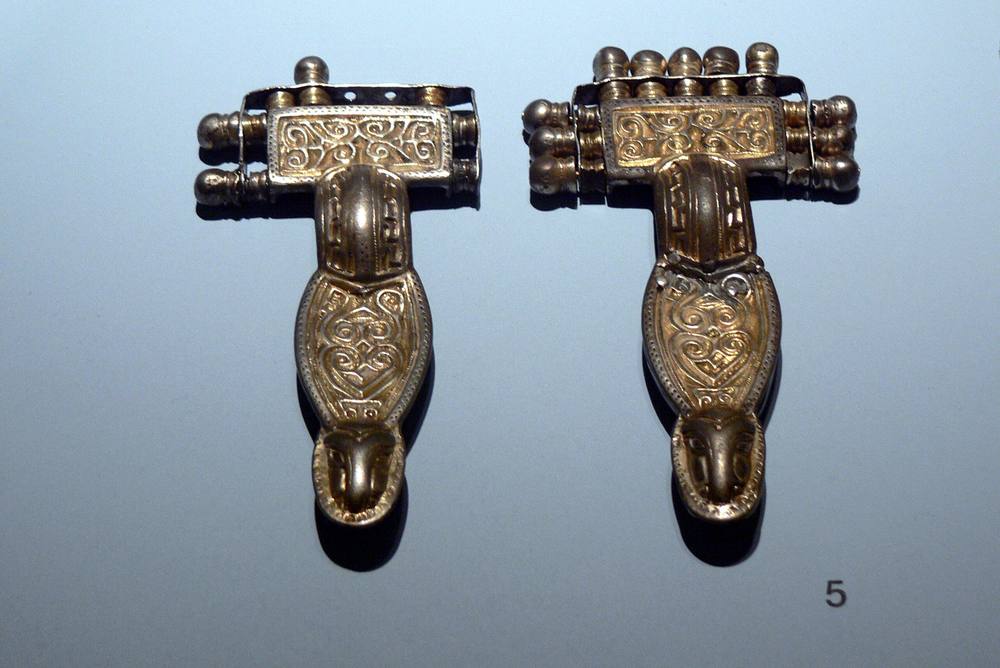
The finds include strap ends and fittings from late Roman military belts as well as jewellery worn by men and women. In Alamannic territory such belts show contacts with the empire: service, gifts or booty. Researchers interpret sites such as the Zähringer Burgberg and the Runder Berg near Urach as probable seats of retinue leaders, the men Ammianus calls "kings". "Probable" is the right word. There is no inscription assigning the hill to a particular king, let alone to Vadomarius.
The finds belong broadly to the fourth and fifth centuries, matching the Notitia units and Vadomarius in time. That does not prove that the people on the hill called themselves Brisigavi. Archaeology yields traces of life, not self-designations.
Two further hilltop sites are often mentioned in the same breath as the Zähringer Burgberg, but they lie not in the Breisgau but further north in the Ortenau, where the Kinzig valley opens onto the Rhine plain. The Geißkopf near Berghaupten rises about 200 metres above the plain. Since 1989 parts of late antique military belts have been found there; the finds attest use in the fourth and fifth centuries.
According to the summary of work by Steuer and Hoeper, more than 1,300 iron or bronze objects are scattered across the surface: spearheads, axes, arrow and bolt heads, belt parts, Germanic and Roman brooches and many tools for woodworking and metalworking. Some spearheads are bent. Pottery and women's jewellery are almost absent, so the excavators interpret the Geißkopf as a purely military camp, unlike the Kügeleskopf north of the Kinzig. Whether Romans, Alamanni or mixed forces camped there remains open.
For the Brisigavi these sites matter only indirectly: they belong to the same world, not necessarily to the same district.
The afterlife of the Brisigavi is above all geographical. The name outlasted late antiquity as a regional term and in the Middle Ages became the name of a district and later of a territorial lordship. If the usual interpretation is right, "Breisgau" is a word that already denoted a group of people in late antiquity.
A second strand is the castle on the Zähringer Burgberg, after which the high medieval house of the Zähringer named itself. The family has nothing to do with the hill's late antique inhabitants; only the place connects them.
The Alamanni as a whole were absorbed into the Frankish realm after their defeats by the Franks around 500. What that meant for the Breisgau group in particular is not recorded. Their units in the Roman army vanish from the sources with the end of the western Roman army.
Who were the Brisigavi? An Alamannic group named after the Breisgau. In writing the name is attested only as the title of two Roman infantry units in the Notitia Dignitatum. Their settlement history is inferred from the regional name and from archaeology.
Does Ammianus Marcellinus mention the Brisigavi? No. The name is absent from the surviving text. Ammianus does mention King Vadomarius, whose home lay "opposite the Rauraci", that is opposite Augst. Many scholars therefore link him with the southern Breisgau.
Where does the name Breisgau come from? The common explanation derives it from Breisach (Mons Brisiacus) and the Germanic word for a district. A Celtic name element is also discussed. Which explanation is right has not been settled.
Are there archaeological traces of the Brisigavi? There are traces of people in the fourth- and fifth-century Breisgau, above all the hilltop settlement on the Zähringer Burgberg. Whether its inhabitants called themselves Brisigavi cannot be shown by archaeology.
Do the Brisigavi have anything to do with the Vikings? No. They belong to the West Germanic Alamanni of the fourth and fifth centuries, several centuries before the Viking Age. The article Germanic peoples and Vikings explains the difference.

The Alemanni · The Lentienses · The Bucinobantes · The Juthungi · Germanic Tribes of the Rhineland.
All History & Finds articles →
The Britons were not one nation but a web of Celtic peoples that Rome conquered step by step from AD 43. The greatest …
Read more →The Brizani are said to be the Slavic tribe of the Prignitz and the area around Havelberg. Anyone looking for them …
Read more →Yes, Scandinavia really had horned helmets – but in the Bronze Age, not the Viking Age. The two bronze helmets from …
Read more →In the first century the Bructeri lived between the Lippe and the Ems, in country that is now part of Westphalia. Roman …
Read more →