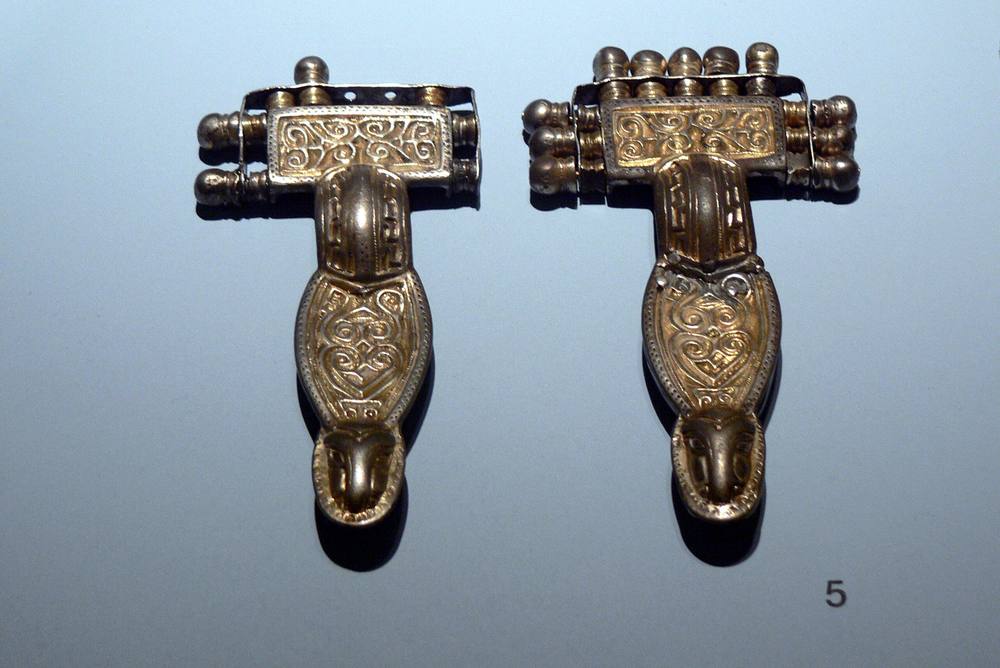
One February, a band of warriors crosses the frozen Rhine because a countryman in Roman service has talked too freely at home: the young emperor Gratian, he said, would soon march east. That is the trigger of the Lentiensian war as Ammianus Marcellinus tells it. Together with an earlier campaign in 355, it is practically everything ancient writers preserve about this Alamannic people. This article sets the two reports side by side, tests what is secure, explains the link to the Linzgau north of Lake Constance, and says openly where scholarship only has conjecture: this cannot be established with certainty.
The Lentienses, Latin Lentienses, belonged to the Alamanni, the confederation that from the third and fourth centuries AD occupied and harried the Roman frontier zone between the Rhine, the Main and the upper Danube. We know their name from exactly one ancient source: the history of Ammianus Marcellinus, born around 330, an officer who served in the Roman East and West and who finished his Res gestae (“Deeds”) in Rome late in the fourth century. He names the Lentienses twice, in Book 15 (chapter 4) for the year 355 and in Book 31 (chapter 10) for 378. I know of no other contemporary mention, and the reference works cite only these two passages.
That is a thin foundation, and it is worth saying so from the start. Anyone writing about the Lentienses writes about two episodes seen through a Roman narrator’s eyes, about a district name that appears in charters centuries later, and about conclusions that join the two. The Lentienses left no testimony of their own. No inscription, tombstone or letter names them. How they called themselves, or whether they saw themselves as a people at all, is unknown.
Ammianus classifies the Lentienses in a similar way both times. In 355 he speaks of “the Lentienses, Alamannic districts” (Lentiensibus, Alamannicis pagis); in 378 of “the Lentiensian Alamannic people, bordering the districts of the Raetiae”. Two things stand out. First, he uses the Latin word pagus, which means a district or canton: a sub-unit, not a large nation with a king and a capital. Second, he places them next to Raetia, the Roman province in the Alpine foreland and the southern Danube region. Whether he means the land directly north of Lake Constance or a wider country between the lake, the Iller and the Danube, he does not say.
Scholarship has assembled these hints into a settlement area. The handbook articles on which the reference works rely think of the region between the Danube, the Iller and Lake Constance. This is an inference from Ammianus’s border remark, from the geography of the two campaigns and from the place name Linzgau. The source itself gives no coordinates. The land north of the lake had belonged to the Roman empire; Roman rule there receded in the third century. What came afterwards is hard to grasp archaeologically, and I return to it below.
A caution: the name Lentia is Celtic, and several places carry it. Roman Lentia on the Danube is today’s Linz in Austria and has nothing to do with the Lentienses, even if the names may go back to a similar root. Anyone looking for the Lentienses in Upper Austria is following no source.
The first mention belongs to a troubled year. In summer 355 the general Silvanus had been proclaimed emperor at Cologne and was overthrown within a month; the emperor Constantius II was residing in Milan. Ammianus opens the fourth chapter of Book 15 with the end of that affair and goes on: shortly afterwards war was declared on the Lentienses, an Alamannic district that kept breaking into Roman border land.
The emperor set out and reached Raetia and the Campi Canini, the “Dog Fields”. Exactly where this plain lay is not settled in scholarship; I could not locate it with confidence and name it only. After long deliberation, Ammianus says, it was decided that the master of the horse Arbetio should march with a strong part of the army “along the margins of Lake Brigantia” (relegens margines lacus Brigantiae) against the enemy. Brigantia is the Roman name of Lake Constance, after the settlement Brigantium, today’s Bregenz.
Here Ammianus interrupts his narrative for a digression on the Rhine, which rushes down from high mountains, enters the lake without mixing its water with the lake’s, and leaves it on the other side. He describes the lake as round, vast, ringed by gloomy forests and almost inaccessible, and credits the effort of earlier Roman generations that a road exists at all. That is ancient geography with literary ambition; the dimensions (he gives about 460 stadia in length) are not measurements. For the Lentienses it shows only that the country where Ammianus places them lies on the north shore of a barely developed Alpine lake.
The action is quickly told. Arbetio advances and, says Ammianus, falls into an ambush. The Alamanni, who had been hiding, spring out unexpectedly. The Roman troops are scattered, run, regroup, and beat their opponents in a later engagement. The emperor then returns to Milan to take up winter quarters. Ammianus reports the outcome briefly.
What matters for the question of what we know about the Lentienses: the report names no numbers, no leader, no place for the fight and no Lentiensian losses. It does not say whether the Lentienses were subdued or whether Arbetio merely saved his skin. Some accounts speak of a successful punitive action; Ammianus is more guarded, and whether one can take a real victory from him is a matter of reading.
After that the thread breaks. In the following books Ammianus describes at length Julian’s wars against the Alamanni, including the battle of Strasbourg in 357, where Chnodomar, Serapio and other Alamannic kings appear. The Lentienses do not figure in it, as far as the surviving text shows. They also stay in the background in the campaigns of Valentinian I against Macrianus and his Bucinobantes. It cannot be concluded that they were peaceful in those years. It means only that Ammianus does not mention them, and his interest followed the great confrontations on the middle and lower Rhine.
When he returns to them in 378, he treats them as known. They had broken a long-standing treaty, violato foedere dudum concepto, “a treaty concluded long before having been violated”. Which treaty he means, he does not say. An agreement after the campaign of 355 is possible, a later one equally. This cannot be established with certainty.
Book 31 deals with the Gothic war and ends with the catastrophe of Adrianople in August 378. Before that Ammianus inserts a western episode: while in the East the Goths ravaged the Balkan provinces, Gratian, the western emperor, received a plea for help from his uncle Valens and prepared to march east. This intention, Ammianus says, became known to the Alamanni. A man of that people serving among the emperor’s bodyguards (inter principis armigeros militans) had gone home on private business and let slip what he knew. The Lentienses seized on the news.
It is a vivid tale, but also one that raises questions. Where Ammianus got it, he does not say. It explains why the raid came in this particular winter, and it turns the incident into a lesson about secrecy. Whether the talkative guardsman existed nobody can check. That Alamanni served in Roman guard units, on the other hand, is well attested; in the fourth century groups from across the Rhine supplied soldiers to the Roman army. The anecdote is plausible, not proven.
In February, Ammianus says, armed bands tried to cross the Rhine, which frost had made passable (Rhenum gelu peruium pruinis Februario mense). Celtic troops, the Celtae, were camped there together with the Petulantes, two auxiliary units of the Roman army. They threw the attackers back, not without losses of their own.
After the Lentienses had been repulsed at the Rhine, Ammianus says, they still knew that most of the Roman army had marched towards Illyricum. That made them angrier, and they drew the population of their villages together into one host. Ammianus gives two figures: 40,000 armed men, or 70,000, as some boasted in order to magnify the emperor’s glory. That he labels the higher number an exaggeration is remarkable. Ancient figures for barbarian armies are generally hard to verify, and even the lower one should be read with care.
Gratian recalled the cohorts he had sent ahead to Pannonia, gathered the troops left in Gaul and placed them under the command of Nannienus. With him was the Frankish king Mallobaudes. Ammianus draws the two as a contrast: Nannienus weighed the changing fortunes of war and wanted to wait; Mallobaudes, as usual, pressed for attack. The place of the battle is called Argentaria in Ammianus. The horns called to battle, and arrows and javelins struck many on both sides.
Then, the report goes on, the Roman soldiers, faced with the enormous superiority, avoided open combat, spread out along narrow, tree-lined tracks and held firmer there. Their armour flashed from afar, and the Alamanni, believing the emperor himself was approaching, grew afraid. They fled and turned to fight only when there was no other way out. By Ammianus’s estimate no more than 5,000 escaped into the dense forests. Among the dead was King Priarius, who, Ammianus writes, had incited the deadly fight.
Brief accounts circulate figures of 31,000 Alamanni killed and 9,000 escaped. These numbers are not in Ammianus as I read him in Rolfe’s English translation, and I found no source for them. I do not adopt them.
Ammianus writes Argentaria; other sources know a place Argentovaria in Upper Alsace. The usual identification points to a site near Colmar, as English Wikipedia has it. German Wikipedia instead names Oedenburg-Biesheim near Neuf-Brisach, where excavations have uncovered a Roman settlement. This is a dispute in scholarship that I cannot decide: both places lie in Alsace a few dozen kilometres apart, and Ammianus gives too few hints to choose. That the battle took place in Upper Alsace is nonetheless the prevailing reading. It was fought west of the supposed Lentiensian country, on the left bank of the Rhine, which fits a force that had pushed across the river and was not fighting at home.
After the defeat, Ammianus says, the remnants of the Lentienses fled into rugged hills and occupied the cliffs. There they tried to protect their goods, their wives and their children, whom they had brought along. That is a significant detail: people who take women and children on a raid are not planning plunder alone but a resettlement or a longer occupation. Whether it was meant so, Ammianus does not spell out. Scholars sometimes read the presence of families as a sign of land-taking intent; that is an interpretation, not evidence.
Gratian had about 500 seasoned soldiers chosen from each legion to storm the heights, which were as hard to take as city walls. The emperor fought in the front rank, which encouraged the attackers. The fight lasted from midday into the night, with heavy losses on both sides. Then Gratian’s council concluded that a frontal assault was too costly and that the enemy should be surrounded and starved out. The Lentienses moved to higher mountains, Gratian followed. At last, Ammianus says, they saw that the emperor was set on destroying them, begged for mercy and submitted. As ordered, they handed over their young fighting men, who were mixed into the Roman recruits. The rest were allowed to go home unpunished.
Defeat followed by a levy of recruits is known from other cases: Rome demanded young men as soldiers from beaten groups. The Lentienses cease to appear as opponents and, if you like, appear as a reservoir for the Roman army. Where the recruits went and what they were later called is not recorded.
For 378 Ammianus gives only one fixed date: the February in which the Lentienses tried to cross the Rhine. When the battle at Argentaria took place and when Gratian left Trier for the East is disputed. For a long time the departure was dated shortly after 20 April, following Otto Seeck and a law in the Theodosian Code (8.5.35). Jan Willem Drijvers and Hans Carel Teitler proposed in 2019 in the journal Historia (vol. 68, pp. 115–124) that Gratian left only after 1 June 378; they rely on another law (Theodosian Code 1.15.9) and place the events in June and July. Short accounts name May instead. I have read the article only in summary and cannot test its arguments in detail. For the Lentienses this means: the February thrust at the Rhine, the battle and the siege belong to spring or summer 378, and an exact sequence is not secure.
The name Lentienses goes back to a word Lentia, a Celtic name. The usual interpretation derives it from a river now called the Linzer Aach, north of Lake Constance; the village of Linz, today part of Aach-Linz, still bears the pre-Germanic form. The word would then not be Germanic but taken over from the older Celtic population. I could not verify a secure meaning of the word and therefore give none.
As a district name the Linzgau appears late in documents. A charter of the monastery of St Gall names a Count Warin in 764, and in 771 the formula in pago Linzgauvia occurs there, the first documented use of the district name. The area lies between the Hegau and the Argengau, north of Lake Constance, with places such as Überlingen, Markdorf, Meersburg and Salem. From 1135 the counts of Heiligenberg held the landgraviate of Linzgau, in 1277 the counts of Werdenberg followed, in 1535 the Fürstenbergs. In the early nineteenth century the region fell to Baden, and the name became a synonym for the district of Überlingen.
What links Lentienses and Linzgau? The common assumption: both go back to the same Celtic river name, and the Lentienses were named after the Lentia landscape. That the group also lived exactly there in the fourth century is not thereby proven. Their migration-period settlement area cannot be reconstructed according to current research; it was probably larger than the later Linzgau.
“… the Lentienses, an Alamannic people bordering the districts of Raetia, had broken the treaty concluded long before by treacherous raids …”Ammianus Marcellinus, Res gestae 31.10.2 (Lentiensis Alamannicus populus, tractibus Raetiarum confinis, per fallaces discursus uiolato foedere dudum concepto); own translation from the Latin, based on a short text excerpt I read
The land north of Lake Constance is well researched archaeologically but strikingly poor for the period that interests us here. The Linzgau shows settlement traces since the Mesolithic, lake dwellings on the shore and at the Egelsee near Ruhestetten, Hallstatt-period burial mounds at Hödingen, Salem and Stetten that point to a Celtic population, and a late Celtic Viereckschanze at Aach-Linz, a rectangular enclosed site of about the first century BC. Roman-period settlements are known near Bambergen, Meersburg and Mettenbuch. After that finds thin out: early Alamannic and Frankish graves are rare; named are a Hallstatt mound reused at Salem and a woman’s grave at Bruckfelden.
What does not follow is as important. No fourth-century grave carries a label “Lentiensis”, and none will. Archaeological finds cannot be assigned to an ancient people’s name unless a text makes the link. Whether the Lentienses can be grasped archaeologically, whether they become visible in the sparse finds of the region, can only be put as a hypothesis. The scarcity of finds may be chance of survival; it may also point to thin settlement or to shifts within the country. There are differing views on this, and I know of no study that settles it.
Older scholarship liked to speak of Alamannic “tribes” each holding a clearly defined territory. Newer work, including Dieter Geuenich’s Geschichte der Alemannen, sees the Alamanni rather as a loose confederation of changing groups whose names Roman observers recorded. Ammianus’s wording fits: the Lentienses are a pagus, not a regnum. That they have a king in 378, Priarius, does not contradict this. All that is known of him is that Ammianus calls him king and reports his death; origin, family and predecessors are not recorded.
The Lentienses are part of a grouping that took shape in conflict with Rome, and their name survives only because Ammianus tells of them twice. For comparison with other Germanic groupings see the Suebi.
After Argentaria the name no longer appears in ancient tradition. Reference works often put this as if the Lentienses had vanished from history. More precisely: the name is absent because Ammianus’s work ends with the death of Valens in 378 and because no other surviving author names them. The people presumably stayed in the land. How they understood themselves later is not recorded. That the name resurfaces a thousand years on in the Linzgau shows how place names can outlive groups of people.
On the region’s political history: in the sixth century Alemannia, and with it the land north of Lake Constance, came under the rule of the Franks; by the tenth century it belonged to the duchy of Swabia. The charter record in which the Linzgau finally appears comes from the monastery of St Gall; for the wider context see Christianisation of the Germanic peoples.
It pays to keep apart the things that blur easily for peoples with a thin record. One contemporary written source (Ammianus, 15.4 and 31.10) carries two episodes. A place name (Linzgau, 771) shows that a Celtic river name lived on in the region. Archaeological finds show the settlement of the landscape, but no people’s name. Modern interpretation joins everything into one picture: an Alamannic sub-group on the north shore of Lake Constance that stood against Rome in 355 and 378. The picture is plausible and widely held. It is still a construction, and the sources do not prove it.
Who were the Lentienses? An Alamannic sub-group mentioned by Ammianus Marcellinus in 355 and 378. They lived near the Raetian border, presumably between Lake Constance, the Iller and the Danube. Antiquity records little beyond that location and two campaigns.
Where exactly did the Lentienses live? That cannot be established with certainty. Ammianus gives no coordinates. Scholars assume the area north of Lake Constance, mainly because of the name link with the Linzgau.
What was the battle of Argentaria? The defeat of the Lentiensian host by Roman troops under Nannienus and Mallobaudes in 378, in which King Priarius fell. The place lies in Upper Alsace; the exact site is disputed (near Colmar or Oedenburg-Biesheim).
Where does the name Linzgau come from? From a Celtic river name Lentia, which lives on in the Linzer Aach and the village of Linz. The district is named in a St Gall charter of 771. Whether the Lentienses gave the district its name or the reverse is not proven.
Are there archaeological traces of the Lentienses? There are finds of the period in the Linzgau, but none that can be assigned to the Lentienses with certainty. Without a text linking name and find site, such an assignment remains a hypothesis.

The Alemanni · The Juthungi · The Bucinobantes · Germanic Tribes of the Rhineland · The Suebi.
All History & Finds articles →
Little kings with swords across their knees, queens resting a cheek in one hand, warriors chewing the rims of their …
Read more →In the summer of 56 BC, western Gaul produced a moment that Caesar records in a single subordinate clause: the Lexovii …
Read more →A Viking army had no national flag, no passport and no uniform. It was made up of men who had joined a leader and men …
Read more →The Lindisfarne raid of 793 – usually dated to 8 June – was an attack by pagan Scandinavian seafarers on the monastery …
Read more →