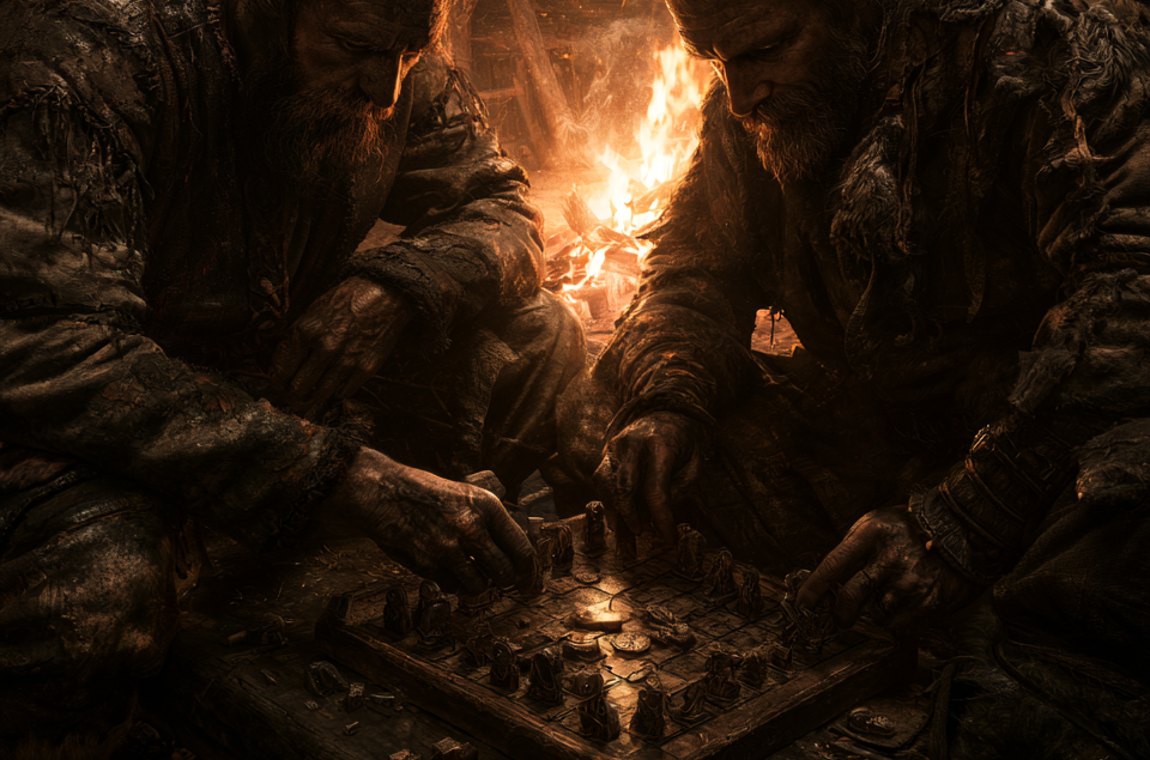
Little kings with swords across their knees, queens resting a cheek in one hand, warriors chewing the rims of their shields: the Lewis chessmen are among the best-known objects of the European Middle Ages. They turned up in 1831 in the parish of Uig on the Isle of Lewis in the Outer Hebrides, off the north-west coast of Scotland. Current opinion holds that they were carved in the late twelfth or early thirteenth century, probably in Norway, at a time when the Hebrides lay within the Norwegian sphere of rule. This article works through the find, the material, the theories of origin and the interpretations, and keeps apart what the objects themselves show, what written sources say and what remains modern guesswork.
The name covers a hoard, a group of objects hidden or deposited together. According to the key study by David Caldwell, Mark Hall and Caroline Wilkinson (Medieval Archaeology 53, 2009), the find comprised 93 objects: 78 chessmen, 14 flat round gaming pieces and a belt buckle. The chessmen break down into 8 kings, 8 queens, 16 bishops, 15 knights, 12 rooks in the form of standing warriors and 19 pawns. A thirteenth rook that surfaced in 2019 is discussed further down.
Almost all of them are walrus ivory, the dentine of walrus tusks. A few are sperm whale tooth. For two pieces in Edinburgh, a knight and a rook, whale tooth is confirmed in the catalogue; for four pieces in the British Museum it is considered likely.
Why a hoard from a Norwegian workshop should lie on Lewis is explained by the history of the islands. Scandinavians had raided and settled the Hebrides since the ninth century; an overview is in the article on the Vikings in Ireland, Scotland and the islands. In 1098 King Edgar of Scotland recognised the overlordship of Magnus III of Norway over the western isles, in Norse the Suðreyjar, the “Southern Isles”. Politically, Lewis and the rest of the Hebrides belonged in the twelfth and thirteenth centuries to the Kingdom of the Isles, which was tied to the Isle of Man and acknowledged the Norwegian crown as overlord.
The church, too, looked to Norway. The archdiocese of Nidaros, modern Trondheim, was founded in 1152/53. According to the Store norske leksikon, the diocese of the Isles, later called Sodor and Man, was placed under Nidaros in 1154 and covered Man, the Hebrides with Skye, Lewis, Mull and Islay, and other islands off the west coast of Scotland. The same province included Orkney, the Faroes, Iceland with Skálholt and Hólar, and Greenland.
The arrangement ended in the thirteenth century. After the indecisive battle of Largs in 1263, King Håkon IV died in Orkney. His son Magnus VI, “the Law-mender”, concluded the Treaty of Perth with Alexander III of Scotland on 2 July 1266. Norway ceded the Hebrides and Man to Scotland in return for 4,000 marks and an annual payment of 100 marks; Orkney and Shetland stayed Norwegian. The Lewis pieces were therefore made before this break and very probably reached the island before it too. For Orkney’s later story see the article on the earls of Orkney.
Little is secure. On 11 April 1831 Roderick Ririe, a merchant from Stornoway, the main town of Lewis, exhibited the pieces in Edinburgh at the Society of Antiquaries of Scotland. Soon afterwards the group was split. Ririe sold ten pieces to the collector Charles Kirkpatrick Sharpe, who probably acquired another bishop later. The rest went to a dealer named T. A. Forrest, from whom the British Museum bought 82 objects. The driving force there was the curator Frederic Madden, who published a detailed report in 1832.
After Sharpe’s death his eleven pieces passed to Lord Londesborough and were bought at Christie’s in 1888 for the Society of Antiquaries of Scotland. That is why 82 objects are in the British Museum in London today, namely 67 chessmen, all 14 discs and the buckle, while 11 chessmen are in the National Museum of Scotland in Edinburgh: two kings, three queens, three bishops, one knight and two rooks.
As early as 1833 the antiquary David Laing noted that contradictory accounts of the discovery were circulating. One version says a storm uncovered the pieces on the beach; others speak of a small stone “subterranean” chamber in the sand, or even the vault of a nunnery. In yet others a cow churns up the spot, and the latest layer tells of a stranded sailor who was murdered. The British Museum presents these stories as legends.
The finder is uncertain as well. Early reports mention an unnamed peasant. The name Malcolm MacLeod of Pennydonald near Ardroil appears only in 1863, more than thirty years after the find. For a long time the sands of Uig Bay at Ardroil were taken as the findspot. Caldwell, Hall and Wilkinson consider Mèalasta (Mealista), about ten kilometres further south in the same parish, more likely. That cannot be proven; it is a reasoned weighing of the tradition, not an excavation result.
Walrus ivory was a sought-after material in the high Middle Ages. It is denser than bone, takes fine carving and polish, and in the north it was easier to obtain than African elephant ivory. Tusks came from waters Scandinavians sailed: northern Norway and above all Greenland. The British Museum regards a Greenland source for the raw material as possible, since Greenland traded with Norway. More on that in the article on the Greenland Norse.
A walrus tusk has a solid outer layer and a softer, grainy core, which shows on the base or back of some pieces. The quantity used is considerable. The historian Alex Woolf has been quoted as saying that “a hell of a lot of walrus ivory went into making those chessmen”. Whoever worked that much of it needed access to a trade stream and wealthy buyers; see also the article on Viking trade.
Some pieces showed red staining when found, which has since disappeared. Analyses found traces of mercury, pointing to cinnabar as a red pigment. The obvious inference is that one side was red and the other natural white.
The kings sit on thrones with swords across their knees. The throne backs carry scrolls, trefoils, interlace and in places animal motifs. This decoration recalls the woodcarving of Norwegian churches and Romanesque architectural sculpture; the British Museum catalogue draws comparisons with Lund Cathedral and Ely Abbey. On older ornamental traditions see Viking art styles.
The queens rest a cheek in one hand. Whether that signals worry, grief, contemplation or dignity is open; the gesture carries all these meanings in medieval art. The knights are armoured riders on strikingly small horses with saddles, stirrups and bridles. The horses are squat because a piece had to fit a square and stay shorter than the king.
The rooks are not castles but standing warriors with helmet, shield and sword, often called “warders”. The pawns are non-figurative: small pillar shapes or tombstone-like slabs. On paper the kings, queens and bishops suffice for four sets, while one knight and four rooks are missing, and the 19 pawns cover only a little more than one set, which needs 16. From the spread of sizes, especially among the pawns, some infer parts of at least five sets.
Caldwell, Hall and Wilkinson sorted the figures by facial features and workmanship into five groups and suggest five carvers; nine pieces fit no group. That points to a workshop with several hands.
Four of the rooks bite the upper rim of their shields, eyes wide. Three are in the British Museum, one in Edinburgh. Frederic Madden identified them as berserkers as early as 1832, the warriors of the Icelandic sagas who fall into a battle frenzy.
The best-known description is in Snorri Sturluson’s Ynglinga saga, the opening part of his history of the kings, Heimskringla, written in Iceland around 1230. Snorri writes of Odin and his fighters:
“Odin could make his enemies in battle blind, or deaf, or terror-struck, and their weapons so blunt that they could no more but than a willow wand; on the other hand, his men rushed forwards without armour, were as mad as dogs or wolves, bit their shields, and were strong as bears or wild bulls, and killed people at a blow, but neither fire nor iron told upon themselves. These were called Berserker.”Snorri Sturluson, Ynglinga saga, ch. 6, in the public-domain translation by Samuel Laing (1844); wording read in sections via a retrieval tool
Two caveats apply. Snorri’s text is about as old as the pieces or younger, and it describes a mythical past, not observed practice. And whether the carvers meant a berserker or simply a grim warrior, we do not know; the motif is unambiguous, the label is modern interpretation. What the sources say about berserkers and the related wolf-warriors is covered in the articles on berserkers and úlfheðnar. How shields of the period were built is shown in the article on the Viking shield.
Chess came from India via Persia and the Arab world to Europe. In the Arabic game the piece beside the king was the firzan or firz, a vizier or counsellor, and the piece we call the bishop was al-fil, the elephant. Europe recast them in the image of its own society: the vizier became the queen, and the elephant became, depending on the country, a messenger, a fool or a bishop.
Their sixteen bishops sit or stand, wear mitre and vestments and hold a crozier, some also a book, and a few raise a hand in blessing. They are often described as the earliest known chess bishops in clerical form. Whether that holds strictly depends on how older fragments are judged; I give it as a widely held view.
The mitres help with dating. Until about 1150 bishops wore the mitre with its peaks at the sides, afterwards with peaks at front and back. The Lewis bishops show the later form. Two particularly tall mitres may point to the thirteenth century. Hence the usual date of about 1150 to 1200; Caldwell and colleagues also consider the early thirteenth century possible.
The most common answer is Trondheim. Called Nidaros in the Middle Ages, it was a royal seat, the pilgrimage centre at the tomb of St Olaf and from 1152/53 the seat of the archbishop. Excavations in Trondheim produced a fragmentary walrus-ivory queen, published by Christopher McLees and Øystein Ekroll in 1990, which is regarded as directly comparable to the Lewis queens in material, size, form and pose. Accounts of the exact findspot differ, and I could not check them against the excavation report.
Add to that stylistic parallels between the throne backs and the sculpture of Nidaros Cathedral and Norwegian woodcarving, the warriors’ long kite-shaped shields, and a chess king from the island of Hitra off Trondheim. The economics fit as well: the archdiocese received dues from Greenland, including walrus tusks, and the town had a wealthy elite who could buy such luxuries. Both museums follow this view, and Sotheby’s described the rook sold in 2019 as “probably Norwegian, Trondheim”.
What this establishes is a Trondheim workshop tradition that made very similar pieces. It does not establish that these 93 objects were made there. There is no signature, no workshop account and no blank by the same hand.
The best-known counter-theory comes from Iceland. The engineer Guðmundur G. Þórarinsson, a former president of the Icelandic Chess Federation, presented it with Einar S. Einarsson at a 2010 conference at the National Museum of Scotland. His main arguments: only English and Icelandic call the piece a “bishop”, Icelandic biskup, and the rook by a related word, Icelandic hrókur; the small horses resemble Icelandic horses; and Iceland had skilled ivory carvers and brokered the Greenland trade.
The Páls saga biskups, the life of Bishop Páll Jónsson of Skálholt (bishop 1195 to 1211), names a Margrét hin haga, “Margrét the Adroit”. She was the wife of the priest Þórir, one of the bishop’s assistants, and according to the saga the most skilled carver in Iceland in her day. For Páll she carved a walrus-ivory crozier, which he intended as a gift for an archbishop, and an altarpiece. In her 2015 book “Ivory Vikings”, the American writer Nancy Marie Brown developed the idea that Margrét carved the Lewis pieces and Páll commissioned them.
The objections carry weight. In 2011 the Norwegian chess historian Morten Lilleøren pointed out that Faroese (bispur, rókur) has similar terms and that Norwegians and Icelanders in the twelfth century spoke the same Old Norse language anyway; word history does not separate Iceland from Norway. The horses are stylised to fit the board. And the saga links Margrét with a crozier and an altarpiece, not with gaming pieces. The Iceland theory is possible, but it rests on circumstantial evidence with no demonstrable link to the hoard. Background on the Icelandic tradition is in the article on the sagas of Icelanders.
The British Museum catalogue notes that the carving “could have been carried on either side of the North Sea” and compares the style with the sculpture of Lund Cathedral in then-Danish Scania and Ely Abbey in eastern England. Lund was the seat of an archbishop for all Scandinavia from 1103/04 until Nidaros received its own province in 1152/53. I know of no find from Lund that comes as close to the Lewis pieces as the Trondheim queen. The Lund lead is therefore a stylistic comparison, not an origin theory with evidence of its own. Manufacture on the Hebrides themselves has also been suggested, without any workshop finds. Realistically, the origin lies in the Scandinavian North Sea world, with Trondheim the best-supported candidate.
The older explanation is that the pieces were the stock of a merchant travelling from Norway to Ireland who stopped on Lewis, or was shipwrecked, and buried his goods. The lack of wear and the number of sets support this; Dublin and other ports with Norse traditions were important markets.
Caldwell, Hall and Wilkinson questioned this view in 2009. If the findspot was Mèalasta, it lies close to sites associated with church or aristocratic ownership. The authors consider it possible that at least four sets were meant for use on Lewis, for example by a bishop or a clan chief. They also note that kings and pawns suit other board games, especially hnefatafl, the Norse game in which a king and his defenders try to break out against superior numbers (more in the article on hnefatafl; despite its nickname, modern kubb has nothing to do with it). Without a secure find context, neither the merchant nor the owner model can be confirmed.
The 14 discs are usually read as pieces for “tables”, a family of dice-and-board games from which backgammon descends; a British Museum blog post also describes them as blanks meant to be carved. The sources differ here. Either way, the find is not a pure chess set but a collection of gaming material.
In summer 2019 Sotheby’s announced a remarkable case. An Edinburgh antiques dealer had bought a small ivory figure for £5 in 1964 without knowing what it was. The family kept it in a drawer for decades. Alexander Kader of Sotheby’s studied the piece for a year and compared it with the figures in London and Edinburgh. It is a rook, a warder, 8.8 centimetres tall and made of walrus ivory. It is not one of the four shield-biters.
It was auctioned in London on 2 July 2019. The estimate was £600,000 to £1,000,000; the hammer fell at £735,000 to an undisclosed buyer, according to Sotheby’s a record for a medieval chess piece. That reduced the number of missing pieces, on paper one knight and four rooks, to one knight and three rooks.
Two cautions. Sotheby’s wrote that the rook “could be” one of the lost pieces; a Lewis provenance rests on style, not on an unbroken ownership history. And the English Wikipedia lists two radiocarbon dates for this very piece, 1283–1479 and 1328–1434, clearly later than the stylistic date. I could not check the reason for this discrepancy against an original publication. Whether the rook belongs to the hoard therefore remains open.
In the British Museum the pieces are now in Room 40, the “Medieval Europe 1050–1500” gallery; the National Museum of Scotland shows its eleven in Edinburgh. Since the mid-2010s six London pieces have been on long-term loan to Museum nan Eilean at Lews Castle in Stornoway, back on Lewis. Other collections with Norse finds are listed in the article on Viking museums.
Neil MacGregor, then director of the British Museum, included the pieces in his series “A History of the World in 100 Objects” (BBC Radio 4, 2010). Back in the 1960s they had already inspired the British animated series about “Noggin the Nog”, whose characters clearly echo the Lewis kings.
A mass audience met them through the film “Harry Potter and the Philosopher’s Stone” (2001), which uses replicas in the Lewis style for wizard chess. Which scene is meant, the sources do not agree: a British Museum blog post links the replica with the giant chess game near the end of the film, a fan encyclopedia with Ron’s own set. I leave the attribution open.
This popularity shapes a skewed picture. The pieces look “Viking” and are often sold as “Viking chess”. In fact they bear witness to the Christian monarchy of Norway, its church and its North Atlantic trade, around a century and a half after the end of the Viking Age.
Where can the Lewis chessmen be seen? 82 objects belong to the British Museum in London, 11 chessmen to the National Museum of Scotland in Edinburgh. Six London pieces are on loan to Museum nan Eilean in Stornoway on Lewis.
What are they made of? Mostly walrus ivory, that is, walrus tusk; a few pieces are sperm whale tooth. Some showed traces of red colour when found, probably cinnabar.
Were they made in Norway or Iceland? Most specialists consider Trondheim the likeliest, based on a similar queen from Trondheim, stylistic comparisons and the archdiocese’s role in the ivory trade. An Icelandic origin is argued by Guðmundur Þórarinsson and Nancy Marie Brown; it is possible but less well supported.
Are the biting warriors really berserkers? The shield-biting matches the description in Snorri’s Ynglinga saga. Whether the carvers had berserkers in mind we do not know; the label is a nineteenth-century interpretation.
What did the rook found in 2019 sell for? It was auctioned at Sotheby’s in London on 2 July 2019 for £735,000. An Edinburgh dealer had bought it in 1964 for £5.

Hnefatafl – Viking chess · Berserkers · The Vikings in Ireland, Scotland & the Isles · The Earls of Orkney · Viking-age art styles.
All History & Finds articles →
In the summer of 56 BC, western Gaul produced a moment that Caesar records in a single subordinate clause: the Lexovii …
Read more →A Viking army had no national flag, no passport and no uniform. It was made up of men who had joined a leader and men …
Read more →The Lindisfarne raid of 793 – usually dated to 8 June – was an attack by pagan Scandinavian seafarers on the monastery …
Read more →The Lingones lived on the plateau around present-day Langres, where the Marne, the Aube and the Meuse have their …
Read more →