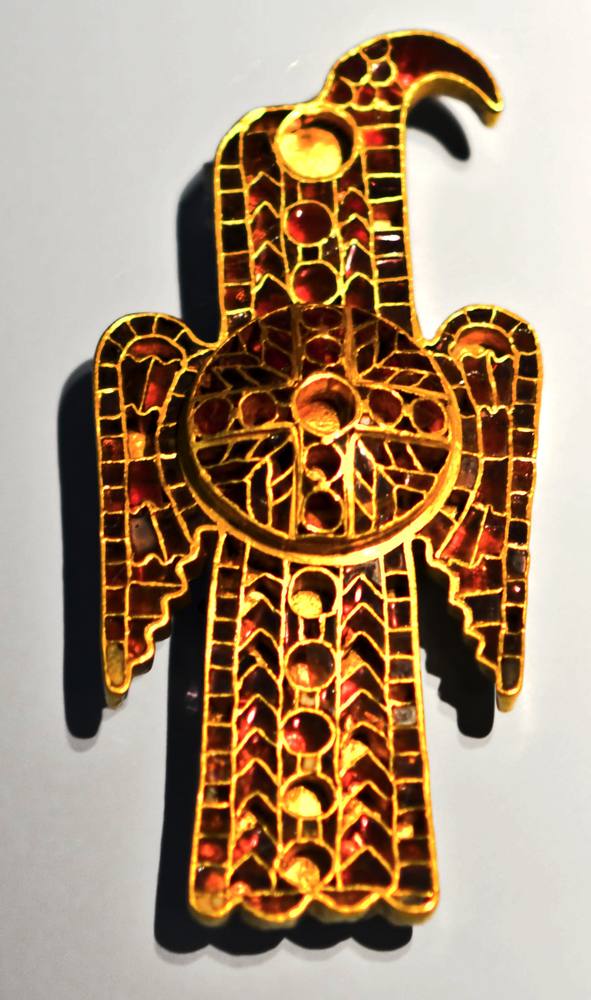
A Roman emperor has a bridge of boats thrown across the Rhine in secret, hoping to seize an Alamannic king in his sleep. The plan fails because his own soldiers make too much noise, the king escapes in a fast wagon into the hills, and three years later the same emperor sits in a river boat off the bank near Mainz and swears friendship with him. Ammianus Marcellinus tells this story, and it is the only reason we know that the Bucinobantes existed at all. This article sets the few pieces of evidence side by side, separates the ancient account from later interpretation, tests the explanation of the name and says plainly, where necessary: this cannot be established with certainty.
The Bucinobantes were a group within the Alamanni who lived in the fourth century AD on the right bank of the Rhine, facing Mainz. Roman Mainz was called Mogontiacum and served as the capital of the province of Germania Prima. Beyond that location the record gives us very little. As far as is known, the name occurs exactly once in surviving ancient historical writing, in book 29 of Ammianus Marcellinus. To that we can add an entry in the Notitia Dignitatum, a register of Roman offices and troops, which lists a unit called the Bucinobantes.
At the centre stands a man named Macrianus, whom Ammianus calls a king of the Alamanni and whose realm was the land of the Bucinobantes.
Two terms first. A sub-tribe here means a regional group within a larger confederation. The Alamanni were not a single kingdom but a patchwork of districts with their own kings, whom Ammianus calls sometimes reges (kings), sometimes reguli (petty kings). A pagus is the Latin word for such a district, usually rendered "canton" in English and "Gau" in German; Ammianus uses it for the land of the Bucinobantes.
Ammianus Marcellinus was a Greek-speaking officer from the eastern half of the empire, probably from Antioch, who wrote in Latin. He composed his history, the Res gestae, towards the end of the fourth century, probably in Rome. Books 14 to 31 survive, covering the years 353 to 378. For the Rhine frontier of those decades he is the most important narrative source we have.
For the Bucinobantes this means that everything we know of their history comes filtered through the eyes of a Roman officer. Ammianus writes about the Alamanni mostly as enemies and takes an interest in them chiefly when they threaten Roman territory. He says nothing about the settlements, beliefs or daily life of the Bucinobantes, and he did not witness the events on the Rhine in the 370s himself.
Even so, Ammianus is regarded as a comparatively careful writer who does not hide the failures of Roman emperors. The campaign against Macrianus is one such failure.
Ammianus locates the Bucinobantes with a terse phrase: quae contra Mogontiacum gens est Alamanna, "an Alamannic people living opposite Mogontiacum". This means the right bank of the Rhine around the mouth of the Main, the area of today's Mainz-Kastel, Wiesbaden and the lower Main valley. No source says how far their land reached east into the Wetterau or north into the Taunus hills.
The region had a long Roman past. Until the third century it lay inside the Limes, the fortified frontier. This was the land of the Mattiaci, whose name lived on in Roman Wiesbaden: Aquae Mattiacorum, the waters of the Mattiaci, centre of its own local territory, the civitas Mattiacorum. Opposite Mainz a bridgehead on the right bank, today's Kastel, secured the river crossing.
After the middle of the third century the Roman frontier system on the Upper German Limes collapsed. The land east of the Rhine, often called the Agri Decumates, passed under Alamannic control over the following decades. Around 260 the Roman settlement at Wiesbaden was badly damaged but survived in reduced form. Rome never entirely gave up its claim to the right bank opposite Mainz. The Bucinobantes, in other words, lived within sight of a Roman provincial capital, on formerly Roman soil.
The name has two parts. The second, -bantes, is usually linked by linguists to a Germanic word *bant, thought to have meant "district, region, land". The asterisk marks a reconstructed, unattested form. The same element is widely believed to appear in the regional name Brabant, a Frankish formation interpreted as "fallow-land district".
The first part, Bucino-, is less certain. The best-known interpretation, already put forward by Jacob Grimm in the nineteenth century, connects it with the word for the beech tree. The Bucinobantes would then be "the people of the beech district". The Wiesbaden city encyclopedia renders the name along those lines as "dwellers of the beech forest". Others think of a word for a rise or hill, and some point to the medieval regional name Buchonia around Fulda.
None of these proposals is secure. The specialist entry "Bucinobantes" in the Reallexikon der Germanischen Altertumskunde was written by the linguist Günter Neumann; I have not consulted it myself and know its verdict only from summaries. Anyone who reads that the Bucinobantes were "the beech people" should treat that as a plausible hypothesis, not a translation. The link with Buchonia is likewise conjecture: at least two centuries separate Ammianus' Bucinobantes from the earliest early-medieval references to Buchonia, and the Fulda region lies a good 100 kilometres from the mouth of the Main.
The king of the Bucinobantes appears earlier, though without the tribal name. In 359, a year Ammianus dates by the consuls Eusebius and Hypatius, the Caesar Julian, later emperor, led a campaign across the Rhine. In book 18 Ammianus describes how Julian first sent a tribune named Hariobaudes, who spoke the Alamannic language, as a scout to King Hortarius. Rejecting a bridge at Mainz itself, Julian had three hundred light-armed men ferried over by night in forty boats at another point and then built his bridge there.
The army marched through Hortarius' territory to a district Ammianus calls Capellatii or Palas, where boundary stones marked the border between the Alamanni and the Burgundians. The aim was to seize two kings whom Ammianus calls brothers: Macrianus and Hariobaudus. After the Romans had burned villages, the two came and asked for peace. Ammianus describes how Macrianus, seeing the Roman standards and the splendour of the arms for the first time, was astonished. The brothers were granted peace.
Two points matter here. First, the tribune Hariobaudes, Julian's scout, and King Hariobaudus, brother of Macrianus, are two different people with similar names. Second, Ammianus does not mention the Bucinobantes in this passage. That the realm of Macrianus in 359 is the same as the land of the Bucinobantes in 371 is an inference by modern scholars, because the same Macrianus later appears explicitly as their king. The inference is reasonable, but it remains an inference. Where the boundary stones of Capellatii or Palas stood is disputed; several locations have been proposed, none of them proven.
Valentinian I became emperor of the West in 364, while his brother Valens ruled the East. He resided for long periods at Trier. Ammianus portrays him as harsh but praises his care for frontier defence.
One episode in book 27 is revealing for the Mainz area. An Alamannic prince named Rando, after long preparation, slipped into an ungarrisoned Mogontiacum while the inhabitants were celebrating a Christian festival and carried off people and household goods. Scholars usually date this raid to 368. Whether Rando belonged to the Bucinobantes, Ammianus does not say. In the same year Valentinian and his young son Gratian defeated the Alamanni at Solicinium, a place whose location is still uncertain.
Around 370 Valentinian tried another approach. According to Ammianus he wrote to the kings of the Burgundians, urging them to attack the Alamanni while he himself would cross the Rhine. Ammianus names Macrianus explicitly as the king whose raids troubled the emperor. The Burgundians, who quarrelled with the Alamanni over salt springs, did march to the Rhine. But Valentinian failed to appear on the agreed day, and the Burgundians went home embittered.
In book 29 Ammianus tells the episode that earned the Bucinobantes their place in history. Scholars usually date it to 371; Ammianus gives no year at this point, and some accounts place it a year later. Valentinian, Ammianus says, wanted to take Macrianus alive. From deserters he learned where the king, who expected no attack, could be found. The emperor quietly had a bridge of boats laid across the Rhine. The text does not say where.
Ahead of the infantry the general Severus marched towards Aquae Mattiacae, that is, Wiesbaden. On the way Severus had slave dealers killed who might have betrayed his approach. Severus himself then halted, because his force seemed too small to face the enemy's numbers.
At dawn the main army followed, led by a cavalry detachment under Theodosius, father of the later emperor Theodosius I. But the soldiers ignored the order to keep quiet. They plundered, set fires and shouted. Macrianus' attendants were woken by the crackle of the flames and the noise, put the king on a fast wagon, in Latin carpento veloci, and hid him in a narrow pass among steep hills. The emperor lost a catch he had thought certain. Ammianus blames the indiscipline of the troops, not the emperor or his generals.
Valentinian then had the enemy's land laid waste for fifty miles. The emperor returned to Trier, in a bad mood, as Ammianus stresses. Which hills sheltered Macrianus is unknown; the Taunus is an obvious thought, but it remains a guess.
Ammianus compares the emperor at this moment to a lion that has lost a stag or a roe deer and snaps its empty jaws. Then comes the sentence in which the name of the Bucinobantes appears. I give it in my own translation from the Latin:
"In place of Macrianus he appointed Fraomarius king of the Bucinobantes, an Alamannic people opposite Mogontiacum. Shortly afterwards, because a fresh incursion had utterly laid waste that same canton, he transferred him to Britain and set him, with the authority of a tribune, over a unit of Alamanni which at that time was flourishing in numbers and strength."Ammianus Marcellinus, Res gestae 29.4.7; own translation from the Latin
The sentence is short, and that is what makes it revealing. The verb ordinavit ("he appointed") states plainly that Rome chose the king. Ammianus gives a fresh incursion that devastated the pagus as the reason for the transfer. He does not say who carried out that incursion. Supporters of Macrianus are an obvious guess, but the text does not say so. Online one reads that the Bucinobantes "rejected" Fraomarius; that, too, is interpretation rather than Ammianus' statement.
Fraomarius was sent to Britain and led a numerus, a unit, of Alamanni there as tribune. Where the unit was stationed in Britain and what became of Fraomarius is not recorded.
In the same breath Ammianus names two more men: Bitheridus and Hortarius, nobles nationis eiusdem, "of the same people". Whether he means the Alamanni in general or the Bucinobantes in particular, the sentence leaves open. Hortarius was later accused of treason on a report by Florentius, the commander in Germany: he was said to have written to Macrianus and other barbarian chiefs. Under torture he confessed and was condemned to be burned. Whether he is the same man as King Hortarius of 359 remains unclear.
Three years after the failure the situation had changed. Ammianus dates what follows to the year in which Gratian was consul together with Equitius, that is, 374. Valentinian was building a fort near Basel when news reached him of an invasion by the Quadi in Illyricum on the middle Danube. His advisers warned him against leaving at once, citing among other things the kings on the Gallic frontier, Macrianus above all.
Valentinian therefore invited Macrianus to meet him near Mogontiacum. The king arrived full of confidence and stood on the bank of the Rhine while his warriors clashed their shields. The emperor came on river boats, surrounded by officers and standards, and cautiously approached the bank. After long speeches on both sides, friendship was sealed with an oath.
The emperor came not as a victor but because he needed his hands free for the Danube. Ammianus stresses that from then on Macrianus remained a loyal ally to the end of his life. Some online accounts date the treaty to 371; by Ammianus' consular date it belongs to 374.
Ammianus reports the death of Macrianus in a few sentences. The king later marched into the land of the Franks, pressed on too far, devastating as he went, and fell into an ambush laid by Mallobaudes, whom Ammianus calls a warlike king of the Franks. Mallobaudes had him killed. The same Mallobaudes appears in Ammianus in 378 as comes domesticorum, commander of the imperial guard, fighting the Alamanni: king of his people and Roman officer at the same time.
Ammianus gives no year for Macrianus' death. All that is certain is that he died after the treaty of 374. What happened to the Bucinobantes afterwards is unknown. The Bucinobantes vanish from the historical record together with their king.
The name survived in quite another place. The Notitia Dignitatum is a register of the empire's civil and military offices and their troops, which in its surviving form dates to the early fifth century and has come down to us in medieval copies with coloured shield emblems. In the section for the eastern empire, under the second magister militum praesentalis, one of the field-army commanders at the court in Constantinople, seventeen auxilia palatina are listed. Among them, between the Vindices and the Falchovarii, is a unit called the Bucinobantes.
When and how this unit was raised is not recorded. Recruitment from the land opposite Mainz, perhaps linked to the treaty of 374, is a plausible conjecture. The company it keeps is worth noting: the same list includes the Mattiaci iuniores, a unit whose name recalls the Mattiaci of the Wiesbaden area. Units often kept their names long after they were filled with quite different recruits; the Notitia does not prove that Bucinobantes were still serving in this one around 400.
There is no archaeological find that could be labelled with the name Bucinobantes. What archaeology can offer are traces of people who lived opposite Mainz in the fourth and early fifth centuries and who differed from the provincial Roman population in dress and burial custom. Whether these people called themselves Bucinobantes remains open.
Wiesbaden is a particularly rich site in this respect. The city encyclopedia lists early Alamannic graves in several places: a double burial of a man and a woman inside the long-abandoned first-century stone fort, graves on the south-eastern slope of the Michelsberg inside and outside the Heidenmauer, burials around Kirchgasse, Friedrichstraße and Luisenstraße, and a single grave on Waldstraße. Men received weapons such as long swords, axes and spears; women received necklaces of glass and amber beads, earrings, hairpins and above all brooches. One of these brooches, of silver or bronze sheet with a lozenge-shaped foot, gave its name to a whole type: the "Wiesbaden type" brooch. Eduard Brenner published the finds in 1911.
Settlements, by contrast, have not yet been identified in Wiesbaden itself. During construction of the high-speed rail line, a settlement layer of the early Alamannic period came to light at Breckenheim, outside the city centre. Further east, in the Wetterau, the Glauberg was fortified again in the migration period. That the Glauberg belonged to the land of the Bucinobantes is nowhere attested.
One structure is often linked directly with Valentinian and so with the conflict over Macrianus: the Heidenmauer ("heathens' wall") in Wiesbaden, a late Roman wall about 520 metres long, of which sections still stand at the Römertor. Older scholarship saw it as part of the fortifications Valentinian built on the right bank of the Rhine and assumed it was never finished. Reused gravestones built into it point to a late date. A radiocarbon measurement on wood remains from the mortar, however, gave a range of AD 214 to 344, which suggests an earlier date for the sampled section. Its purpose is also disputed: barrier wall, part of a larger complex, or aqueduct. Anyone who calls the Heidenmauer "a wall against the Bucinobantes" is cutting short an open research question.
After the death of Macrianus and the entry in the Notitia, the trail goes cold. The land at the mouth of the Main remained inhabited, though. According to the Wiesbaden city encyclopedia, settlement continued without a break into the Merovingian period.
Politically, the balance shifted several times in the fifth century: the Rhine crossing of Vandals, Alans and Suebi in 406/407, the kingdom of the Burgundians on the middle Rhine until 436, and finally the victory of the Franks under Clovis over the Alamanni around 500. By then at the latest, the land opposite Mainz belonged to the Frankish sphere.
The Bucinobantes did not "die out". The people stayed; their lordship and their name disappeared. Whether part of the population still remembered older allegiances in the Frankish period cannot be seen in the sources.
The case shows that "the Alamanni" of the fourth century were not a single power. Rome dealt with individual kings, deposed and installed them and played neighbours off against each other. Macrianus was a power in his own right in this world: in 359 an astonished petitioner, in 371 a king the emperor hunted in person, in 374 a treaty partner whom the emperor met in a boat.
Ammianus knows similar regional groups elsewhere, such as the Lentienses near the border of Raetia. With the Brisigavi the Notitia lists another unit whose name recalls an Alamannic landscape, the Breisgau. Rome fought these groups and recruited from them at the same time. The frontier was a zone of constant exchange, where captives were sold, warriors enlisted and treaties sworn on riverbanks. For an overview of the peoples on both sides of the river, see Germanic peoples in the Rhineland.
Where exactly did the Bucinobantes live? Ammianus says only "opposite Mogontiacum", that is, on the right bank of the Rhine at Mainz. This means the area around Mainz-Kastel, Wiesbaden and the mouth of the Main. No source gives the boundaries of their land.
Were the Bucinobantes Alamanni? Yes. Ammianus calls them a gens Alamanna, one of the regional lordships within the Alamannic confederation.
Who was Macrianus? An Alamannic king who made peace with Julian in 359 together with his brother Hariobaudus, escaped a raid by Valentinian around 371, swore a treaty with the emperor near Mainz in 374 and later died in an ambush set by Mallobaudes in Frankish territory.
What does the name Bucinobantes mean? The second part is usually connected with Germanic *bant, "district, region", the first often with the beech tree. "People of the beech district" is an interpretation, not a secure translation.
Are there finds that certainly belonged to the Bucinobantes? No. There are early Alamannic graves in the Wiesbaden area from the right period, but archaeology cannot assign them to a particular tribal name.

The Alemanni · The Vangiones · The Mattiaci · The Sunuci · Germanic Tribes of the Rhineland.
All History & Finds articles →
When people hear „Viking fortress“, many picture a grey stone castle with battlements and a drawbridge. But the …
Read more →The Burgundians (Latin Burgundiones) lived on the Rhine in the early fifth century, were beaten in 436 by Aetius and …
Read more →The Buri are one of those peoples who only flash up in ancient writing: a sentence in Tacitus, a mushroom sent as a …
Read more →