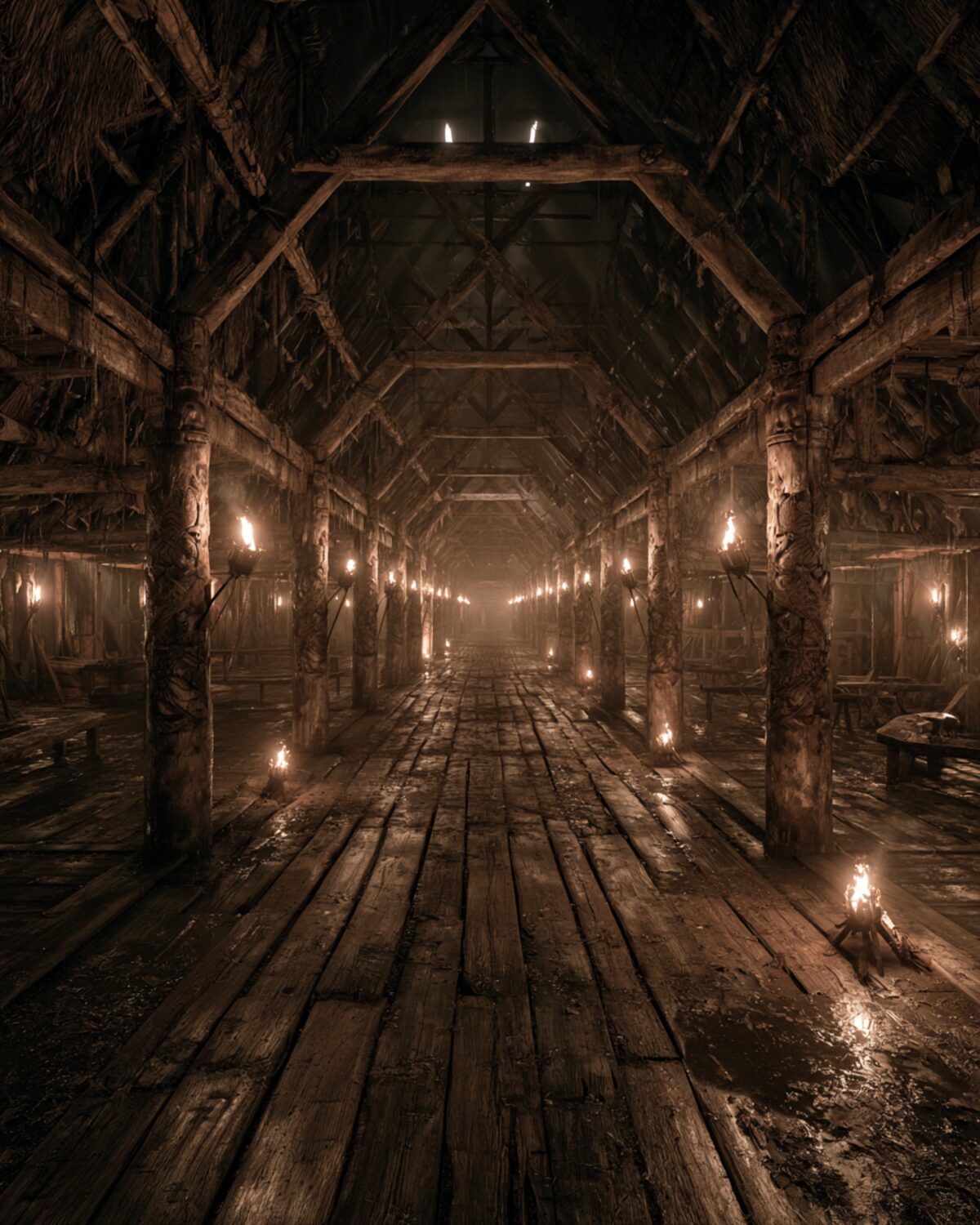
Grágás means "Grey Goose" and names the law of medieval Iceland as preserved in two large thirteenth-century manuscripts. Nobody knows for certain where the name comes from, and scholars do not agree on how much of the Viking Age actually lies behind the texts. This article separates what Ari Þorgilsson reports in the early twelfth century, what the manuscripts themselves show, and what is later interpretation.
Anyone who says "Icelandic law of the Viking Age" usually means Grágás. That is a shortcut, and it starts with the word "code". Grágás is not a law code in the modern sense, enacted by a ruler. The evidence is plainer: two large manuscripts from the thirteenth century, plus fragments and later copies, containing legal texts from the Icelandic Commonwealth, the period when Iceland had no king. By the usual account, that period began with the founding of the Althing around 930 and ended in the 1260s with submission to the Norwegian crown.
The gap in time matters. The two main manuscripts are dated, on current knowledge, to about 1260 and about 1280. More than three centuries separate them from the settlement of the island, and generations separate them even from the first writing-down of the laws in the early twelfth century. Citing Grágás to show how an Icelander conducted a lawsuit in the year 950 jumps that gap. The texts are nonetheless extraordinarily valuable: they show a legal system that had to work without a state, without police and without a ruler, and they do so in a detail that is rare in medieval Europe.
For the thing as an institution, see the thing: court, parliament and fair; general legal foundations are covered in Viking law. This article is about the document itself: its name, its transmission, its contents and the limits of what can be drawn from it.
Grágás is Icelandic, from grár ("grey") and gás ("goose"). As far as I can trace in the accounts I checked, the name appears only in the sixteenth century, long after the manuscripts were written. Medieval Icelanders did not call their law that. One account says the term was originally used in a medieval source for a collection of Norwegian laws and was later transferred, probably by mistake, to Icelandic law. Another study speaks of a scribal misunderstanding carried over from an early Norwegian legal text. Both agree that the name probably did not arise naturally in Iceland. What exactly went wrong at the time cannot be reconstructed from the sources available to me.
Three popular explanations circulate as well: the laws were written with a goose quill, they were bound in goose skin, or they were so old that people compared them to the supposed longevity of geese. None of the three is documented, and the account I took them from does not choose between them. The catalogue entries I consulted simply call the title one of uncertain origin. The neighbouring page Love in the Viking Age says the same: where the name comes from is uncertain.
In practice this means that "Grey Goose" is a modern collective label, not a contemporary book title. Anyone who loads the name with Viking romance, a quill and candlelight in the hall, is telling a pleasing story, but not a documented one.
The key source for the early history of Icelandic law is not Grágás itself but the Íslendingabók, the "Book of the Icelanders" by the priest Ari Þorgilsson. Ari wrote in the early twelfth century; scholarship usually dates the work between 1122 and 1133, because its prologue names bishops whose terms fix that frame. For the introduction of laws, Ari names a man called Úlfljótr.
"… þá hafði maðr austrænn fyrst lög út hingat ór Norvegi, sá er Úlfljótr hét" – "… then a man from the east first brought laws out here from Norway; he was called Úlfljótr."
Ari Þorgilsson, Íslendingabók, ch. 2; clause seen through a fetch tool from heimskringla.no (start of the sentence omitted), translation my own
That sentence is all I read of the text itself. From summaries comes the following: Úlfljótr is regarded as the first lawspeaker, and his laws, according to a tradition that secondary literature traces to Ari, were modelled on the Norwegian legal district of the Gulathing. The introduction is placed in the 920s. This is the account of an author writing roughly two centuries later. Whether Úlfljótr was a historical person, and what exactly he did, cannot be checked independently. All that is certain is that in the twelfth century people in Iceland believed their law derived from Norwegian law.
The Althing, the yearly assembly of free men, is traditionally dated to 930. More on the place and its running can be found on thing sites of the Viking Age. For Grágás the decisive element is the office anchored there: the lawspeaker, Old Norse lögsögumaðr.
According to a general overview I found, the lawspeaker was elected for three years. He presided over the Althing and recited the law, in thirds, one each summer. Beyond that he gave advice and sometimes acted as arbitrator. He had no other formal power; the account calls his post the sole government office of the medieval Icelandic Commonwealth. That detail is often missed: he did not pronounce the law, he recited it. He did not deliver judgments.
Two caveats belong here. First, the list of office-holders printed there contradicts the three-year rule, because it shows spans of very different length; probably total tenure of one person who was re-elected is recorded, but the page does not say so. Second, Ari himself names much longer terms: Hrafn Hængsson, Úlfljótr's successor, held the office for twenty summers (Íslendingabók, ch. 3; wording seen through the fetch tool). That does not fit a three-year rule; from which date it applied cannot be seen from the sources I saw. A curious side note: one office-holder, Grímr Svertingsson, had to step down early because his voice was too weak for the task.
That one third of the law was recited each summer is stated by the overview account; I have not checked whether Grágás itself lays this down. Arithmetically the whole law would then have been heard once after three summers. The speaker's memory and the public hearing of the assembly were thus the actual source of law as long as nothing was written down.
A turning point lies in 1117, by the usual dating; Ari gives no year, it follows from the lawspeaker Bergþórr's term of office. Then the Althing decided to put the law into writing. By the usual account the writing took place the following winter on the farm of a man called Hafliði Másson, and the result was presented the year after. The basis is again Ari, whose text contains a sentence saying that it was decided as a novelty that the law should be written "in the book" at Hafliði Másson's farm the following winter. The passage is in chapter 10 of the Íslendingabók; I saw the wording ("at lög ór skyldi skrifa á bók at Hafliða Mássonar of vetrinn eftir", after the first summer in which Bergþórr recited the law) through the fetch tool, not the full text.
What came out of it has not survived. The 1117/18 redaction is lost as a book of its own; what we have are later manuscripts. Whether and how much of the winter 1117/18 text flowed into the surviving texts therefore cannot be tested directly. The neighbouring page gives the redaction the name Hafliðaskrá; I could not verify that name independently and pass it on only as the neighbouring page's statement.
Writing had consequences. A law that lives only in the head of an elected speaker shifts imperceptibly with each recitation, and in a dispute whoever remembers better prevails. A law on parchment can be looked up, compared and cited. This probably strengthened the position of those who mastered writing, chiefly clergy and the wealthy. That the surviving texts partly contradict one another suggests there was no single binding version even afterwards.
Two codices carry the tradition. The Konungsbók ("King's Book") is kept in Copenhagen as GKS 1157 fol. in the Royal Library and is dated to about 1260. The Staðarhólsbók is AM 334 fol., dated to about 1280, and belongs to the Arnamagnæan collection. English Wikipedia gives the Árni Magnússon Institute in Reykjavík as its location, another account Copenhagen. The Arnamagnæan collection is divided between the two cities; I found no second, independent confirmation for Reykjavík (handrit.is could not be fetched), so the location stays open here.
The two codices complement each other, overlap and in part contradict one another. A study of women's status in Old Icelandic law notes that the Konungsbók has a section with constitutional content that the other manuscript lacks, and that the Staðarhólsbók is more detailed. Both contain shared scribal errors, from which a lost common exemplar is inferred. That is an inference of scholarship, not a find.
The Konungsbók is lavishly made, which points to a wealthy, literate patron; there is no certainty who that was. Smaller fragments and later copies add to the picture. The nineteenth-century editions were prepared by the Dane Vilhjálmur Finsen: the Konungsbók in 1852, the Staðarhólsbók in 1879, and in 1883 a volume with further material, including the manuscript AM 351 fol. (Skálholtsbók). An English translation by Dennis, Foote and Perkins appeared in several volumes between 1980 and 2000. As an example of dissemination, University College London holds an eighteenth-century paper manuscript of 156 leaves whose text, according to the catalogue, matches Finsen's 1852 edition and is therefore apparently a copy of the Konungsbók.
A study I read through a summary stresses that both manuscripts were private collections and not an official statute. That changes the question: the scribes did not copy a law, they assembled legal knowledge that seemed useful to them. The same study explicitly warns that the compilation may also reflect how its authors imagined proper law should work, and that dating individual norms is difficult.
How well the texts reflect the Viking Age is disputed. The account I read on this takes the view that the written-down oral law better reflects Icelandic tradition after the year 1000. That is a reasoned position, but a position. Anyone wanting to assign a single rule to the tenth century needs additional evidence, from sagas or from Ari. The sagas, for their part, were recorded generations after the events they describe. The two groups of sources therefore support one another only to a limited degree. More on sagas as sources is on the page Sagas of Icelanders.
The content is broad. The study of women's legal status shows that the manuscripts deal with family obligations, households, property, livestock, fishing, buying and selling, dangerous animals and religious duties. Much of the secular law consists of default rules that the parties could vary by agreement. That fits a society in which settlement mattered more than punishment.
Further details of the structure, such as the division of the manuscripts into parts like the Christian law section or the procedural rules for the Althing, I know only from memory and handbook knowledge, not from a source I saw during this research. I therefore do not state them as fact. Anyone needing the structure should open the table of contents of the English translation by Dennis, Foote and Perkins or the editions of Finsen.
It is already remarkable that the texts regulate everyday matters. The picture of Viking law as pure blood-feud law falls short when one sees how much room contracts, property and livestock take up. The page Women and law in the Viking Age follows this for marriage, inheritance and property.
The gravest penalty the system knew was outlawry. According to the account of women's law that I saw, full outlawry applied, among other things, to consensual unlawful intercourse, abduction, composing a love poem about a woman, major incest and concealing the father of a child. Lesser outlawry applied, among other things, to bigamy, minor incest and couples who did not meet the property qualification; they could return once they held 120 ounce-units. I give these details as they stand there and have not checked them against the original text.
The Old Norse technical terms are skóggangr for full outlawry ("forest-going") and fjörbaugsgarðr for the milder form. I find the terms on the neighbouring pages but not in the sources I examined for this article; they are familiar in the specialist literature, and I give them here only as terms, without asserting details of the legal consequences. That a love poem about a woman could be grounds for outlawry has occupied scholars repeatedly. The page Love in the Viking Age takes it up, as does insults and slander verse.
Before Norwegian rule Iceland had no state in the modern sense that would have enforced judgments. Enforcement lay with the injured party and their kin and friends. The study I read notes that extra-judicial means such as mediation, arbitration and self-help were used most often in disputes. The court was thus often not the beginning of a conflict but a means of pressure, or the place where a settlement was authenticated.
A core piece of the settlement system was wergild, the money compensation for a slain person, regulated in the section called Baugatal. The study describes this regulation as intricate and points to a striking finding: none of the more than one hundred atonement payments described in the sagas follows the rules of the Baugatal. That indicates a distance between statute and practice, at least as the sagas depict it. Either the law was an ideal, or the saga authors tell what was dramatic rather than what was usual, or both.
What a dispute looks like in the saga world is shown by Njáls saga and Grettis saga. The combat ritual of the holmgang is covered in Holmgang. Whether and how far these narratives reflect real procedure is a separate source question and often underestimated.
On procedure the literature I read gives me only individual building blocks. Prosecution lay with the injured party or their legal representative. Women needed male representatives. In some cases a verdict from a panel of five neighbours was required, and some settlements needed leave from the Law Council, the lögrétta. For the separation of a marriage a bishop had to give leave, and he had one day to decide after hearing testimony. On this account women could neither be witnesses nor jurors and were not shown speaking publicly at assemblies. The study links the rule that women could not prosecute killing cases with the Eyrbyggja saga; whether that is a finding from the law or from the saga does not emerge from my summary.
Everything else found in popular accounts, such as quarter courts, oath-helpers or figures for judges, is on the neighbouring pages The thing and Viking law. I did not check it against Grágás in this research and do not take it over here as fact. That a case could stall if both sides staffed the court equally strongly is a plausible explanation, but I saw no source for it.
Grágás is often used as a window on daily life. That is legitimate as long as one remembers who compiled it: men, presumably with ties to the church or to rich families. The rules on marriage and property show a society in which property and kinship strongly ordered who could do what. The study of women's status arrives at a picture of restrictions in litigation but equally notes that many rules were negotiable. A fuller discussion is on Women and law in the Viking Age.
With Iceland's submission to the Norwegian crown in the years 1262 to 1264 the Commonwealth lost its foundation. According to one account Grágás remained in force a few more years, until in the early 1270s a Norwegian-based law book, the "Iron Side" (Járnsíða), was introduced. I have this from a single overview; the dates vary there (1271 to 1273). The office of lawspeaker lingered briefly and was then replaced by that of the lögmaðr; the Althing itself was abolished only in 1800.
That the Grágás manuscripts were made only around 1260 and 1280, in the last decades of the Commonwealth and just after, is perhaps no accident: people wrote down what was in danger of disappearing. That is a plausible interpretation, not evidence.
For an entry point, use the English translation by Dennis, Foote and Perkins, Laws of Early Iceland: Grágás, and Jesse Byock's overview Grágás: The "Grey Goose" Law in Viking Age Iceland; I know both only as bibliographic entries from an overview. Finsen's original editions are the basis for readers of Old Norse. For the legal position of women, the article by Włodzimierz Gogłoza in the journal Limes (2020) is openly accessible.
Anyone working with Grágás should ask three questions: Which manuscript stands behind the passage? Is there a second manuscript that says the same? And is there evidence outside the legal text, for example in Ari or in charters? If the answer is missing, it remains a legal rule of the thirteenth century.
What does Grágás mean? Literally "Grey Goose". Why the law book is called that is unresolved.
When was Grágás written? The two main manuscripts date from about 1260 and 1280. A first writing-down of the law in the winter of 1117/18 is attested through Ari, but that version has not survived.
Who was the lawspeaker? An office held for a term by election: he recited the law at the Althing, a third each year, and advised on legal questions.
Is Grágás a ruler's law book? No. Iceland had no king in this period, and the manuscripts were private collections.

The Thing · Viking Law & Thing · Viking women and the law · The Icelandic Sagas · Njáls saga.
All History & Finds articles →
The Greuthungi are a name that almost only one author knows: Ammianus Marcellinus, a Roman officer and historian of the …
Read more →On a few dozen runestones in central Sweden, an inscription says that someone was "in Greece", died there, shared out …
Read more →On Sunday, 16 September 1408, an Icelandic man and an Icelandic woman were married in the stone church at Hvalsey. The …
Read more →After Edington, England had become a bad place for a Viking army. Alfred had beaten Guthrum, Guthrum had been baptised …
Read more →