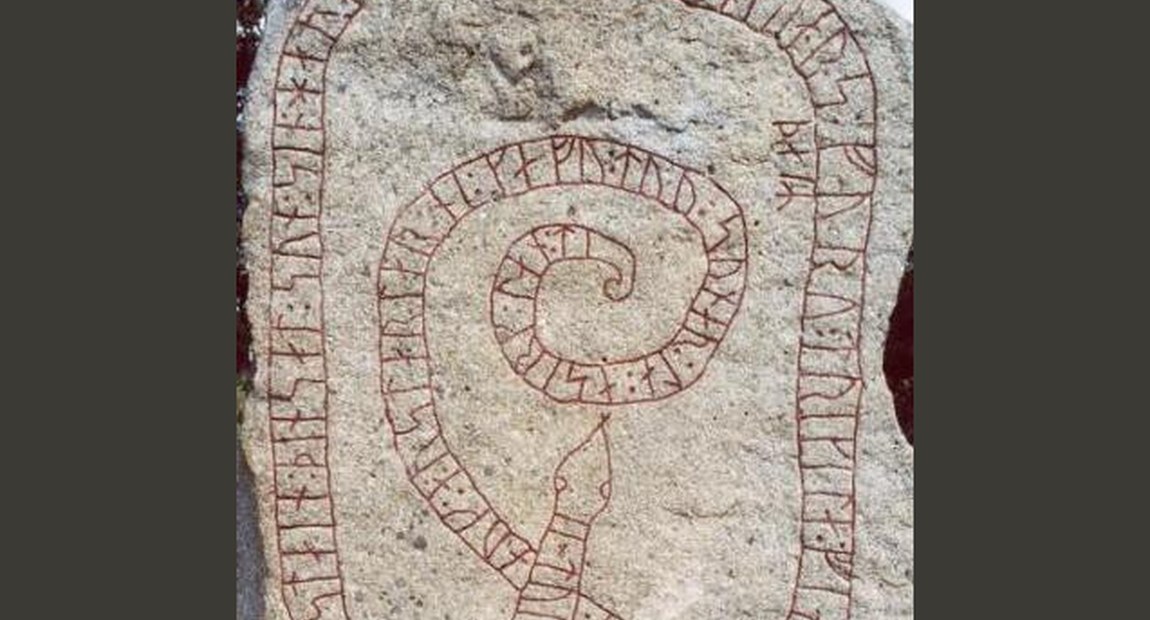
On a few dozen runestones in central Sweden, an inscription says that someone was "in Greece", died there, shared out gold there or led a retinue. Scholars call these monuments the Greece runestones, and depending on how you count, there are about 30. "Greece" here means the Byzantine Empire, not the modern country. This article sets the inscriptions side by side, explains why the numbers vary, and separates what is written on the stones from what later readers have made of it.
The Old Norse word Grikkland means "Greece", but in the mouth of an eleventh-century Swede it meant something other than today. It denotes the Byzantine Empire, which Norse speakers also knew as Miklagarðr, "the great city", after its capital Constantinople. Someone who had been "in Greece" may have been in the capital, in imperial service somewhere in Asia Minor or the Balkans, or on a trading trip. The inscriptions do not say which.
The word appears on the stones in several forms. According to the English Wikipedia overview, which relies on the Rundata runic database, Grikkland occurs in only three inscriptions, Grikkjar ("the Greeks") in 25, grikkfari ("Greece traveller") in two and Grikkhafnir ("Greek harbours") in one. These counts may overlap, and I have not re-counted them in the original editions. Spellings vary widely, with forms such as girkium, krikum or kirikium. That is normal: rune carvers wrote as they spoke, and there was no fixed spelling.
One point of context: Greece is only one of several destinations named on runestones. Men also travelled to England, Italy, the Baltic and "Serkland". The groups include the England stones and the Ingvar stones, to which we return below.
"About 30" is the figure you read everywhere, and as an order of magnitude it holds. An exact number cannot be given, because the question of what counts as a Greece stone leaves room for choice. Two overviews I consulted show this.
English Wikipedia speaks of "about 30" stones but lists only 18 from Uppland and seven from Södermanland, 25 in all. An overview on scandinavianarchaeology.com, a general knowledge site, also says "around 30" and, when counted, lists 28 entries: 14 in Uppland, seven in Södermanland, three in Östergötland, two in Västmanland and two uncertain cases, Gs 13 (Gästrikland, interpretation disputed) and DR 330 from Zealand in Denmark, where possible service in the Byzantine army is discussed. The two lists therefore disagree, and neither is a scholarly primary source.
Why the differences? Three reasons are obvious:
For figures on this blog that means: "about 30" is defensible, "exactly 30" is not.
Almost all Greece stones come from the Mälaren region: Uppland and Södermanland hold most of them, with some from Östergötland and Västmanland. That matches the picture of the Ingvar stones. The area around Lake Mälaren, which also held Birka and the sanctuary at Uppsala, was the region with the densest runestone raising in the eleventh century.
In time, the stones belong to the eleventh century. English Wikipedia says the tradition "probably died out before 1100" and by 1125 at the latest; most pieces belong, by style, to the Ringerike and Urnes groups. These style names, taken from the animal ornament, give a relative dating: stones are ordered by how the rune beast is drawn, not by a year. No stone carries an absolute date. Individual dates are even less certain; the Ed stone is placed in the mid-eleventh century by one source and only generally in the Viking Age by another.
The best-known Greece stone is not a cut block but a large boulder. It lies in Ed parish, now Upplands Väsby north of Stockholm, beside a wooded path called Kyrkstigen ("church path"). The boulder is about 18 metres around. Two inscriptions (side A and side B) are carved on it.
The text comes in two parts. Side A names Ragnvaldr, who had the runes carved in memory of his mother Fastvi, daughter of Ónæmr; she died "in Eið", as the edition puts it, that is, at Ed. Side B is the famous one: Ragnvaldr had the runes carved, and "he was in Greece, he was leader of the retinue". The transcription (as given on runkartan.se) for side B reads huar a griklanti uas lis forunki.
"Ragnvaldr had the runes carved. He was in Greece, he was leader of the retinue."Runic inscription U 112 (Ed, Uppland), side B, eleventh century; own translation after the Rundata transcription (huar a griklanti uas lis forunki) and the English rendering "was in Greece, was commander of the retinue", which I saw on runkartan.se
Two things need saying. First, the word "Varangian" does not appear on the stone, and neither does "guard". That Ragnvaldr was a captain of the Varangian Guard is a common interpretation. The stone says only that he led a retinue. Research has read this as a unit in Constantinople; literally, it is not. Second, who this Ragnvaldr was cannot be said with certainty. A Wikipedia article links him to a Ragnvaldr who appears on two other stones (U 309 and U 310) as the son of a man named Ingvar, and states that Omeljan Pritsak considers it possible that this Ragnvaldr, like his father Ingvar and the latter's brother Ingifastr, died before 1050, perhaps in the Rus war against Byzantium in 1043. I have not read that in Pritsak's work. U 112 itself names no father; the identification rests on the shared name and on interpretation. Identifying him with "Ingvar the Far-Travelled" remains speculation.
Who carved it is likewise handled with caution. The rune map names Olev, Fot and Torgöt Fotsarve as carvers (each for side A). The inscription text itself names no carver; the attribution is a scholarly one.
Not all Greece stones stand in Sweden. The Uppland stone U 104 is in the Ashmolean Museum in Oxford. According to English Wikipedia it was donated in 1687 after a request by James II; Johannes Bureus had already recorded it in 1594. The inscription: Þorsteinn had the stone raised for his father Sveinn and his brother Þórir, both said to have been "in Greece", and for his mother Ingiþóra. The carver names himself as Öpir (spelled Œpir in some sources). Öpir is one of several rune masters who signed Greece stones; a stone in Uppsala Cathedral (U 922) also bears his name.
The connection between U 104 and the place name "Ängby", which sometimes turns up, I could not confirm in the sources I consulted, and I leave it out. The original findspot is something to look up in the edition series Sveriges runinskrifter before publishing anything on it.
Anyone expecting a travel account will be disappointed. The Greece stones follow the memorial formula typical of eleventh-century runestones: who raised the stone, for whom, what he was, where he died. The journey itself stays in the background. A selection of the wording, as the English Wikipedia overview gives it:
It is striking how little is said about circumstances, fighting or employer. No stone names an emperor. No stone mentions the Varangian Guard. Everything we know about service in Byzantium comes from other sources: Byzantine chroniclers, saga narratives such as the one in the story of the Varangian Guard, and individual skaldic poems.
A few inscriptions break the pattern. On Sö 163 from Snesta (Södermanland), Þryðríkr raises a stone for two sons. One, it says, went to Greece and "divided gold". What that means is open. It may refer to paying out wages to mercenaries, to dividing plunder, or to wealth in a figurative sense. Readings differ, and none can be proven.
U 792 from Ulunda is similar: a man returned wealthy from Greece and left property to his heirs. This is not about a death abroad but about inheritance. The same motif, succession after a man who travelled abroad, appears on U 73 from Hägerstalund, where, according to Wikipedia, the stone was probably raised to settle the order of inheritance after two men who died in Greece as Varangians. The Wikipedia overview explicitly gives the word "Varangians" here, a rare example; I have not checked the reading in the edition.
U 136 mentions Jerusalem: Ástríðr raised the stone for her husband Eysteinn, who "sought or attacked" Jerusalem (the verb sœkja allows both) and met his end in Greece. Anyone who reads this as pilgrimage or as a war expedition makes a choice the text does not make. It is one of the few stones that link Greece to a goal beyond the empire.
These stones were raised by relatives: mothers, widows, brothers, fathers, sons. That is the real finding when you read the inscriptions. The Ed stone is an exception in that the returned man himself has it made, for his mother and for himself. On U 431 from Norrsunda the mother Tófa comes before the father Hemingr in the list of names, which the overview calls unusual. Women appear on these stones as patrons, for example Ástríðr (U 136) and Steinhildr (U 956).
Why raise stones at all? Here too, we can only infer it from the whole picture. Runestones were monuments standing by roads, bridges and assembly sites. They commemorated the dead, secured the family's standing and, as the inheritance stones show, also recorded legal claims. Whoever saw the stone learned that the family stood in line with a man who had travelled far. Whether the destination "Greece" was a distinction is not documented. That Byzantium is named at all shows at least that the stay was worth mentioning.
Popular texts often say the Greece stones commemorate men of the Varangian Guard. That is a possibility, not a finding. The term "Varangian" (Old Norse væringjar) denotes Norsemen in Byzantine pay, and the emperor's famous guard long consisted mostly of them. How this fits together is covered in detail in Miklagard and the Varangian Guard and in overview in Vikings, Normans and Varangians.
For the stones, the rule is this: someone who was "in Greece" may have been a guardsman, but also a mercenary in a field army, a merchant, or someone who made a detour on the way to Jerusalem. Only at Ed does the "leader of the retinue" hint at a military role. The other stones fix nothing. And even at Ed the source says "retinue", not "guard".
The Ingvar stones are a group of their own: about 26 stones for men who went east with Ingvar around 1040. We treat them in a separate article. The difference is basic: for the Ingvar stones a single expedition links the monuments, for the Greece stones a destination reached over decades. The groups sometimes overlap. On U 540 from Husby-Sjuhundra an Ingvar is among the patrons; older research (Braun, 1910) tied him to Ingvar the Far-Travelled, which the Wikipedia overview reports as a mere hypothesis.
The England stones commemorate participants in the campaigns and tribute payments in England, which we describe under the England-farers. Wikipedia names a further group, the Italy stones, three or four in number. The count of three or four Italy stones is Wikipedia's; for the Ingvar stones it gives "around 26" and an expedition between 1036 and 1041.
Related, but not a runestone: the Piraeus Lion. The marble figure originally stood at the harbour of Piraeus near Athens; it is dated to about 360 BC. In 1687 the Venetian commander Francesco Morosini took it as booty after the Venetians captured Athens. Today it stands in front of the Arsenal in Venice; copies are in the Archaeological Museum of Piraeus and the Swedish History Museum in Stockholm.
Two carvings on its shoulders and flanks carry runes in the form of a lindworm, similar to the bands on Swedish runestones. Johan David Åkerblad recognised them as runes at the end of the eighteenth century; Carl Christian Rafn published the first translation in 1854 (per Wikipedia), which, according to Wikipedia, mentions "Harold the Tall". Erik Brate offered a reading in 1914 that is regarded as the most successful (so Wikipedia, citing Omeljan Pritsak, 1981); on Brate's reading the carvers were Swedes. The carvings are dated to the second half of the eleventh century.
The text is badly weathered, many signs barely legible, and readings rely on supplied characters. Anyone wishing to tie the carving to Harald Hardrada faces a dating problem: Harald's service for the emperor falls in the 1030s and early 1040s, clearly earlier, and Wikipedia calls the link doubtful. Who the carvers were remains open; Varangians in imperial service are one possibility, not the only one.
Runestones are a particular kind of evidence. Families commissioned them soon after a death or a return, and they were set in stone, not later rewritten. That makes them reliable proof that a family in the eleventh century knew of a journey to Greece and thought it worth recording. They are not reports. No stone tells how the journey went, who paid for it or whom the man served.
Then there are transmission problems. Several stones are lost or known only from drawings. Dybeck still saw U 270 from Smedby intact in 1864, by 1866 it had been blasted apart; Peringskiöld found U 374 from Örby in 1684 as the base of a stove, and only his drawing survives; Sö 85 was destroyed in 1835, fragments were built into fireplaces, and some survive. For lost stones, early drawings and readings are the only basis, and misreadings can hardly be corrected any more.
For counting and reading the inscriptions the standard works are the edition series Sveriges runinskrifter and the Rundata database. This article rests on Wikipedia summaries and the Rundata version of U 112 as given on runkartan.se; the other details I did not cross-check in the original editions and have phrased with corresponding caution.
A few questions are best left open. How did the men reach Constantinople? Probably via Russia and the rivers, as the Varangian route describes, through Kiev and the Black Sea. The stones say nothing. How many returned? We see only those whose families raised a stone. Survivors without a stone are invisible to us. How large was the Swedish share in imperial service? The runes give no clue, because they record only a fraction of the travellers.
Why the Greece stones stand in the Mälaren region is also not conclusively answered. Perhaps connections via Kiev and the Rus were denser there; perhaps the custom of raising runestones was especially widespread. The stones alone cannot separate the two.
The Ed stone lies freely accessible on the Kyrkstigen near Upplands Väsby, listed in the heritage register as L2017:1138. Others stand in or at churches (Skepptuna, Angarn, Uppsala Cathedral); the Skepptuna stone was re-erected in 1942. For planning a trip, the rune map runkartan.se lists locations and condition. U 104 is in the Ashmolean Museum in Oxford, the lion in front of the Arsenal in Venice.
If you want to read for yourself, our article on the Younger runes covers the basics: the Younger Futhark manages with few signs, so names and words are often ambiguous, and the edition has to read what the signs leave open.
How many Greece runestones are there? Usually "about 30" is quoted. Depending on how you count, the overviews I consulted yield 25 to 28 entries; no fixed number can be given.
What does "Grikkland" mean on the stones? The Byzantine Empire, not just modern Greece. Its capital was called Miklagarðr, "the great city", by the Norse.
What does the Ed stone say? On side A, that Ragnvaldr had the runes carved for his mother Fastvi. On side B, that he was in Greece and led a retinue. There is no mention of a guard.
Are the Greece stones the same as the Ingvar stones? No. The Ingvar stones belong to a single expedition around 1040, the Greece stones to a destination over several decades. Individual stones can fall into both discussions.
Did Vikings inscribe the Piraeus Lion? The carvings are dated to the second half of the eleventh century and made by Norsemen; who exactly is open. A link to Harald Hardrada is regarded as doubtful.

The Ingvar runestones · Miklagard and the Varangians · The Varangian route · Harald Hardrada · Runes: origin & history.
All History & Finds articles →
On Sunday, 16 September 1408, an Icelandic man and an Icelandic woman were married in the stone church at Hvalsey. The …
Read more →After Edington, England had become a bad place for a Viking army. Alfred had beaten Guthrum, Guthrum had been baptised …
Read more →England had known raids since Lindisfarne in 793. Raiders came by ship, took what they could carry and were gone before …
Read more →Gudme, on the Danish island of Funen, was one of the richest centres of power and cult in Scandinavia from the 3rd to …
Read more →