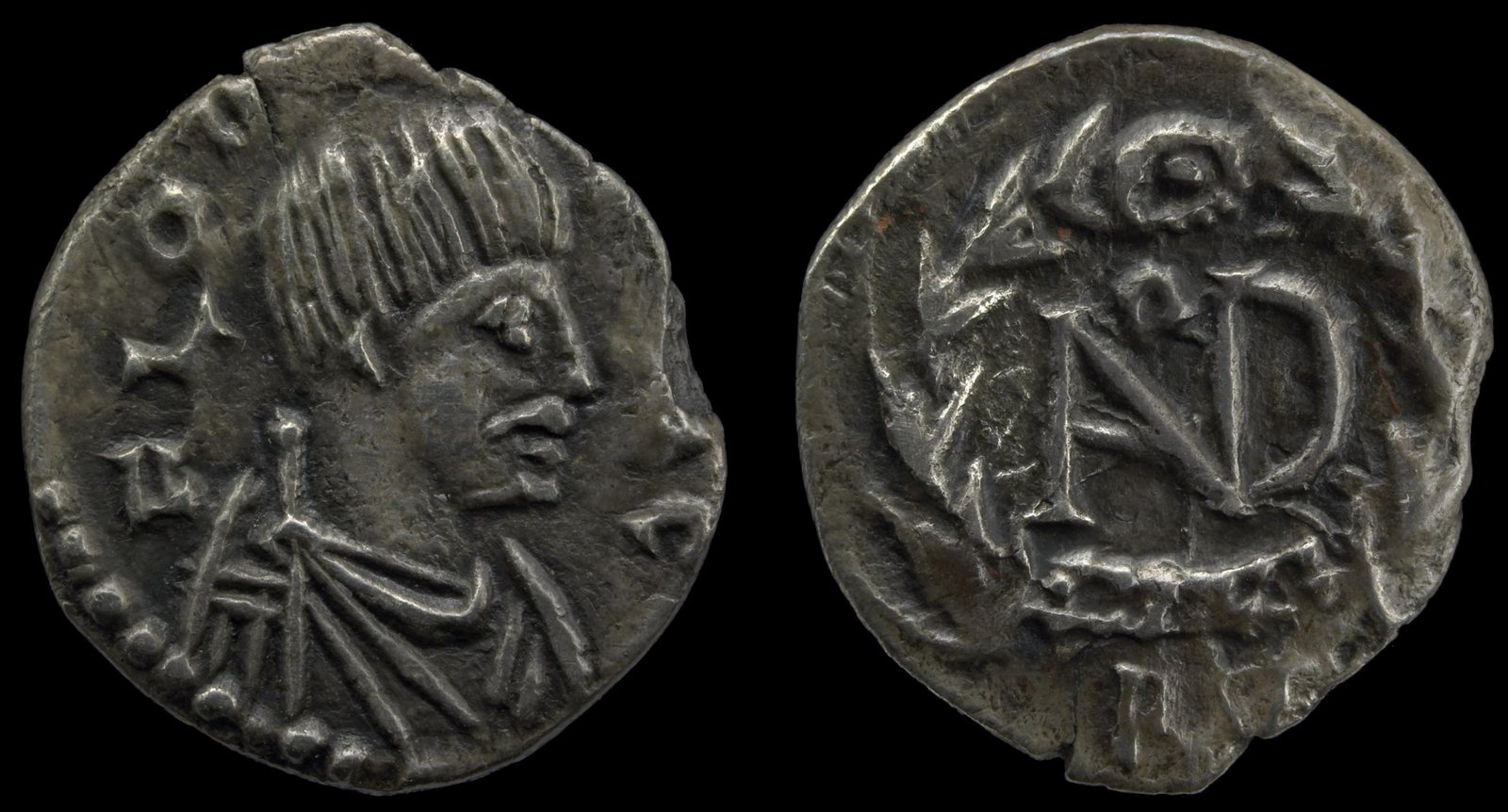
Odoacer, the man who deposed the last Western Roman emperor in 476, is called “king of the Torcilingi” by Jordanes. Nobody knows exactly who these Torcilingi, or Turcilingi, were. The name turns up in a handful of sentences, almost all of them written by a single sixth-century author, and later writers merely passed it on or reinterpreted it. This article collects the passages, explains the theories scholars have proposed and is open about where knowledge runs out.
Most peoples of the Migration Period are known to us from several angles: Roman histories, saints’ lives, law codes, sometimes cemeteries. The Turcilingi are different. They are little more than a word. In Latin they appear as Turcilingi, Torcilingi or Thorcilingi, depending on the author and the manuscript. The same group is always meant, one that is named in the circle around Odoacer in the late fifth century.
Interest in them rests almost entirely on that connection. Odoacer was a commander from the Danube region who was raised to kingship by the troops in Italy in 476 and who deposed the young emperor Romulus, mockingly called Augustulus (“little emperor”). Anyone who wants to know who Odoacer was and where his men came from will sooner or later run into the Turcilingi – and into the question whether they were a separate people at all.
They are usually classed as an East Germanic group, related to the Goths, Sciri, Rugii and Heruli who lived between the Baltic, the Black Sea and the middle Danube. That classification is an assumption, not a statement in any source. No ancient text tells us what language the Turcilingi spoke, where they lived or how many of them there were.
The only near-contemporary source to mention the name is Jordanes. He was an author of Gothic background who wrote two histories in Constantinople around 551: the Getica, a history of the Goths, and the Romana, a brief outline of Roman history. Jordanes was therefore writing some 75 years after Odoacer seized power. He was no eyewitness. He relied on earlier works, above all the lost Gothic history of Cassiodorus, the chancellor of Theoderic the Great.
According to the overview of scholarship I was able to consult, the two works of Jordanes contain three passages with the name: two in the Getica, one in the Romana. To these we can add Paul the Deacon in the late eighth century and a series of high and late medieval chroniclers who are generally held to depend on Jordanes or on Paul. There are no independent witnesses from the fifth century itself.
This is striking, because Odoacer’s era is otherwise comparatively well documented. Several other authors report on him and his followers, as the section further down shows – and, as far as is known, none of them mentions the Turcilingi.
The best-known passage is in chapter 46 of the Getica, section 242 in the usual numbering. Jordanes is describing the end of the Western emperors. He calls Odoacer rex Torcilingorum, “king of the Torcilingi”, and says that he had Sciri, Heruli and auxiliaries of various peoples with him when he took possession of Italy. He then goes on to tell of the deposition of Augustulus.
Two things stand out. First, the Torcilingi are not presented as one contingent among many but as the people of whom Odoacer is king. The Sciri and Heruli are added as companions. Second, Jordanes gives no explanation whatsoever. Either he assumed his readers would know the name, or he took it over from a source without knowing more himself. Which of the two applies cannot be decided.
I was unable to read the full Latin wording of this section for this article, because the online editions I could retrieve broke off before this point. The details above therefore follow the way the passage is reproduced in the scholarly literature. Its core – Odoacer as rex Torcilingorum – is reported consistently there.
The second passage comes from the Romana, section 344. Here Jordanes puts things differently. Odoacer is now not king of the Thorcilingi but himself “a Rugian by descent”, and the Thorcilingi appear alongside the Sciri and Heruli as bands on which he relied.
“… genere Rogus, Thorcilingorum Scirorum Herolorumque turbas munitus …”
“… a Rugian by descent, backed by crowds of Thorcilingi, Sciri and Heruli …”Jordanes, Romana 344 (c. 551/552), Latin wording as reproduced in the scholarly literature, our own translation
Even this half-sentence has sparked a dispute. Most scholars take genere Rogus to mean “a Rugian by birth”; Jordanes consistently spells the name of the Rugii with an o, as Rogi. In 1946 the American historians Robert L. Reynolds and Robert S. Lopez proposed instead to read Rogus as a personal name, roughly “offspring of Rogus”, and thought of Rua or Rugila, Attila’s uncle. Otto Maenchen-Helfen objected a year later and kept the reading “Rugian”. I know this debate only from summaries, not from the papers themselves.
Quite apart from that, the comparison with the Getica shows that Jordanes was either unsure or not committed when it came to Odoacer’s affiliation. In one work Odoacer is king of the Torcilingi, in the other a Rugian who leads Torcilingi. That is not necessarily a contradiction – a Rugian could well be king of a mixed following – but it makes clear that such labels were not fixed tags of descent.
The third passage in Jordanes is in chapter 57 of the Getica, section 291. Here the Ostrogothic king Theoderic asks Emperor Zeno in Constantinople for permission to march on Italy. In the speech Jordanes puts in his mouth, Italy is said, in essence, to be tossed about under the tyranny of the king of the Thorcilingi and Rugii: sub regis Thorcilingorum Rogorumque tyrannide fluctuatur.
The scene belongs to the years before Theoderic set out, which by the usual dating was in 488, reaching Italy in 489. One overview places the request in 493; that does not fit the sequence of events, since by 493 Odoacer had already been defeated and was killed in Ravenna. More important is what the passage is for: it is rhetoric. Theoderic needs a reason to attack Italy, and Jordanes, writing for a Gothic self-image, has him portray Odoacer as a foreign tyrant over barbarian peoples.
What Jordanes does not write is just as notable. Elsewhere in the same work he names the Thuringians – Thuringi – praises their horses and mentions their king Herminafrid. He thus treats them as a separate people with a spelling of their own. Whether he thought the Torcilingi and the Thuringians were the same, he does not say. Scholars who doubt a mix-up rely on this observation – and so, in their own way, do those who think a corruption crept into the manuscript tradition.
The second important author is Paul the Deacon, a Lombard scholar who wrote in the late eighth century and spent time at the court of Charlemagne. In both his histories the name appears as Turcilingi – the spelling with u that is most common in modern literature.
In the Historia Langobardorum, his history of the Lombards, Paul names the Turcilingi twice. In the first chapter of book one he counts them among the peoples who came from Germania to Italy before the Lombards. In chapter 19 of the same book he tells of Odoacer’s war against the Rugian king Feletheus, who lived on the far bank of the Danube opposite Noricum. For this campaign Odoacer gathered the peoples subject to him – according to the scholarly overview, Turcilingi, Heruli and part of the Rugii – defeated Feletheus, killed him and led captives off to Italy. The Lombards then moved into the abandoned Rugiland.
In the Historia Romana, a continuation of the late antique outline by Eutropius, Paul goes further. Among the peoples in Attila’s army he lists, according to the overview, Eruli Turcilingi sive Rugi, “Heruli, Turcilingi or Rugii”. And when Odoacer marches on Italy, he relies there on the help of the Turcilingorum sive Scirorum, “the Turcilingi or Sciri”. So Paul equates the Turcilingi once with the Rugii and once with the Sciri.
According to a summary of his work, the ancient historian Andreas Krautschick pointed out in 1986 that these equations are most likely Paul’s attempts to make sense of Jordanes’ puzzling remarks. Paul evidently knew the Turcilingi only from Jordanes and drew his own conclusions. For the question of who the Turcilingi were in the fifth century, his statements therefore carry little weight of their own. They do show that by the eighth century nobody knew any more exactly who was meant.
A counterpoint is provided by the Origo gentis Langobardorum, a short Lombard origin story from the seventh century. It tells of the same campaign against the Rugii but has Odoacer set out from Ravenna with an army of Alans, and it calls the Rugian king Theuva. It says nothing about Turcilingi.
Later chroniclers of the ninth to twelfth centuries also took over the name. The general view is that they copied Jordanes or Paul. I have not checked their texts myself.
Eugippius wrote the Life of Saint Severinus around 511. Severinus was a monk active in Noricum on the Danube in the decades after Attila’s death. The Life tells of the Rugian kings north of the river, and of an encounter between Severinus and the young Odoacer, to whom the saint foretells a great future in Italy. As far as I know, the Turcilingi do not appear in it. I have not, however, checked this against the full Latin text.
The same goes for the Anonymus Valesianus, which names Odoacer’s father Edeco and describes Odoacer as a leader of Sciri and Heruli, and for John of Antioch, who calls Odoacer a Scirian. In the summaries I know, the Turcilingi have no place there either. A tenth-century Byzantine lexicon, the Suda, makes Odoacer’s brother Onoulf a man who was Thuringian on his father’s side and Scirian on his mother’s. This note probably goes back to a fragment of an older historian and plays an important part in the Thuringian theory.
The Turcilingi depend on a single author, Jordanes, and on repetitions two centuries younger. That puts them on much narrower ground than their neighbours, the Sciri, Heruli and Rugii, who are attested by several authors independent of each other.
Wherever the Turcilingi came from, they appear in a clearly defined world. In the first half of the fifth century the Huns under Attila ruled an empire that stretched from the steppe north of the Black Sea to the middle Danube. Many peoples lived under their overlordship: Ostrogoths, Gepids, Sciri, Rugii, Heruli, Sarmatians, Alans and others. An Edeco who appears in Priscus’ account as an envoy of Attila is usually identified with Odoacer’s father of the same name; the identification is likely but not certain.
After Attila’s death in 453 the empire fell apart. At the battle of the Nedao, a river in Pannonia that cannot be located with certainty, an alliance led by the Gepids defeated Attila’s sons; the battle is usually dated to 454. Afterwards several small lordships emerged along the middle Danube: the Rugii north of the river opposite Noricum, the Heruli further east, the Sciri somewhere in the Danube–Tisza region that cannot be pinned down exactly, the Ostrogoths in Pannonia. The Sciri, for example, were defeated by the Ostrogoths around 469; many of their warriors then sought service in the Roman army – probably Odoacer among them.
If the Turcilingi were a group of their own, they very likely belonged to this setting. Paul the Deacon, though at second hand, places them in Attila’s army; Jordanes always names them in the same breath as the Sciri, Rugii and Heruli. A location on the middle Danube is therefore plausible, but nowhere explicitly attested. No source says where the Turcilingi lived. Nor can their participation in the battle of the Nedao be demonstrated.
Odoacer appears around 470 as an officer in the Western Roman army. In 476 the Germanic troops in Italy, who had demanded land from the commander-in-chief Orestes, raised him to be their king. Orestes was killed, his son Romulus Augustulus deposed and sent to Campania. Odoacer chose not to proclaim a new emperor in the West and ruled Italy until 493.
For the Turcilingi, Odoacer’s second great campaign matters more. By the usual dating he crossed the Alps in 487 against the Rugian king Feletheus, also called Feva, captured him and his wife Giso and brought them to Italy. In 488 his brother Onoulf defeated Feletheus’ son Fridericus and had the Roman population of Noricum resettled in Italy. This is the very war Paul the Deacon describes with Turcilingi in Odoacer’s army.
A year later Theoderic arrived in Italy with the Ostrogoths. After several years of war Odoacer surrendered in Ravenna and was killed by Theoderic at a banquet in 493. With him, the Turcilingi also vanish from history.
Because the sources yield so little, scholars have come up with several explanations. None has won general acceptance. I know most of these positions only from summaries and therefore give them with names and without judging between them.
A Germanic people in its own right. In 1837 Kaspar Zeuss derived the Turcilingi from the Rhoutikleioi, a tribe placed on the Baltic by the second-century geographer Ptolemy; Karl Müllenhoff followed him. That link is now abandoned. What remains is the general classification as an East Germanic group – a classification based on their association with the Sciri and Rugii, not on evidence of their own.
A Scirian royal clan. Herwig Wolfram, one of the leading historians of the Goths, considered it possible, according to the scholarly overview, that “Torcilingi” was the name of the family Odoacer came from – a dynasty rather than a people. The ending -ling fits this reading, since in Germanic it denotes descendants or members, much like -ing in names such as Merovingians or Carolingians. In that case rex Torcilingorum would be a kind of family label that Jordanes or his source misunderstood.
A Hunnic or Turkic-speaking group. The opening Turci- has made some scholars think of “Turks”. Reynolds and Lopez saw Odoacer as a Hun in 1946, Edward A. Thompson and others followed that line, and in 2013 Hyun Jin Kim interpreted the Turcilingi as a Turkic-speaking tribe under Hunnic leadership whose name had been Germanised. A note of caution: by the usual account, the name of the Turks as a people only becomes tangible in the sources from the mid-sixth century, and a mere similarity of sound proves little. Bruce Macbain already asked sceptically in the title of a 1983 paper whether Odoacer was a Hun. Wolfram, for his part, thought the question pointless, because under Attila Hunnic and Germanic affiliations could hardly be separated.
A slip for the Thuringians. Another reading sees Torcilingi as a corrupted form of Thuringi, a copying or hearing error for the Thuringians. According to the overview available to me, Helmut Castritius and Wolfgang Brandes hold this view and base it on the Suda note that calls Odoacer’s brother half Thuringian; Wolfram also thought it possible. Opponents point out that Jordanes names the Thuringians correctly and separately elsewhere, and that no regular sound change links the two names. Penny MacGeorge suggested the reverse, that the form “Thorcilingi” is the actual error.
Because the Thuringian theory comes up so often, a clear distinction helps. The Thuringians are a well-attested people. They first appear in the sources in the fifth century, form a kingdom in central Germany around 500, can be traced archaeologically through cemeteries and were subjugated by the Franks in 531. Jordanes knows them, mentions their famous horses and their king Herminafrid, who married a niece of Theoderic.
The Turcilingi, by contrast, exist only as a name in Odoacer’s following. Anyone who equates them with the Thuringians has to explain why Jordanes writes the same name correctly once and garbled another time, and why Thuringians from central Germany should appear in the army of a Danubian leader. That is possible, since a war band could include men from many regions. It is not attested. The equation remains a scholarly hypothesis.
The Turcilingi cannot be identified archaeologically. There is no cemetery, no settlement and no type of object that can be clearly assigned to them. Finds do not carry ethnic labels.
From the middle Danube region of the fifth century, archaeologists know many furnished graves attributed to the world after Attila: bow brooches, belt buckles, artificially deformed skulls reflecting a custom widespread in the Hunnic empire. These finds illustrate the milieu in which the Turcilingi may also have lived. Assigning any of them to the Turcilingi would be pure speculation, and I am not aware of any publication that seriously proposes such an attribution.
In the Middle Ages the Turcilingi lived on only as a word in chronicles. Writers took them from Jordanes or Paul, often in the sequence “Heruli, Turcilingi, Rugii”, without adding anything. There is no legend, no hero and no place bearing this name.
A side path leads to the Frankish chronicle known as Fredegar from the seventh century. It tells the legend that the Franks descended from the Trojans and, in this context, names a people called the Torci, said to be related to the Franks. According to a summary, the orientalist Claude Cahen suggested in 1973 that this might be an echo of the Turcilingi. That remains an isolated conjecture; the Trojan legend itself is a learned invention, not historical tradition.
Who were the Turcilingi? A group in Odoacer’s circle in the late fifth century, named almost only by Jordanes. Whether they were a people of their own, a royal clan, a group shaped by the Huns or a misspelling of the Thuringians is unresolved.
Where did the Turcilingi live? No source says. Since they are always named with the Sciri, Rugii and Heruli, they are assumed to have lived in the middle Danube region, but this is not attested.
Why is Odoacer called “king of the Torcilingi”? That is what Jordanes calls him in the Getica. He does not explain what he meant; in the Romana he describes Odoacer as a Rugian backed by Torcilingi, Sciri and Heruli.
Are there archaeological finds of the Turcilingi? No. No group of finds can be clearly assigned to them; fifth-century finds from the Danube region only show the general milieu.
Do the Turcilingi have anything to do with the Vikings? No. They belong to the fifth century, some 300 years before the Viking Age, and to the Danube region, not to Scandinavia.

The Sciri · The Rugii · The Heruli · The Gepids · The Ostrogoths.
All History & Finds articles →
The Turones lived on the middle Loire, in the country now called Touraine. Ancient authors mention them only in …
Read more →The typical Viking was, above all, a farmer, trader or craftsperson in the North – comb on the belt, ale in the cup …
Read more →Ubba (also Ubbe, Hubba) is regarded as a brother of Ivar the Boneless and Halfdan and as a leader of the Great Heathen …
Read more →In Caesar's day the Ubii lived on the right bank of the Rhine. They attached themselves to Rome early and crossed to …
Read more →