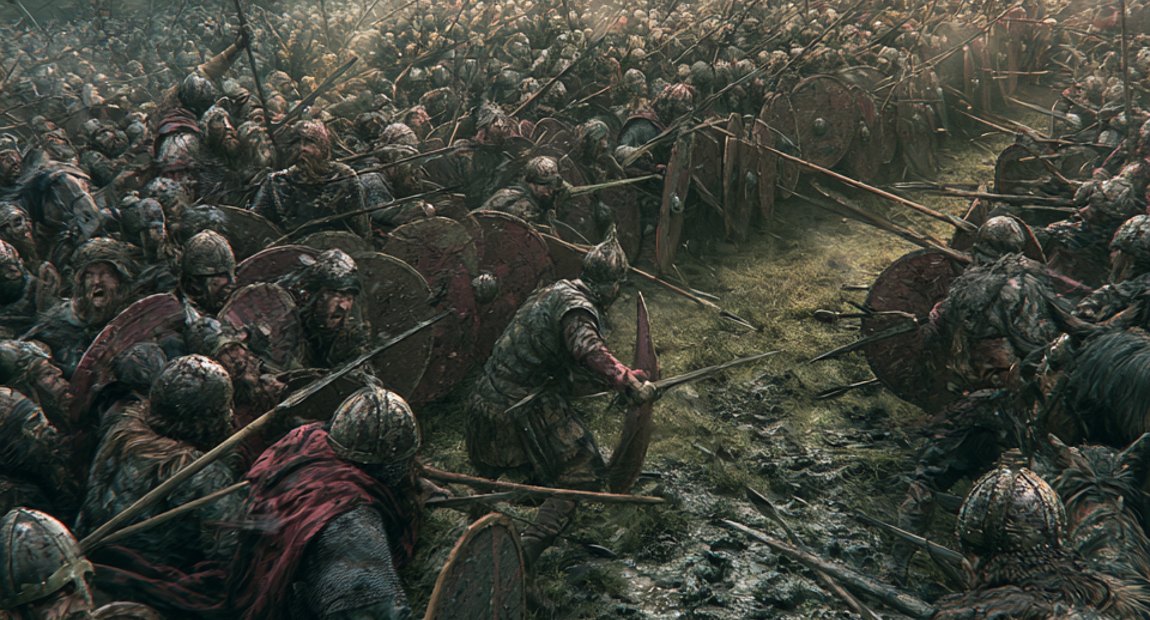
Ubba (also Ubbe, Hubba) is regarded as a brother of Ivar the Boneless and Halfdan and as a leader of the Great Heathen Army. His name does not appear in the oldest English chronicles. This article goes through the sources by age and weight, separates what is established from conjecture and legend, explains why the death at Cynwit in 878 is only an identification, asks about the "dux of the Frisians", and says plainly where there is a link to Frisia and where there is none to the Rhineland.
There is no coin of Ubba, no runic inscription, no grave find and no poem composed in his lifetime. What we have are names in texts written decades or centuries later. That is common for ninth-century Viking leaders, but in his case extreme. Anyone portraying him ends up writing more about the sources than about the man.
The name comes in several forms. Scholars mostly write Ubba; the Old Norse form would be Ubbi; Abbo's text has Hubba, and later writers use Ubbo and Ubbe. Nobody knows his birth year or origin; "around 820 to 830" in reference works is a back-calculation. Established is only that a leader of this name was mentioned in the circle of the Great Army. Everything beyond depends on which source one believes.
The Great Heathen Army is the modern term for the force the Anglo-Saxon Chronicle simply calls micel here, "great army". It landed in East Anglia in 865 and stayed for thirteen years. Scholars now assume it was not one army under one king but an alliance of warbands from Scandinavia, the British Isles and the Frankish world. The overall course is told in the articles on the Great Army and on Ragnar's sons; here the subject is the one man who is hardest to grasp in that story.
The negative first. The Anglo-Saxon Chronicle, our main narrative for 865 to 878, does not name Ubba in its original entries. For 878 it speaks of an unnamed "brother of Ivar and Halfdan". Stephen Lewis, whose 2016 article I read in extracts, cites Patrick Wormald's remark that the phrase "Inwær's brother and Halfdan's" is "certainly a strange phrase".
The names come later and from three different directions.
First, saints' lives. Abbo of Fleury, a scholar from western France, wrote his Passio Sancti Eadmundi, the passion of the East Anglian king Edmund, between 985 and 987 as a guest at Ramsey Abbey. It is the earliest source to name "Hubba". Abbo says the story came from Archbishop Dunstan, who as a young man had heard it from Edmund's armour-bearer; that is Lewis's report, and I could not check Abbo's Latin myself. Soon afterwards Ælfric of Eynsham wrote an Old English version; I read the lines with Hubba in an Oxford course extract. Around the year 1000 Byrhtferth's Life of St Oswald also names "Huba and Hinuuar" as leaders, according to Lewis.
Second, northern English texts. The Historia de sancto Cuthberto (History of St Cuthbert, probably tenth or eleventh century) contains the sentence Nam Ubba dux Fresciorum cum magno Danorum exercitu in regnum eius uenit, "for Ubba, leader of the Frisians, came into his kingdom with a great army of Danes". The Annales Lindisfarnenses et Dunelmenses of the early twelfth century repeat the "dux Fresonum". Both after Lewis. Dux means war leader or duke; Frescii and Fresones are the Frisians.
Third, twelfth-century historiography. The Annals of St Neots (early twelfth century, dating uncertain; a set of annals associated with the priory of St Neots) link Hubba and Hingwar with a "Lodbrok" whose daughters are said to have woven the raven banner. Geffrei Gaimar, an Anglo-Norman poet, identifies the man who fell at Cynwit with Ubbe in his Estoire des Engleis (about 1140).
The Scandinavian sources are largely silent. According to Wikipedia, Ragnars saga loðbrókar has no son Ubba; the Ragnarssona þáttr (about 1300) lists Ubba second after Ivar without letting him do anything. Saxo Grammaticus knows, by the same source, an "Ubbe", Ragnar's son, who rebels against his father, with no link to England. All of this is 300 to 450 years younger than the events. On the genre see the Icelandic sagas.
Rule of thumb: the further a text is from 878, the more exactly it knows. That is appetite for narrative, not knowledge.
What the Chronicle reports in general is well attested. Where Ubba fits in is interpretation.
865: The Great Army lands in East Anglia, is supplied with horses and moves north. The Chronicle names no leader. Æthelweard (tenth century) presents "Inwær", that is Ivar, as head of the venture. Lewis follows Frank Stenton in seeing Ivar as the original leader.
866/867: York falls. In Northumbria Osberht and Ælla, rival kings, both fall trying to retake the city. Here the northern English texts insert Ubba: according to the Historia de sancto Cuthberto he came to York on Palm Sunday; the Lindisfarne annals say he slaughtered "almost the whole people of the Northumbrians". Lewis regards the Cuthbert passage as credible at its core and concludes that Ubba probably arrived in spring 867, not in 865, with a warband of "Danes".
867 to 869: The army sits at Nottingham and returns to York. Gaimar mentions Ubba at Nottingham; he is a twelfth-century poet.
869/870: The army winters at Thetford in East Anglia. King Edmund falls; the Chronicle dates it to 870, probably it was late 869. The older Chronicle text names no culprits. The later manuscript F (twelfth century) names Ingware and Ubba, according to Wikipedia. Abbo names only Hinguar and leaves Hubba behind in Northumbria (see below).
870 to 874: Reading, London, the winter camp at Torksey and finally Repton. Ivar vanishes from the English sources. Æthelweard says he died in the same year as Edmund; whether he is the Dublin king Ímar is debated. Ubba is missing from the Chronicle's accounts of the fighting of 871, where the "kings" Bagsecg and Halfdan appear.
874: The army splits. Halfdan goes to Northumbria, Guthrum with two other leaders to Cambridge. More on the split at Halfdan Ragnarsson and Guthrum.
875 to 878: Wareham, Exeter, a treaty with Alfred that the armies break; in January 878 Guthrum surprises Chippenham, an unnamed brother of Ivar and Halfdan falls in Devon, and in May Alfred defeats Guthrum at Edington.
Between about 869 and 878, then, Ubba is invisible in the English texts. Either he left England, or the sources omit him, or he stands there under another name. Here the identifications begin.
Popular retellings make Ubba King Edmund's murderer. According to Abbo that is wrong. In the Passio it is Hinguar and his army; Hubba appears in the landing and then stays in Northumbria. So it stands in Ælfric too, whose Old English text I read in the original. The key sentences, in my own translation:
"On that fleet were the foremost leaders, Hinguar and Hubba, bound together by the devil, and they came ashore in the land of the Northumbrians ... Then Hinguar turned east with his ships, and Hubba stayed behind in the land of the Northumbrians, having won victory by cruelty."Ælfric of Eynsham, Life of St Edmund (1990s, following Abbo's Passio), Old English text, lines 149 and 152 in the numbering of the Oxford course pack; original text read by me, the lines do not stand directly next to each other, material between them omitted; English version my own translation from the public-domain source
It is the oldest narrative passage on Hubba, and his role stays small: co-leader, cruel, left behind. Whether Hubba thereby held Northumbria as a governor or the text merely explains his absence from the martyrdom, it does not say. Abbo names a chain of transmission (Dunstan, armour-bearer, eyewitness); Lewis quotes Wormald, who thought such tradition "of a pretty high order", and notes that others doubt Byrhtferth.
Later legend wanted more. The Liber de infantia sancti Eadmundi (twelfth century) is the first to connect Lodbrok's sons Ivar, Ubba and Bjorn with Edmund's death, Chronicle manuscript F names Ubba as one of the killers, and in the Ragnarssona þáttr it is, according to Wikipedia, "Yngvar and Husto", illegitimate brothers of Ivar, who torment Edmund. Legends about English monasteries, such as Abbess Æbbe of Coldingham, also draw Ubba in; they are late. Of all monastery destruction, archaeology confirms, according to Wikipedia, only the damage at St Wystan's, Repton; for Medeshamstede (Peterborough), Chronicle manuscript E and Hugh Candidus (about 1160) name Ivar and Ubba, which cannot be confirmed.
Little, and only about the frame. A war leader of the ninth century kept followers through plunder, agreements and reputation. The Great Army lived in winter camps on rivers: York 866/67, Nottingham 867/68, Thetford 869/70, Reading 870/71, London 871/72, Torksey 872/73, Repton 873/74. In summer one set out; in winter one had horses and silver brought in. Archaeology has found the camps at Torksey and Repton; see The Great Army.
Inside this structure the sources show Ubba differently: leader of his own warband (Cuthbert text), co-leader with Ivar (Abbo), not recognisable in the hierarchy (Chronicle). The designation "dux", not "rex", stands out: of the leaders the Chronicle calls only Bagsecg and Halfdan "kings" in 871, and Ubba is not there in either case. Whether that reflects a genuinely lower rank is a plausible assumption, no more.
The only fight linked to Ubba is Cynwit (below): landing with 23 ships, an attack on a fort believed to be badly supplied, a dawn sortie by the besieged. On ships see the longships.
In winter 877/78 Wessex was in trouble: Guthrum had surprised Chippenham, King Alfred was in the Somerset marshes. Into this falls a side theatre in the south-west. The Chronicle says, in the 1915 translation I read: in the winter "the brother of Inwar and Halfdene" was in Wessex, in Devonshire, with twenty-three ships, and was slain there with 840 of his men and the banner they called the "Raven" was captured.
Asser, Alfred's Welsh court scholar, writes more fully around 893. He brings the force from the land of Dyfed in the far south-west of Wales, where it had wintered, to Devon, before the stronghold of Cynuit (Cynwit). The besieged made a surprise sortie at dawn, and the leader "was miserably cut off with twelve hundred others". The number differs from the Chronicle (840). Æthelweard (tenth century), in a rendering I saw only on a secondary page, gives thirty ships and the "brother of Halfdan and of the tyrant Inwær", and names Odda, ealdorman of Devon, as the victor. Three texts, three numbers: 23 or 30 ships, 840 or 1,200 dead.
Where was Cynuit? Countisbury on the north coast of Devon is named most often. The English Place-Name Society considers Plummer's identification "probably right"; others propose Kenwith Castle near Bideford, Cannington near Combwich on the Parrett, or the hillfort settlement at Beaford. Clifford argued for Cannington in a paper of the Somerset society, because Asser describes a waterless summit.
And the name? Geffrei Gaimar calls the fallen leader "Ubbe" around 1140 and has him buried under a mound called Ubbelawe ("Ubba's hill"). The chronicler John Brompton (fourteenth century) knows the form "Ubbalowe" in Devon, William Camden (around 1600) "Hubbaboro, tumulus Hubbae"; John Aubrey (died 1697) notes "Hubba's Low". That is a chain of texts that know each other, so the place-name argument is weak. Lewis thinks Gaimar may have jumped to a conclusion from the Edmund legend: an Ubba there, a brother of Ivar here, hence the same man. Gaimar was also a romancer. Secure proof is missing.
For the reader this means: Ubba fell in Devon in 878 is a possible identification, attested only since the twelfth century. The Chronicle, Asser and Æthelweard do not know the name.
The banner belongs to the fight. The Chronicle calls it, in the translation I read, a banner "which they call the Raven". It does not say it had magical powers. That is added later by the Annals of St Neots: three daughters of Lodbrok are said to have woven it and finished it in a single midday hour, illud uexillum tex'u'erunt et totum parauerunt illud uno meridiano tempore (the Latin wording as I saw it in a Wikipedia quotation). If the army was to win, a living raven flapped its wings in the middle; if the outcome was defeat, it hung still. An 1848 English edition of Asser (Giles) has a similar addition with the "three sisters of Hingwar and Hubba"; I saw it only in a quotation. Whether this passage belongs to the original Asser or was inserted from the St Neots annals I could not establish; it is expressly to be checked.
The same idea, a raven banner foretelling victory or defeat, appears in the Encomium Emmae for Cnut's army at Ashingdon in 1016 and in the Orkneyinga saga for Sigurd the Stout, who carried it at Clontarf in 1014. The raven motif points to Odin and Huginn and Muninn, but as a common war flag of all Scandinavians it is not attested according to scholarship (see The raven in the north).
The title dux Fresciorum opens a trail that is hard to ignore. In the ninth century the Carolingians granted coastal areas in Frisia to Danish leaders so that they would guard the coasts against their own kind. Heriold received Walcheren in 841, Rorik part of Frisia around 850; so the Annales Bertiniani and Fuldenses report, according to Wikipedia. A force with a Frisian base going to England is therefore not absurd.
But what does "dux of the Frisians" mean? Three readings are on offer.
He was a Frisian. The simplest reading, and the least supported. Lewis cites Bremmer (1981), who holds that Ubba cannot himself have been a Frisian; his men may have made a name for themselves in Frisia.
He led Vikings from Frisia. The commonest assumption: Ubba led a force based in Frisia. In a later sentence the Historia de sancto Cuthberto also speaks of "Ubba, dux of the Frisians, and Healfdene, king of the Danes" and of "Scaldingi". Whether this word means "people of the Scheldt" (so Steenstrup, Lappenberg, Storm, Woolf) or derives from Skjöldungar/Scyldingas, the Danish royal line of Beowulf (Plummer, Stevenson, Collingwood and others), is a debate of its own. Lewis leans to the Scheldt reading.
He is a man the Frankish sources call by another name. This is Lewis's proposal in Saga-Book 40 (2016): Ubba could be the Viking Rodulf, who fell in northern Frisia in 873 when he demanded tribute from the Frisians; the Annals of Fulda report this at length, according to the Annals of St-Bertin he died with at least 500 followers, and the Annals of Xanten comment unkindly on his death although he had been baptised. The arguments: Rodulf is absent from the Frankish sources between 865 and 871, when Ubba appears in England, and reappears in Frisia in 872, after Ubba has vanished from the English texts. The name Ubbi can be understood as a short form of Úlfr, itself a short form of Hróðúlfr; the Knýtlinga saga says Úlfr was "called Ubbi"; the Roskilde Chronicle lists "Ulf" and "Ubbi" as brothers. Lewis calls it circumstantial evidence that would not meet the criminal standard, but perhaps the civil one. He concedes that the Roskilde cleric may have meant two different people, in which case the identification falls.
The hypothesis explains a gap; it is not a find. I know Lewis's article only from a summary.
Anyone who meets Ubba in a series as Ivar's younger brother sees an order that appears in the sources late at best. The Chronicle says "brother of Ivar and Halfdan" with no ranking by age. The Ragnarssona þáttr (about 1300) names four sons of Ragnar and Aslaug: Ivar, Ubba, Hvitserk and Sigurd, and describes Ivar as the eldest and cleverest; Ubba has no action there, he is only listed. So the Wikipedia account of the text; I have not seen the wording. In Ragnars saga loðbrókar, according to the summary, Ubba is missing altogether; there stand Ivar, Bjorn, Hvitserk, Ragnvald and Sigurd Snake-in-the-Eye. Saxo makes Ubbe a rebellious son of Ragnar and names him between Ivar and the rest. On Ragnar Lodbrok and Bjorn Ironside there are articles of their own.
It can be set out soberly. Established is that Ivar and Halfdan are called brothers (Chronicle 878) and that sources of the tenth to twelfth centuries connect Ubba with Ivar. Plausible is that Ubba was related to or allied with both. Not attested is that all were sons of one Ragnar; Ragnar himself is a disputed historical figure.
Frisia: Here there is a link in the sources, but an uncertain one. The title "dux of the Frisians" in the northern English texts is the only early argument, and it is itself two centuries younger than 867. Reading "Scaldingi" as "Scheldt people" would point to Walcheren, the identification with Rodulf to northern Frisia. Both are scholarly opinions. See the Frisians and Dorestad.
North Sea: The voyage of the 23 ships from Dyfed to Devon shows how the army used the sea as a road; that is frame, not evidence. On the voyages to England see England-farers and Vikings in England.
Rhineland and Aachen: No attested link. The Great Army crossed from the Thames to Ghent in 879 and plundered Aachen, Cologne, Bonn, Prüm and Trier in the winter of 881/82; the articles The Great Army on the Continent and Vikings in Aachen give the sources. Ubba appears in none of them. If he were to be identified with Rodulf, he would have fallen in 873, long before Aachen. The claim that "Ubba ravaged the Rhineland" cannot therefore be sustained.
Hubba's Low. The word low means "burial mound" in dialect. The mound is said to have been called Ubbelawe or Hubba's Low. Where is disputed: Brompton says only "in Devon"; Clifford suggests a round mound near Stert and concedes he found no evidence it was ever called "Hubbalowe". Westcote joked in the seventeenth century that as many Devon places claimed the battle as Greece claimed Homer.
The Hubbastone at Appledore. On the bank of the Torridge at Appledore stands today a granite block of about 2.5 tonnes, the Hubbastone. According to the North Devon Gazette it was made from Lundy granite as a millennium project, with longships, warriors and the raven banner. A plaque at "Bloody Corner" names the spot where "King Hubba the Dane" is said to lie buried. That is local tradition. The report cites no find; the names Bloody Corner and Bonehill are offered as hints without their origin being shown. The commemoration is real, a grave is not attested.
Hubberston. The place near Milford Haven in Pembrokeshire is often traced to Hubba. According to the Wikipedia page that is wrong: the name is Norman French, first recorded in the thirteenth century as Hobertiston and Villa Huberti, and means "Hubert's farm". I found no "Ubbelade" anywhere.
Modern times. Ubba was a minor figure in English Alfred poems as early as the eighteenth century. The series Vikings (from 2013) brings Ubbe on stage, The Last Kingdom (novel 2004, series from 2015) does too, and Assassin's Creed Valhalla also uses the name.
Open are the identity of the man who fell at Cynwit, Ubba's origin and his role in the army, and so it will stay until a new text or find appears. Coins and camps that are archaeologically secure belong to other leaders, above all Halfdan. That he was Ragnar's son, that he murdered Edmund, that he lies in Devon: each of these stories comes from a different layer of text, and none reaches back to the man himself.
Who was Ubba? A leader in the Great Heathen Army of the ninth century, regarded in later sources as a brother of Ivar and Halfdan. His origin is unknown; the northern English texts call him "dux of the Frisians".
Did Ubba die in Devon in 878? Possibly. The Chronicle reports the death of an unnamed brother of Ivar and Halfdan at Cynwit; the name Ubba first appears around 1140 in Gaimar. The identification is not secure.
Was Ubba involved in Edmund's death? According to Abbo and Ælfric, no; there Hinguar acts and Hubba stays in Northumbria. Later legends make Ubba an accomplice.
Was Ubba a Frisian or a Dane? That is open. The title "dux of the Frisians" speaks for a base in Frisia; whether he came from Scandinavia, was himself a Frisian or is to be identified with the Viking Rodulf remains a research question.
What is Reafan? The raven banner that according to the St Neots annals Lodbrok's daughters wove and that was captured at Cynwit. The Chronicle mentions only a banner called "Raven".
Related articles: Ivar the Boneless, Halfdan Ragnarsson, Ragnar's sons, The Great Army, Guthrum, Alfred the Great, Ragnar Lodbrok, Vikings in England, The Frisians and Jorvik.

Ivar the Boneless · Halfdan Ragnarsson · Ragnar's sons · The Great Heathen Army · The Vikings in England – from Lindisfarne to 1066.
All History & Finds articles →
The Ubii were a Germanic tribe who originally lived on the right bank of the Rhine, in the area between Main and Sieg …
Read more →The Ukrani left us not a single sentence. Everything we read about them comes from outsiders: Saxon chroniclers who …
Read more →Uppåkra is an archaeological site about five kilometres south of Lund in Scania, southern Sweden, where one of …
Read more →