Between the Salzach, Mur and Drava, in today's Salzburg, Carinthia and Styria, there existed in the last centuries BC something the Romans called regnum Noricum, the kingdom of Noricum. It had kings, struck coins, sold iron to Italy and finally became a Roman province, without any ancient author telling its story as a whole. What we know about the Norici is scattered in subordinate clauses: in Caesar, Strabo, Pliny, Livy, Appian, Velleius and Cassius Dio. This article collects those clauses, sets the archaeology beside them and says openly where the sources are silent or contradict each other.
The word "Norici" is used in three senses, and anyone who does not keep them apart soon gets confused. First, it denotes a single tribe, the Norici in the narrow sense. Second, it means the league of several tribes that appears in the sources as a kingdom. Third, Noricum is the name of the later Roman province, which covered roughly today's Austria south of the Danube and parts of Slovenia. A tribe here is a community with its own name and area of settlement, not a state with boundary lines. A kingdom in the sense of the sources is a league headed by a king who speaks for all to the outside world; how much power he had within it we do not know.
Which tribes belonged to it is shown not by historians but by stones. On the Magdalensberg in Carinthia, early Roman honorary inscriptions were found for members of the imperial house, set up jointly by several native communities. According to the secondary literature, eight names are given: Norici, Ambilini, Ambidravi, Uperaci, Saevates, Laianci, Ambisontes and Alauni. The Ambidravi are literally "those on both sides of the Drava", the Ambisontes, on a common interpretation, "those on both sides of the Isonta", i.e. the Salzach. The inscriptions date to the Augustan period; we have not seen the Latin wording ourselves. German-language overviews state that thirteen tribes united around 200 BC under the leadership of the Norici. For the number thirteen and for the date we found no ancient source; both are a modern reconstruction.
The relationship to the Taurisci, a name that older texts use for the Celts of the Eastern Alps, is difficult. Pliny the Elder writes in his Natural History (III, 133) that next to the Carni lived people "once called Taurisci, now Norici" (quondam Taurisci appellati, nunc Norici). Strabo, on the other hand, says (Geography IV, 6, 9) that the Taurisci belong to the Norici, and elsewhere (VII, 5, 2) he names them together with the Boii as a people under the ruler Critasirus whom the Dacians destroyed. For Pliny, then, "Taurisci" is an older name for the same people, for Strabo a sub-group, and in the east the name seems to mean a people on the border with Pannonia. This vagueness is not the fault of one source but lies in the matter itself. Our own article on the Taurisci should be read with this caveat.
The earliest reports about the Eastern Alps concern natural resources. Strabo (IV, 6, 12) passes on an account by the Greek historian Polybius (2nd century BC): in the land of the "Noric Taurisci", opposite Aquileia, gold had been found lying just two feet below the surface. Part of it was pure, and the rest could be smelted at a profit. After Italians joined in the work, the price of gold throughout Italy fell by a third within two months; the Taurisci then drove out their co-workers and kept the mining for themselves. In Strabo's time, around the turn of the era, these gold mines were under Roman control. Whether the price figure is correct cannot be checked; it is a story that Polybius evidently passed on, not a statistic.
In his fifth book (V, 1, 8), Strabo describes the trading town of Aquileia on the Adriatic and mentions a journey inland to the city of Noreia, 1,200 stadia away (a stadion is about 180 to 190 metres). The region, he says, has places well suited to gold-washing, and iron-works too. This names the basis of the Norici's reputation: gold from the rivers and mountains of the Tauern, and iron from the ore deposits of Carinthia and Styria.
For iron, archaeology says more than literature. According to an overview by the Leibniz Centre for Archaeology (LEIZA), the most important district in Roman times was the area between Hüttenberg and Mösel in southern Noricum. At Mösel, shaft furnaces up to 1.6 metres across were found that smelted ore at 1,100 to 1,300 degrees; near Feldkirchen, slag heaps from about AD 15 to 45. Late Celtic ironworking is also attested in north-western Noricum. In Roman times the person who leased the iron revenues was called conductor ferrariarum Noricarum, lessee of the Noric iron mines; five such lessees are known by name from inscriptions, two of them with links to Aquileia.
The third raw material was salt. At the Dürrnberg near Hallein in the Salzburg region, underground mining of rock salt began, according to current research, around 600 BC. The rich graves of the Dürrnberg belong to the Hallstatt and La Tène periods; these are the names scholars give to the earlier and later Iron Age of Central Europe, after the sites of Hallstatt in the Salzkammergut and La Tène on Lake Neuchâtel. Whether the salt people of the Dürrnberg in the 5th century BC were already "Norici", no one can say; the assignment of the area to the Ambisontes dates from the Roman period. According to regional historical accounts, mining stopped after the Roman incorporation, presumably because imported sea salt was cheaper. That too is an explanation offered by researchers, not a transmitted report.
Noric iron was proverbial among Roman poets. Horace in an ode (I, 16) names the "Noric sword" (Noricus ensis) as something that does not deter anger, and uses the same phrase in an epode (17, 71). Ovid makes the unyielding Anaxarete harder than the iron that "Noric fire" smelts out.
Wilder than the sea when the waves rise at the setting of the Kids, harder than the iron that Noric fire smelts out, and than the rock still held living by its root, she spurns him and laughs at him.Ovid, Metamorphoses XIV, 711–714 (abridged); Latin text from thelatinlibrary.com, our own translation
Such lines show that iron from Noricum had a name in Rome; but they are poetry, not a materials test. Anyone who claims that Noric iron was "the best steel of antiquity" cannot appeal to the most matter-of-fact author of all. In his chapter on iron (XXXIV, 145), Pliny explicitly gives first place to "Seric" iron and second place to Parthian; he means types of iron from the Far and Middle East. According to the Lewis and Short dictionary, Noricum appears in the same section as an example of a region whose iron was praised; on the common reading, Pliny explains its quality there by the nature of the ore. We could not retrieve the exact Latin wording of this sentence.
Metallurgical studies give a hint as to why the iron was good: ores from the Hüttenberg area and the Styrian Erzberg contain manganese, which can favour the production of a hard, steel-like iron. According to the secondary literature (Buchwald 2005), a sword from Moravia of about 300 BC and one from eastern Slovakia of about 100 BC have been linked to Noric ore through their chemical composition. We have not read these studies ourselves. "Steel" should not be understood in the modern sense here: it means iron with a raised carbon content that could be hardened, not an industrial product of uniform quality. More on the technique of Celtic blades can be found in our articles on La Tène swords and on smithing.
The first possible evidence of a political relationship with Rome is in Livy (XLIII, 5). Envoys of a king Cincibilis, whom Livy calls "king of the Gauls", appear before the Senate. The king's brother complains that the consul Gaius Cassius Longinus had laid waste the lands of the Alpine peoples, the king's allies, on his march and carried off many thousands of people into slavery. At the same time envoys of the Carni, Histri and Iapydes complain. The Senate declares that it had known nothing of this and does not approve of it, but that an absent former consul cannot be condemned unheard. Envoys are sent across the Alps, and the king's brother receives rich gifts, among them two gold torques of five pounds each and two horses with harness.
Livy does not say that Cincibilis was a king of the Norici. The identification is an interpretation by scholars, based on place and time, and it is plausible but no more. Nor does the frequently read formula that Rome and Noricum were bound from this time on by a hospitium publicum, a state guest-friendship, appear in the chapter we read; it is a technical term historians use to describe the relationship. The date of 170 BC follows from the context of Livy's book.
The best-known episode of Noric history concerns the Norici only at the margin. Around 113 BC, the migrating Cimbri and Teutones appeared in the Eastern Alps (see Cimbri and Teutones). Strabo (V, 1, 8) says briefly that near Noreia Gnaeus Carbo clashed with the Cimbri to no effect. The summary of Livy's book 63 is just as short: the Cimbri, a roving people, came plundering into Illyricum, and the consul Papirius Carbo and his army were routed by them. It does not name Noreia.
Only a fragment of Appian from the 2nd century AD, preserved in a Byzantine collection of excerpts, is detailed. According to it, a band of Teutones invaded Noricum. Fearing for Italy, Carbo occupied an Alpine pass and attacked although the Teutones made no move to advance; he justified this by saying they had wronged Noricum, a "guest-friend" of Rome. Appian remarks that the Romans used such friendships to intervene without being bound to defend. When the Teutones declared that they had known nothing of the relationship and would keep away from Noricum, Carbo gave them guides for the way home, but secretly had them sent on a detour and ambushed them. He lost a large part of his army and, according to Appian, would probably have perished entirely had not a thunderstorm separated the combatants.
The sources thus contradict each other in detail: Cimbri in Strabo and Livy, Teutones in Appian; "near Noreia", "in Illyricum" or "in Noricum". Where exactly the fighting took place is unknown, and the figures for army sizes and losses found online have no ancient basis that we could find. For the Norici one sentence matters: Rome appealed to a friendship with them. According to the secondary literature, Carbo was later prosecuted by Marcus Antonius and is said to have taken his own life; we have not checked this against an ancient source.
Caesar mentions Noreia only once, in the first book of the Gallic War (I, 5), when describing the departure of the Helvetii around 58 BC. The Helvetii take on as allies the Boii, "who had lived across the Rhine, had crossed into Noric territory and were besieging Noreia" (qui trans Rhenum incoluerant et in agrum Noricum transierant Noreiamque oppugnabant). Nothing more is said there: no statement that Noreia was the capital, and not a word about the outcome of the siege. The claim, found even in reference works, that Caesar calls Noreia the capital of Noricum is not supported by the text. On the Boii and their migrations, see our article on the Boii.
Already in the 1st century AD, Pliny lists Noreia among the places that have "perished" (III, 131: interiere … Tauriscis Noreia). Its location is unknown to this day. Proposals include Neumarkt or Murau in Styria, the Magdalensberg or the Zollfeld in Carinthia, the Gurina near Dellach, the Hüttenberg ore district and, according to a more recent suggestion, the Gracarca by Lake Klopein. A village in Styria, St. Margarethen am Silberberg, renamed itself "Noreia" in 1930 after excavations; later investigations showed that the finds were medieval. The late Roman road map preserved as the Tabula Peutingeriana in a 12th-century copy names a station Noreia, probably a Roman staging post that need not be identical with the Celtic place. Whether the city of the battle of 113 and the city of the Boian siege were the same place is also open. These details come from the secondary literature.
We know one Noric king by name. After his victory over the Suebian leader Ariovistus, Caesar reports (I, 53) that Ariovistus had two wives, "one a Suebian, whom he had brought with him from home, the other a Norican, sister of King Voccio, whom he had married in Gaul, sent by her brother". Both died in the flight. A marriage between a Noric royal family and a Germanic war leader is an alliance, not a romance; Caesar does not say what it was meant to achieve. The supposition that Voccio needed Ariovistus against the Boii at Noreia connects two passages of Caesar and is a hypothesis (see Suebi).
In the civil war of 49 BC, Caesar received reinforcements before Corfinium in central Italy: the eighth legion, 22 cohorts from new Gallic levies and "about 300 horsemen from the Noric king" (Civil War I, 18). The king is not named. Whether it was still Voccio is open. Some reference works have the Noric horsemen go to Pompey; the text says clearly that they came to Caesar. A silver coin inscribed VOKK was formerly attributed to Voccio; more recent numismatic studies date it earlier and consider the reading untenable. The Norici struck their own silver money, large silver coins on Greek models and smaller denominations; the attribution of individual names on the coins to known kings is disputed.
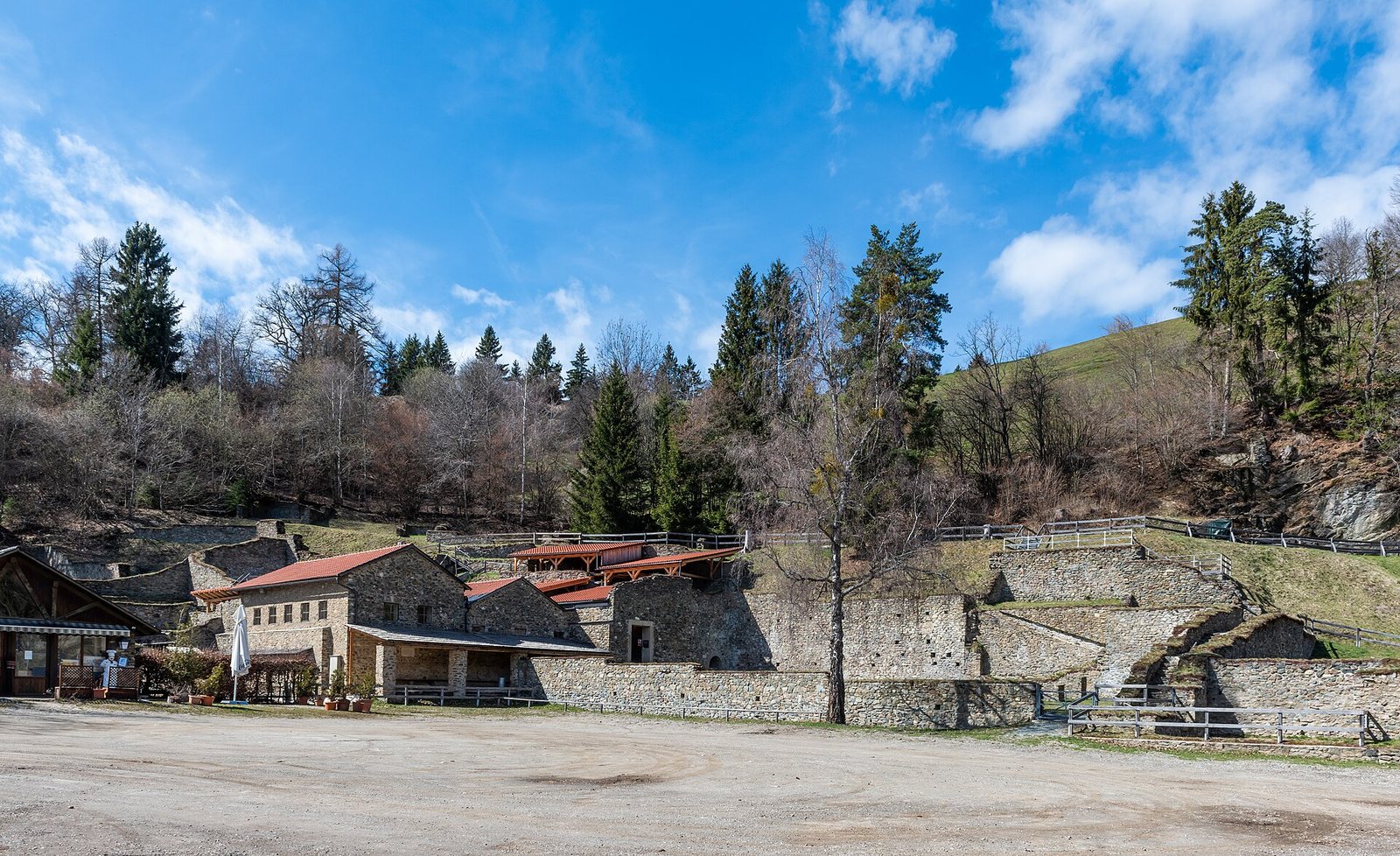
The most important archaeological site of the late royal period is the Magdalensberg north of Klagenfurt, 1,058 metres high. Excavations have taken place there every year since 1948, today as the Archaeological Park of the Carinthian State Museum. What has been uncovered is not a Celtic stronghold but chiefly a town with a forum, merchants' houses, a market basilica and a podium temple. According to current research, Italian merchants settled here around the middle of the 1st century BC to run an emporium, a trading post; a rampart on the north side dates to 40 to 30 BC. This fits the reports about iron and gold and the importance of Aquileia as the counterpart on the sea.
A striking find dates from the early imperial period: two moulds for gold ingots inscribed C(aii) Caesaris Aug(usti) Germanici imp(eratoris) ex Noric(is), i.e. from the reign of Caligula (AD 37–41). According to the LEIZA overview the ingots weighed 5.6 to 14.5 kilograms; in one workroom stood at least fifteen smelting furnaces (other counts give nineteen), and scientific analyses assign the gold to the Tauern. The emperor thus claimed the gold of Noricum for himself. Shortly before the middle of the 1st century AD the mountain town was abandoned quickly, some buildings left unfinished; in the valley, on the Zollfeld, the municipium Claudium Virunum arose. What the town on the mountain was called is unknown. Noreia is discussed, a view losing support for lack of finds from the 2nd century BC, as is an earlier Virunum; an inscription fragment with the letters VIRV is not enough to decide.
How Noricum became Roman is often told as a peaceful annexation. The sources paint a less smooth picture. Cassius Dio reports (LIV, 20) under the year 16 BC that the Pannonians together with the Norici overran Istria; after Publius Silius and his legates had defeated the Pannonians, these made peace and also brought the Norici "into the same slavery". Strabo (IV, 6, 9) writes that Tiberius and his brother Drusus put an end to the raids of the Alpine peoples in a single summer campaign; since then, for 33 years, they had been quiet and paid their tribute. Velleius Paterculus (II, 39) counts Raetia, the Vindelici, the Norici, Pannonia and the Scordisci among the new provinces that Tiberius subjected to the empire (see Vindelici and Scordisci). Whether there was fighting in Noricum itself, none of these passages says; but they do not rule it out either. The usual date of 15 BC comes from the Alpine campaign of Drusus and Tiberius; Dio dates the raid into Istria a year earlier.
At first, on the current view, the land kept a special status under Roman supervision. In AD 69, Tacitus lists Noricum among the territories administered by a procurator, an imperial official of equestrian rank rather than a senator (Histories I, 11). Pliny names (III, 146) as towns of the Norici Virunum, Celeia, Teurnia, Aguntum and Iuvavum, "all Claudian", as well as Flavium Solvense. From this scholars conclude that the emperor Claudius (AD 41–54) granted these places municipal rights; Iuvavum is today's Salzburg, Celeia is Celje, Teurnia lies near Spittal an der Drau. Under Marcus Aurelius, with the Marcomannic Wars, a legion, the legio II Italica, was moved to the Danube, and its commander was henceforth also governor (see Marcomanni). Under Diocletian the province was divided into Riverside Noricum on the Danube and Inland Noricum in the south.
We know the end of Roman times on the Danube from the life of Saint Severinus, written by his disciple Eugippius around 511. It shows the Roman population of the Danube towns between the Rugii and other groups (see Rugii). After that the Norici disappear as a name; in the south come the Slavic Carantanians, in the north the Bavarians of later centuries. How much of the Celtic-Roman population merged into them cannot be said from the sources read here.
The helmet find from Negau is often mentioned in connection with the Eastern Alps. In 1812, near Ženjak close to Negova in what was then Lower Styria, now Slovenia, a hoard of 26 bronze helmets was found, 23 of which survive. The helmets belong to a type widespread in northern Italy and the Alpine region that scholars call the "Negau type" after this find, and are dated to around 450 to 350 BC; when they were buried is unclear. The helmet "Negau B" is famous for an inscription in a North Etruscan alphabet, usually read as harikastiteiva and interpreted as a Germanic personal name with the word for "god". This interpretation is disputed; other helmets bear names that are rather Celtic.
For the Norici, the find is an example of how carefully attributions must be made. The helmets are older than any written report of the Norici, and the findspot lies rather at the edge of later Noricum. There is no such thing as a "Noric helmet" in the technical literature. Anyone wishing to pursue the Negau inscription further will find more in our articles on runic research and on Tiwaz.
Certain are the name Noricum for a region in the Eastern Alps, a Noric kingship in Caesar's time with a King Voccio, the connection of gold, iron and trade with Aquileia, Carbo's defeat in 113 BC, the subjection around 16/15 BC and the procuratorial province of the 1st century AD. Plausible are the identification of Cincibilis with a Noric king, the assignment of the Ambisontes to the salt district of the Dürrnberg, and a continuity from kingdom to province in the tribal communities that set up inscriptions on the Magdalensberg. Interpretation remains the number of thirteen tribes, the location of Noreia, the description of the relationship with Rome as hospitium publicum, and any identification of coin legends with known kings. About the gods, rituals or daily life of the Norici before the Romans, the written sources say nothing; what there is comes from excavations and later dedications, for instance to the god Belenus.
In our family workshop in Alsdorf we make laser-engraved slate plaques with Norse-Germanic and Celtic motifs. For the Norici there is no transmitted emblem and no sign we could document as their own, and so we do not invent one. Anyone interested in the Celtic world as a whole will find more under Celts and among the neighbours to the west, the Helvetii.

The Taurisci · Cimbri & Teutones · The Boii · The Vindelici · The Carantanians.
All History & Finds articles →
On Christmas Day 1130, in the cathedral of Palermo, a man was crowned king whose great-grandfather had been a minor …
Read more →There are peoples we can argue about because the sources contradict one another. And there are peoples we cannot even …
Read more →The sacrificial bog of Oberdorla in Thuringia is the largest known Iron Age cult site in Central Europe: at a small …
Read more →