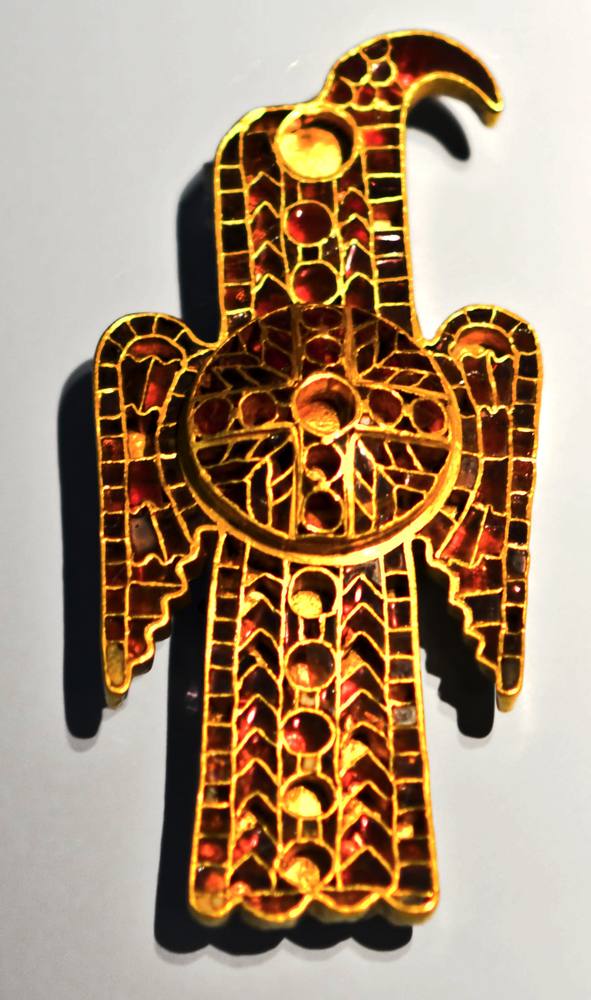
Two sentences in Jordanes, and that is all: the Vidivarii sit where the Vistula runs into the sea in three branches, and they are, in the Goth's words, assembled "from various nations". No other ancient author names them. This article reads both passages in their Latin wording, sets the research on the name, the Wielbark culture and the Elbląg Group beside them, and marks exactly where an observation turns into an interpretation.
Some peoples of antiquity are known from dozens of passages, from inscriptions, graves and coins. The Vidivarii (Latin Vidivarii, in the second passage Vividarii, German also Widiwarier) are not among them. As far as scholarship can tell, their name appears only in Jordanes, and in exactly two places in his Getica. Anyone writing about them is therefore always also writing about the author, about his source, and about how much one may squeeze out of so little text.
The brief for this article spoke of "Getica 36 and 17" and of East Germanic peoples in the Vistula region. The numbering is misleading, and the attribution is less clear than it sounds. What is meant are chapter 5, section 36, and chapter 17, section 96; some editions and accounts count the second chapter as XVI. That Jordanes calls the Vidivarii "Germanic" is stated nowhere; he calls them a composite people. Both points are treated more closely below.
Jordanes, a man of Gothic descent living in the orbit of the Eastern Roman Empire, wrote the Getica, according to the scholarship, around 551 in Constantinople; Peter Heather reckons with 552, Walter Goffart with 554. He says himself that he had Cassiodorus's twelve-volume work on the Goths in his hands for only a few days and had to rely on memory and other supports. Cassiodorus's work is lost. The Getica is thus a summary at second hand, and what it says about the Vistula country goes back to sources we can no longer check.
Scholars treat the text unevenly. Some, such as Arne Søby Christensen and Michael Kulikowski, hold large parts of the early Gothic history in Jordanes to be invented or heavily bent; Goffart doubts the origin tale of the island of Scandza. Others take it more seriously. For the Vidivarii this matters because both passages lie in the first and most contested part of the work. More on the background of the Goths is in the article on the Goths.
The first passage stands in Jordanes's description of the world north of the Black Sea and the Danube. He first describes Dacia, then the Venethi (Veneti), whom he has settle "from the source of the Vistula", and then turns to the Baltic coast. There it says that on the shore of the Ocean, "where the waters of the river Vistula are swallowed through three mouths", the Vidivarii dwell. The Latin sentence, in the excerpts I could read via The Latin Library, runs: "Ad litus autem Oceani, ubi tribus faucibus fluenta Vistulae fluminis ebibuntur, Vidivarii resident, ex diversis nationibus adgregati". The spelling adgregati rather than aggregati is that of the edition used; the meaning is the same.
It continues: "post quos ripam Oceani item Aesti tenent, pacatum hominum genus omnino", that is, after them the Aesti hold the shore of the Ocean, a thoroughly peaceable people. To the south Jordanes names the Acatziri, who know no farming and live from herds and hunting. The Aesti (Latin Aesti, in scholarship mostly understood as ancestors of Baltic groups) are treated at length in the article on the Aesti.
The place is sharply drawn: a coast with a many-armed river mouth. Today the Vistula (Polish Wisła) has a delta there with several arms, and the Vistula Lagoon, a shallow bay behind a spit, was according to scholars larger then than now. Whether Jordanes's "three mouths" hit this landscape exactly would be an interpretation; he says only what he had heard.
The second passage stands in an entirely different context. Jordanes asks there how the Gepids are related to the Goths. He tells how the Goths came from Scandza under their king Berig in three ships; the last, slowest ship carried the Gepids, and their name derives from a Gothic word for "sluggish" (gepanta). This is a pun that scholarship does not accept as certain.
Then he says that the Gepids, "struck by envy", lived in the province of Spesis on an island surrounded by the shallows of the Vistula, which they called "Gepedoios" in their ancestral tongue. In the Latin of the edition used the passage goes on: "Nunc eam, ut fertur, insulam gens Vividaria incolit ipsis ad meliores terras meantibus", meaning that the people of the Vividarii now inhabit this island, as is said, while the Gepids themselves have moved on to better lands. The Gepids appear here as predecessors. One cannot speak of "neighbours" in the strict sense; Jordanes has the Vidivarii move into the area the Gepids left. The phrase ut fertur ("as is told") also shows that he relies on hearsay. Where this island lay is disputed; the most likely proposal in Polish scholarship (J. Okulicz) is the Elbląg Upland, which was then surrounded by a much larger lagoon. More on the people who left the island is in the article on the Gepids.
The second sentence of 17.96 is the famous one. Jordanes writes: "Qui Vividarii ex diversis nationibus ac si in unum asylum collecti sunt et gentem fecisse noscantur."
These Vividarii have been brought together from various peoples, as it were into a single place of refuge, and it is known that they have made a people of it.Jordanes, Getica 17.96; my own translation from the Latin wording of the edition at The Latin Library (retrieved only as a text excerpt); rendered in sense, not word for word
Three things stand out. First, the text has nationes, in the Latin of this period roughly "tribes, peoples". Second, Jordanes compares the origin to an asylum; the word calls up the Roman foundation image in which Romulus opened a place of refuge into which fugitives and adventurers from the surroundings poured. That is the rhetoric of a late Latin writer, not an eyewitness report. Third, the text has noscantur, "it is known", in the manner of a rumour. All that can safely be read from the sentence, then, is that Jordanes's sources described the Vidivarii as a mixed union. How this union arose, who belonged to it, how large it was, the text does not say.
It also matters what the sentence lacks: a ruler's name, a date, a number, a leader. The Vidivarii never act in Jordanes. They merely sit there, and the text explains why they have no single origin. For a people one would like to make a building block of Migration Period history, that is astonishingly little.
Several offers exist for the name, and none can be proven. The second element -varii occurs in many Germanic tribal names: among the Ampsivarii and the Angrivarii, among the Baiuvarii, the Bavarians, and others. According to the widespread reading, which German Wikipedia gives following the article "Vidivarier" by Friedrich E. Grünzweig and Herwig Wolfram in the Reallexikon der Germanischen Altertumskunde (2007), it contains a Germanic word for "inhabitants", reconstructed as *-warijōz. A deeper root is not secured; English Wikipedia states explicitly that the precise origin is unclear.
The first element is more open. It may belong to Germanic *widuz, "wood" or "forest", which would make the Vidivarii "forest dwellers", occasionally also read as "people of the sacred grove". Alongside stand further readings in Polish scholarship (the thesaurus of the project "Migration Period between Odra and Vistula"): an Old Prussian one ("country lying within"), a Baltic-Germanic hybrid, and a Slavic one resting on a variant form Vinidiair. That the name sounds Germanic in the end while the union is described as composite fits a mixture of Germanic and Baltic groups; it does not prove one, since Jordanes renders names in his own sound shape.
The brief also named Ptolemy's "Ouiktoualoi" as a possible forerunner. I found no evidence for this. Ptolemy (2nd century) lists in his Geography east of the Vistula, among others, the Gythones, Finni, Sulones and the Venedae; a name reading Ouiktoualoi that could be tied to the Vidivarii I found neither in the compilations I read nor in the literature on the Vidivarii. The form therefore remains unchecked. Likewise I found the name "Chaldeans", given in the brief, in no source on the topic. The Old English poem Widsith does know the Wistlawudu, the "Vistula wood", in which the Gothic homeland is sought, but it names neither Vidivarii nor Chaldeans; no evidence for a connection is therefore available.
Anyone wanting to understand the Vidivarii must know the landscape in which they appear. The Wielbark culture is an archaeological culture of the Roman Iron Age; it is named after a cemetery at Wielbark (German Willenberg) in northern Poland, where graves were first recorded in 1873. It emerged around the Vistula mouth in the Gdańsk and Chełmno region, later spread south and east as far as the upper Dniester, and is dated by scholars roughly from the 1st to the 5th century. Its hallmarks are inhumations alongside cremations, few weapons in burials, and a women's dress with two brooches at the shoulders.
Roman authors place the Gutones, the Rugii and the Lemovii in this area. Many historians and archaeologists conclude from Jordanes and Tacitus that the ancestors of the Goths, the Rugii and the Gepids carried the culture politically; Peter Heather places it in the Germanic cultural sphere. The Wielbark culture also had a decisive influence on the formation of the Chernyakhov culture by the Black Sea. More on the bearers of these names is in the articles on the Gutones and the Rugii.
On the Vandals, whom the brief mentioned, I found no source that connects them with the Vidivarii. The people themselves are treated in the article on the Vandals; here it remains only to note that evidence for a closeness to the Vidivarii is missing.
By the 5th century at the latest the Wielbark culture disappears as a recognisable unit; in northern Poland, according to the archaeological literature, small islands of it persist before find groups appear that are linked to early Slavs. Pollen analyses at 52 sites in northern and central Poland point, according to a summary by Adam Ziółkowski, to a population crisis from the 3rd century and to reforestation in the 5th and 6th centuries, with exceptions such as Masuria. Recovery sets in, on this account, only in the late 7th century.
That is the background against which the Vidivarii appear: not a densely settled land, but a region from which large parts of the population had gone. The Gepids moved away, as Jordanes tells; Goths and other groups left the area over the centuries. What remained were remnants and newcomers. Scholarship uses the word Restgermanen for this, a term for groups that stayed behind after the majority departed. Whether the Vidivarii were at their core descendants of such stay-behinds is an interpretation. The source does not say.
Polish scholarship has described a find pattern that might fit the Vidivarii: the Elbląg Group (German Elbinger Gruppe) east of the lower Vistula around present-day Elbląg. It is regarded as a West Baltic culture of eclectic, that is mixed, character. The thesaurus of the project "Migration Period between Odra and Vistula" sees in its earlier phase the likely material correlate of the Vidivarii, with possible Gothic and Gepid remnants from the Wielbark period and Germanic arrivals from elsewhere. Bartosz Kontny, in his chapter "The Making of the Vidivarii: Germanic and Baltic Interculturation in the Late 5th Century" (Brill, 2020), examined the growing together of Germanic and Baltic elements in the late 5th century. I could not read the text of the chapter; I know only the title and the bibliographic data.
Adam Ziółkowski calls the equation "very probable" in his review of the volume, yet concedes that the group's chronology is hard to pin down: weapons reappear in graves only in the late 6th century, and grave goods vanish in the early 7th. Anyone needing a date gets only an approximate one. One further warning is in order: a find group and a name from a written source can never be laid over each other without remainder. The label "Vidivarii" for the Elbląg Group is a hypothesis with good reasons, not a proof. Wikipedia speaks of a "Widiwar stage" of the Willenberg culture; that is not attested to me as a technical term, and since Willenberg is merely the German name form of Wielbark, the wording remains unclear.
A further indication is finds of solidi, the late Roman gold coins. The thesaurus assigns solidus hoards of the second half of the 5th and the early 6th century to the Vidivarii. According to Ziółkowski, East Pomerania is the oldest and largest recipient of solidi in the Baltic zone; he concludes that the Vistula mouth region could have been a redistribution point for coins bound for Scandinavia. This too is an interpretation, based in that article on finds but not in any ancient source. The article on amber treats the material that made this coast famous. That the Vidivarii themselves traded amber is stated neither in Jordanes nor in any source I read.
A telling side note comes from Cassiodorus, whom Jordanes epitomised: in a letter in Theoderic's name he thanks the Aesti for sent amber. That comes from the Wikipedia summary on the Aesti; I have not read the letter itself.
More than three centuries after Jordanes a landscape turns up in an entirely different source that is gladly linked with the Vidivarii. In the Old English Orosius, which arose in the circle of King Alfred the Great, the seafarer Wulfstan reports a voyage from Hedeby to Truso that took "seven days and nights". Truso, he says, lies on the lake from which the Ilfing flows. The Vistula (Wisle) is a very large river that separates Witland and Weonodland and runs into the Estmere, today's Vistula Lagoon. And: "þæt Witland belimpeð to Estum", Witland belongs to the Este (Aesti). I know the quotations from the compilation on jassa.org, not from a critical edition.
Scholars asked early whether Witland corresponds linguistically to the Vidivarii. German Wikipedia names this connection explicitly and traces it to earlier work; it cannot be proven. Wulfstan does not mention the Vidivarii, and an unbroken arc from Jordanes's coastal people of the 6th century to a land name of the 9th would be an assumption across more than three centuries. Ziółkowski also gives the link between the trading place Truso and the Vidivarii as a mere hypothesis that cannot currently be tested. Anyone looking for traces of the Viking Age on the Baltic finds Truso in the wider context of the article on Vikings on the Baltic and, on the other side of the sea, in the article on Ralswiek. Neither place is an attested Vidivarii site.
The brief named Vandals, Gepids and Aesti as possible components of the union. Of these three names only the Gepids stand in a connection to the Vidivarii in the sources, and even that is only spatial: the Vidivarii sit on the island the Gepids left. The Aesti lie "after them" on the shore in 5.36, so they are neighbours, not components. Jordanes says elsewhere that the Gothic king Ermanaric subdued the people of the Aesti (section 120 of the edition). That changes nothing about the relation to the Vidivarii, who do not occur there.
From the combination of clues a picture emerges that scholarship considers possible: a union that arose in the course of the 5th century from remnants of the former Wielbark population, from Germanic immigrants and from Baltic groups. The sources supply no name for any of these components. Whoever presents "Gepids and Vandals" as components speaks faster than the text allows.
Why do the Vidivarii appear in the Getica at all? One possible reading, drawn from the structure, is that they are set dressing. In chapter 5 they belong to the panorama of peoples on the northern Ocean. In chapter 17 they explain where the Gepids once sat and why the island is no longer Gepid. In both cases they serve description, not plot. That does not rule out that the name goes back to a real group, but it explains why Jordanes never ties them into battles, treaties or name lists.
The time too is blurred. Jordanes writes around 551 and describes a situation that comes either from his own present or from older knowledge. The thesaurus dates the emergence of the Vidivarii to the 6th century, possibly somewhat earlier, after the Gepids' departure. Kontny's title speaks of the late 5th century. Both are compatible with the wording; anyone naming a year goes beyond the source.
Established is what stands in Jordanes: two passages, a coastal people at the Vistula mouth, a mixed origin, the succession on the Gepid island. Plausible are the assignment of the Elbląg Group as the archaeological counterpart, the reading of the name as "inhabitants (of the wood)", and the connection with the depopulation of the Wielbark region in the 5th century. Interpreted remain the origin of the name from the Baltic, the link to Witland, the role of the solidi as a sign of a redistribution point, and every statement about their language, religion or number.
A people that occurs in only two sentences cannot be narrated. It can be placed: in a landscape of Vistula mouth, lagoon and amber coast, in a sequence of cultures, and in a tradition that reached us through a Goth in Constantinople. Marking the gaps belongs to the account itself. Whoever fills them invents.

The Goths · The Gepids · The Aestii · The Rugii · The Vandals.
All History & Finds articles →
In December 2020 a metal detector beeped in a field near Vindelev, only a few kilometres from Jelling. What came to …
Read more →The Vindelici were Celtic (partly Celtic-Raetian) peoples on the northern edge of the Alps, between Lake Constance, the …
Read more →Yes, a maternal DNA lineage belonging to haplogroup C1 – a group found today mainly among Indigenous peoples of the …
Read more →Vinland is the name Norse sailors from Greenland gave to a stretch of North American coast around the year 1000 – and …
Read more →