One sentence in a Roman campaign report has carried about a dozen tribal names across two thousand years. Eleven names in a row, without a word of explanation – and for some of these peoples that is still everything we know. A look at what the list actually says, what it leaves out, and what became of its names.
Sometimes a campaign report ends with a sentence that bears more weight than its author could have guessed. Publius Crassus, Caesar's young legate, had subdued Aquitania in the summer of 56 BC. The account fills eight chapters of the third book of the Gallic War. The last of them is a two-liner: after the battle most of Aquitania surrendered, sent hostages, and the names of those involved are listed.
For several of those peoples this list is the only notice we possess. No second ancient author names them, no inscription, no coin. What they ate, how they were organised, which language they spoke, where exactly they lived: all unknown. What remains is a name in a row.
First the part we can actually argue about: the text itself.
Hac audita pugna maxima pars Aquitaniae sese Crasso dedidit obsidesque ultro misit; quo in numero fuerunt Tarbelli, Bigerriones, Ptianii, Vocates, Tarusates, Elusates, Gates, Ausci, Garumni, Sibusates, Cocosates: paucae ultimae nationes anni tempore confisae, quod hiems suberat, id facere neglexerunt.
"When this battle became known, the greater part of Aquitania surrendered to Crassus and sent hostages of its own accord; among them were the Tarbelli, Bigerriones, Ptianii, Vocates, Tarusates, Elusates, Gates, Ausci, Garumni, Sibusates and Cocosates. A few of the most remote peoples failed to do so, trusting to the season, for winter was at hand."
Caesar, Gallic War III.27; translation: Glanz & Gravur
That is eleven names, not twelve and not ten. Twelve-name lists online usually include the Sotiates, who appear seven chapters earlier and have nothing to do with this surrender. And in seventh place stands Gates, not "Garites", as older literature occasionally writes. The Ausci stand eighth, the Garumni ninth.
The manuscripts are uncertain at several points. Ptianii appears in part of the tradition as Preciani, Sibusates also as Sibuzates, and Vocates has the variant Vacates, from which some scholars derive a corruption of Vasates. These are not trivia: whether a people can be located at all may hang on such letters.
The list closes a short, hard campaign. Crassus marched south with twelve cohorts and strong cavalry into a region where two Roman commanders had recently failed – Lucius Valerius Praeconinus was killed, Lucius Manlius lost his baggage and fled. Caesar says so explicitly, which explains why his legate moved carefully and drew reinforcements from Tolosa, Carcaso and Narbo.
The Sotiates were hit first: a cavalry engagement, an ambush, then a siege of their oppidum with sheds, towers and countermines. There Caesar remarks that the Aquitani are highly skilled at mining "because in many places among them there are copper mines and quarries". It is one of very few factual statements he makes about the region at all – and it applies to the Aquitani in general, not to a single people.
After the oppidum fell, Crassus moved into the territory of the Vocates and Tarusates. There the real resistance formed: embassies, oaths, an exchange of hostages – and help from neighbouring Spain. The commanders, Caesar writes, were men who had served all their years with Quintus Sertorius and were reckoned highly skilled in war. They laid out camps in Roman fashion and cut the Roman supply lines.
Crassus stormed the camp and had it broken open from the rear. His balance sheet: of 50,000 men said to have gathered from Aquitania and the Cantabrian lands, scarcely a quarter remained. Such figures are war reporting, not statistics – but they show that Rome wanted the affair understood as a major campaign.
This is the heart of the matter. The row of eleven names is not an ethnographic chapter. Caesar describes neither customs nor religion nor settlement patterns; he does not even name a landscape. What he records is an administrative act: who surrendered, who gave hostages. The list is the receipt of a submission.
That has consequences. The order need not be geographical, although it runs roughly from the coast eastwards and north. The names need not be of equal rank – a large people and a small neighbourhood can stand side by side. And above all: those who negotiated were recorded. Those who sent no envoys do not appear. Caesar says as much in the second half of the sentence.
The opening sentence of the Gallic War already separates the Aquitani from the Gauls in language, institutions and law. Strabo is blunter: the Aquitani differ from the Galatic stock in build as well as in speech and resemble the Iberians. He adds that there are "more than twenty" Aquitanian tribes, small and without repute – most along the ocean, others reaching inland.
That remark matters more than it sounds. It explains why Caesar's eleven names and the later province of the "nine peoples" fit together so badly: the number of groups was higher, and the divisions finer, than Roman lists could render.
That Aquitania was not linguistically Celtic is not a matter of reading ancient authors; it is measurable. From the Roman imperial period some 200 indigenous personal names and about 60 divine names survive from this region, almost all on Latin inscriptions of the first to third centuries. There are no continuous texts – but the names suffice.
They can be compared element by element with Basque: andere "woman" (Basque andre), nescato "girl" (neska), cison/gison "man" (gizon), sembe "son" (seme), umme "child" (ume), sahar "old" (zahar), hars- "bear" (hartz), belex, gorri, ilun. Structural traits point the same way and away from Celtic: a frequent H in every position, an almost absent m, no word-initial r-. Scholars call this Aquitanian-Vasconic; whether it is the direct ancestor of Basque or its sister remains open.
Four of the eleven we have treated in detail. The Tarbelli do not stand first by accident: they are the wealthiest and best-attested people of the coast, with the hot springs of Dax and the gold Strabo mentions. The Bigerriones are the model case of a name turning into a landscape – Bigorre. The Ausci are the model case of a tribal name displacing an older town name: the town is Elimberris before, and Auch today. And the Garumni carry the name of the river beside which they lived.
The Elusates around Éauze in the Gers are, after the Tarbelli, the most tangible group: some two dozen inscriptions, a pre-Roman oppidum at Esbérous, a town that became a colony in the early third century and ended as a provincial capital. Their name lives on in Éauze.
With the Vocates the guessing begins. Three readings stand side by side: Camille Jullian and Paul-Marie Duval saw in them the Boiates of the Pays de Buch; Michel Rambaud and Louis Maurin emended the transmitted genitive Vocatium to Vasatium and made them the Vasates of Bazas; Robert Boudet and Philippe Gardes regard them as a separate people in the Marsan around Mont-de-Marsan. None of these is proven. The Tarusates are usually placed in the Tursan in the south-east of the Landes, with Atura – Aire-sur-l'Adour – as their later chief town; that too is a well-argued proposal, not a finding.
Four names remain in the dark, to differing degrees. The Cocosates fare best: they held the Marensin, the coastal strip of the Landes, and a whole run of place-names from Seignosse to Coos traces their ground; their chief town Coequosa survives in modern Coucouse. For the Ptianii there is at least a proposal: Philippe Gardes equates them with Pliny's Venami, behind whom in turn the Benarnenses of the Béarn are suspected – a chain of conjectures, no more.
For the Sibusates and the Gates there is no secure location, no inscription, no place-name that carries them. They are pure list-names. You cannot put them on a map without guessing – and many maps guess anyway.
Two peoples one would expect here are absent. The Sotiates are missing because they had been subdued earlier and their surrender gets its own chapter. The Convenae are missing because in 56 BC they may not yet have existed as a "people": Pompey is said to have assembled them from stragglers some sixteen years before. They first appear in Pliny – and they of all peoples would later provide one of the most significant towns of the province.
That is the quiet point of the list: it shows not who was there, but who negotiated on that day.
A good century later Pliny enumerates the peoples of Aquitania in the fourth book of his Natural History – and reaches more than thirty names. Much does not overlap: Ausei (Ausci), Elusates, Sottiates, Tarbelli and Cocosates appear in both, but Gates, Ptianii and Sibusates are entirely absent from Pliny, and the Garumni are nowhere in his book. Conversely Pliny brings names Caesar does not know: Convenae, Consoranni, Monesi, Oscidates montani and campestres, Sybillates, Basaboiates and many more.
The forms shift too: Caesar's Bigerriones are Pliny's Begerri. And his famous phrase mox in oppidum contributi – "soon gathered into one town" – refers on the standard reading to the Convenae; how far it extends grammatically is still unsettled.
Two of Pliny's additions are especially telling: the Tarbelli quattuorsignani and the Cocosates sexsignani, the "Tarbelli of the four standards" and the "Cocosates of the six standards". The older reading took these as military contingents. Paul-Marie Duval and Jean-Pierre Bost read them civilly: as a note that under Augustus four, respectively six, smaller communities were attached to a larger people.
If that is right, we have the transition under a magnifying glass: Roman administrative arithmetic turns a bundle of settlement pockets into a "people". The number sits in the name like a file reference.
At some point the land south of the Garonne became a province of its own: Novempopulana, the country of the nine peoples. It is present in the Verona List, now dated around AD 314; the usual attribution to Diocletian's reform fits.
The only inscription that names the "nine peoples" itself stands at Hasparren in the Basque Country (CIL XIII 412). A certain Verus – priest, duumvir, quaestor and head of his district – records that as an envoy to the emperor he obtained pro novem optinuit populis seiungere Gallos, "for the nine peoples, that the Gauls be separated". Note the direction of view: it is not the Aquitani who are detached from Gaul, but the Gauls from them. On his return Verus dedicated the altar to the Genius of his district. The dating is disputed – ad Augustum may mean the emperor Augustus or simply the reigning Augustus; most scholars place the stone in the later third century.
The Notitia Galliarum, a register of Gallic cities from around AD 400, lists twelve civitates for Novempopulana: Ausciorum, Aquensium, Lactoratium, Convenarum, Consorannorum, Boatium, Benarnensium, Aturensium, Vasatica, Turba with the castrum Bigorra, Illoronensium, Elosatium. Nine in the name, twelve in the list – a contradiction often sold as a riddle, and it is none.
The standard explanation, going back to Duval, is simple: three civitates were added later – Béarn, Oloron and Bazas – while the provincial name stayed put. Subtract those three and exactly nine remain. That is scholarly reconstruction, not a statement in a source; no ancient list names the original nine. But it adds up.
The order itself is contested. In Seeck's edition the civitas Ausciorum heads the list as metropolis and Elusa stands last; part of the scholarship holds Elusa to be the provincial capital instead. Either way it reads as a snapshot of a change of rank – Ammianus, at any rate, names Ausci and Vasates together as the leading peoples.
The balance after two thousand years is strikingly uneven. Surviving securely: Ausci in Auch, Elusates in Éauze, Bigerriones in Bigorre, Convenae in Comminges, Consoranni in Couserans, Benarni in Béarn, Vasates in Bazas and the Bazadais, Lactorates in Lectoure, Boiates in the Pays de Buch. The Cocosates too left their trace in the place-name fabric of the Landes.
With the Tarbelli it was the town name, not the tribal name, that held: Dax goes back to Aquae, not to Tarbelli – and Tarbes has nothing to do with them, lying in Bigerriones country. Ptianii, Gates and Sibusates vanished without trace. The difference rarely lies in size or courage. It lies in whether a name happened to attach to a Roman administrative unit that became a bishopric and later a region.
Archaeology cannot confirm the list. It can show settlement sites: the hilltop site of Sos for the Sotiates, Esbérous near Éauze, Cossium beneath Bazas, La Sioutat near Roquelaure in Ausci territory, Lactora beneath Lectoure. It shows a landscape of fortified hilltop settlements abandoned after the conquest in favour of lowland towns.
What it cannot do is assign material to one of the eleven names. There is no "Tarusatian" pottery and no "Sibusatian" brooch type. Where a people exists only as a name, it remains a name – even after excavation. The same holds for the material traces of religion: the Aquitanian divine names on votive stones can be mapped by valleys, not by peoples.
So, back to the opening question. Are these "peoples" in the modern sense? Probably not. For some the case is clear: the Tarbelli or the Ausci were large and durable enough to carry Roman administrative units. For others, the epithets quattuorsignani and sexsignani suggest groupings assembled from smaller units. Others again – Gates, Sibusates, Ptianii – may have been settlement pockets, valley communities, followings around a leader, or simply the group that sent an embassy in the autumn of 56.
Strabo's phrasing fits better than any map with tidy borders: many small groups, of no great name, hard to count. What Caesar delivers is a Roman snapshot of that – filtered by the question of whom one had to negotiate with. It is the best source we have, and it is still a receipt. Comparable client structures are known from the world of the Vellavi and Gabali north of the Garonne, except that there the Aedui and Arverni were the points of reference.
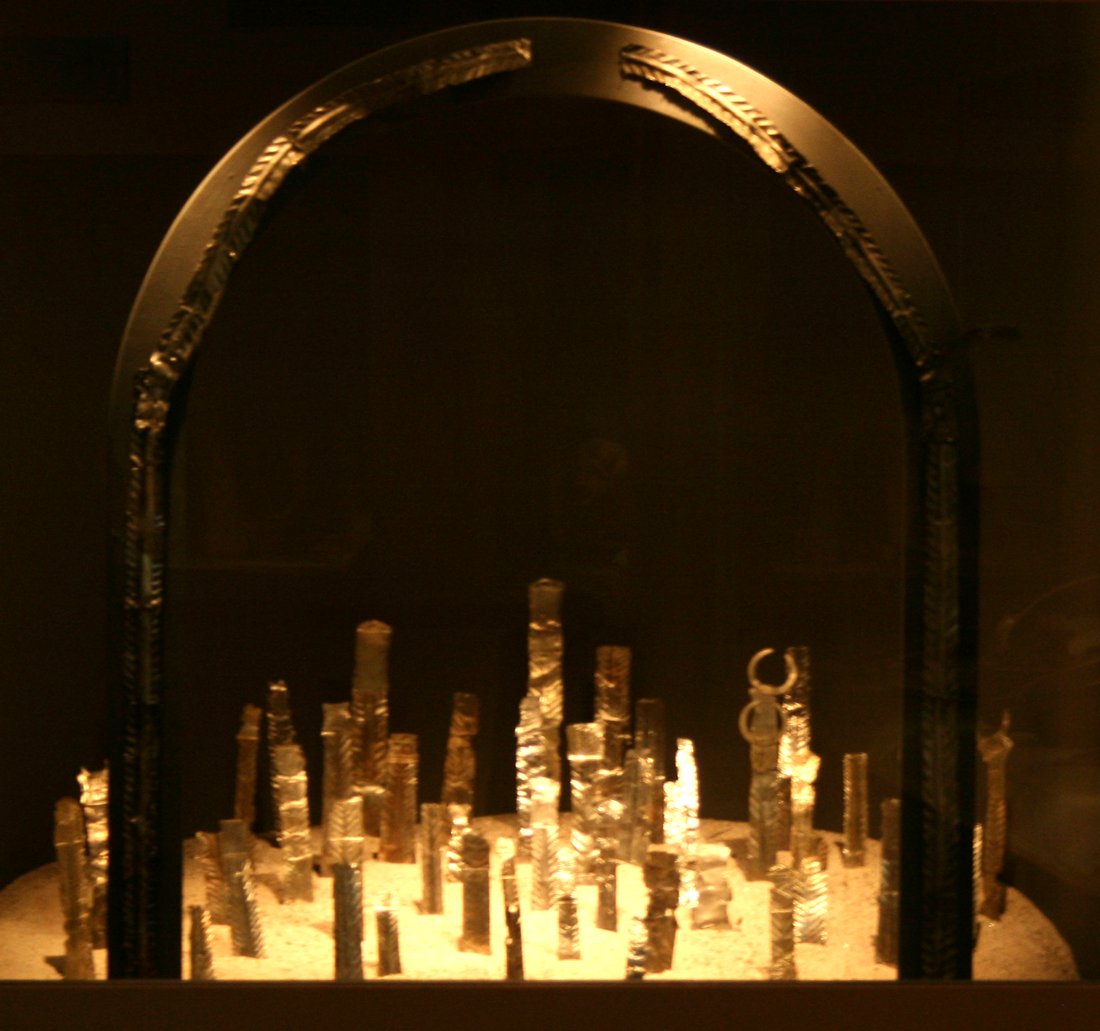
One find reaches surprisingly far from here. In the Rhine at Hagenbach a hoard came to light containing more than a hundred silver votive plaques bearing Aquitanian divine names – offerings from the Pyrenees, carried to the Rhine as loot in the third century and lost there. The names of the list stayed in Gascony and Bigorre; their gods ended up in the Rhine gravel. That too is transmission: accidental, fragmentary, and preserved for exactly that reason.
The Tarbelli · The Bigerriones · The Ausci · The Garumni · The Sotiates · The Convenae · The Vellavi · The Gabali.
All History & Finds articles →
High above the world of humans, beyond the burning rainbow bridge, lies Asgard – the fortified home of the Æsir. It is …
Read more →