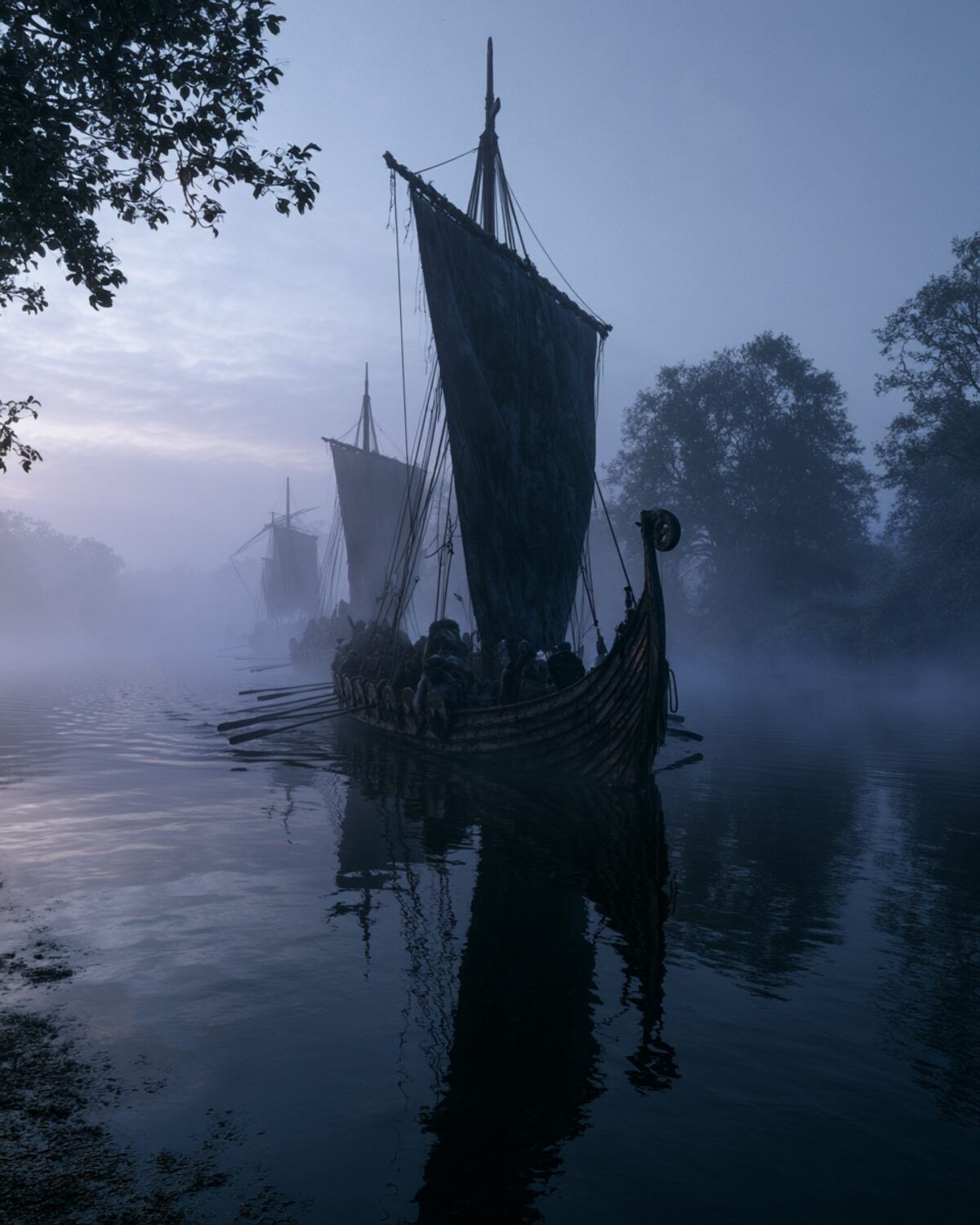
Hæsten was the best-known Viking leader of 892. With his fleet he crossed from Boulogne to Kent and tied down King Alfred and his son Edward for several years. The Anglo-Saxon Chronicle describes camps, oaths, a captured family and chases as far as Wales. Whether this man is the same Hasting whom Frankish and Norman texts place on the Loire, in Brittany and even in the Mediterranean has never been settled. This article separates what the sources say about Hæsten, what scholars infer from them and what is later legend. It also looks at the Meuse and Rhine background: the battle on the Dyle near Leuven in 891, which came right before the move to England.
Hæsten is the Old English spelling used in the Anglo-Saxon Chronicle. Latin texts mostly call him Hastingus, later Norman tradition Hasting, and in Old Norse the name would be Hásteinn. From what I have read, the Chronicle calls him a Dane and says nothing more about where he came from. That matters, because depending on whom you identify him with, his biography gains or loses some forty years.
The question runs like this. In the south of the Frankish realm, on the Loire and the Seine, Northmen appear from the 860s into the 880s, and one leader among them is called Hasting. In 892 a leader called Hæsten turns up in England. One person, or two men with the same name? Popular books and many websites treat them as one and tell a single career of up to forty years. The sources themselves do not. I know of no source that explicitly links the two. This article therefore treats Hæsten of 892 as the secure core and everything earlier as a possibility.
A note up front: this piece rests on translations and secondary accounts, not on my own reading of the Latin annals in critical editions. The source list at the end says which texts I saw in wording and which only in summaries. For the wider setting, see the article on the Great Army and the overview of Nordic kings.
The tradition falls into four layers. Anyone checking a claim should ask which layer it comes from.
The Anglo-Saxon Chronicle. It survives in several manuscripts, and its oldest parts were compiled under King Alfred around 890. The entries for 892 to 897 are the fullest account of Hæsten’s years in England. They are written from a West Saxon point of view, which colours a great deal: Alfred’s men act sensibly, the Danes treacherously. One warning for anyone reading dates: at this point the year-numbering of the manuscripts is shifted against the years now assumed. Depending on edition and account, the same event stands under 892, 893 or 894. The order is clear; the year is not always.
Continental annals. The Annales Fuldenses (Fulda annals, East Frankish), Regino of Prüm’s chronicle (written around 906/908) and the annals of St-Vaast near Arras (Annales Vedastini, West Frankish, contemporary) report the battle on the Dyle in 891 and the situation on the mainland. In the summaries I have seen, they do not name Hæsten in connection with 891. Anyone who puts a Hasting on the Dyle is reading something into the sources.
Dudo of Saint-Quentin. Dudo wrote a history of Normandy shortly after the year 1000 at the court of the Norman dukes. His Hasting is a literary figure, a leader who appears in the narrative before Rollo. The work serves the self-image of the ducal family, not the chronology of the ninth century.
Later tales and sagas. Hasting was linked in Scandinavian and Norman literature to further figures. According to Frederic Amory’s criticism, Henri Prentout equated him with two Icelanders from the Landnámabók and Eyrbyggja saga, an identification Amory calls arbitrary and erroneous, as far as I could read his introduction through a retrieval tool. As a source of fact, this is worthless.
For the years before 892 the English-language account I could consult relies on Frankish sources and later tradition. According to it, a Hasting led a fleet of 62 ships into the Mediterranean together with Björn Ironside, fought at Brissarthe in 866 against Robert the Strong as an ally of the Breton prince Salomon, later threatened Bourges and Orléans and occupied Angers in 872. In 882 Charles the Bald is said to have driven him from the Loire, after which he moved to the Seine. One thing stands out: Charles the Bald died in 877. That account therefore contains an inaccuracy or a mix-up of rulers, which alone shows how blurred the tradition is. I give it only as a report, not as a secure biography.
Björn Ironside is in a similar position. In the annals he is a Seine Viking of the 850s and 860s; only later tradition makes him a saga king. More in the article on Björn Ironside. Linking Hasting with him is something one reads often and can hardly pin to the annals.
Why do scholars doubt the identification? Accounts differ. Three reasons are named: the span of more than thirty years between the earliest and the latest mentions, the commonness of the name, and the fact that no contemporary source connects the two stages. In favour of identification, the name is rare enough to be recognised in the tradition, and the army of 892 came from the Frankish world anyway. Both are probabilities, not proof.
The Luna story is famous. Hasting sets out with a fleet for Rome, lands at the Tuscan coastal town of Luna, takes it for Rome and captures it by a ruse: he has it announced that he has died, asks for a Christian burial, and in the coffin lies a warrior who rises at the right moment. That is how later tradition tells it. Turning it into a source for Hæsten is a mistake. The English Wikipedia, which I consulted, says the truth of the Luna raid is much debated, and I know of no contemporary source that confirms it.
What the Luna tale does is literary: it shows Hasting as a schemer who breaks faith. That fits strikingly with what the Anglo-Saxon Chronicle says about Hæsten’s broken promises. It may be an echo of the same memory, or a cliché pinned on any Viking leader. It does not help answer who he was; it only shows how early legends gathered around the name.
Dudo’s link between Hasting and the early Rollo belongs to the same narrative world. Anyone wanting to understand the later duke will find the Norman foundation story placed in the article on Rollo.
The move to England did not begin on the coast but in the Meuse and Rhine lands. The prehistory: the army that the annals call “Danes” or “Northmen” had lain since 881 in the region between Scheldt, Meuse and Rhine. One of its stations was the 881 attack on the palace of Aachen; what the sources say about it is in the article Vikings in Aachen 881.
On 26 June 891 Frankish troops suffered a defeat against this army at the river Geule; the English Wikipedia gives the exact day. In September 891 came the answer: King Arnulf of Carinthia, returning from the Bavarian frontier, confronted the Northmen on the Dyle near Leuven. The Fulda annals and Regino of Prüm agree on a victory, with different emphases: Regino describes how Arnulf had his horsemen dismount and attack on foot while the rear guard stayed mounted. The two leaders of the Northmen, Sigfrid and Godfrid, fell in the battle according to the account I could consult. Sixteen standards were captured. The high casualty figures in the Fulda annals cannot be checked, since there is no archaeological confirmation on Belgian ground.
What matters for Hæsten is what follows. The annals of St-Vaast trace the Danes’ departure in 892 to a famine, not to the battle. The Anglo-Saxon Chronicle confirms that the battle took place and then tells of the fleet crossing the Channel. Whether part of the army beaten on the Dyle is found in the host that landed in Kent in 892 is plausible but is nowhere stated outright in the texts I have seen. The same goes for Hæsten himself: as far as I could see, he is named in no report of the Geule or the Dyle.
For the region this means, soberly: Leuven lies roughly 100 kilometres west of Aachen as the crow flies and belongs to the same war zone. That Hæsten was there is not documented. That the army which crossed the Channel in 892 came from this area is what the sources say.
According to the Anglo-Saxon Chronicle and the accounts I could consult, there were two separate landings on the coast of Kent in 892. The larger fleet, about 250 ships, built a fortified base at Appledore on the edge of Romney Marsh. Hæsten himself came with about 80 ships to Milton near Sittingbourne on the north coast of Kent and fortified a position there too. The ship numbers are Chronicle figures and, like almost all numbers of the period, cannot be checked. The English Wikipedia names Boulogne as the port of departure.
How many men that made is impossible to say. How many warriors a ship carried varies widely in scholarship, and the Chronicle counts only ships. More on the vessels is in the article on longships.
Notably, Hæsten had his family with him. The Chronicle mentions this in passing, and it explains why a wife and two sons of Hæsten come into play at Benfleet in 893 or 894. This was no raid from which one sailed home in autumn. It was an attempt to settle in.
Alfred reacted by keeping the two camps apart. In the English account he could not fight two armies at once. He made an agreement with Hæsten. Hæsten swore oaths; two of his sons were baptised. According to the Chronicle, Alfred and Æthelred, ealdorman (governor and war leader) of the Mercians, stood as sponsors. That is a striking detail, because sponsorship created a spiritual kinship that, in the thinking of the time, made breaking the peace a sin.
Whether Hæsten meant it, we do not know. The Chronicle claims the opposite: he broke the peace at once. That is the West Saxon reading. One can also read it as a man caught between camps, with Appledore and Milton no longer tenable, and the baptism of the sons a price Alfred was willing to pay for quiet months. Both are interpretations. All that is certain is that Alfred later held the sons and released them.
Alfred had used this strategy of binding opponents by baptism and sponsorship against Guthrum in 878; how that went is told in the article on Guthrum. The Frankish world knew the pattern too, for instance with the baptism of Harald Klak in 826.
Oaths and hostages belonged to everyday negotiation in the ninth century, on both sides. Frankish kings bargained with Viking leaders just as Alfred did, and the annals report again and again that promises did not hold. One example from the Danish frontier is Horik I, who sent envoys and broke pledges. The verdict “treacherous” belongs to the voice of the Christian chroniclers; it says little about an individual’s character. What can be shown is only what he did: Hæsten stayed in Kent and Essex, and his men went on raiding.
The events of the following months are told densely in the Chronicle, and modern writers connect them in different ways. I keep to the sequence on which the accounts agree.
A group of the Danes was beaten by Alfred’s son Edward at Farnham (893). They gathered on an island called Thorney, where Edward besieged them, joined by Æthelred and troops from London. Because the levies’ term of service ran out and supplies ran short, they were allowed to leave. They withdrew to Essex and met Hæsten at Benfleet.
There Hæsten built a fortress, and from it his army went out plundering. While it was away, troops from London, with Æthelred and Edward involved, attacked the camp and took it. The Chronicle says tersely that the army from London put Hæsten’s army to flight (the wording is in the box further down; the year in the rendering I saw is 894). Hæsten’s wife and his two sons were captured. They were brought to King Alfred, who, according to the Chronicle, gave them back. The reason given by later chroniclers, such as Holinshed in the sixteenth century, who summarises medieval authors, is the sponsorship: one of the sons was Alfred’s godson, the other Æthelred’s.
Most of the ships were captured, by these accounts, and taken to London or Rochester; the rest were broken up or burnt. Hæsten rebuilt at once: he “repaired the fortress at Shoebury” as soon as wife and sons were back. As for the site at Benfleet, nineteenth-century finds during the building of the railway station, human bones and charred timbers, are sometimes linked to the battle. Whether they really date from 894 is not secure.
After that the action moved west. Part of the Danes went to Buttington, in what is now Powys, and were besieged there. They tried to break out, which according to the Chronicle failed, and fled back to Essex. Another part went to Chester and from there into Wales; the accounts give about nine months for this. Later camps appear on Mersea island and on the Lea. Anyone wanting to understand Alfred’s fortification policy will find background in the article on Alfred the Great.
Around 896 the army dissolved; the accounts I could consult give the year but no details about where the men went. After this period Hæsten is no longer named in the sources. Where he went, we do not know. The English Wikipedia describes him as an old man who vanishes around 896; that is an estimate. His death is unknown too.
What allowed a leader like Hæsten to hold out against a kingdom for four years? The answer lies less in his men than in his mobility. He had ships that could travel rivers, and fortified bases. The army could split, as in 892, and reunite, and it could make up for hunger and losses by plundering.
Part of that mobility was the craft of camps. The Chronicle and the accounts know Hæsten’s sites at Milton, Benfleet and Shoebury as fortifications he could lay out or repair within a short time. That fits what is known of the winter camps of the 880s on the Rhine: rampart, ditch, ships on the bank. As far as I can see, none of these sites has been excavated and securely identified; what we know comes from texts.
Alfred, for his part, had built in the 880s and 890s a system of fortified towns (burhs), a divided levy and ships. The levy was the weak point: men who had to go home after a set time could not sustain a siege. That happened at Thorney and happened again. Why the venture failed is only partly explained by the sources. Alfred’s fortifications, the speed of counter-moves and the loss of ships and family at Benfleet are named; how much each one weighed is interpretation.
Hæsten himself is not called a king in the accounts I saw. His power rested on his following and on his ability to feed it. That is a difference from the kings whom Fulda and Regino name for 881 and 891, and it helps explain why he left so few traces: no land, no name on coins, no dynasty.
The town name Hastings in Sussex goes back to an Old English people, the Hæstingas. A link to Hæsten is sometimes suggested but is a conjecture without evidence. The claim that he founded Hastings also belongs among name legends.
In modern fiction the name keeps turning up. I deliberately give no titles and no years, because I have not checked them; these figures have little to do with the sources.
The following excerpt is short, because I could not see the text in the full wording of an edition, only sentence fragments from an older English rendering whose translator is not named there. The fragments are quoted as I read them; the year numbers of the manuscripts are, as explained above, shifted against today’s datings.
“Then came the army from London and put Haesten’s army to flight. […] They brought the wife of Hasten and his two sons to the king.”Anglo-Saxon Chronicle, entry for 894 (numbering of the rendering), older English translation, translator not named; wording seen only as excerpt
The sentence says less than one would like. It names no place, no number and no feeling. That Alfred returned the family follows in the Chronicle immediately. And that Hæsten rebuilt at once makes the tone of the passage plain: someone is writing here who wants to contrast Alfred’s generosity with Hæsten’s incorrigibility.
Who was Hæsten? A Danish leader who landed in Kent in 892 with a fleet and his family and fought Alfred and Edward until about 896. There is no secure information on his life before that.
Is he the same as the Hasting of the Loire? That cannot be shown clearly. Many accounts assume so; the sources do not connect the two.
Why did Alfred give the family back? According to the Chronicle, because he and Æthelred were sponsors of the sons. Whether he also pursued bargaining aims is open.
What did Hæsten have to do with Aachen or Leuven? Nothing documented, in the sources I could consult. The war zone between Meuse, Dyle and Rhine is the background from which the army of 892 came.
Where is all this written down? In the Anglo-Saxon Chronicle for 892 to 897, in the Fulda annals, in Regino of Prüm and in the annals of St-Vaast; the Luna story is in Dudo of Saint-Quentin.
The Great Army · Alfred the Great · Vikings in Aachen 881 · Guthrum · Björn Ironside · Rollo · Longships · Danes · Nordic kings

The Great Heathen Army · Alfred the Great · Guthrum · The Vikings before Aachen · Norse Kings.
All History & Finds articles →
Hedeby was not a fortress and not a royal seat. It was a place where goods changed hands – the most important one in …
Read more →He drove a sleigh across a frozen lake in spring, broke through the ice and drowned – and because every district wanted …
Read more →Halfdan is one of the best-known names of the Great Heathen Army, and yet he is surprisingly hard to pin down in the …
Read more →A peace treaty between an English king and a Viking army devotes several chapters to merchant ships. Another demands …
Read more →