A peace treaty between an English king and a Viking army devotes several chapters to merchant ships. Another demands hostages before anyone may haggle over cattle with the other side. A third sets out what an Icelander pays on landing in Norway and allows him timber from the royal forest. Read the small print of these texts and a side of the Viking Age appears that sagas rarely show: trade needed agreements. This article sets the main witnesses side by side and separates what survives in writing, what archaeology suggests and what only the laws of the later Middle Ages say.
A ninth-century merchant travelled with everything he owned, through foreign waters, among people whose law did not know him. Protection in this world depended largely on belonging. If a man was killed, his kin claimed compensation. A stranger with no kin nearby had no such insurance. So who protected the man who did not belong? (On law in general, see Viking law.)
The sources suggest three answers. A powerful man declares a place protected and profits from it. Two rulers write rules for traffic between their people into a treaty. Or those involved rely on their weapons and on the fact that everyone will need the trading place again.
No free-standing "trade treaty" in the modern sense survives from Scandinavia. What we have are trade clauses in peace treaties, a letter, a legal agreement in a thirteenth-century Icelandic manuscript, and later laws. Jenny Benham, who works systematically on medieval treaties, observes that most of them refer to trade even when trade was not their main purpose.
Old Norse friðr and Old English frið are related to German Friede, "peace". In legal texts they describe a condition of law more than a mood: within a certain space or between certain persons violence is forbidden, and breaking that rule has consequences. The assembly had such a protected space, as the article on the thing shows.
The word itself appears late. According to the Lexicon of Medieval Nordic Law, Old Danish torghfrith, literally "market peace", is attested only once, in Valdemar's Law of Zealand. Violence that broke this peace brought heavy fines payable to the king, on top of compensation to the victim. Jutish and Swedish provincial laws know the concept too. All of these texts date from the thirteenth century or later. Anyone speaking of a "Viking Age market peace" is therefore inferring earlier practice from later law, and that should stay visible as an inference.
The earliest Scandinavian case has no text, only soil. At Ribe on the North Sea coast of Jutland, a marketplace appeared in the first decade of the eighth century, well before what is usually called the Viking Age. The excavator Claus Feveile describes a brief first phase with irregular ditches, then, from 704–710 by tree-ring dating, a regular system of probably at least 40 to 50 plots on either side of a narrow street. This layout barely changed until the ninth century. For the first decades nothing permanent stood there: tents, huts and fences, which points to seasonal use. Regular buildings on the plots can be shown from around 780–790 at the latest.
More than 85 percent of the coins found at Ribe are sceattas, small silver pennies of the North Sea world, most of them of the Wodan/Monster type. According to Feveile about a tenth of the pottery is imported, chiefly cooking pots probably used by foreign merchants. The coins of Ribe have their own article; what counts here is that strangers and locals traded in the same place for generations. Something must have regulated that.
What it was remains a matter of interpretation. Older accounts made a Danish king the founder. Feveile considers that hard to prove and looks instead to the Frisian-influenced southern North Sea. The town ditch from the first half of the ninth century is telling: about 1.5 to 2 metres wide, at most a metre deep, with a small bank inside. An attacker would have stepped across it. Feveile therefore reads it as a boundary that made the place controllable. Inside that line, he suggests, a king or a royal representative guaranteed the market peace and perhaps collected dues. The shape of the ditch supports this; no written witness does.
The idea of royal protection has met serious objection. In 2007 the Danish archaeologist Søren Sindbæk studied the early trading places as nodes of a network: Ribe, Kaupang, Birka, Åhus, Truso, Groß Strömkendorf and Hedeby. They were first of all points where routes converged, and only secondarily political structures.
He then asks a question that troubles any theory of the protecting king. If even Dorestad, Paris and London could be plundered, which ruler of the early ninth century could have enforced a market peace without broad consent? Sindbæk suspects that peace rested mainly on the mutual dependence of traders. Until the tenth century, merchant ships sailed with armed crews who looked after themselves.
Rimbert's life of the missionary Ansgar, written in the ninth century, offers a glimpse of this. Ansgar's first journey to Birka nearly ends in failure: the merchants he sails with fight off pirates for a time and are then overcome (ch. 10). At Birka, Rimbert names a prefect called Herigar, a counsellor of the king, so an official at the trading place (ch. 11). Later, Danes want to attack the town because of its many rich merchants (ch. 19). More on the place itself is in the article on Birka.
What a fully formulated protection of merchants looked like is shown by a text with no Vikings in it at all. Around 795/796 Charlemagne wrote to King Offa of Mercia. The letter draws a clean distinction. Whoever travels to Rome as a pilgrim goes unmolested. Whoever seeks profit under a pilgrim's cloak pays the customary tolls. And merchants are to enjoy protection in the realm; if wrongly oppressed they may appeal to the king or his judges.
The letter survives in several forms. The version in William of Malmesbury and the extract in Roger of Wendover differ, and one source book even files Wendover's version under 790. The core is the same in all the versions I read, and it has three parts by which the later texts can be measured: a clearly defined group of people, a due, and a route to justice.
Nothing comparable survives from the North at this date, and that has first of all to do with transmission: the Frankish court had a writing office, Danish kings did not. Agreements may have existed; we cannot read them.
This brings us to the most famous Danish intervention in trade, which was precisely not a treaty. Under 808 the Royal Frankish Annals report that the Danish king Godfred (Latin Godofridus) destroyed the trading place of Reric in the land of the Obodrites, a Slavic people. Reric had brought his kingdom great benefit through tolls. He had the merchants taken away, then set sail and came with his whole army to the port of Sliesthorp (Schleswig). The events and the excavations at Groß Strömkendorf on the Bay of Wismar are told in detail in the article on Reric. Three points matter here.
First, the market was a source of income and so something a king could own, even on foreign ground. Whether Godfred offered the merchants protection for their dues or simply extorted them cannot be clearly established. Second, he treats the merchants as a movable asset. The annals do not say outright where they went: the only destination named is Sliesthorp, and that for the fleet and army. That the merchants reached Hedeby is a modern, if plausible, inference. Third, 808 did not finish Reric: in 809 the Obodrite leader Thrasco was murdered there by Godfred's men, and according to the information available to me the latest timbers from the site run to 811.
Another line is at least as valuable for our subject. In 809 Godfred sent word to the emperor "by some merchants" that he had heard of his anger and wished to clear himself. Merchants, then, moved between the parties in the middle of a conflict. The meeting that followed across the Elbe, probably at Beidenfleth, ended without result. Godfred died in 810. His successor Hemming made peace with the Franks, but no arrangement on trade has come down from it, at least none known to me.
The first treaty text in this series with a Scandinavian ruler as a party and an explicit mention of trade comes from England. The agreement between Alfred of Wessex and Guthrum, ruler of the Danes in East Anglia, survives in Old English in Cambridge, Corpus Christi College MS 383, and in Latin in the Quadripartitus, a legal collection of about 1100. Its date is not fixed: it falls between 878 and Guthrum's death in 890. Some place it after Alfred took London in 886, and Thorpe's old edition heads it 879. It must not be confused with what was arranged at Wedmore in 878; the background is in the articles on Guthrum and the Danelaw.
The text first draws a boundary: up the Thames, up the Lea, straight to Bedford, up the Ouse to Watling Street. It then values life: English and Danish are rated equally, at eight half-marks of pure gold for a man of high rank. Clause 4 requires every man to know his warrantor for slaves, horses and oxen. Then comes the sentence on trade:
"And we all ordained on that day that the oaths were sworn, that neither bond nor free might go to the host without leave, no more than any of them to us. But if it happen that from necessity any of them will have traffic with us or we with them, with cattle and with goods, that is to be allowed in this wise: that hostages be given in pledge of peace, and as evidence whereby it may be known that the party has a clean back."Alfred and Guthrum's Peace, clause 5, translated by Benjamin Thorpe, Ancient Laws and Institutes of England (1840)
This clause is the exact opposite of a free-trade agreement. Separation is the rule, trade the exception "from necessity". Whoever wants to trade anyway gives hostages. A "clean back" presumably means that no hostile purpose lies behind the deal. Taken with the warrantor, the aim is clear: the agreement wants to prevent cattle theft and border traffic from wrecking a newly concluded peace. The clause protects the peace from trade, not the other way round.
The most detailed rules for northern merchants are in the treaties of the Rus with Byzantium, given in the Russian Primary Chronicle for 907, 911 and 944; the 907 text is disputed. They regulate lodging, supplies and access to the city down to the details, such as a single gate and no weapons. The article on the men of the Rus treaties covers them in full. There an empire with a writing office set the form; in the West and North the texts are plainer and tied more closely to an acute state of war.
The phrase "Æthelred 991" covers two different things that are easily confused. The first really is dated to the day. On 1 March 991 a peace between Æthelred II of England and Duke Richard I of Normandy was sworn at Rouen, brokered by the papal legate Leo of Trevi. Vikings were not a party. Each ruler undertook not to receive the other's men or enemies without the other's seal. This is usually read as a measure against Vikings using Norman harbours. Jenny Benham considers that a false trail: the dispute more likely concerned attacks on pilgrims and merchants, which would explain the pope's involvement, and the seal served to identify travellers. That is one scholar's reading and should not be taken as consensus.
The second is the treaty legal historians call II Æthelred, made between the king and three leaders: Anlaf, Josteinn and Guthmund. Most scholars identify Anlaf with Olaf Tryggvason, which is plausible but unproven. The usual date is 994. Some accounts place its terms straight after the Battle of Maldon in 991, and some even divide them between two treaties. Sources differ here, and the tribute puzzle remains unsolved too: the Anglo-Saxon Chronicle gives ten thousand pounds for 991 and sixteen thousand for 994, while the treaty text itself names 22,000 pounds in gold and silver.
In substance it is a mercenary contract. The fleet defends England against other attackers and receives provisions and money. Right in the middle, however, stand several chapters on merchants, their ships and goods, chapters 2 to 5 in Liebermann's edition. Every merchant ship entering an estuary is under the peace, even if it comes from a region outside the treaty, provided it is not being pursued. If it is pursued and its men escape into a town within the peace, men and goods are protected (ch. 2). Anyone included in the peace stays so on land and water, even if he hauls his ship ashore or puts up a hut or tent. If he moves his goods into a house shared with people outside the peace, he loses the goods but not his life, provided he identifies himself (ch. 3). A man who has been robbed and knows the ship can demand restitution from its master, who may clear himself with four oath-helpers, making a fifth (ch. 4). I know these provisions from an English translation, not from the Old English text.
The text also regulates killing between the two groups. An Englishman who kills a free Dane pays 25 pounds or hands over the killer, and the same applies the other way round (ch. 5). If eight men are slain, that is a breach of the peace, in town or countryside; for fewer than eight the full wergild is paid (ch. 5.2). If the army's men kill eight of the English, they are outlaws on both sides and cannot buy themselves off (ch. 7.1). And everything done before the treaty is to be forgotten: nobody may avenge it or claim compensation (ch. 6.1). Why merchant ships get so much space the text does not say. One plausible reading: an army lying in the land for months and needing food is itself a market.
The most unusual piece in this series is also the least dramatic. In the appendices to Konungsbók, the chief manuscript of the Icelandic lawbook Grágás ("Grey Goose"), stand two chapters, numbered 247 and 248 in Finsen's edition: on the rights of the Norwegian king in Iceland and on the rights of Icelanders in Norway. The arrangement goes back to King Olaf the Saint, who ruled Norway from 1015 to 1028. The usual date of "about 1022" is an approximation on which Strauch, the Lexicon and an article in the journal Saga agree; I know of no document from that year. According to Strauch a statement that Bishop Gizurr is said to have given around 1083 went into these chapters, and the Saga article takes the surviving text as a version of 1083. The manuscript itself is from the thirteenth century.
In content it reads like a settlement of travel conditions. The provisions as set out by Dieter Strauch:
The agreement deals with no border, no army and no tribute. It regulates the daily life of people who commuted between two legal areas. Strauch regards rights and burdens as roughly balanced, but also sees that the king thereby got a foot in the Icelandic door. Accounts of what followed differ: the 1964 Saga article speaks of confirmations by oath in Norway in 1056 and 1083, while Strauch knows, for 1056, a relief measure by Harald Hardrada for poor Icelanders during a famine and, for 1083, Gizurr's statement. The landing due ended for Norwegians in the early twelfth century, and for Icelanders only when Iceland came under the Norwegian crown in 1262.
How little the treaty made Iceland a subject land is shown by the episode Snorri Sturluson tells in Heimskringla some two hundred years later. Around 1024 Olaf sends the Icelander Thorarinn Nefjolfsson as a messenger to the Althing. The king offers friendship and asks for the small island of Grímsey off Eyjafjord, with goods from Norway in return. Einarr, brother of the influential Gudmund of Möðruvellir, objects: whoever accepts such dues binds himself to Norway, and a foreign foothold on Grímsey would threaten the farmers. Better to send the king gifts. The assembly follows him.
Some years later Olaf draws prominent Icelanders to Norway, keeps them there and sends back only Gellir Thorkelsson to demand Norwegian law and poll taxes. The Althing refuses again. The details of these scenes are the work of a thirteenth-century storyteller who had Iceland's submission to the crown in view, and they should not be read as minutes. The contrast with the Grágás text is real all the same. There we find what the sides could agree on: rights for travellers. In Snorri we find what they could not: lordship.
Town law stands at the end of this development. Its Old Norse name is bjarkeyjarréttr, "law of the birch island". The name probably derives from a lost law for an island so called; whether Birka in Lake Mälaren is meant remains a suggestion. Norway preserves a fragment of the older law for Nidaros and the younger law accepted at an assembly in Bergen in 1276. The oldest manuscript of the Swedish version, made for Stockholm, dates from about 1345.
In the seventeenth century the scholar Johan Hadorph claimed that King Björn issued the law for Birka in 832. This cannot be supported; I know of no medieval source for the year. Birka's prefect in Rimbert does at least hint that trading places had supervision of their own early on. How old their special law was in detail, we do not know.
Set the witnesses side by side and it is striking how rarely trade itself is the goal. Alfred and Guthrum secure their boundary, Æthelred buys a fleet, Godfred secures income and influence. Only the letter to Offa and the Iceland agreement come close to what we would call commercial law, and both arise from relationships in which no war was under way.
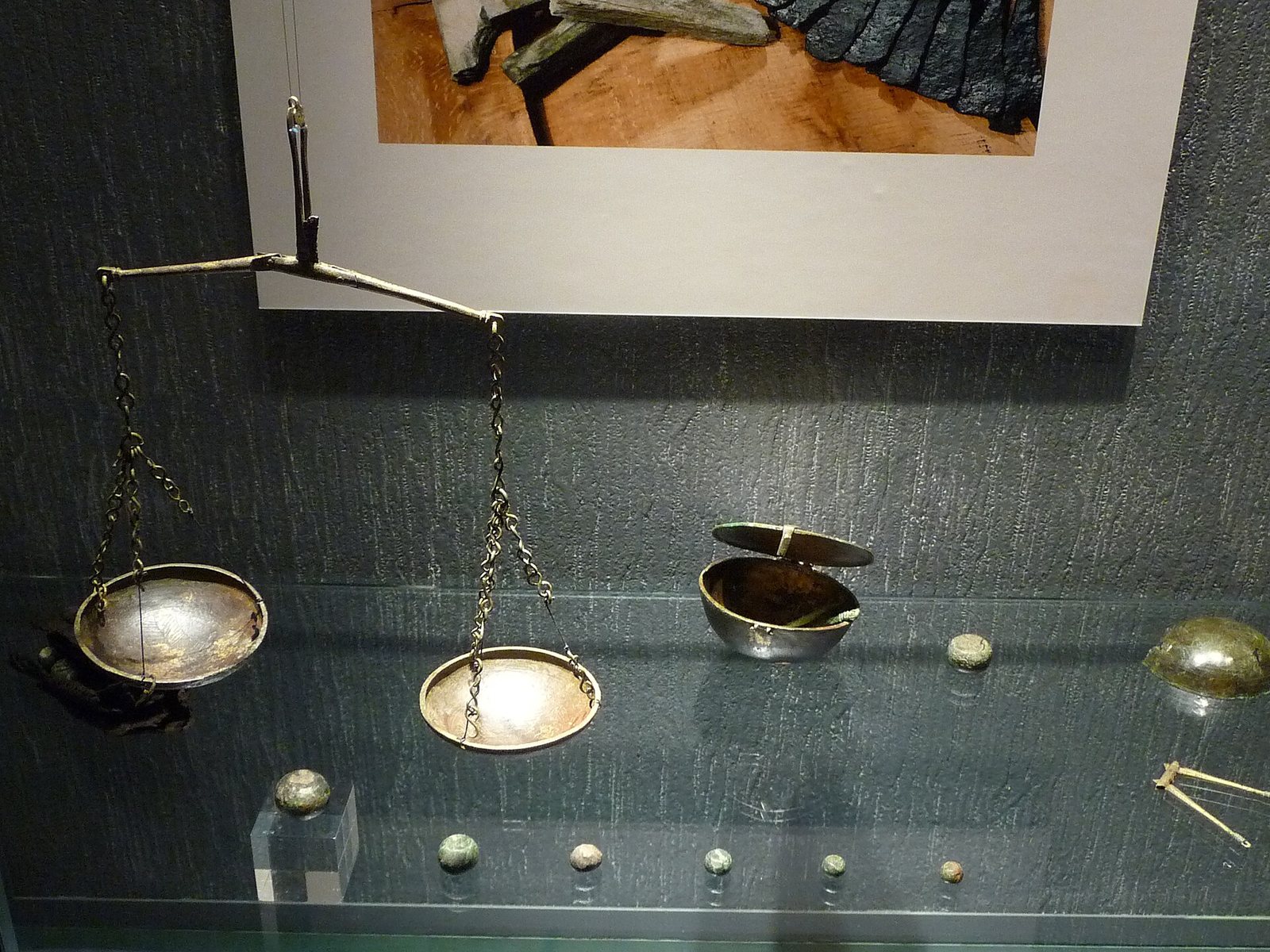
Three instruments recur: the due; the guarantee, in the form of hostages, warrantors and oaths; and the bounded space, whether a ditch at Ribe, a harbour or an exemption for storm-driven ships. The silver that changed hands under all these rules was weighed, as the article on hacksilver explains, and the wider picture is in Viking trade.
Were there trade treaties in the Viking Age? No free-standing trade treaties survive from Scandinavia. What survives are trade clauses in peace treaties, such as Alfred and Guthrum or Æthelred's treaty with Anlaf, along with the Rus treaties and the Icelandic-Norwegian agreement.
What is market peace? A legal condition that punishes violence at a market with special severity. The Old Danish word torghfrith is attested late and only once, linked to heavy fines to the king. For the Viking Age the thing itself is only inferred.
Why did Godfred destroy Reric if it paid him tolls? The annals give no reason. Power politics against the Obodrites and a wish to draw trade closer to his own territory have been suggested. This remains interpretation.
Why did trade with Guthrum's people require hostages? The treaty kept the populations apart and aimed to stop border traffic endangering the peace. The hostages guaranteed that trade was no pretext.
What did an Icelander pay to travel to Norway? The landing due was half a mark of impure silver or an equivalent in wadmal and cloaks. Shipmasters driven off course by storms, among others, were exempt.
Viking trade · Reric · The coins of Ribe · Birka · Guthrum · Danegeld and Maldon · The men of the Rus treaties · The Icelanders · Viking law

Viking Trade · The Men of the Rus Treaties · Reric · Guthrum · Viking Law & Thing.
All History & Finds articles →
Harald Bluetooth (Old Norse Haraldr Gormsson, Danish Harald Blåtand) was king of the Danes from about 958 until 986/87 …
Read more →Harald Hardrada (Old Norse Haraldr harðráði, "hard ruler", properly Harald Sigurðarson) was a Norwegian prince who fled …
Read more →A petty king from Jutland loses his realm in 814, asks the Frankish emperor for help and waits twelve years for the …
Read more →He is said to have sworn never to cut or comb his hair and beard until all of Norway obeyed him – and in the end he was …
Read more →