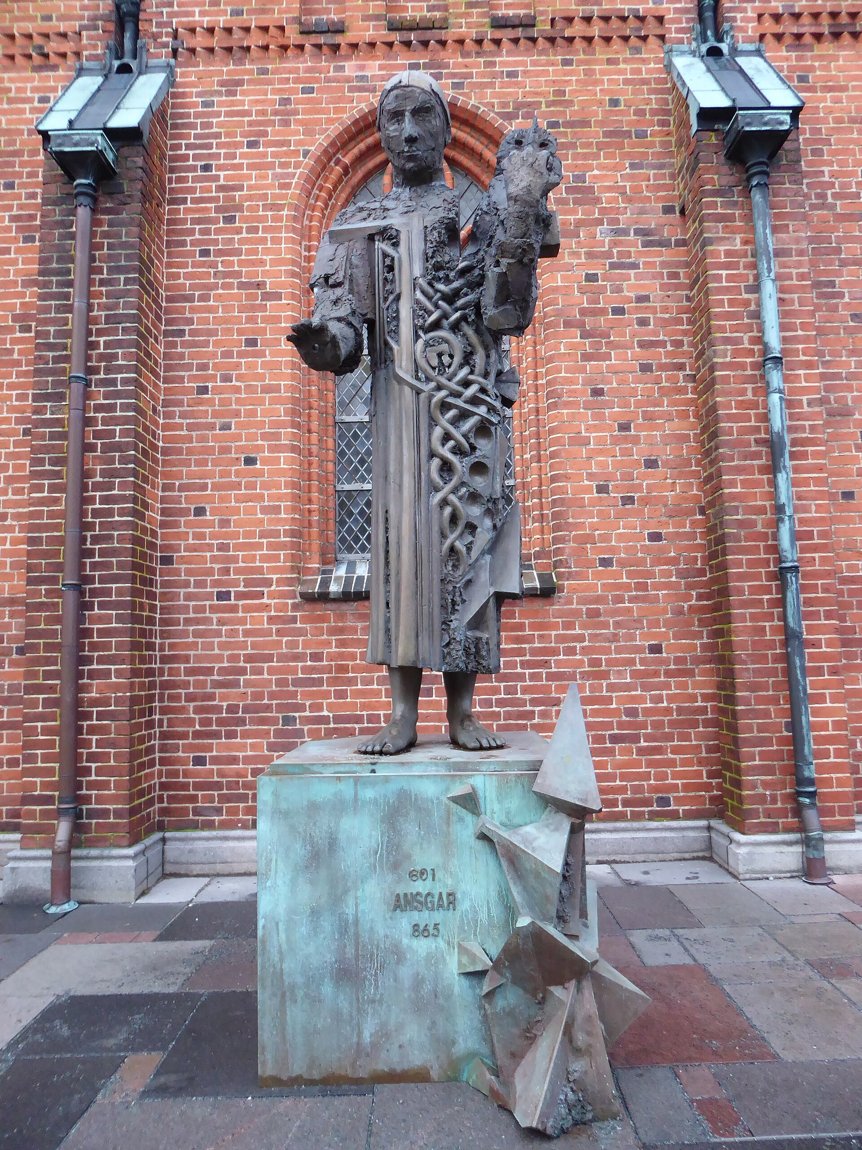
A petty king from Jutland loses his realm in 814, asks the Frankish emperor for help and waits twelve years for the price of it: in 826 he is baptised with his wife and retinue, receives land in Frisia and travels home with the monk Ansgar, only to be driven out for good a year later. Harald Klak, called Heriold or Hariold in the annals, is a Dane whose baptism the Frankish sources describe at length. This article sets the testimonies side by side, separates him from his namesake Harald the Younger, tests the place of baptism, the godparents and the fief, and says plainly where the sources fall silent: this cannot be proven.
Harald Klak was a Danish ruler of the early ninth century who appears between 812 and 827 in changing roles: co-king, refugee at the court of Louis the Pious, ally of an emperor and finally a man without land. The Latin annals write Heriold, Herioldus or Hariold. The byname "Klak" appears in no Frankish source; it occurs only in medieval Icelandic texts, as discussed below.
He was not a sea raider in the usual sense but a pretender, someone claiming a throne he held only for short periods. Around 800 there was no unified Denmark. Several men from related families claimed parts of the country, above all Jutland and the border zone near the Danevirke, the frontier rampart in the south (see Danewerk). A man who lost these struggles could flee to Slavs, Saxons or Franks. Harald chose the Franks, and the Franks chose him: a Denmark ruled by a baptised ally suited Louis better than one ruled by the sons of his old opponent Gudfred.
The case has a concrete Rhineland dimension. The baptism took place near Mainz, the negotiations in the orbit of the imperial palace at Ingelheim, and the journey home led down the Rhine past Cologne and Dorestad into Frisia. For the Franks themselves see Franks; for the wider setting of Danish rulers see Nordic kings.
All contemporary news about Harald comes from Franks, which shapes every detail. The Royal Frankish Annals (Annales regni Francorum) are a court chronicle, short and year by year; they cover 812, 814, 815, 817, 819, 823, 826, 827 and 828 and underlie almost every later account. The Life of Louis attributed to the Astronomer and the history of Thegan, a cleric from Trier, add scenes. The Annals of Xanten alone give the number of more than four hundred baptised. The Annals of Fulda and of St-Bertin cover the 830s to 850s.
Two texts are told in colour. Ermoldus Nigellus, a cleric who wrote in the late 820s the praise poem "In honorem Hludowici", describes in book four the Danish king's visit to Ingelheim; it is poetry with a purpose, written by a man who wanted to win back the emperor's favour. Rimbert's Life of Anskar was written decades later and is hagiography, shaped for effect. Norse sagas call him "Klakk-Harald" only centuries later and do not count as witnesses.
To see why Harald needed help, start with the prelude. King Gudfred (Godofridus in the annals) threatened Charlemagne around 808, destroyed the Slavic trading place Reric (see Reric) and had the Danevirke extended. He died in 810. His nephew Hemming succeeded him and made peace with the Franks, and Hemming died in 812.
Then the quarrel broke out from which Harald emerges. According to the annals two parties faced each other: Sigifrid, a nephew of Gudfred, and Anulo, whom the annals call a nepos of a Heriold. Anulo's party prevailed and made "his brothers Heriold and Reginfrid" kings. That is the first mention of our man. Whether it concerned all of Jutland or only a part, the annals do not say.
As to the family, scholarship broadly holds that Anulo, Reginfrid and a Hemming were Harald's brothers (not to be confused with the Hemming of 810). His father is guessed to be Halfdan, but the only support is a Fulda entry for 837 that calls a Hemming the son of a Halfdan. Whether that Hemming is Harald's brother cannot be shown; the genealogist Stewart Baldwin allows for two men of the same name. What is certain is only that the Franks saw Harald and his brothers as a group.
The takeover did not last. According to the annals Gudfred's sons drove Harald and Reginfrid out in 813. In 814 Reginfrid died in battle, as did Gudfred's eldest son. Harald, the annals say, lost confidence in his position, came to the emperor and put himself into his hands. This was commendation, the legal act by which a man placed himself under the protection and service of a lord.
"quo facto Herioldus rebus suis diffidens ad imperatorem venit et se in manibus illius commendavit." – "After this Heriold, doubting his position, came to the emperor and commended himself into his hands."Annales regni Francorum, year 814, Latin as quoted in an article on Ermoldus Nigellus (Classnorr portal); my own translation
The sentence is dry, almost casual, yet it marks a turning point: from 814 Harald was the vassal of a Christian ruler without being a Christian himself. Louis sent him to Saxony to wait. I did not read this wording in an edition but as a quotation in a scholarly article; the translation is mine.
That an emperor helped a refugee was nothing unusual. Simon Coupland, who studied Harald's relationship with Louis in a much-cited 1998 paper, points out that Charlemagne had already received and supported exiled rulers, among them Eardwulf of Northumbria. An exiled king was a pledge: whoever restored him gained influence in his homeland.
Louis tried several times. In 815 an army of Saxons and Obotrites (a Slavic people) marched north and turned back without installing Harald. In 817 the emperor promised help again. A second attempt in 819, supported by the Obotrites, succeeded in a limited way: Harald now ruled together with two sons of Gudfred. The arrangement took effect around 821 but did not hold, and in 823 the quarrel resumed.
In that year Harald asked for help once more. According to the annals Louis sent counts Theotharius and Hruodmund to Denmark to assess the situation. They returned with Ebo, archbishop of Reims, who had preached and baptised in Denmark on the emperor's authority and with papal backing. Harald spent the winter of 823 in Frankfurt, according to the Classnorr article; there, it is supposed, Ebo told him that baptism would ease future help. The supposition is plausible but not explicitly attested. Rimbert writes that the emperor urged Harald toward the faith so that a common religion would make the loyalty of Christian princes easier. That is the interpretation of a hagiographer, and whether it reflects Harald's own view cannot be checked.
Why Louis relied on baptism and fief is not recorded. Coupland stresses that the primary sources give no motives. An older thesis by the Norwegian archaeologist Haakon Shetelig (1940) saw the emperor preparing a campaign against Denmark; Coupland finds it incomplete and considers that Louis may have wanted a protectorate on the model of the Slavic border lands.
In the summer of 826 Louis held an imperial assembly in the palace of Ingelheim, a large Carolingian residence on the Rhine in today's Rhineland-Palatinate. A footnote in Robinson's translation of the Life of Anskar quotes Thegan: the emperor was in his palace at Ingelheim when Harald came to him from the Danes. The Annals of Xanten link Harald's arrival to the assembly and synod there. That Louis stayed in Ingelheim in 826 is therefore well supported.
The place of baptism is another matter. The Royal Frankish Annals and the Life of Louis speak of Mainz, and the annals name the church of St Alban ("apud sanctum Albanum"), a collegiate church outside the city walls. Ermoldus lets the Danish king and his ships arrive on the Rhine and sets the action in Ingelheim. The Classnorr article mentions a scholarly view that the baptism took place in the church of St Remigius by the palace. The Kaiserpfalz Ingelheim website gives 24 June 826 as the date and St Alban near Mainz as the place. I have no edition that proves the date; it is a modern statement which I pass on as such.
The likeliest reading is that court and assembly were at Ingelheim while the baptism itself took place at St Alban near Mainz, a short journey away. That cannot be proven, but it contradicts none of the witnesses. The river links both places; according to Ermoldus the Danes arrived with a whole fleet, though the Ingelheim palace foundation regards his figure of a hundred ships as certainly exaggerated.
Ermoldus turns the visit into a scene. He has Harald renounce idols ("respuo sculpta manu", roughly "I reject what hands have carved"), shows the Dane's amazement at the splendour of the court, a hunt and a banquet, and ends with the king leaving laden with gifts and ships. Independent sources confirm the core, baptism before witnesses and the fief. The speeches are poetic shaping.
Many details are disputed, and some that circulate online cannot be proven.
The godfather. Rimbert writes that after the baptism the emperor himself lifted Harald from the font. Robinson's 1921 translation renders it "he himself received him from the sacred font". Whether it amounted to formal adoption, as some accounts say, is not clear from the sources; contemporaries speak of sponsorship, not adoption.
Judith. Robinson's footnotes name the empress as sponsor of Harald's wife and cite Thegan, Ermoldus and Adam of Bremen. I read these footnotes only in a summary and could not check which author says what. The empress's role is plausible but attested only at second hand. For Lothar, Louis's son and co-emperor, as a further sponsor I found no evidence.
The wife. In none of the sources I could consult does Harald's wife have a name; the annals speak only of his wife, baptised with him. The name "Sigrid Helgesdotter" found in some online reference works is unsupported, and I could find no source for it. The children listed on genealogy sites come from later tradition and are uncertain.
The retinue. The Annals of Xanten give more than four hundred baptised; according to the Robinson footnote Ermoldus mentions wife, son and about 400 Danes. Adam of Bremen adds a brother of Harald whom he calls Harekr; who is meant cannot be said with certainty. A son named Godfrid being baptised is reported in secondary literature citing the Annals of St-Bertin; whether a son of Harald is meant, I cannot confirm.
After the baptism Louis showered his new son with gifts. The annals report that Harald was dismissed with many presents from the emperor's hand and returned through Frisia. There the emperor gave him the county of Rüstringen ("Hriustri") to use as a refuge should he come into danger. This is how Coupland summarises the annals and the Life of Louis.
Rüstringen lay on the North Sea coast in Frisian country, west of the Weser around today's Jade Bight; see Frisians for the land and its people. The Franks had no real fleet and the coast was hard to protect. Settling a Dane with his own following there bought a kind of coastal defence. Scholars see it as an early example of a pattern that later recurs with Rorik. Whether Harald was expressly given that task, the 826 annals do not say as far as I could read them; it is the modern interpretation of a report that names only the fief and the refuge.
Two further statements stand beside it, and they are not the same thing. Rimbert says Harald received a place beyond the Elbe where he could stay until he regained his kingdom. Adam of Bremen speaks of a fief beyond the Elbe and adds that Louis set Harald's brother to fend off pirates. Both texts are younger than the annals. A footnote in Robinson remarks that "beyond the Elbe" seems from context to mean south rather than north of the river; scholars place it variously, suggesting Holstein or Frisia. Whether Rimbert's territory and Rüstringen are the same, whether Harald got both, or whether one report distorts the other, cannot be settled.
Louis wanted not only an ally but also a priest in his company. Rimbert tells that at an assembly of the magnates nobody at first volunteered to go with Harald. Wala, abbot of Corbie, proposed a monk of his house, Ansgar (see Ansgar). The abbot would not force anyone; Ansgar agreed. A second monk, Autbert, joined him. Equipped by the emperor, they set out. Hadebald, bishop of Cologne, gave them a boat with cabins. The route ran through Dorestad, written Dorstadt, and Frisia to the Danish border.
When Harald set foot in Denmark, and whether he did at all, remains unclear. Rimbert writes that Harald could not take possession of his kingdom and was therefore given a place beyond the Elbe. How long and how far the two monks could work in Denmark is not clear from the texts I have read; Harald's expulsion in 827 took away their backing in any case. The idea that Harald's baptism founded Christianity in Denmark belongs to later idealisation. The Danes became lastingly Christian only in the tenth century under Harald Bluetooth; see Harald Bluetooth and, for the wider north, Christianisation of the Germanic peoples.
According to the Royal Frankish Annals Gudfred's sons had sent envoys to the emperor in 825 and 826 offering peace. Horik, named in this source for the first time, promised to appear before Louis at Nijmegen in 827 and did not keep the promise. Instead he and his brother drove Harald out of Denmark for good. Nijmegen on the lower Rhine was the planned meeting place; according to the annals it never took place. Aachen, the Carolingians' main residence (see Vikings and Aachen), does not appear in the testimonies about Harald; the talks ran through Frankfurt, Ingelheim and Mainz.
In 828 Harald answered militarily. He raided Denmark, plundering and burning several villages. Horik and his brother raised an army, crossed the Eider and attacked the imperial troops stationed there. The Franks were beaten and fled their camp. The Danish kings then sent envoys to Louis to forestall reprisals. For 829 the annals speak of a rumour that the Danes would invade the empire; it proved false, and it is possible but unproven that Harald had spread it. After that the sure trail ends.
Here the hardest source work begins, because the reports of the 830s to 850s often concern another Harald. In 837 Northmen landed on Walcheren, an island in the Scheldt estuary. According to the Annals of Fulda, count Eggihard and "Hemingr, son of Halfdan" fell on 17 June; Thegan also names Hemming. Who this Hemming is remains open: he is often equated with a brother of Harald Klak, but the only support is the shared name.
In 841 Emperor Lothar I, seeking allies in the civil war over Louis the Pious's inheritance, gave the island of Walcheren to two Danes, Harald and Rorik. The Annals of St-Bertin, written by Prudentius of Troyes, call Harald a persecutor of the Christian faith and an idol worshipper and the grant an abominable crime. Nithard, a contemporary, writes that Lothar placed a Christian population under Northmen and allowed them to plunder Christians in his enemies' lands; modern scholarship connects this with Walcheren.
One often reads that Lothar enfeoffed Harald Klak with Walcheren in 841. According to the English-language scholarly overview based on Coupland, the Harald of 841 is Harald the Younger, whom Prudentius calls an idol worshipper, hence a pagan; Harald Klak had been baptised since 826. The German Wikipedia dates a grant to Harald Klak to 840; I found no source for that and follow the other view. Confusion is easy because the annals simply write "Harald" and older literature merged the two.
The Annals of Xanten speak under 850 of a "Harald the Younger" (Herioldus iunior). Rorik, who received Dorestad from Lothar in 850, is his brother in Xanten and also in Fulda, while the Annals of St-Bertin call Rorik a nepos of Harald. What this means for the relation to Harald Klak is discussed in Rorik of Dorestad; suffice it to say that Harald Klak was probably Rorik's uncle, though this is not proven.
For 852 the Annals of Fulda report that a Harald who had fled Horik's anger, been received kindly and baptised, was later killed because the magnates of the north regarded him as unreliable and possibly treacherous. Probably Harald Klak is meant, but it is not certain. Coupland sees an execution on suspicion alone. A death "around 852" can be named if the reservation is written beside it.
The Frankish annals know only Heriold. "Klakk-Haraldr" appears first in Norse texts such as the Ragnarssona þáttr and Heimskringla, centuries later. What the byname means is unsettled. Klakkr is attested in Old Norse as a personal name and byname; the database emidsvikings.ac.uk suggests an original sense of "peg on a saddle from which baggage hangs". Whether Harald's byname has that root, and what it would then have said about him, nobody has spelled out there, and I found no reliable explanation.
Kinship is similar. It is certain that the annals name Harald with several brothers: Reginfrid, Anulo and elsewhere a Hemming. Halfdan is assumed to be the father on the Fulda entry of 837 and is at best a probability. For Harald's relation to Gudfred and his sons the sources say only that they were rivals. Whether the two lines were distant or close cannot be shown. Saxo makes Horik Harald's brother, which scholars treat as one of Saxo's free combinations. Rorik and Harald the Younger are seen by Coupland and others as two brothers and nephews of Harald Klak; the annals of St-Bertin call Rorik nepos, a medieval Latin word that can mean nephew, grandson or just relative. Their father is unknown. The sagas (Ragnarssona þáttr, Heimskringla) make Klakk-Harald the father of Thyra, who marries Gorm the Old; Saxo gives other parents and no testimony exists, see Thyra Danebod and Gorm the Old.
For the Danes the baptism of a king was a risk. After 826 Harald lost the backing a northern ruler needed: the followers among pagan magnates, who saw a man who had submitted to the emperor as the vassal of a foreigner. That is a scholarly explanation for his failure in 827, not a statement of the sources. The annals say only that Horik and his brother drove him out.
For the region between the Rhine and the North Sea Harald's road shows how dense the links already were in 826. A Dane sailed up the Rhine to Mainz, was baptised in a church outside the city, went down the Rhine to Cologne and Dorestad and received land on the Frisian coast. The Rhine axis later used by Rorik, Godfrid and the Great Army already existed; for the army see The Great Army.
Open points are Harald's parents, the origin of his byname, the identity of his wife, Judith's role, the exact place of baptism between Ingelheim and Mainz, the location of the land beyond the Elbe, whether he ever entered Denmark again, and whether the Harald of 852 is Klak. I could not check the wording of the Royal Frankish Annals for 826 to 828, the Life of Louis, Thegan or the Annals of Fulda in an edition; where I speak of them, I rely on secondary literature and summaries. Anyone needing exact words must consult the Monumenta Germaniae Historica.
When and where was Harald Klak baptised? According to the Royal Frankish Annals in 826 at St Alban in Mainz; the court was then at Ingelheim. The date 24 June appears only in modern accounts.
Was Louis the Pious his godfather? Yes, Rimbert writes that the emperor himself lifted him from the font. Whether Lothar or Judith also took sponsor roles is attested only partly and at second hand.
What was Rüstringen? A Frankish county in Frisia on the North Sea coast, which Louis gave Harald in 826 as a refuge. Whether Harald ever resided there is not documented.
Is Harald Klak the same as Harald the Younger? No. According to the annals Harald the Younger was a pagan and received Walcheren with Rorik around 841; Harald Klak had been baptised since 826. By the usual reading they were uncle and nephew.
When did Harald Klak die? This cannot be shown with certainty. Usually "around 852" is given, based on a Fulda entry that may refer to him.

Rorik of Dorestad · Ansgar · Dorestad – the great trading place · The Frisians · The Franks.
All History & Finds articles →
He is said to have sworn never to cut or comb his hair and beard until all of Norway obeyed him – and in the end he was …
Read more →Black shields, darkened bodies, attacks on pitch-dark nights: in a few lines, written around AD 98, Tacitus created an …
Read more →Of some peoples we know towns, graves, coins and the names of their gods. Of the Harudes we know a name, a number and a …
Read more →The Hasdingi are the part of the Vandals from which the kings Godigisel, Gunderic and Geiseric are said to come, and a …
Read more →