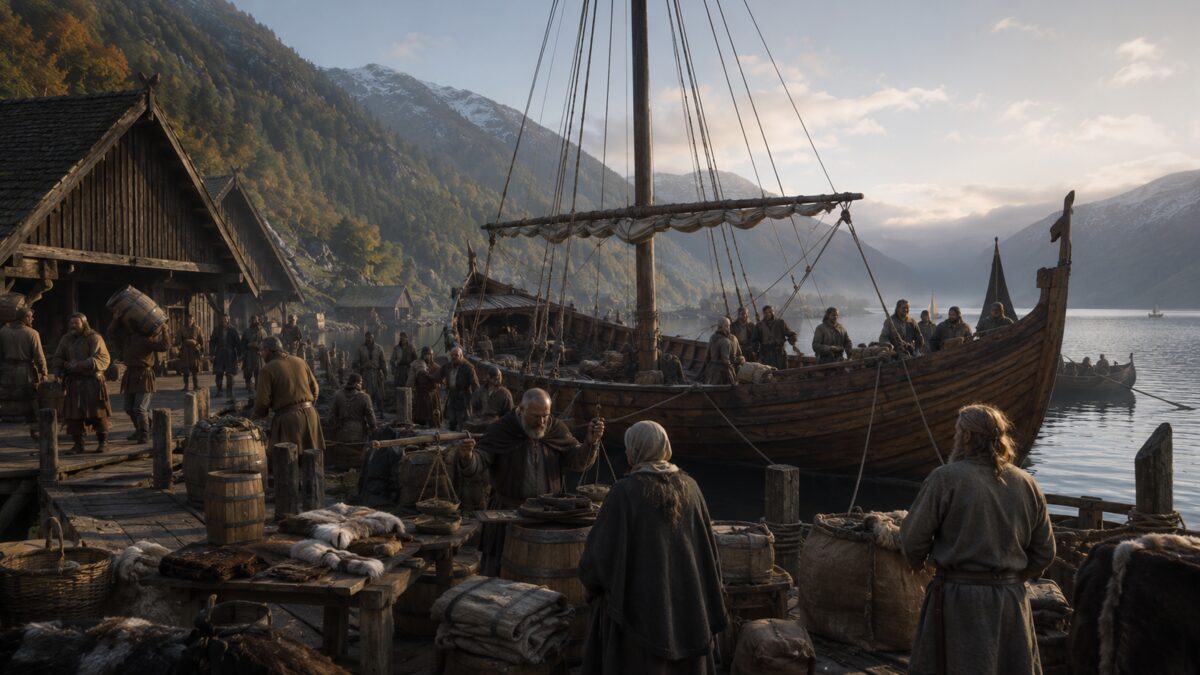
A Danish warlord ravages Frisia, is not defeated by the Frankish king but enfeoffed, and then holds for years one of the richest trading places in Europe. That is how the annals read on Rorik of Dorestad, who from 850 to 873 had dealings with four rulers of the Carolingian house and then vanishes from the sources. Everything we know about him comes from Frankish churchmen who describe him now as a danger, now as a contract partner. This article lays the testimonies side by side, examines the kinship with Harald Klak, places Godfrid, Rodulf and the Great Army, and says, where it has to: this cannot be shown clearly at present.
Rorik of Dorestad, in the Latin sources Roricus or Rorich, in Old Norse probably Hrœrekr, held parts of Frisia for the Frankish kings in the 9th century. In this period Frisia means the North Sea coast with its marshes and islands; Rorik's territory lay in the area of the present Netherlands. His name hangs on Dorestad, a trading place on the Kromme Rijn near today's Wijk bij Duurstede, which the article Dorestad describes. The annals attest him from 850 to 873; for 882 they say that the realm of the Frisians which Rorik had once held passes to another Dane.
What is missing is astonishing. No text gives his year of birth; modern accounts vary between about 800 and 810, and that is an estimate. His parents are unknown, I know of no inscription, seal or coin with his name, and his death can only be grasped as a window: after 873, before 882.
Three terms first. Annals are year-by-year records, mostly from monasteries, which note briefly what their authors thought worth reporting. A fief, in source Latin beneficium, "benefit", is land or office that a ruler grants for use in return for loyalty and service; the developed feudalism of the high Middle Ages is younger, and for the 9th century the term is a working construct of scholarship. The oath of fealty is the oath that binds the recipient to the giver.
All testimonies on Rorik come from Franks, and none is a self-portrait. A Norse tradition that names him unambiguously I have not found; that is no statement about all Norse texts. The picture comes from opponents and contract partners.
The Annales Bertiniani, the Annals of St-Bertin, are the West Frankish voice, named after the monastery in which a manuscript lay. Prudentius of Troyes kept them, by the present reading, from the early 840s until his death in 861; then Archbishop Hincmar of Reims wrote on until 882. They are churchmen in the circle of Charles the Bald who see Vikings above all as a danger to monasteries; of a Harald who received Walcheren in 841, Prudentius says, according to the summary I read, that he was a persecutor of the faith and that the enfeoffment was an abominable crime. Edition: Georg Waitz 1883, English Janet Nelson 1991.
The Annales Fuldenses, the Annals of Fulda, are the East Frankish counter-voice. Down to 863 or 864 they are ascribed to the monk Rudolf of Fulda, not without dispute; after that they divide into a Mainz and a Bavarian continuation with interests of their own. Edition: Friedrich Kurze 1891, English Timothy Reuter 1992.
The Annales Xantenses, named after Xanten, lie closest to the Lower Rhine. According to Heinz Löwe a royal chaplain, Gerward, wrote the entries to about 860 probably at Lorsch; around 871 entries from 861 on were added at Cologne which are hostile to Archbishop Gunthar of Cologne. On Rorik they judge most sharply. Added to these are the Annales Vedastini (named after Saint-Vaast; I have checked nothing on their author) and two letters of Hincmar of Reims around 863, whose content I know only from the summary of Flodoard of Reims, who wrote in the 10th century.
Later testimonies need care. The saint's life of Adalbert of Egmond from the late 10th century calls Rorik, according to English Wikipedia, "Roricus barbarorum rex", "Rorik, king of the barbarians"; it is a hagiography, over a century younger than Rorik. In Rimbert's Life of Ansgar, which tells of Harald's baptism, I did not find Rorik in the chapters I read; an article in the journal Gripla speaks of a close relationship with Ansgar, which I cannot confirm.
Harald Klak, a Danish pretender, that is a claimant to the throne, had himself baptised in 826; according to Rimbert Louis the Pious received him from the font. As the place Thegan, according to a note in Robinson's translation of the Life of Ansgar, names Ingelheim, other accounts speak of Mainz. According to secondary literature Harald received the county of Rüstringen in Frisia (I have not checked the source passage) and lost his position in Denmark in 827. The pattern that later concerns Rorik is older than he: a Dane gets coastal land from the emperor so that he keeps other Danes away.
On Rorik's kinship the three annals for 850 give three statements that do not fit together smoothly. Fulda: Rorik held Dorestad as a fief "with his brother Harald" (English translation as Wikipedia gives it). Xanten: he is the brother of the "younger Harald", Herioldus iunior. St-Bertin: he is nepos Herioldi, quoted in the edition as "Rorich, nepos Herioldi".
Nepos in medieval Latin means nephew, but also grandson or generally relative. "Nephew of Harald Klak" is therefore an interpretation. It is possible that Rorik and Harald the Younger were sons of a brother of Klak; scholarship counts Anulo, Ragnfrid and Hemming as Klak's brothers, and some, on chronological grounds, take Hemming for the father. Wikipedia calls that plausible, not secure. It is also possible that St-Bertin means a different Harald. Secure is only what all three share: Rorik belongs to a circle of Danes around a Harald. How closely he was related to Harald Klak cannot be shown clearly. In addition older research confused the two Haralds; Simon Coupland corrected that in 1998.
Harald the Younger appears as the recipient of the island of Walcheren (841). That Rorik sat on Wieringen in North Holland stands in modern accounts as a fact; I found no source passage for it, so until checked the assignment is a reconstruction.
Godfrid, in the literature "Godfrid Haraldsson", appears in 855 as Godofridus beside Rorik; the passage I could read states no kinship. "Haraldsson" is a modern addition: English Wikipedia makes him a son of Harald Klak and Rorik's cousin, without my being able to check the evidence. Rodulf, whom the Xanten annals call Rorik's nepos, counts in the literature as a son of Harald the Younger; here too nephew or cousin is conceivable.
For orientation: attested means a contemporary annal says it expressly, as far as I know it through quotations and summaries; plausible means it follows from the attested; conjecture means scholarship is guessing. I have never read an annal text in full.
841. Lothar I grants Walcheren and neighbouring districts to a Harald, in his quarrel with his brothers Louis the German and Charles the Bald. Attested, because Prudentius denounces it. Rorik's share is not expressly attested; Fulda puts the enfeoffment under Louis the Pious, which scholarship, by the account I read, holds to be an error of the annals.
Around 844. According to Fulda the brothers are falsely accused of treason against Lothar and imprisoned; Rorik escapes and goes to Louis the German. The year 844 is a modern estimate, Harald's death in prison a conjecture.
850. Rorik returns with a fleet. St-Bertin reports that he ravaged Frisia and the Betuwe, up the Rhine and the Waal, and that Lothar, unable to defeat him, received him into his fealty and gave him Dorestad and further counties. Fulda adds the condition: he was to collect the royal dues and oppose the raids of the Danes. Xanten writes that, offended by Lothar, he demanded Dorestad back and treacherously did the Christians much harm. According to Wikipedia Utrecht fell too, and Godfrid fought alongside. Attested is the essential: with Lothar's consent Rorik becomes lord of Dorestad.
854 or 855. After the death of King Horik I of Denmark civil war rages there. St-Bertin for 855: after Lothar I had given all of Frisia to his son Lothar (II), Rorik and Godfrid returned to Denmark "in the hope of gaining royal power" (spe potestatis regiae nanciscendae). It did not succeed. At the end of the entry: Roric et Godefridus … Dorestado se continent et parte maxima Fresia potiuntur, roughly "hold themselves in Dorestad and rule the greatest part of Frisia". Modern accounts waver between 854 and 855; the edition counts 855. After that Godfrid vanishes from the summaries known to me; his death soon afterwards Wikipedia itself calls only "probable".
857. Fulda: Rorik sails with Lothar's consent with a fleet to the borders of the Danes and, with the agreement of Horik II, occupies the part of the realm "between the sea and the Eider". Coupland estimates the area lay north of the Eider and reached to the Schlei; that Rorik thereby controlled Hedeby the chronicler does not say, it is conjecture. In the same year, according to St-Bertin, other Danes storm Dorestad and ravage the Betuwe. That Rorik was recalled is plausible but not attested.
863. A Danish fleet plunders Dorestad and sails up the Rhine. When a Frankish army occupies the banks, the Danes withdraw, according to St-Bertin, "on Rorik's advice". Rumours that he had called them existed even then; Coupland holds them unfounded. It is the last mention of Dorestad in the written sources. Around this time Hincmar writes two letters: to Bishop Hunger of Utrecht, that he should impose penance on Rorik if the rumour were true and keep him from sheltering Baldwin I of Flanders; and to Rorik, that he should not support enemies of Christendom. That Hincmar addresses him as a Christian presupposes a baptism; when and where it took place is not transmitted.
867 to 870. An uprising which, according to Wikipedia, the annals ascribe to the Cokingi (I found nothing reliable on the name) drives Rorik out of Frisia. After the death of Lothar II in 869 and the division of Lotharingia in the Treaty of Meerssen, Charles the Bald meets "the Norseman Hrørek" at Nijmegen in 870 and binds him, says St-Bertin, by a treaty.
872 and 873. In January 872 Charles negotiates with Rorik and Rodulf; in October he receives Rorik kindly at Maastricht and sends Rodulf away empty-handed. In June 873 Rodulf is killed in Ostergo as he demands tribute; the Frisians answer that they owe dues only to Louis the German. In the same year Rorik, according to Xanten, swears the oath of fealty to Louis the German. Xanten calls him, in Wikipedia's summary, "the gall of Christendom"; I know the wording only so. After that the sources fall silent.
Before 882. Rorik is dead; when and how stays open. For 882 the annals say that Emperor Charles III gave Godfrid the realm of the Frisians which Rorik once had (quotation below). English Wikipedia on the siege of Asselt speaks here of Kennemerland, the coastal strip in West Frisia, as Rorik's former territory; I did not find the source passage.
The Carolingians had a tried procedure for Danes on the coast: whoever knew the sea routes and brought warriors of his own got land and was to ward off other plunderers in return. Louis the Pious did so in 826 with Harald Klak, Lothar I in 841 and 850 with Rorik's family. Fulda names the condition for 850 expressly: collect dues, ward off raids. Whether the Franks bought security or only time has not been answered uniformly by scholarship.
Rorik served several lords in succession, and the sequence shows his skill. Lothar I enfeoffed him in 850, but in 855 gave Frisia to his son Lothar II, who according to Coupland tried to push Rorik out. With Louis the German Rorik found refuge in the 840s and swore the oath in 873. Charles the Bald bound him by treaties in 870 and 872. After the division of Lotharingia in 870 Rorik's holdings lay, according to Coupland, on both sides of the border between Louis's and Charles's realms, an unenviable position, as Wikipedia puts it. According to Wikipedia Coupland calls him the most powerful and influential of all the Danes drawn into the Carolingian world, and counts for about 23 years only two recorded raids on his territory, 857 and 863. One conclusion from that count: the Franks got for Dorestad something they had not achieved with their own armies.
Warfare in Rorik's world meant ships first. In 850 the annals describe an advance up the Rhine and the Waal, which presupposes a fleet able to use shallow rivers; on ship types see Viking ship types. Bases on islands such as Walcheren and Wieringen would be obvious for such a war but are, as said, a modern assignment. How large Rorik's following was no source states. The Frankish practice of paying tribute to Vikings is treated in the article Danegeld, the opposing side's army system in Carolingian armies.
Whether Rorik called himself "king" or was so called is unclear. Sedulius Scottus calls someone rex, which some refer to Rorik and others to Rhodri the Great of Wales; the hagiography of Egmond speaks of a "king of the barbarians". The annals, by contrast, describe him as the recipient of a fief. The two do not exclude each other, for a title can count outwardly and a fief inwardly. A kingship in the Carolingian sense the summaries I read do not attest.
The name Godfrid needs ordering, for there are several men. The Danish king Göttrik (Latin Godofridus) destroyed the trading place Reric in 808 and died in 810, more in the article Reric; his sons, among them Horik, later drove out Harald Klak. The Godfrid who appears with Rorik 850 to 855 is, by the present reading, a relative from Harald's line. And the Godfrid who received Frisia in 882 was a vassal of Charles III and was killed on the Rhine in 885; English Wikipedia assumes he "probably" served in the Great Army. Whether he is identical with Godfrid Haraldsson is left open in the literature ("may or may not be"); I found no reliable equation. The Great Army that stood on the Lower Rhine in the 880s falls in the years after Rorik's last mention (873); no testimony known to me places Rorik himself in that army (see The Great Army and The Great Army on the Continent).
Dorestad is the decisive site for Rorik's time. The excavations of 1967 to 1977 uncovered some 30 hectares, above all the lower town by the river with wooden causeways. Simon Coupland interpreted the coin finds in 1988: the place flourished, on his reading, until about 840, minting went on at least to around 850 and perhaps to 860, and by the mid-860s trade had almost ceased. Coins of Lothar I with the temple motif lie in large numbers in northern hoards of the 840s and 850s; issues of Charles the Bald from 864 are entirely absent in Dorestad. That fits a decline in Rorik's decades. Whether raids, Rorik's rule or a shift of the Rhine's course was the cause is disputed; an interplay is close at hand, but it cannot be proved.
In 1996 a pot of Badorf ware, stopped with grass, was found at Westerklief on Wieringen, holding 78 silver coins, 16 ingots, arm rings and a necklace. The Rijksmuseum van Oudheden dates it to 850 to 880; the latest coins are from about 850, two bear the name of Charles the Bald. The jewellery style points, according to the museum, to a Danish origin. Whether the owner belonged to Rorik's circle we do not know; the museum does not name Rorik. The archaeologist Jort Smit points out that these are surface finds and nobody knows where houses stood or whether they were built in Nordic fashion.
Rorik's world lies on the lower reaches of the Rhine and the Meuse. Dorestad on the Kromme Rijn, the Betuwe between Rhine and Waal, Utrecht, Nijmegen, where Charles the Bald negotiated with him in 870, Maastricht, where he was received in 872: these are his attested places. Maastricht lies about 30 kilometres from Aachen, but a stay in Aachen is not attested for Rorik, and I do not claim one. Aachen enters the history of the Vikings on the Rhine only in 881, when the army treated in Vikings near Aachen struck the palace town; whether Rorik was still alive in 881 is open, and a connection with that army is not attested.
Further up the Rhine lies Duisburg. Regino of Prüm tells for 883 of an attack by the Norsemen on the settlement, which belonged to the monastery of Prüm, and of a winter camp nearby; in spring they went back down the Lower Rhine. That too lies after Rorik's last mention, and his name does not occur there. The article Vikings in Germany places Duisburg.
The most striking aftermath is a hypothesis. Since 1816 Hermann Hollmann has proposed equating Rorik with Rurik, the Varangian whom the Primary Chronicle has called in 862 and with whom the Rurikids begin. Friedrich Kruse took up the idea in 1836, Nikolai Belyaev revived it in 1929, later also Boris Rybakov and Anatoly Kirpichnikov; Alexander Nazarenko and others reject it. In favour is the similarity of the names (Hrœrekr). Against it is that Rorik is attested in the West in 863, 867, 870, 872 and 873, while the chronicle lets Rurik rule in the East from 862 to 879. Since the chronicle's years are back-calculated, this cannot be strictly refuted. Nothing supports the equation except the name. More in the article Rurik.
A second, smaller legend hangs on Egmond. A blog on coastal history tells that Rorik wanted to have the church of Egmond, buried under sand, dug out, but it emerged from the sand by itself overnight, and connects this with the Adalbert tradition. Whether the Vita tells it so I have not checked; as history it does not count.
Third, the Norse tradition: later sources such as the Ragnarssona þáttr and Heimskringla make Harald Klak the father of Thyra, wife of Gorm the Old. Saxo gives her other parents, and scholarship regards these attributions as legendary (see Thyra Danebod). Rorik does not occur in these stories, as far as I see.
Godefridus vero rex ad eum exiit, cui imperator regnum Fresonum, quod olim Roricus Danus tenuerat, dedit.
"King Godfrid went out to him, and the emperor gave him the realm of the Frisians, which the Dane Rorik had once held."Annales Vedastini, for the year 882; Latin wording read through a retrieval tool from a collection of quotations (Henry Project, referring to the edition by de Simson, MGH SS rer. Germ. 12), not in the edition itself; comparison outstanding; English version my own translation
Open are Rorik's parents and his degree of kinship to Harald Klak, the source passage for Wieringen as his seat, the date of his baptism and the question whether the Godfrid of 882 is identical with the one of 855. Equally open is how the annals of St-Vaast for 882 and the Mainz continuation of Fulda read in the original on Kennemerland and Frisia. A find with Rorik's name or an excavated farmstead on Wieringen would clarify much. Neither exists so far.
Who was Rorik of Dorestad? A Dane to whom Emperor Lothar I gave Dorestad and further counties in Frisia as a fief in 850 and who appears in the Frankish annals until 873. He died before 882.
Was Rorik related to Harald Klak? The annals of St-Bertin call him nepos of a Harald, Fulda and Xanten brother of a Harald. How close he stood to Harald Klak cannot be shown clearly.
Did Rorik destroy Dorestad? No, the great attacks came earlier. Under his rule the annals report raids by other Danes in 857 and 863.
Is Rorik the Rurik of the Russian chronicle? That has been considered since 1816 but is unproved and rejected by the majority.
Is there a link to Aachen or the Rhineland? Rorik is attested on the Lower Rhine, at Nijmegen and Maastricht; a stay in Aachen is not attested. The Vikings near Aachen in 881 and at Duisburg in 883 fall in the years after his last mention.
Related articles: Dorestad, Frisians, Franks, Norse kings, The Great Army, The Great Army on the Continent, Vikings near Aachen, Vikings in Germany, Vikings in France, Rollo, Reric, Hedeby, Ribe and its coins, Ansgar, Rurik, Carolingian armies, Danegeld and Regional Vikings.

Dorestad – the great trading place · Rurik · The Frisians · The Great Army on the Continent · Viking traces in Germany.
All History & Finds articles →
The Rugii appear around AD 100 on the southern Baltic coast, fight under Attila in the fifth century, settle the land …
Read more →Rurik is the man northern tribes are said to have called as ruler in 862, founder of the Rurikid dynasty that governed …
Read more →Karl. Inegeld. Farlof. Veremud. So begins a list in a Russian chronicle of the early twelfth century, and no reader in …
Read more →The Ruteni lived in the southern Massif Central, in the area of today's departments of Aveyron and Tarn, with …
Read more →