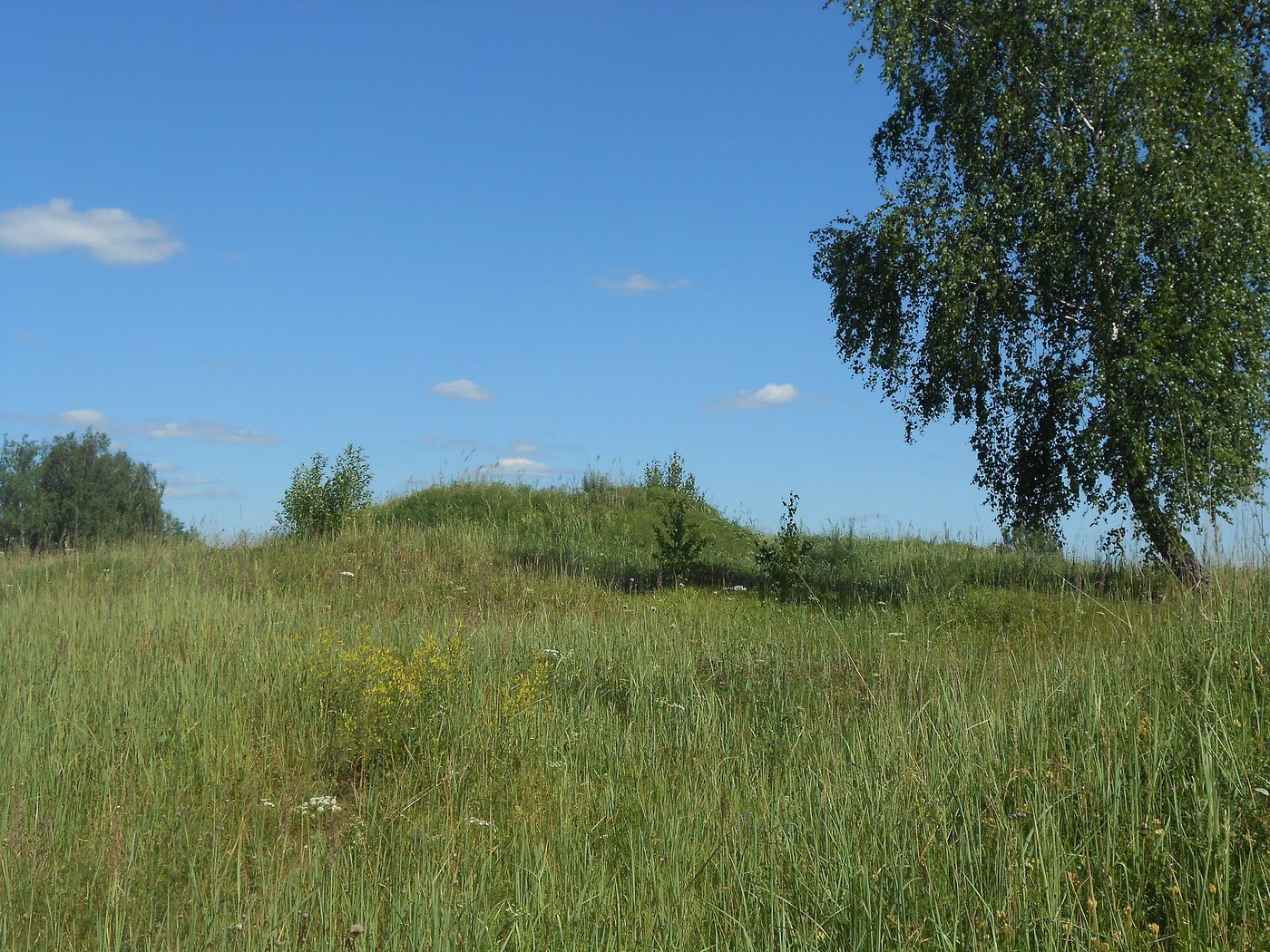
Rurik is the man northern tribes are said to have called as ruler in 862, founder of the Rurikid dynasty that governed until 1598. Almost nothing about him is secure: the story sits in a chronicle written around 1113, its years are calculated backwards, and the brothers Sineus and Truvor are doubtful. This article sorts the Primary Chronicle, the Novgorod First Chronicle, Ladoga, Rurikovo Gorodishche and Gnezdovo by age and weight, tests the identification with Rorik of Dorestad on the Rhine, and says openly where no evidence exists.
In Eastern Europe history often begins with a sentence from a chronicle: in the year 6370 since the creation of the world, 862 by our count, tribes in the north summoned foreign rulers from across the sea. The eldest of the three brothers who came was Rurik. From him the Rurikids descend, the house that ruled Kyiv, later Moscow, and finally all Russia until the death of Tsar Feodor I in 1598. On the Millennium of Russia monument in Novgorod, his figure stands at the very beginning.
What stands out is how thin the ground is. Rurik can be grasped almost only through one text, and that text is some 250 years younger than the event it describes. There is no coin with his name, no inscription, no grave that can be attributed to him, and no contemporary source that clearly refers to him. Whether he was a historical person is disputed. Many specialists consider a leader of this name plausible; others see a founder figure that chroniclers of the eleventh and early twelfth centuries needed in order to explain where the princely family came from.
His name is usually read as a Slavic form of an Old Norse name, Hrœrekr (also written Hrøríkr; spellings vary). The Rus, who appear in the chronicle as the "summoned", were according to the prevailing view a group with a Scandinavian core that slowly became Slavic. The wider setting is covered in the articles on Kyivan Rus, Vikings in the East and the Varangian routes.
This article therefore keeps four layers apart: what written sources report, what archaeology and science show, what later ages added, and what is only hypothesis. One hypothesis concerns the Rhineland and runs through Dorestad; it gets its own section.
The Primary Chronicle. The main source is called Povest vremennykh let, "Tale of Bygone Years", PVL for short, also the Primary Chronicle or Nestor Chronicle. It was probably compiled in Kyiv around 1113. For a long time it was attributed to the monk Nestor of the Caves Monastery; scholars no longer generally accept this, and who wrote the base text remains open. The abbot Sylvester of St Michael's at Vydubychi revised it in 1116, and a third version centred on Mstislav the Great followed in 1118, ending its narrative in 1117. The original does not survive, only copies: the Laurentian Codex of 1377 preserves Sylvester's version, the Hypatian Codex of about 1425 Mstislav's. Between Rurik and the oldest text lie some 200 years, between Rurik and the surviving manuscripts more than 500.
The chronicle counts years from the Byzantine world era, the supposed creation of the world; 6370 corresponds to 862. Several scholars think the dates for the ninth and tenth centuries were largely inserted afterwards, probably in the eleventh century, unless taken from the Byzantine chronicler George the Monk. Alexei Shakhmatov showed that even the starting point is off: the text puts the accession of the Byzantine emperor Michael III in 852, while it was 842. The year 862 is therefore a calculation, not a measurement.
Shakhmatov and his school also showed that the PVL is not the single narrative of one author but a compilation of older accounts, documents and oral tradition. How much was oral is hard to judge. The historian Tolochko concluded in 2015, very bluntly, that its content is largely fictional and that there is no reason to base knowledge of the early period on it. That sits at the sharp end of the spectrum, but it shows how far scepticism goes.
The Novgorod First Chronicle. This is the second main line. Its oldest manuscript, the Synodal Scroll of the thirteenth or fourteenth century, begins in mid-sentence in the year 1016; the "Younger Redaction", preserved in fifteenth-century copies, starts with 854. It also knows the calling of the princes but differs in detail: it dates Oleg's death to 922, the PVL to 912. Whether it goes back to an older lost Kyivan code or, as Tetyana Vilkul argued in 2015, was influenced by the PVL, is open.
Frankish annals. The Annals of St-Bertin, the Annals of Fulda and the Annals of Xanten were written in the ninth century and mention a Dane called Rorik, of whom more below. No Rurik in the East appears in them. Important, though, is the Bertin entry for 839: envoys of a people called "Rhos" came to the court of Louis the Pious at Ingelheim and turned out, by origin, to be Swedes (sueones). That is an early western witness for Rus from the North, a quarter of a century before 862, without any Rurik.
Added later. The so-called Joachim Chronicle is lost; it is known only through the historian Vasily Tatishchev (1686 to 1750), who relied on it. Tatishchev gives Rurik a mother Umila, a grandfather Gostomysl, a wife Efanda from Norway and a cousin Vadim. There is no independent confirmation, and research regards these details as unreliable. Anyone repeating them as fact is repeating Tatishchev, not Rurik.
The story is short. According to the PVL the northern tribes, Slavs and Finnic peoples, drove the Varangians back across the sea, refused them tribute and wanted to govern themselves. But no law arose among them, clan rose against clan, and there was strife. So they decided to look for a prince who would rule and judge by law. They went across the sea to the Varangians, to the Rus. Their words are the most famous quotation in Russian historiography:
„земля наша велика и обильна, а наряда в ней нет“
"Our land is great and rich, but there is no order in it."Primary Chronicle (PVL) under 6370 (862); wording in normalised spelling after a quotation of the Hypatian version at Cyclowiki (not read in the manuscript itself; the continuation "Come and rule over us" is given by the same source only in modern Russian); English version my own translation, by sense, наряд meaning order, arrangement
According to the PVL three brothers then chose to come with their kin and took the whole Rus with them. The eldest, Rurik, settled according to the Laurentian Codex in Novgorod, Sineus at Beloozero, Truvor at Izborsk. The Hypatian Codex has Rurik settle first in Ladoga and move to Novgorod later. After two years, says the chronicle, Sineus and Truvor died, and Rurik took all power. It adds that the Russian land took its name from these Varangians.
It is a foundation story, and its form is known from many cultures: a quarrelling people calls a stranger who brings order. That reality was this peaceful and orderly is unlikely. The same chronicle reports shortly afterwards how two Varangians, Askold and Dir, went south and took Kyiv. The picture of a small band of warriors and traders who set up bases on rivers and collect tribute fits what archaeology shows in the East better than a summons by a whole tribal assembly.
Sineus and Truvor. An older reading took "Rurik, Sineus and Truvor" as garbled Old Norse words, roughly sine hus, "his house", and thru varing, "faithful retinue": Rurik came with kin and followers, and the brothers were a misunderstanding. This is a hypothesis, and a weak one: Elena Melnikova showed in 1998 that such forms contradict the morphology and syntax of the Old Norse dialects. Others looked for real names, such as Signjótr and Þórvarðr (Kunik, Belyaev); that, too, remains a suggestion. Valentin Yanin considered the existence of the brothers doubtful in 2008: Beloozero is far from Novgorod and came under Novgorod only in the mid-tenth century, under Olga, and Izborsk and Beloozero have yielded no Scandinavian traces of the ninth century. The stone cross at Izborsk said to mark Truvor's grave cannot date from that period. The brothers are therefore not attested.
A timeline for Rurik needs two columns, because the secure and the transmitted do not fit in one row. First, what finds or contemporary sources support:
And what only the chronicles report, with the PVL's dates:
The PVL's spans for Oleg and Igor, about 33 years each, are regarded as too long. David Christian and Constantine Zuckerman therefore consider a power struggle between the two camps; some even think Igor may have been a more distant descendant of Rurik rather than his son. That is hypothesis too, but it shows that the family chronology of the chronicle may be a construction. The Schechter Letter from the Cairo Genizah mentions a "Helgu", often equated with Oleg, in the 940s, which does not fit the PVL timeline.
No source gives details of Rurik's reign: no battle, treaty, law or coin. What can be said concerns the setting in which such a leader would have acted, and that setting is better attested than the person.
The early Rus were, by majority opinion today, traders and warriors with a Scandinavian core who travelled the rivers of Eastern Europe. Boats that could be hauled over portages between river systems opened routes from Lake Ladoga via the Volkhov and Lake Ilmen to the Volga and the Dnieper; Arabic coins at Ladoga and later the account of Ibn Fadlan show where they led. Trade brought silver, furs and people to market (see slavery among the Vikings). The historians Omeljan Pritsak and Horace Lunt described the Rus as multilingual networks that included Slavs, Balts and Finns as well as Norsemen. That Ladoga was devastated around 865 appears in a survey of Ladoga; who did it, the sources do not say.
On arms, we know more of the tenth century than of the ninth: at Gnezdovo came mail shirts, helmets, battle axes and Carolingian swords (more in the article on Ulfberht blades). That Rurik himself bore such arms is not attested; the helmet on the 1862 monument is a nineteenth-century idea. Tribute journeys (polyudye) are attested only for the tenth century, in Constantine VII Porphyrogennetos, not for Rurik.
Staraya Ladoga. The site lies on the west bank of the Volkhov, about twelve kilometres from the southern shore of Lake Ladoga; Old Norse sources call it Aldeigja or Aldeigjuborg. Tree-ring dating of the oldest buildings to 753 makes Ladoga some hundred years older than the calling. Scandinavians are attested there over centuries, as traders, craftsmen and farmers (so Grigorjeva 2021); the older finds, however, are mostly Finno-Ugric and Slavic, a mixed milieu. The Hypatian Codex has Rurik settle in Ladoga, and large burial mounds at the edge of town are popularly called the graves of Rurik and Oleg. That is local tradition; a grave of Rurik has been demonstrated nowhere. More in the article on Staraya Ladoga.
Rurikovo Gorodishche. The name means "Rurik's fortified site" and is itself a piece of legend: it came up in the early nineteenth century under the influence of the chronicle; before that the place was simply Gorodishche. It lies about two kilometres south of today's Novgorod, where the Volkhov leaves Lake Ilmen. The settlement began in the eighth century with a fortification of the Ilmen Slavs and was a trading, craft and princely centre in the ninth and tenth centuries. Excavation began in 1901 (N. I. Polyansky) and was led from 1975 to 2019 by E. N. Nosov. According to a survey, Scandinavian-type objects make up about 0.5 to 1.5 per cent of the finds: brooches, iron neck rings with Thor's-hammer pendants, a silver Valkyrie figure. Tree rings from an oven date to 889, 896 and 897. This documents a place where Norsemen and Slavs lived together, and in the tenth century a princely residence. Whether a man called Rurik sat there does not follow.
Gnezdovo. The site near Smolensk on the Dnieper flourished in the tenth century as a trading place on the route "from the Varangians to the Greeks". About 3,000 burial mounds lie in eight groups, some 1,300 excavated since 1874; there are coin hoards, weapons and an amphora with one of the earliest Old East Slavic inscriptions (gorušna, read as "mustard" by the excavator but not universally accepted). Petrukhin and Pushkina see a tribute seat of the Kyivan prince with a Varangian retinue beside the Slavic Smolensk of the Krivichi. Chronologically Gnezdovo belongs to the tenth century, not to Rurik; it shows what a Rus settlement looked like once it becomes visible.
What archaeology does not supply. No proof of the calling of 862 and no trace of a sudden seizure of power. It shows gradual development with older roots and a process in which mixed groups became a ruling stratum. F. Donald Logan put it in a formula: in 839 the Rus were Swedes, in 1043 Slavs.
For the Rhineland, Rurik matters only through a hypothesis, and it must be handled with care. No testimony links Rurik to the West or Rorik to the East. There is a similarity of name, a contemporary, and a line of scholars who made an equation out of both.
Rorik, the Dane in the Frankish realm. Rorik (also Hrørek, Latin Roricus) lived roughly from 810 to after 873 and died before 882. He came from a Danish family; his brother was Harald, and Harald Klak was probably their uncle. In 841 Emperor Lothar I, in conflict with his brothers Louis the German and Charles the Bald, granted the two brothers parts of Frisia: Rorik received Wieringen, Harald Walcheren, and both held Dorestad, then the leading trading place on the Lower Rhine (see Dorestad). Around 844 both were accused of treason and imprisoned. Rorik escaped; Harald probably died in custody.
For 850 three annals report Rorik's return. According to the Annals of Fulda he gathered Danish troops, plundered Lothar's coasts and took Dorestad; Lothar reinstated him on condition that he manage the royal fisc's taxes and fend off Danes. The Annals of St-Bertin call him Harald's nephew, the Annals of Xanten Harald's brother. All three are contemporary, unlike the PVL. In the following decades: in 857, with the consent of Lothar and King Horik II, he occupied the land between the sea and the Eider; in 863 Danes sacked Dorestad and sailed up to Neuss, where Lothar II and Saxons stopped them, and they withdrew on Rorik's advice; rumours that he had instigated the raid Simon Coupland considers unfounded. Archbishop Hincmar of Reims wrote to him in these years as a baptised man. In 867 a revolt of the Cokingi drove him from Frisia, in 870 Charles the Bald bound him to himself at Nijmegen, in 872 he received him, as "Hrørek", at Maastricht according to the Annals of St-Bertin, and in 873 Rorik swore allegiance to Louis the German according to the Annals of Xanten. After that he is not mentioned again.
Aachen, the centre of the Carolingians, lay in the realm of Lothar II; Maastricht, where Rorik was received in 872, is only about 30 kilometres away. More on Vikings in this region in the article Vikings near Aachen. That is the regional hook: Rorik is a Dane who played politics in this area, and the sources are Frankish, contemporary and attested.
The equation. Since the early nineteenth century it has been suggested that Rorik and Rurik were one person. The idea goes back to Hermann Hollmann (1816), who pointed to Rüstringen in Lower Saxony, and Friedrich Kruse (1836), who favoured Jutland. N. T. Belyaev revived it in 1929; later it was supported in varying degrees by Anatoly Kirpichnikov, Boris Rybakov, Dmitry Machinsky and Igor Dubov. Alexander Nazarenko rejected it in the Lexikon des Mittelalters. By the state of the surveys I read, it is unproven and has no majority.
In its favour, the names fit linguistically. Against it stands a point that a common presentation often gets wrong: it is sometimes said that Rorik vanishes from Frankish sources in the 860s, matching Rurik's appearance in 862. That is not so; Rorik is attested in the West in 863, 867, 870, 872 and 873, while the PVL has Rurik ruling in the East from 862 to 879. Anyone equating the two must either hold the chronicle's dates to be shifted or assume Rorik moved between East and West, for which there is no hint. Since the PVL years are calculated backwards, the equation cannot be strictly refuted; but nothing supports it beyond the similarity of the names. To be clear: there is no evidence for a link between Dorestad and Novgorod.
The Rurikids. The dynasty that traced itself to Rurik ruled Kyivan Rus until the Mongol invasion of 1240 and afterwards in its princely lines, last in Moscow. With the death of Feodor I in 1598 the line on the Moscow throne ended; Vasily IV of the house of Shuisky, also a Rurikid, still ruled until 1610 and died in 1612. That the whole line descends seamlessly from one man Rurik is a genealogical construction by chroniclers and later princely houses that appealed to him.
The Millennium monument. After a competition in 1859 (won by the architect Viktor Hartmann and the artist Mikhail Mikeshin), the "Millennium of Russia" monument was erected in Novgorod in 1862, a thousand years after the calling: about 15.7 metres high, roughly 100 tonnes of bronze, 129 figures of rulers, commanders, clerics and cultural figures such as Pushkin, Gogol and Glinka. Ivan IV is absent because of the massacre of Novgorod in 1570. Rurik appears on the first relief, "The arrival of the Varangians", in a helmet and with a shield bearing the number 6370, the Slavic god Veles behind him. The image shows how the nineteenth century imagined a Varangian, not how he looked.
The Normanist controversy. Whether the Rus were Scandinavians or Slavs has been argued since the eighteenth century. Gottlieb Siegfried Bayer wrote on the Varangians in 1729 and 1736; Gerhard Friedrich Müller provoked such outrage in 1749 with a speech tracing the dynasty to Scandinavian Varangians that he could not finish it; Mikhail Lomonosov attacked him. By the end of the century Müller's view prevailed (Schlözer 1802, Karamzin, Pogodin); the Anti-Normanists (Ilovaisky, after 1945 above all Rybakov) held that a Slavic state existed before Rurik, and Artamonov sought a middle way. Today most scholars assume the Rus came from Scandinavia and helped form Kyivan Rus; the question is rather how quickly they were absorbed into Slavic society. That the early princes bore Norse names (Rurik, Oleg from Helgi, Igor from Ingvarr, Olga from Helga) and Slavic names appear only with Sviatoslav supports the origin of the ruling stratum, not the story of the calling.
Open is whether Rurik was a historical person. A leader with a Norse name around Ladoga and Lake Ilmen in the ninth century is conceivable given the archaeological picture; that he bore this name, came in 862 and that later princes descend from him cannot be proven. Also open are the origin of the names Sineus and Truvor and whether Igor was Rurik's son. The equation with Rorik remains a hypothesis; only new texts or a find bearing a name could decide it.
Who was Rurik? According to the Primary Chronicle a Varangian leader called with his brothers in 862, founder of the Rurikids. The chronicle was written around 1113, some 250 years later; whether he was historical is disputed.
Why does 862 appear in the books? It is the chronicle year 6370 of the Byzantine world era, inserted afterwards. By Shakhmatov even the chronicle's starting calculation is shifted by ten years.
Was Rurik the Dane Rorik of Dorestad? This has been suggested since 1816 but is unproven. Rorik is attested in the West in Frankish annals to 873, while the chronicle places Rurik in the East from 862. Most specialists reject the equation or consider it unprovable.
Are there archaeological traces of Rurik? None bearing his name. Ladoga has been settled since 753 at the latest, and Rurikovo Gorodishche near Novgorod shows trade, craft and Scandinavian finds in the ninth and tenth centuries; none of this can be tied to one person.
How long did the Rurikids rule? Until 1598 with Feodor I on the Moscow throne; Vasily Shuisky, also a Rurikid, was tsar until 1610.
Related articles: Kyivan Rus, The Rus treaties with Byzantium, Staraya Ladoga, Dorestad, Vikings near Aachen, Vikings in the East, The Varangian route, Miklagard and the Varangians, Vikings, Normans and Varangians, Ilmen Slavs, Krivichi, Ibn Fadlan and The great kings of the Viking Age.

The Rus (Kiev) · The Men of the Rus Treaties · Staraya Ladoga and Gnezdovo · The Varangian route · Dorestad – the great trading place.
All History & Finds articles →
Karl. Inegeld. Farlof. Veremud. So begins a list in a Russian chronicle of the early twelfth century, and no reader in …
Read more →The Saxons were a Germanic tribal confederation in the north-west of today's Germany – between the North Sea, Elbe and …
Read more →There are peoples we know everything about, and peoples of whom we know a name. The Sagudates belong to the second …
Read more →