He drove a sleigh across a frozen lake in spring, broke through the ice and drowned – and because every district wanted the blessing of his body, he was supposedly cut into four parts. Halfdan the Black, Old Norse Hálfdan svarti, is the father of Harald Fairhair and the link between the petty kings of south-eastern Norway and the later kingdom. His story rests almost entirely on texts of the twelfth and thirteenth centuries, written long after his death. This article lays the sources side by side, separates report from interpretation and says plainly where it applies: this cannot be proven.
In Norse tradition Halfdan the Black is king of Vestfold, the coastal region west of the Oslofjord, and ruler of parts of the neighbouring inland districts. He is the son of Gudrød, whom the sources call "the Hunter", and the father of Harald, whom later generations named "Fairhair". According to the Heimskringla he belongs to the Ynglings, the legendary royal line that the poem Ynglingatal traces back to gods and the kings of Uppsala. The historian Claus Krag, writing in the Store norske leksikon, places him at the transition between the Yngling line and the line of Harald.
What that sentence does not say matters just as much. It does not claim that Halfdan ran a state, and it does not claim that the chain Gudrød – Halfdan – Harald is documented link by link. Southern Norway around 800 to 860 had no written record. There are no charters, no coins with his name and no inscription that mentions him. Anyone who wants to portray him works with texts three to four centuries younger and with a few archaeological finds that connect to him only through hypothesis.
A few signposts on this site: the son is covered in Harald Fairhair. The region where the father ruled is described in the article on Vestfold. For the wider picture of Norwegian rulers see Nordic kings. He has nothing to do with the Dane Halfdan Ragnarsson of the Great Army in England – that Halfdan has his own article. The name was common in the Viking Age, and tradition even knows a second "Halvdan Svarte", made a son of Harald. That makes every attribution of a name in annals or sagas harder.
The sources can be put in a row that also shows how the tradition grew. According to the Store norske leksikon no contemporary source names him or expressly calls him the father of Harald Fairhair. The one exception is a stanza of the Haraldskvæði, a praise poem said to date from shortly after the battle of Hafrsfjord. There Harald is called "Halvdanssønnen", Halfdan's son. That is a single word in a single verse. No source comes closer in time.
After that come texts written in Iceland and Norway in the twelfth and thirteenth centuries. According to the English Wikipedia, which I could not check against the manuscript, the priest Ari Þorgilsson names Halfdan as Gudrød's son in his Íslendingabók of about 1133. The Historia Norwegiae, a Latin text of about 1180, calls Halfdan, like his father, a king "in montanis", in the mountains or inland; scholars usually understand this as Oppland. According to Krag it rests on an older, lost work by Ari on the Norwegian kings. The Nóregs konungatal, a verse list of kings from about 1190, names Stein in Hole in Ringerike as his burial place. The Ágrip, a short Old Norse chronicle of the Norwegian kings from the same period, mentions his drowning according to the English Wikipedia. The Fagrskinna, about 1220, shares with the Heimskringla the marriage to the daughter of Harald Gullskegg of Sogn and the early death of their son, but leaves out the episode of the berserker Hake and the second marriage.
The fullest version is in Snorri Sturluson's Heimskringla, about 1230: the "Saga of Halfdan the Black" (Heimskringla, see also Snorri Sturluson). Unlike many other king's sagas, this section contains no skaldic stanzas that could serve as older testimony. It narrates in prose. That does not make it invented; it means that the check of a fixed older poem is missing. I read the saga in Samuel Laing's translation (the Gutenberg edition) through a retrieval tool that summarises the text and quotes only short excerpts; I did not read the Old Norse original in full.
This gives a first result of source criticism. The statements that recur in several texts that are at least partly independent are these: Halfdan was Gudrød's son, Harald was his son, he was tied to the inland (Oppland, Ringerike, Hadeland), he drowned in the ice of Lake Randsfjord, and he lies or lay at Stein in Ringerike. Everything beyond that – the campaigns, the marriages to two women named Ragnhild, the dream – hangs on the Heimskringla and belongs to later narrative elaboration. How much of it has a historical core cannot be settled.
According to the Heimskringla, Gudrød was killed when Halfdan was one year old. His mother Åsa, daughter of a King Harald of Agder, took the child to the south-west, to Agder, her home, where he grew up. The saga says the nickname "the Black" comes from his black hair; it gives no other explanation. At eighteen he took over the kingship in Agder and went to Vestfold, where he shared the realm with his half-brother Olaf. This Olaf is the Geirstad-Alf whom tradition lists as a Yngling king (so the Store norske leksikon too).
What of this is secure? None of it can be checked independently. According to the English Wikipedia the mother Åsa is named only in the Heimskringla, and so is the half-brother. That is no proof against their existence, but it is a warning sign: names that appear only in a thirteenth-century text may preserve older tradition or may be later additions. Both are conceivable, and there are arguments for each.
One feature of the family stands out in every version: it moves between landscapes. Vestfold is coastal land with trading places such as Kaupang close by, Agder lies on the south coast, and Oppland and Ringerike are inland country of lakes, forests and farms. A prince seeking his inheritance in several places fits a world in which power rested on personal followings and marriage alliances, not on borders.
The Heimskringla describes Halfdan's rise as a series of fights with neighbours. In the autumn of his arrival in Vestfold he first fights King Gandalf in Vingulmark, the land east of the Oslofjord. They agree that Halfdan holds part of Vingulmark, as his father had. He then attacks Romerike, defeats King Sigtrygg Eysteinsson, who falls to an arrow, and afterwards fights Sigtrygg's brother Eystein. Eystein flees to a lord named Gudbrand, returns with fresh men and loses on an island in Lake Mjøsa, where Gudbrand's son Guthorm falls. In the end Eystein makes peace through his kinsman Halvard Skalk. Halfdan gives him half of Hedmark and keeps Toten, Land and Hadeland for himself.
Later, says the saga, Gandalf's sons Hysing and Helsing attack the king by night. Halfdan is surprised and has to flee; his foster-father Olver Spake falls. He gathers new men, meets the brothers at Eid by Lake Øyeren and kills both. Their brother Hake flees, and Halfdan now holds all of Vingulmark.
That these fights happened this way is not proven. The opponents' names appear nowhere else, the places are recognisable, but the course of events follows a pattern common in sagas: preparation, defeat, revenge, gain. According to Claus Krag the saga writers deliberately made Halfdan's realm a model for the later state-building of his son. The wide map would then be a narrative anticipation of what Harald Fairhair achieved, not the reconstruction of a reliable chronicle.
What remains sober is this: in the layers of tradition older than the Heimskringla, Halfdan appears as a king centred on the inland. That he also held Vestfold is Snorri's statement. The Historia Norwegiae, which places him "in montanis", contradicts this at least in emphasis. Scholars link such differences to the question of whether the family's close tie to Vestfold, to Gokstad and Oseberg, is a later construction. According to the English Wikipedia some scholars consider it possible that the link to the Yngling dynasty was made afterwards, to fold the rulers displaced by Harald Fairhair into the glory of the old royal line. That source does not name the scholars, and I have not checked the opposing view in the specialist literature.
The Heimskringla gives Halfdan two wives. The first, Ragnhild, is a daughter of Gullskegg (Harald "Gold-beard"), king in Sogn on the west coast. Their son, also called Harald, grows up with his grandfather, inherits his kingdom and dies at about ten years old, soon after his mother. Halfdan then takes Sogn and sets a jarl named Atle Mjove over it. The Fagrskinna also knows this first marriage.
The second Ragnhild is a daughter of Sigurd Hjort, king in Ringerike. The berserker Hake of Hadeland kills Sigurd and carries off his daughter and son. Halfdan sends his man Harek Gand, who raids Hake's farm, frees the children and burns the servants' quarters; the wounded Hake follows them over the ice and falls on his own sword. Then Halfdan holds his wedding. Ragnhild's mother Thorny is described as a Danish princess. In the saga this marriage produces Harald.
Scholars doubt that there were two marriages to two women of the same name and two sons of the same name. According to Krag, a later saga writer most likely married Halfdan twice. The second Ragnhild is made a descendant of Ragnar Lodbrok in the tradition. The chronology also fails, according to the English Wikipedia: Sigurd Snake-in-the-Eye, who in some versions is the father of this Ragnhild, was active a generation or two after Halfdan at the earliest. That points to genealogies being harmonised. Why? Because such links create claims – on Sogn in the west, on Ringerike in the north, on a place among the great names.
What "king" means for a man like Halfdan depends on the yardstick. The sagas draw a leader who rules through retainers, kinsmen and allied great farmers, settles disputes and rides against rivals. By today's understanding that is a petty king or regional ruler; the sources expressly do not say that Halfdan governed a unified realm. The saga itself hints at the legal world: it calls him a wise, truthful and upright man who made laws, kept them and fixed penalties for offences. Whether that means a lawgiver in the modern sense or an ideal that fits the virtue lists of medieval royal lives stays open. The thing, the assembly of free men where law was spoken, is not mentioned at this point of the saga.
The saga also praises him as a king under whom the seasons were fruitful. In the thinking of the time a ruler's good fortune was tied to the thriving of the harvest. On that rests the picture of Halfdan's body as a bearer of blessing, which we look at below. The point is that this is a pattern of saga literature, found for other Yngling kings too, and not an observation by a contemporary.
Also striking is what the saga leaves out. Seafaring is hardly mentioned, and raids to the west or south not at all. Halfdan fights land wars over valleys and lake districts. That fits the picture of a regional prince in the interior of south-eastern Norway. At the same time it is not absurd to think that the Vestfold kings linked their influence with coastal trade; whether Halfdan himself had a share in places such as Kaupang cannot be proven.
Two episodes of the saga deserve a look because they reveal less about Halfdan than about the narrators' interests. In the first, Ragnhild dreams of a thorn that grows into a huge tree whose branches seem to cover all of Norway. In the second, Halfdan, who rarely dreamed, sleeps in a pigsty on the advice of Thorleif Spake and sees his hair in locks of different length and colour; one lock surpasses the rest. Thorleif reads this as a great posterity with one most famous offshoot. The saga says people later saw Olaf the Saint in it (Olaf the Saint).
Dreams like this serve in sagas to announce later developments. They are no testimony about the ninth century but about the thirteenth. The lock of hair also ties the motif of the nickname "Fairhair" into the family. Anyone who reads the passage historically gets at most a hint of the intention to show the dynasty as predestined.
In the second episode, at a Yule feast in Hadeland, meat and ale vanish from the tables. Halfdan has a Finn – in Norse usage a Sami or generally a sorcerer from the north – tortured, but his son Harald pleads for him and goes with him. At the Finns' chief Harald learns after a winter that his father is dead and that he should take the kingdom. Here the saga joins the end of Halfdan to the beginning of Harald. How Harald came to power is covered in the article on Harald Fairhair.
Here the tradition reaches its greatest agreement. According to the Store norske leksikon all sources agree that Halfdan broke through the ice of Randsfjord and drowned. According to the Heimskringla he was driving home by sledge from a feast in Hadeland in spring. At Røykenvik (in Laing's English "Rykinsvik") the ice was weakened by a cattle pond and the dung there; it broke under the team and he drowned with many others. Laing's version gives his age as about forty.
The detail of the dung looks at first like an invented touch, but it is remarkable precisely for that reason: the death is not told as a hero's death but as an accident. That speaks, without proving it, for a tradition that kept an event instead of embellishing it. Even so, that Halfdan died in this way cannot be confirmed independently. The year is about 860 according to the chronological statements of the twelfth century that Krag reports; his year of birth is unknown. This chronology too comes from scholarly reckoning, not from charters.
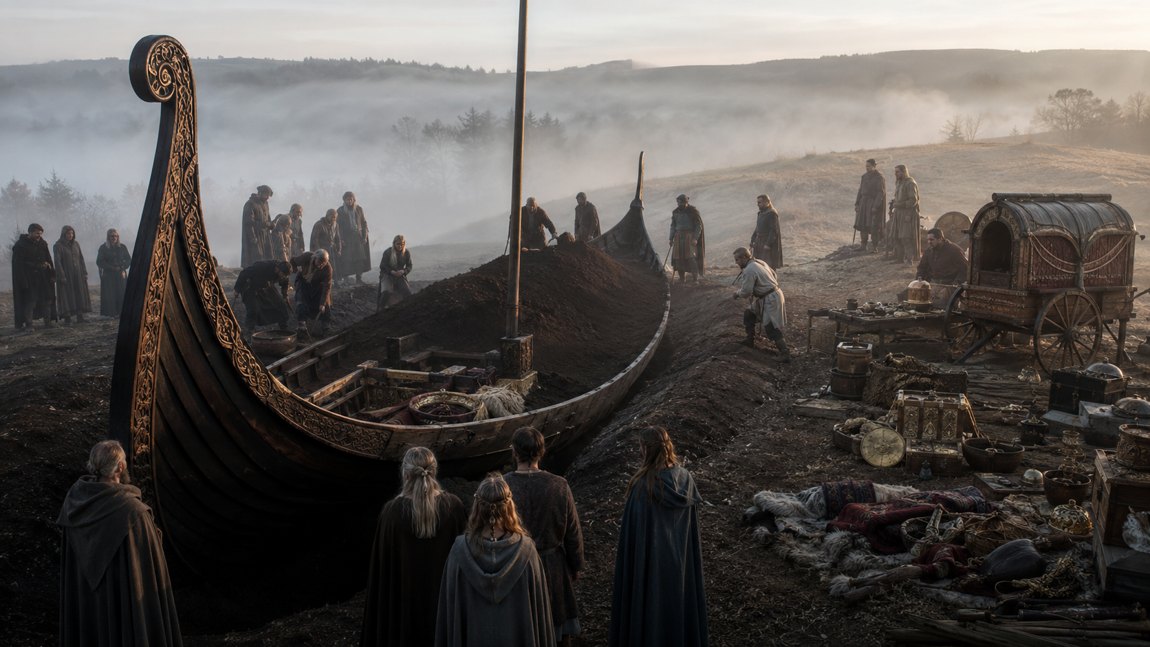
According to the Heimskringla the body was floated to Ringerike to be buried. But the leading men of Romerike, Vestfold and Hedmark came and demanded the dead king, because they believed a grave in their own district would bring good harvests. They agreed to divide the body into four parts. The head went into a mound at Stein in Ringerike; each of the others took one of the remaining parts home and buried it in a mound of its own. These are called Halfdan's mounds (Halvdanshaugen).
"The head was laid in a mound at Stein in Ringerike."
Heimskringla, Saga of Halfdan the Black, ch. 9, translation by Samuel Laing (English wording confirmed in the Project Gutenberg text via a retrieval tool, ch. 9)
This is the version peculiar to the Heimskringla. According to Krag the Nóregs konungatal names only the grave at Stein; the division is mentioned by later saga writers. One may therefore say: the idea of the quartering is younger in the tradition than the grave itself. Whether people in the ninth century really shared out a ruler in this way is not proven. There is no archaeological evidence for such a division in Halfdan's case.
The mound at Stein (Hole, Ringerike) is known as Halvdanshaugen. According to the Store norske leksikon it has never been excavated; investigations in 1998 and 1999 suggest that it is considerably older than the ninth century. That does not rule out that it was later linked to Halfdan. Local tradition likes to attach existing mounds to famous names. The other three mounds are not clearly identified either. I have not read the article by Marie Olaussen on the Halvdanshaugen that the English Wikipedia cites.
The ship burial of Oseberg in Vestfold is dated by dendrochronology to the autumn of 834; the English Wikipedia cites the study by Bonde and Christensen (1993). Two women lay in it (more on the women of Oseberg). One interpretation sees in the higher-ranking woman Queen Åsa, Halfdan's mother and Harald's grandmother. The English Wikipedia reports this idea, says it has been challenged, and names as an alternative the reading of the woman as a seeress (völva). It does not say who holds either view.
Whether the idea holds is doubtful. By the saga's figures Halfdan died at about forty around 860 and would have been born about 820; his mother would then have left a child of about fourteen at the burial in 834, while the saga has him take the kingdom of Agder at eighteen. This calculation rests on uncertain numbers and proves nothing. But nothing in the chapters I read says that Åsa lies in a ship grave, and Oseberg does not prove Halfdan's power either. The Gokstad ship belongs to another grave. What can be held: a member of Vestfold's leading family may lie in Oseberg; proof is missing.
In the memory of the country Halfdan remained a figure at the start. Snorri makes him the begetter of Harald, the first king over all Norway, and an ancestor of Olaf the Saint. The mound at Stein still bears the name Halvdanshaugen. At the same time he lives on in the obscurity of the Yngling genealogy, with relatives such as Olaf Geirstad-Alf, Gudrød the Hunter and ancient Uppsala (Gamla Uppsala). How to weigh the Yngling line is dealt with in the article on the Nordic kings.
For readers who want more on sagas as a source genre: Sagas of Icelanders and the sagas at a glance.
Who was Halfdan the Black? A king of Norse tradition, son of Gudrød and father of Harald Fairhair, to whom the sources attribute rule in Vestfold and the inland. Contemporary evidence is missing.
When did he die? Around 860 according to twelfth-century statements; the year is calculated, not secure.
How did he die? According to all sources he broke through the ice of Randsfjord and drowned.
Was he really divided into four parts? Only the Heimskringla tells it. It cannot be proven.
Does he lie in Oseberg? No. Whether his mother lay there is an unproven hypothesis.

Harald Fairhair – the first king of all Norway · Norse Kings · The Oseberg ship & the two women · Heimskringla: Snorri's history of the kings · Snorri Sturluson.
All History & Finds articles →
Halfdan is one of the best-known names of the Great Heathen Army, and yet he is surprisingly hard to pin down in the …
Read more →A peace treaty between an English king and a Viking army devotes several chapters to merchant ships. Another demands …
Read more →Harald Bluetooth (Old Norse Haraldr Gormsson, Danish Harald Blåtand) was king of the Danes from about 958 until 986/87 …
Read more →Harald Hardrada (Old Norse Haraldr harðráði, "hard ruler", properly Harald Sigurðarson) was a Norwegian prince who fled …
Read more →