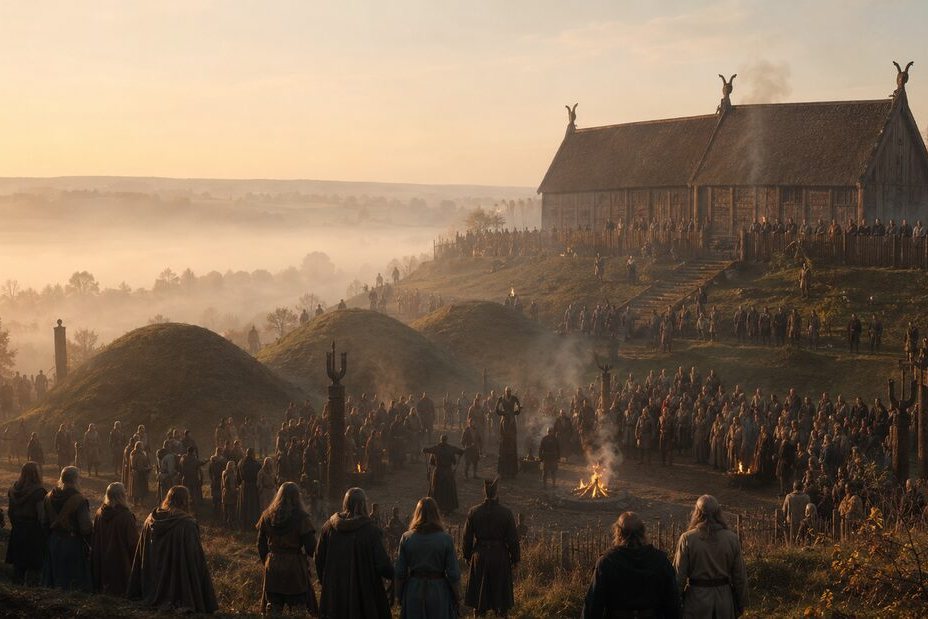
Three mounds in a row, several metres high, just north of the city of Uppsala: the royal mounds of Gamla Uppsala are among the best-known burial monuments in Northern Europe. Only two were ever excavated, in 1846 and 1874, and both held cremation burials with grave goods. No find says who lay there. The names come from sagas written centuries later. This article deals with the mounds themselves: what was found, how they are dated, and what remains interpretation.
Gamla Uppsala (“Old Uppsala”) lies in the Swedish province of Uppland, north of today’s university city of Uppsala. The site has many layers: an Iron Age settlement and power centre, a cemetery, a medieval church, and the famous, elusive question of the “temple at Uppsala”. Our neighbouring page on the temple of Uppsala follows that temple question and Adam of Bremen’s report in detail. Here we deal with something more tangible: the three large burial mounds, in Swedish Kungshögarna, the “royal mounds”.
The boundary is deliberate. A good deal can be said with evidence about the mounds, little about the temple. Mix the two and you end up with sentences such as “the gods lay in the mounds, and above them stood the golden temple”, for which there is no basis. We therefore keep four kinds of knowledge apart: archaeological finds, written sources, later tradition and modern interpretation. Anything we know only from summaries is marked as such in the source list.
A word on time: the mounds are not Viking graves. They belong to the Vendel Period, the era before the Viking Age (see our article on the Vendel Period). When the first Viking voyages began around 800, the mounds had stood in the landscape for roughly two centuries. For people of the Viking Age they were old, venerable monuments.
The three mounds stand in a row and are visible from afar across the flat farmland. Their names follow the compass: East Mound (Östhögen), Middle Mound (Mellanhögen) and West Mound (Västhögen). Measurements are thinly documented in the sources we could consult. English Wikipedia gives the East Mound a height of about nine metres. A press page (medieval.eu) speaks of roughly 55 to 70 metres in diameter and 7 to 11 metres in height for the three mounds; we did not check this against any scholarly source and give it only as an order of magnitude. Anyone who wants to quote figures should look them up in publications of the Upplandsmuseet or the Swedish heritage board rather than copy them from travel blogs.
More important than centimetres is the construction. Ljungkvist and Frölund, who describe the power centre in a survey article, note that the West and Middle mounds were enlarged at least once after the first monument was built. When this happened is unclear in their account. So the mounds are not snapshots. Why they grew cannot be shown; a link with tending the memory of the dead is conceivable, but that is a guess. Other mounds and a cemetery lie beside them, so the royal mounds should not be read in isolation.
An old folk tradition named the three mounds after gods. The Upplandsmuseet writes that the East Mound was formerly “Odin’s Mound” and the West Mound “Freyr’s Mound”. Another source, the site allmogens.se, assigns the West Mound to Thor and the Middle Mound to Freyr; the East Mound is Odin’s there too. The two statements contradict each other, which shows how shaky these assignments are. They are modern-era names, not names attested in Iron Age or medieval sources; we found no older source supporting them.
Why these three gods? Adam of Bremen names three images in his description of the sanctuary: Thor, Wodan and Fricco (see Adam of Bremen). Later name-givers could have picked up that triad. Nothing shows that the mounds were attributed to these gods when they were built. People were buried there, not gods.
In the 19th and 20th centuries a second family of names appeared: Aun’s, Egil’s and Adils’s mounds. It rests on the Yngling tradition discussed below. The sober modern naming by compass direction avoids both interpretations and is the safest choice.
The dating shows how research opinion shifts. English Wikipedia gives the 5th and 6th centuries. The Upplandsmuseet says the mounds were built in the 6th century, when Gamla Uppsala was at the height of its power. The most differentiated account we could read is by John Ljungkvist and Per Frölund: the two excavated mounds, East and West, belong to the late 6th and early 7th centuries, the early Vendel Period. This is a scholarly paper (Journal of Archaeology and Ancient History) that we could evaluate only in excerpts via a retrieval tool.
What matters is the basis. According to the authors it rests on the typology of the finds, that is, comparing the form and style of grave goods with dated finds elsewhere. They give no radiocarbon dates for the mounds themselves. They also note that luxury items from the graves have parallels in Mound 1 at Sutton Hoo (on that English burial see Sutton Hoo). They add that Lindqvist once dated the mounds to the Migration Period and Åberg to the early 7th century; Lindqvist’s view, they say, held for more than sixty years before new analyses of the graves prompted a reassessment.
What follows? First, “around 600” is a well-founded approximation, not a date to the year. Second, a source that says “5th century” is not necessarily wrong, but reflects an earlier state of research. Third, we saw no separate dating for the Middle Mound; it is grouped with the others by its position in the row, without finds.
The first excavations date to the mid-19th century. In the summer of 1846 Bror Emil Hildebrand, then the national antiquarian, opened the East Mound. According to English Wikipedia, King Charles XV ordered the investigation to settle whether the mounds were man-made at all; that comes from a summary we could not check against a primary source. A tunnel was driven into the mound. The Upplandsmuseet reports that on 15 September the dig reached the centre and exposed a stone cairn containing cremated human bones and fragments of grave goods.
Ljungkvist and Frölund mention, in a figure caption, the “tunnel of 1846/47” on the east side of the East Mound. The excerpt we could evaluate contained no further detail. For the contents, English Wikipedia lists a clay pot with cremated bones, charred grave goods, bronze plates with a dancing warrior (probably from a Vendel-style helmet), gold fragments, glass beakers, a board game, a comb and a whetstone. It also says remains of a woman and a boy were found. This list comes only from that summary and we could not compare it with the excavation reports. It is not a verified record.
Wikipedia also states that much of the remains was reburied after the dig. If so, scope for scientific re-examination is limited.
A little over a quarter-century later came the West Mound. The Upplandsmuseet gives the year 1874 and says another cremation burial was found there. English Wikipedia attributes the dig to Hildebrand again; the museum names nobody. Who led it therefore remains unresolved for us, and we do not treat the attribution as secure.
For finds, the museum reports remains of a Vendel-style helmet, gold fragments and the bones of a goshawk, interpreted as a hunting bird and probably a status symbol. The second source, allmogens.se, mentions fragments of a Vendel helmet and a small gold filigree mask. English Wikipedia lists more: a Frankish sword with gold and garnets, a board game with ivory pieces, a costly cloth garment with gold thread and four cameos from the Near East. Because the other two pages do not mention these and we saw no primary account, we pass them on as a pointer only. What can be said with confidence is less spectacular but sound: cremation, Vendel-style helmet remains, gold, a hunting bird.
That the West Mound held a man while the East Mound possibly held a woman and a young person has led researchers to ask whether the “royal mounds” are royal in the narrow sense. This cannot be settled: cremated bone allows only limited statements about sex and age, and the identification of the old finds is uncertain. What is secure is that persons of the very highest rank were buried here.
As far as we found, the middle mound has not been excavated to this day. The Upplandsmuseet describes the digs of 1846 and 1874 and does not mention it; Ljungkvist and Frölund call only East and West excavated. That affects interpretation: the Middle Mound is an archive that cannot be opened without destroying it. Scholars differ on whether the lack of investigation is a shortcoming. A new dig would answer dating questions but would irreversibly alter a monument. Claims about a “third king” in the Middle Mound have no basis.
Both excavated mounds held cremations: the dead were burned with their equipment on a pyre, the remains placed in a vessel or under a stone cairn and covered by a mound. Cremation was a long-established practice in the North; the Gamla Uppsala mounds stand out by their size (for a comparison from the same landscape, though with a different burial form, see Valsgärde; on burial forms in general see our article on burials).
The goods fall into groups: status objects (gold, helmet parts), gaming equipment, everyday items (comb, whetstone) and animal remains such as the goshawk. To our knowledge, gaming pieces and hunting birds are read in elite graves of the period as signs of a way of life: hunting, hospitality, play. The equipment is usually taken as showing what a person of this rank did in life; whether it was meant for an afterlife is interpretation. What the survivors believed we do not know.
This fits what Snorri writes in the Ynglinga saga about Odin’s “law”. According to chapter 8, all the dead were to be burned with their possessions on the pyre, and for noble men a mound was to be raised in memory. That is a 13th-century account, not a Vendel-period one, but it shows how medieval Icelanders remembered such customs and roughly matches what archaeology sees. On Snorri as an author see our piece on Snorri Sturluson.
The graves themselves name no one. The names come from the North, but from a much later time. The poem Ynglingatal is attributed to the skald Þjóðólfr ór Hvini; when it was composed is disputed. Snorri Sturluson builds on it in the Ynglinga saga, with which he opens his history of kings, Heimskringla, around 1225. It presents a line of kings of the Yngling dynasty, tied to Odin and Freyr. Three of them are said in the saga to be buried at Uppsala.
In the text edition on heimskringla.no (using that edition’s chapter numbering) they are Aun the Old (chapter 29), Egill Tunnadolgr (chapter 30) and Aðils (chapter 33). For Aun the text reads: “Síðan andaðist Aun konungr, ok er hann heygðr at Uppsölum.” The verb heygja means “to bury in a mound”. The word “mound” is therefore already in the phrase, but the saga does not say which of the three mounds it was.
“Síðan andaðist Aun konungr, ok er hann heygðr at Uppsölum.” – “Then King Aun died, and he was buried in a mound at Uppsala.”
Snorri Sturluson, Ynglinga saga, ch. 29 (chapter numbering of the heimskringla.no edition, Linder/Haggson 1869–72); translation: our own, from the Old Norse wording
Whether Aun, Egill and Aðils existed as persons cannot be proved. In the 20th century the Swedish archaeologist Birger Nerman equated the three mounds with these three kings. That is a hypothesis, not a finding, and it has weaknesses. The graves date to the late 6th and early 7th centuries. The texts do not say when Aun, Egill and Aðils lived; Snorri wrote some six centuries after the mounds were built. And even if the kings were historical, it would remain open whether a poem of the 9th century, if it is that old, preserved their names correctly.
Part of the research does not treat the Yngling tradition as pure invention. The name Aðils appears, as far as we know, in scholarship also in the Old English Beowulf as Eadgils (we did not check this equation in this research). It is read as a hint that older memories may lie behind some names.
Then there is the evidence itself. In the East Mound, according to the Wikipedia summary, remains of a woman and a boy were found. If that is right, it fits poorly with a list of kings. We can draw no more from it than the warning that a simple equation “one mound, one king” rests on shaky ground.
In his church history of the archbishopric of Hamburg-Bremen, Adam of Bremen describes a sanctuary at Uppsala said to be “all of gold”, with images of Thor, Wodan and Fricco, and a great sacrificial feast. We will not unfold it here; the neighbouring page does. For the mounds only this matters.
We know of no passage in which Adam describes the mounds as royal tombs. Linking royal mounds, royal line and temple is a modern story that welds Adam, Snorri and the mounds into one. The Wikipedia summary cites scholars who read Adam critically: Simek regards a sanctuary at Uppsala as undisputed and asks rather whether it was pagan or Christian, and points to possible biblical models; Janson (per the summary) reads the “sanctuary” in the context of the Investiture Controversy. We know these views only from that summary and pass them on as a sign of an ongoing debate. More on this under Adam of Bremen and in the article on the temple of Uppsala. For sacrifice in the grove see Germanic sacrificial practice; a sacrifice report and cremation graves are different groups of sources.
The mounds did not stand alone. Around them lies an extensive complex that Ljungkvist and Frölund describe as a “magnate complex”, a centre of power, settlement and cult. It includes a large hall on a terrace. According to the paper the building was about 50 metres long and between 4 and 12 metres wide; the hall room itself measured about 26 by 8 metres. Radiocarbon dates from wood splinters fall at 563 to 609 cal AD (one sigma). The hall burned, in the authors’ estimation probably in the decades before or around 800. It would thus have been built at about the same time as the mounds and stood for about two further centuries.
The authors also find traces older than the mounds: layers and features from the 5th century onwards, and a building on the church terrace they date to the early 6th century. They read it as a prelude to the later monuments.
The Upplandsmuseet reports that in 2012 some 70,000 square metres were investigated before a new railway line was built; settlement traces, ritual activity and monumental structures were found. English Wikipedia (as a summary) cites a line of 144 posts about a kilometre long, dated to the mid-5th century, with no demonstrated link to Adam’s temple. It belongs to the early phase of the place, not to the royal mounds. Whether mounds, hall and post rows formed one planned complex we cannot say; only the datings overlap.
Type “Uppsala” into a map and you land in today’s university city. The royal mounds are not there but in Gamla Uppsala, “Old Uppsala”, a few kilometres north of the city. The two are connected; we have not checked the naming history of either place here.
The mix-up has consequences. Texts that say “the temple of Uppsala” almost always mean Gamla Uppsala, and visitors who take the cathedral in town for the site of the royal mounds are in the wrong place. There is a mix-up in content too: Gamla Uppsala is no ship-grave cemetery like Valsgärde, no trading town like Birka and no royal burial like Sutton Hoo, although there are links between these places. The comparison with Sutton Hoo that Ljungkvist and Frölund draw concerns individual luxury objects, not the form of burial.
The dating is better supported than in the 19th century, but it rests on typology and not on direct dating of the graves. Radiocarbon or dendrochronological work on mound material could refine it if new samples were taken. Unresolved are the sex and age of the dead in both graves, the composition of the bone remains (much of the 1846 material is said by Wikipedia to have been reburied), the role of the Middle Mound and the relation between mounds and hall.
An honest balance: we know roughly when, how and with what effort people of the highest rank were cremated and buried here. We do not know who they were, what they called themselves, or whether the later sagas preserve anything of them. That is less than some guidebooks claim. For the gods whose names echo in the mounds see Odin, Thor and Freyr; for sagas as sources see our saga overview.
How old are the royal mounds of Gamla Uppsala? According to Ljungkvist and Frölund the East and West mounds belong to the late 6th and early 7th centuries. Other sources say generally the 6th, or the 5th/6th century. The dating rests on the typology of the finds.
Who lies in the royal mounds? That is not known. Cremation burials of people of the highest rank were found. The names Aun, Egill and Aðils come from the Ynglinga saga and are an unproven assignment.
Were all three mounds excavated? No. The East Mound was investigated in 1846, the West Mound in 1874. As far as we know the Middle Mound is unexcavated.
Are the mounds connected with the temple of Uppsala? A connection cannot be shown. Adam’s temple report dates from the 11th century, the mounds from around 600. Their relationship is interpretation, not a finding.
Is Gamla Uppsala the same as Uppsala? No. Gamla Uppsala (“Old Uppsala”) is the old site with the mounds, a few kilometres north of today’s city of Uppsala.

Uppsala · The Vendel Period · Sutton Hoo – the Grave of a King · Adam of Bremen · Valsgärde: Sweden's boat graves.
All History & Finds articles →
Some peoples leave us a history. Some leave us a place. And some leave us nothing but a name – a name that actually …
Read more →The Geats (Old Norse Gautar, Old English Gēatas) lived in the south of present-day Sweden, in Götaland between the …
Read more →The Gepids were an East Germanic people of the Carpathian Basin. When Attila's empire collapsed, their king Ardaric led …
Read more →Between the Rhine, the Meuse and the Eifel hills, barely a stone's throw from our workshop in Alsdorf, peoples lived …
Read more →