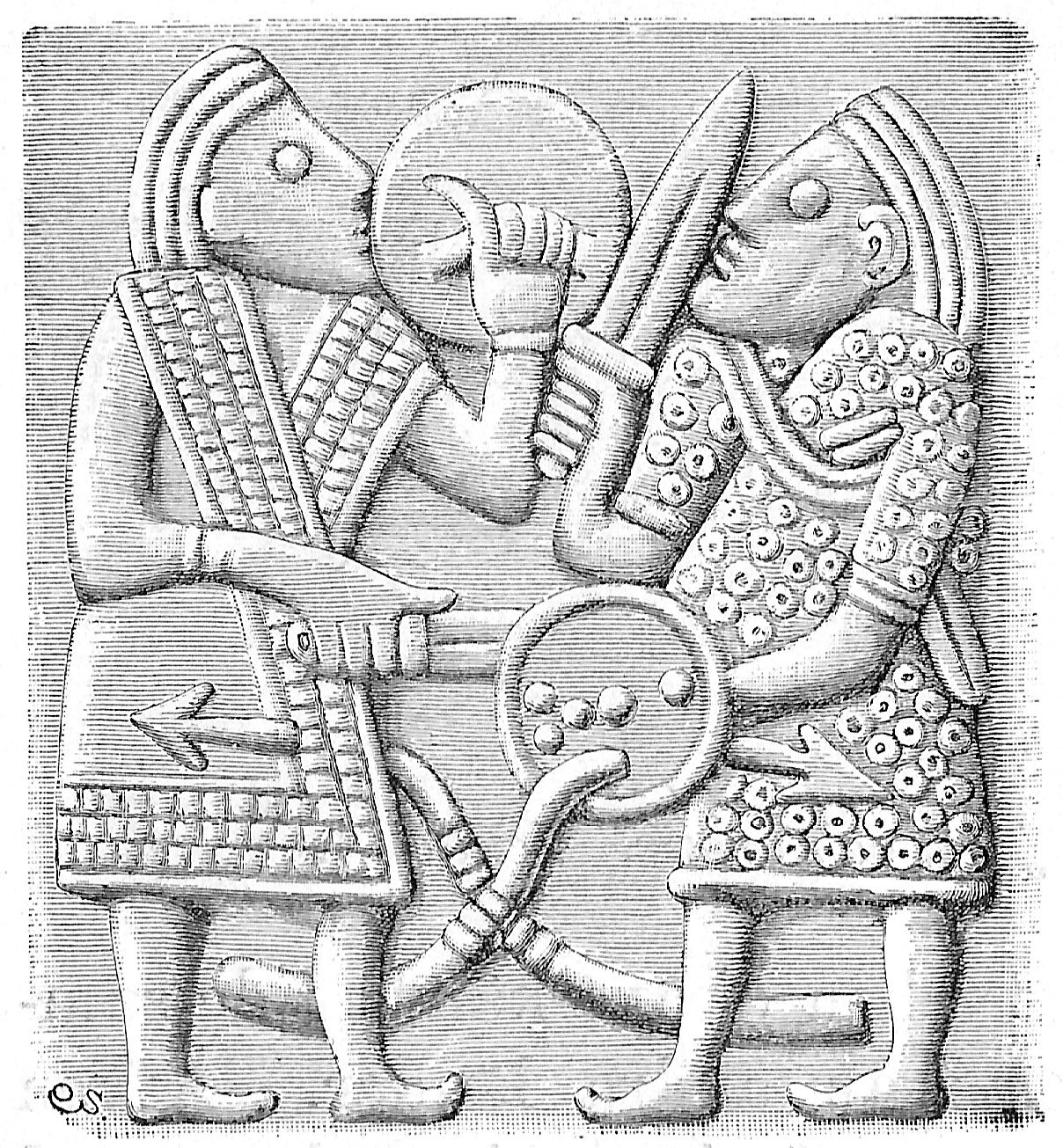
On a gravel ridge beside the river Fyris, a few kilometres north of Gamla Uppsala, people were laid in boats for centuries, equipped with weapons, animals and household goods. Valsgärde is one of the most important cemeteries of Sweden's later Iron Age: 15 boat graves, plus chamber, coffin and cremation burials, excavated since 1928. This article sets out what Uppsala University and survey articles say about it, where their figures disagree, and why much of the material is still unpublished.
Valsgärde, also spelled Vallsgärde, was originally the name of a farm on the river Fyris in Uppland, north of Uppsala. Uppsala University puts it about three kilometres north of Gamla Uppsala; an English-language overview says roughly two. Both are approximations, and the gap points to the basic problem here: there are many short summaries of Valsgärde, but the full excavation publications are only partly available.
What is secure is that a late Iron Age cemetery lay on a gravel ridge here, and that people were buried in boats. Boat and ship burial is known from other parts of Scandinavia, for example the Norwegian ship graves of Oseberg and Gokstad. Valsgärde differs in number: it is a burial ground in which boats were laid down again and again over many generations, not a single showpiece burial. For the wider custom, see the article on boat burial.
Gravel extraction came first. Digging into the ridge brought up objects whose meaning was not at once understood. According to Uppsala University, Petrus Hübinette and E. E. Eriksson recognised in 1926 that these were probably remains of boat graves, and showed the place to Sune Lindqvist and Karl-Alfred Gustawsson. A horse skull with a complete bridle, recovered in 1927, is among the early finds the university mentions.
Before Valsgärde, comparable boat graves were known mainly from Vendel, also in Uppland. The Vendel period, the phase of the Swedish Iron Age before the Viking Age, is named after that place. For the period itself, see the article on the Vendel period.
Systematic excavation began in 1928 under Sune Lindqvist, together with his students and assistants, and ran until 1936. Work then stopped after a dispute between the museums in Stockholm and Uppsala, as the university puts it. Fieldwork resumed from 1946 to 1952 under Bertil Almgren and Bengt Schönbäck.
According to the university the documentation is very good, largely thanks to Else Nordahl. That is not a given: excavations of the 1930s are often thinly recorded, and anyone re-examining old boat graves today depends on the plans, photographs and diaries.
In the mid-1990s Svante Norr and Anneli Sundkvist investigated settlement remains beside the cemetery. That matters, because it is easy to forget that every burial ground had a farm behind it. How settlement and graves relate is, per the university, still an open question, whereas the English overview states that no hall or settlement has been linked to Valsgärde. The two statements stand side by side, and I have not seen an excavation report that settles the contradiction. It cannot be clearly established.
The inventory of the ridge gives, according to Uppsala University: 15 boat graves, 15 other burials (mainly chamber and coffin graves) and 62 cremations. That makes 92, matching the overview that counts 92 graves, 30 of them inhumations and 62 cremations. Another university page speaks more loosely of more than 80 graves. This does not contradict the figure but is less precise.
The university also lists uncertain features, among them a boat-shaped setting of timber posts and traces of settlement. Anyone who counts "the boat graves of Valsgärde" therefore counts 15, leaving such borderline cases deliberately aside.
For comparison, the overview gives 14 boats for Vendel itself and says Valsgärde's concentration is rivalled only by Vendel. A university description calls Valsgärde the largest known cemetery of ship burials. Superlatives like this are a research project's self-description; whether "largest" can be fixed depends on what one counts as a ship grave.
The cemetery was used for a very long time, and sources vary: one overview speaks of more than 300 years, the university of more than 400 years of boat and cremation burial. That cannot be settled without deciding which graves count and where one starts counting.
The sequence of the boats is more precise in the English overview. The first boat grave dates to the late 6th century. During the Vendel period five more followed over about 200 years, the last of them in the second half of the 8th century. After a gap of more than a century, nine more boat graves were made between 900 and 1100, the latest in the 11th century. One plus five plus nine gives the 15 boats. In addition six chamber graves were made in the 11th century and possibly the early 12th.
The overview frames the Vendel period as roughly 550 to 750 and the Viking Age as roughly 750 to 1100. Those limits are conventions. Dates of individual graves rest on typology and comparison with other finds rather than on scientific dating, so "late 6th century" is not wrong but carries an uncertainty of decades. How wide such ranges can be is shown by the Vendel XIV helmet: an English-language description of the Broe helmet says it has been dated variously from 520 to 625, a span of more than a century for a single object.
One detail from the university deserves notice: the first boat grave to be investigated was Viking Age. The four outstanding Vendel graves are called the most dramatic burials of the site, and that focus has, in the university's words, distracted attention from the rest of the cemetery's archaeology. Most of what is written about Valsgärde is therefore about its four grandest graves, not about the whole.
According to the English overview the boats were between about six and fifteen metres long, clinker-built, meaning with overlapping planks, and fastened with iron nails. They suited river travel, which fits the setting on the Fyris. They should be told apart from the sea-going ships described in the article on longships. How well the timber of each boat survived is not stated in the summaries.
The overview is clear on the layout of the goods: in Vendel-period graves weapons lay in the stern and household items in the bow. They included shields, spears, bows, axes and seaxes, single-edged blades. Viking Age graves were less richly furnished; often there was only a plain iron sword. That is surprising, since one expects lavish grave goods from the Viking Age. Whether people buried differently, managed wealth differently or inherited differently in that period, the sources I could see do not say.
The helmets are famous. According to the English overview each of the four earliest boat graves held a "spectacled helmet", with eye guards in a spectacle shape, decorated with bronze, gold and garnet. The helmet from grave 5 is dated to the 7th century. Uppsala University speaks of four exceptional, unplundered Vendel-period boat graves. Whether the overview's "four earliest" and the university's "four outstanding" are the same graves is not clear from the texts, so I have not equated them.
How the individual helmets are built, which images they carry and how they differ is in the specialist publications, which I have not read in full. Greta Arwidsson published graves 6, 7 and 8 (1942, 1977 and 1954 respectively, per Uppsala University). The summaries behind this article give no more than the materials bronze, gold and garnet and the date of the grave 5 helmet.
No horns are mentioned anywhere in these descriptions. The horned Viking helmet is a 19th-century invention; see the article on the horned helmet myth. For a later Viking Age helmet see the Gjermundbu helmet; a broader view is in Viking helmets.
The weapons include swords, some with gold rings on the pommel, so-called ring swords. Uppsala University notes that swords and enamel work were studied in doctoral theses by Greta Arwidsson and Olsén. The short page does not say which swords exactly.
For sword technique and scabbards see the Viking sword and the overview of weapons. For Valsgärde: a weapon in a grave tells us about burial ritual, not necessarily about whether the dead person fought in life.
Vendel-period graves held, according to the overview, horses, cattle, pigs, sheep, dogs, birds and fish, some of them up to four horses. Horses, dogs and birds of prey were usually buried whole. The overview reads sight-hound-like dogs and raptors as signs of high status. That is plausible but an interpretation: only the finds are secure, not what they meant in life. Viking Age graves usually held one horse, sometimes with a dog.
The horse skull with bridle from 1927 shows that the animal burials were noticed from the start. How the animals died and whether sacrifice was part of a ritual cannot be read from the summaries.
Here interpretation begins, and here the sources are thinnest. An English-language overview names three possibilities: members of the Ynglings (also called Scylfings), a royal dynasty; powerful warriors within the leidang, the Norse naval levy; or local strongmen made rich by trade. Elsewhere the same overview treats the dead as local leaders owing allegiance to the rulers of Uppsala. On the Yngling tradition see the article on Uppsala.
None of these attributions is backed by an inscription or a contemporary text. I know of no contemporary written sources from Uppland for this period. The names that later poets and chroniclers give for Uppsala's kings cannot be tied to particular graves. Whether an institution like the leidang already fits the 7th century is uncertain; the overview leaves it open. Accounts differ here.
It is secure that women were included. The university writes that people of both sexes were buried in boat and cremation graves, including women's chamber graves. According to the English overview about half of the cremated are women and many are children. How the figures were arrived at is not stated, so read them as approximate.
Gamla Uppsala is the site of the three large royal mounds, now called the Eastern, Middle and Western Mound. According to an English overview they are dated to the 5th and 6th centuries. In the 19th century people believed they held three Yngling kings and named them after Aun, Adils and Egil. That is now regarded as unprovable. Bror Emil Hildebrand opened the Eastern Mound in 1846 and the Western Mound in 1874; in the latter he found, among other things, a Frankish sword with gold and garnet.
Valsgärde's boats thus begin roughly where the age of the royal mounds runs out: in the late 6th century. The overview places the two sites a few kilometres apart and sees the Valsgärde dead as people loyal to Uppsala. That is an interpretation. Both datings are coarse enough that I will not claim a sequence of "first the kings, then the retainers".
How an ancient author saw the people of this region is shown by a passage in Tacitus. He wrote near the end of the 1st century, some 500 years before the boat graves, about the Suiones. Whether the Suiones were ancestors of the later Svear is disputed, and Tacitus knew neither Uppsala nor Valsgärde. The passage shows only that the Roman world knew early of a powerful sea-going people in the north.
"Next come the communities of the Suiones, on the Ocean itself; they are strong not only in men and arms but also in fleets."Tacitus, Germania, ch. 44, own translation; Latin wording checked against an online text edition, sense compared with the older English translation (Church/Brodribb tradition) (Suionum hinc civitates ipso in Oceano praeter viros armaque classibus valent)
Vendel and Valsgärde both lie in Uppland: Vendel gave the period its name, Valsgärde supplied much of the comparative material. In England the famous parallel is the ship burial of Sutton Hoo in East Anglia, which the English overview dates probably to 610 to 635. The article on Sutton Hoo deals with that grave at length.
The overview notes similarities between the helmets and swords of Valsgärde and Sutton Hoo, and reads them as evidence of contact, trade or a possible alliance between the elites of the two regions. Similarity is not proof of direct exchange; it can arise from shared models, travelling craftsmen or similar fashions. A fixed link between the dead of Valsgärde and those of Sutton Hoo cannot be shown. Who knew whom is not recorded.
The customs are related but not identical. At Sutton Hoo the grave was a ship with a chamber; at Valsgärde the boats were between six and fifteen metres long.
The university's research project "The Viking Phenomenon" links Valsgärde with Salme in Estonia. At Salme two ship burials of a Scandinavian raiding party were found in 2008 and 2010 and excavated in the following years. Isotope, burial and material evidence suggest, according to the university, that the men came from central Sweden. The burials are dated to about 700 to 750, at the threshold of the Viking Age depending on where one draws the line. Dr Jüri Peets of Tallinn University is working on their publication.
The university also points to possible links of Vendel-period graves with the Asian steppe and Tang China, and says itself that the nature of these connections has not been adequately explored. That is an open research field, not a settled result.
The project is coordinated by Docent John Ljungkvist. Its stated aims are a definitive analysis of the cemetery and the society behind it, studies of raiding and military ideology, of distant contacts and trade, and of boats, animal offerings and individual find groups. The original excavation reports are to be made available digitally and free of charge.
Two points matter. First, only some graves are fully published: graves 6, 7 and 8 by Greta Arwidsson and chamber grave 20 in part by Anna-Märta Tjernberg (1948). Second, one overview mentions DNA analysis of the boat-grave remains as in progress. I have not seen results and give none.
For source criticism this means older general accounts, such as Lindqvist's synthesis of 1940, predate the second excavation phase of 1946 to 1952. The data should be checked against the original documentation, not against overviews.
How many boat graves are there at Valsgärde? According to the Uppsala University inventory, 15, plus 15 other burials and 62 cremations.
When do they date from? One overview dates the first boat grave to the late 6th century and the last to the 11th. The Vendel-period group ends in the second half of the 8th century.
Who was buried there? That is not securely established. Royal kin, warriors in Uppsala's service and wealthy local lords have all been proposed. Men, women and children were buried at the site.
Are there horned helmets at Valsgärde? No, as far as the descriptions show. The helmets are spectacled helmets decorated with bronze, gold and garnet.
What does Valsgärde have to do with Sutton Hoo? Both sites hold weapons and helmets with similar features from the 7th century. That suggests contact between elites but does not prove a personal link.

The Vendel Period · Uppsala · Sutton Hoo – the Grave of a King · Boat burial – the burning ship · Helmets of the North.
All History & Finds articles →
Within a single generation the Vandals went from the Rhine frontier through Gaul and Spain to North Africa, founded a …
Read more →The Vangiones lived around Worms on the Rhine, and almost everything we know about them comes from a few lines of text …
Read more →Most Gaulish peoples vanish along with the name under which they were beaten. Not the Vellavii. They appear in Caesar …
Read more →