Two women, buried in the autumn of 834 in a showpiece ship near Tønsberg: one about 80 years old and gravely ill, the other, by newer estimate, around 50. Queen and maid, priestess, Åsa, "Persian woman" – each attribution has its advocates, yet strikingly little proof. This article separates what bones, teeth and tree rings can measure from what later texts and modern interpretation have made of it.
In the autumn of 834 two women were buried in a ship near Tønsberg in Vestfold, and every generation since has made its own story of them. The excavators of 1904 saw a queen and her sacrificed maid. Later writers turned the older woman into a priestess, others into the historical Queen Åsa, and the internet added a "Persian woman". What is actually in hand is less spectacular but checkable: bone fragments, teeth, a handful of measurements, a tree-ring date and a great many objects. The article on the Oseberg ship and its burial chamber covers the find, the ship and the grave goods as a whole. This one asks only what can be said about the two women themselves, and where interpretation begins.
I separate four levels. Finding means something measurable or visible on bone, wood or objects. Written sources are texts composed some four hundred years later that tell Norway's early history from the viewpoint of poets and chroniclers. Scholarly opinion is what specialists infer from the finding. Popular narrative is whatever has settled in documentaries and articles. I could consult only overview sources and a journal table of contents, not the full texts of the specialist papers. The source list says so, and where it matters I write "according to".
The ship lay in a mound about 44 metres across and originally some six metres high. Gabriel Gustafson and Haakon Shetelig excavated it in 1904–1905. Behind the mast stood a tent-shaped chamber of planks holding beds, chests, textiles and the remains of the two women. Most of the grave goods lay outside the chamber, chiefly in the fore part of the ship. The chamber timbers hold the key to the date: dendrochronology, dating by the pattern of tree rings, dates the burial to 834, according to English Wikipedia to the autumn of 834 (Bonde and Christensen 1993, Antiquity; I could not read the study itself, its abstract says only that the dating is exact nearly to the year). According to the Norwegian national encyclopedia the ship itself was built around 820, probably in western Norway. So the women were buried in a vessel that had already been afloat for a decade or more.
One thing matters for everything that follows: the grave had been opened and plundered back in the Viking Age. The bones no longer lay as they had been placed. Anyone reading rank or role from the "position of the dead" stands on shaky ground. Source criticism begins here, before any anthropology.
The skeletons are incomplete. According to the account of the find history on our companion page, the physician Gustav Adolf Guldberg took the first anatomical measurements and the anatomist Kristian Emil Schreiner evaluated them further. Holck describes these studies as dating to the inter-war years. In 1948 the bones went into an aluminium container inside a granite sarcophagus and were returned to the mound. The anatomist Per Holck of the University of Oslo then re-examined them. His paper "The Oseberg ship burial, Norway: new thoughts on the skeletons from the grave mound" appeared in the European Journal of Archaeology, volume 9 (2006). The issue page I read lists, among the results, two radiocarbon dates on bone fragments of 1220 ± 40 and 1230 ± 40 years before present (BP), carbon isotope values, and a mitochondrial DNA profile of the younger woman. The radiocarbon figures are given uncalibrated. They are compatible with death in the early ninth century, but the tree rings give the more precise date.
Since then there has been debate, but to my knowledge no new, widely published full study of the bones. That is a finding in itself: the data base has been essentially the same for almost twenty years, and much of what circulates as "latest findings" traces back to press coverage of this one study.
According to the national encyclopedia the older woman was around 80 or more, about 158 centimetres tall and marked by severe joint changes; parts of her spine had fused. Changes in the pelvis and ribs are read as metastases and point to breast cancer. A thickening of the frontal bone is linked to Morgagni syndrome, a condition that can be accompanied by increased body hair. Whether she actually had a visible beard cannot be seen on bone; the claim appears in the literature as a possibility, not as an observation.
Some coverage after 2006 called it the earliest documented case of cancer in Norway. That is the media's statement about Holck's work; I could not check whether the specialist literature phrases it that way. According to the NBC report Holck himself considered the cancer the likely cause of her death. "Likely" is the right word: bone metastases show an advanced disease, and death from it is the obvious but not strictly provable conclusion.
For the question of rank her age matters. Reaching about eighty was unusual then, and doing so with joint disease and cancer suggests care and provision. That is an inference, not a measurement, but it fits a grave furnished with means and retinue.
For almost a century the second woman was taken for a young servant of 25 to 30. Holck revised this using the tooth roots: the translucency of root dentine increases with age, and in his evaluation it pointed to about 50 to 55 years (according to English Wikipedia, which cites Holck 2006, p. 192; I did not see the page itself). She too stood about 158 centimetres tall. A fractured collarbone had already been healing for several weeks at her death. According to the national encyclopedia, wear on her teeth suggests she used a metal toothpick. Similar grooves can also arise when someone habitually holds thread or needles in the teeth, and which explanation is right cannot be settled with certainty.
With the new age, one prop of the old interpretation falls away. A fifty-year-old woman eating the same meat-rich diet as the elder one fits poorly with the picture of a girl "given" to her mistress. The encyclopedia concludes that she, too, may have belonged to the upper class. The stress is on "may": diet indicates a high standard of living, not a legal status.
The classic reading, developed by the excavators, ran: the older woman was the mistress, the younger an unfree woman who followed her in death. The national encyclopedia summarises this as earlier scholarship, a woman of the Ynglinga royal line and a sacrificed "trellkvinne", a female slave. Today the supports are gone. The younger woman's age does not fit, neither does her diet, and the collarbone fracture once read as a trace of violence had, after re-examination, needed several weeks to heal before death. According to NBC, Holck said there was no reason to believe violence caused her death; the break could come from a fall.
That does not refute human sacrifice. There is simply no evidence for it. A death leaving no mark on bone, by suffocation, poison or illness, cannot be ruled out on skeletons this incomplete, and it cannot be proved either. For Scandinavia the written sources know the idea of followers accompanying the dead, and the Arab traveller Ibn Fadlan describes a funeral among the Rus on the Volga in which a slave girl is killed. That text comes from an entirely different region and scholars read it controversially; I know it here only through secondary literature, and it says nothing about Oseberg. At most it shows the idea was in circulation. It gives no certainty about Oseberg.
Kinship is open too. According to Holck and the reports, the surviving DNA was not enough to establish whether the women were related, for instance as mother and daughter. That removes a possible argument for or against any interpretation.
A haplogroup is a feature of mitochondrial DNA, which is inherited only through the mother. It places a woman on one very long maternal line, but says nothing about passport, language or appearance. Holck reported haplogroup U7 for the younger woman in 2006. The abstract of his paper notes that this group is almost absent among present-day Europeans but common among Iranians. The older woman's bone was too contaminated for a clear profile. The press made a "Persian woman of Oseberg" out of it.
There are three reasons for caution. First, English Wikipedia reports that three later studies could not confirm the result; I did not check which studies these are. It would be plausible that the samples hold little original DNA or are contaminated; that is my supposition, not a documented finding. Second, the bones have been handled, moved and examined repeatedly since 1904, which is exactly how modern DNA reaches ancient samples. Third, U7 is no certificate of origin: a maternal line appearing in Norway in the Middle Ages may have lived there for many generations, and the present-day distribution of a group says little about its spread twelve hundred years ago. More on the possibilities and limits of genetics for Viking women is in the article on Viking women and DNA.
My conclusion on the haplogroup: the 2006 result was published but not confirmed, and even at best it shows a single maternal line. It does not carry a biography.
Strontium and oxygen isotopes in tooth enamel reveal on which geological ground someone lived and drank as a child. This is the method that has identified migrants in Viking graves elsewhere. For Oseberg I know of no published strontium study establishing an origin. What is known from Holck's work are carbon values (δ13C) for the two women of −21.6 and −21.0 per mille. They are similar and, according to the abstract, point to a mainly land-based diet with little fish. That is diet, not origin.
English Wikipedia adds that recent tests showed the women lived in Agder, the home of Queen Åsa; it rests this on a 2007 report by the Norwegian broadcaster NRK, which I did not see. I found no specialist publication that supports it. In the summary of the national encyclopedia I read it does not appear. An Agder origin therefore remains a second-hand claim. It is also not the same as the Åsa hypothesis, although the two are often served together: that someone came from southern Norway says nothing about whether she was a particular queen of the sagas.
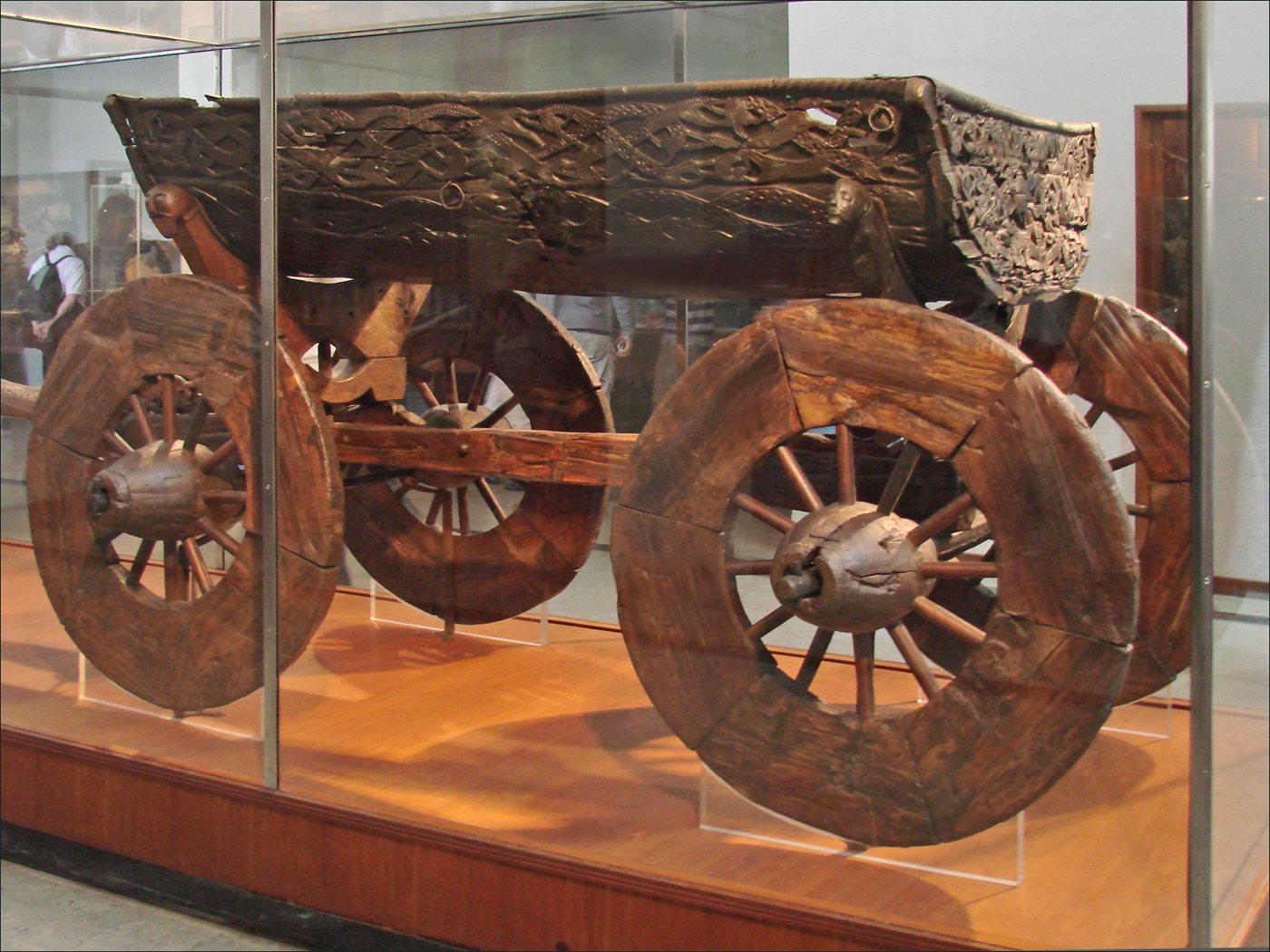
The wealth of the grave is unmistakable. It holds a four-wheeled wagon, the only fully preserved one from the Viking Age, several sleds (three or four depending on the source, probably because not all are equally complete), beds, chests, looms, a box-shaped chair, household goods, farm and craft tools and remains of ship equipment. There are also animal-head posts whose purpose is unknown. Animals formed part of the furnishing as well. The numbers vary by source: 14 horses, an ox and three dogs in English Wikipedia, 15 horses, six dogs and two cattle at lokalhistoriewiki. I therefore give no single number as secure.
The textiles tell most about the wearers. Described are a fine red wool dress in diamond twill, a white linen gauze veil, a plainer blue wool dress with a wool veil, and narrow silk strips sewn onto a tunic. Neither woman wore anything entirely of silk, according to that account. Fragments of woven picture tapestries come on top. How weaving and textiles worked as wealth and labour in this period is explained in the article on Viking weaving.
Which object belonged to whom? That is open. The abundance shows that at least one person of very high rank was buried, perhaps both. Which woman stood at the centre and who accompanied whom cannot be derived from the furnishing alone. The wagon's role is interpretation too: its box can be lifted off, and some authors think of a ceremonial wagon. As a finding, it simply lay in the ship.
The idea that the older woman was Åsa, mother of Halfdan the Black and grandmother of Harald Fairhair, has long been in circulation and lives off a gap: the sagas, above all Snorri's Heimskringla of around 1230, know a queen of that name from Agder who belongs to the Ynglinga house. Snorri wrote well over four hundred years after the burial. I could not read the relevant chapters in this research; what I say about them is general knowledge, not quotation. I know of no text that names Åsa's grave or says she lay in a ship. The link arises only from contemporaneity and wealth.
The national encyclopedia calls the hypothesis unlikely today, and lokalhistoriewiki writes that her age does not fit well. The core of the problem: the line to Harald Fairhair and the life dates of these kings themselves rest on late tradition and cannot be fixed to within a few years. Anyone who sees a woman who died in 834 as the grandmother of a man who made politics later builds on uncertain dates. It cannot be refuted, nor can it be proved. Scientifically it does not currently hold.
According to lokalhistoriewiki the archaeologist Anne Stine Ingstad suggested the older woman was a priestess. This is sometimes sharpened into "völva", a seeress as the Edda and some sagas depict her (see the articles on the völva and on seiðr). The thought is not absurd: ritual objects, animal-head posts and picture tapestries with procession scenes fit a cultic role. It has two weaknesses. First, no object is unambiguously identified as priestly equipment, and what counts as a magic staff or a hint of intoxicating plants I did not check first-hand. Second, all known descriptions of völur come from later Icelandic texts, not from the time around 834. Between the grave and the saga lie centuries and a change of religion.
The roles do not exclude each other. A woman could be mistress of a farm, owner of land and bearer of cultic duties at once. The article on women in the North traces that picture. Whether the older woman belonged to it cannot be established.
According to the national encyclopedia the robbers left spades behind that are dated to shortly after 953. That would be a good century after the burial. Bill and Daly (2012, Antiquity) place the plundering, according to their abstract, in the tenth century under Harald Bluetooth, as part of a campaign against powerful old mounds; that is their interpretation, not a finding. The article gives as explanations either the early Christianisation of the region or a show of power by a new dynasty; both are hypotheses. Precious metal is almost entirely absent from the grave. The bones were also disturbed, and following a proposal by Androshchuk (2005) a third, male person might have been removed from the grave. The encyclopedia mentions this explicitly only as a possibility, not as a finding.
What has been reconstructed is chiefly the ship. The replica Saga Oseberg was launched at Tønsberg on 20 June 2012 and reached about ten knots under full sail according to English Wikipedia. That demonstrates seaworthiness, nothing about the women. I know of no pictorial reconstruction of their faces, nor of serious replicas of their clothing beyond what the cloth finds permit. Anyone seeing illustrations of "the queen of Oseberg" is seeing artistic freedom. The ship and its builders are covered in the articles on shipbuilding and on the Gokstad ship.
"Cattle die, kinsmen die, you yourself will die likewise. One thing I know that never dies: the verdict on every dead person."Hávamál, stanza 77 (numbering differs by one between editions), Old Norse text, my own translation
How old were the women in the Oseberg ship? The older about 80 or more, the younger about 50 to 55 by the tooth-root method, not 25 to 30 as long assumed.
Was the younger woman a sacrificed slave? That is not proved. Age, diet and the healed fracture argue against the old story, but sacrifice is not ruled out.
Do we know the women's names? No. Neither runes nor written sources name them. Åsa is a hypothesis.
What did the older woman die of? Probably her cancer, as Holck assumed according to press reports; it cannot be proven for certain.
What does the DNA show? For the younger woman a U7 profile reported in 2006 that was not confirmed. Kinship could not be established.
The Oseberg ship and the two women · The Gokstad ship · Boat burial · Burial in the Viking Age · Völva · Seiðr · Women in the North · Viking weaving · Viking women and DNA

The Oseberg ship & the two women · Boat burial – the burning ship · The Voelva · Seiðr – the magic · Viking women.
All History & Finds articles →
The Oseberg ship held five carved animal heads on posts, each paired with a rope and a rattling device. They are among …
Read more →The Osismii lived in the far west of Brittany, where the ancient continent ran out into the Atlantic. They first appear …
Read more →The Eastphalians are the eastern part of the Saxons, beside the Angrians (Engern) and the Westphalians, and a name that …
Read more →The name "Ostrogoths" sounds like an ancient people that parted from the Visigoths on the Black Sea. The sources show …
Read more →