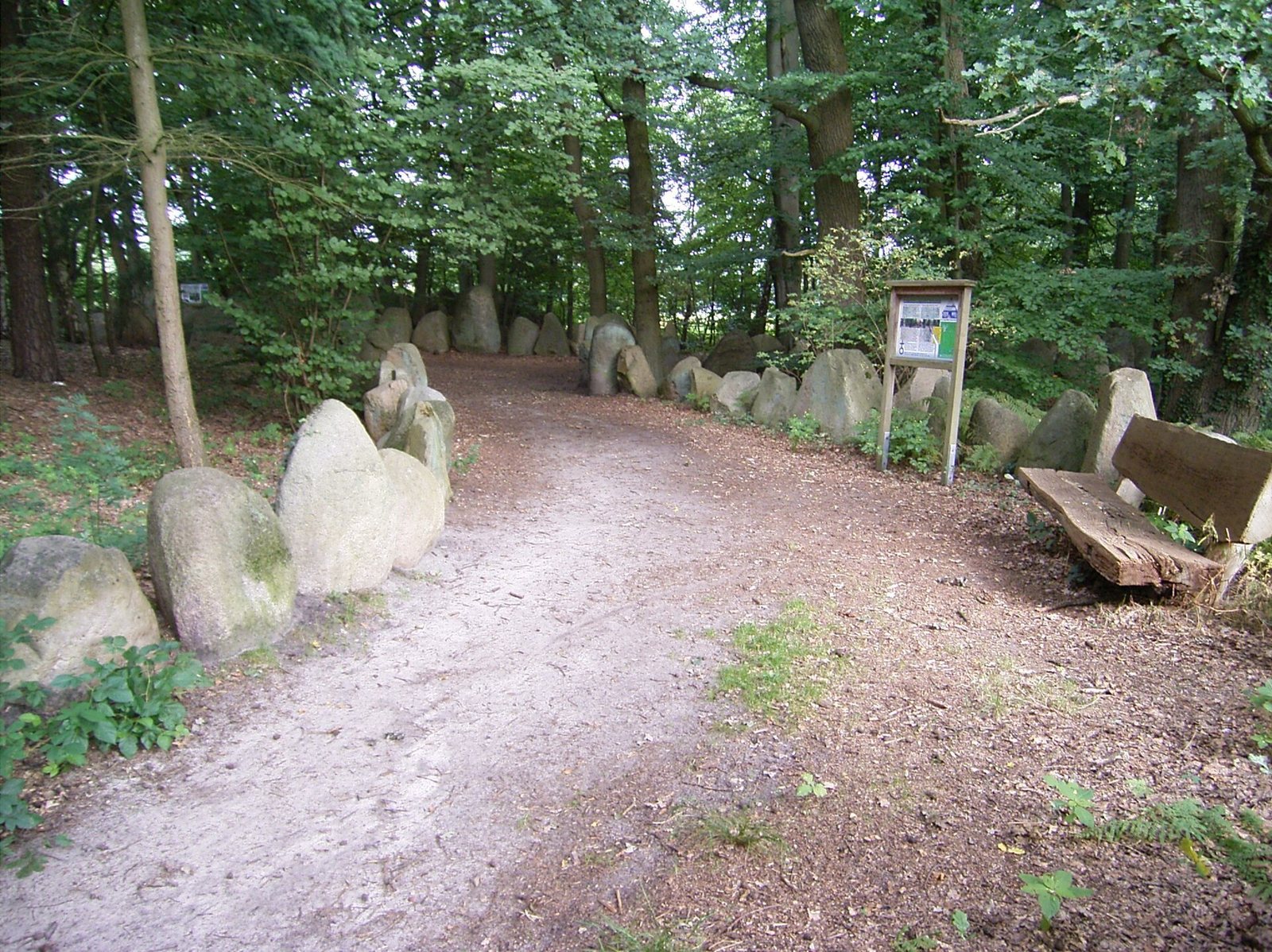
The Eastphalians are the eastern part of the Saxons, beside the Angrians (Engern) and the Westphalians, and a name that enters the sources later than one would expect. The earliest annals know “Austreleudi,” the “eastern people,” for 775; the word “Ostfalai” stands only in the version revised after 814. This article sets the testimonies side by side, separates text, archaeology and interpretation, and says where the division of Saxony into three may be a scheme of the Frankish chroniclers that it may be.
Eastphalia is the eastern part of old Saxony: the land between the Leine, Elbe, Saale and Unstrut, with Hildesheim, Brunswick, Magdeburg and the Harz, as most handbooks say. To the west lay Engern on the middle Weser, further west Westphalia. Together the three form, in the usual account, the tribal federation of the Saxons. It is a convenient picture with a catch: it assumes that “the Eastphalians” existed as a group with a sense of itself before anyone called them that. Whether this is true cannot be answered from the sources.
First, the language. The element -falen is regarded as Germanic and is related to a word for “plain”; the landscape, a common explanation runs, was originally divided by the Weser into an eastern and a western part. That is an interpretation of the name, not evidence of how people in the eighth century understood their land. What is certain is that the spelling in the Latin texts varies (Ostfalai, Ostfalais, in modern research also Ostfali and other forms), and that the older version of the Royal Frankish Annals uses a quite different word. More on that below.
A second warning concerns confusion. “Eastphalia” is not “East Westphalia”; that area in today’s North Rhine-Westphalia lay in old Engern. Nor does the name have anything to do with Austrasia, the eastern subkingdom of the Franks, although the Latin form Austrasii, cited in the literature for the year 775, sounds like it; there it means, in the translations I know, simply “eastern people.” And the dialect area “East Phalian” is an invention of nineteenth-century linguistics and does not coincide with historical Eastphalia.
Here I write only what I have seen in texts or what research explicitly maintains, and I mark whether a statement is a record, a plausible assumption, a conjecture or a legend. Wider context: Saxons, Widukind, Christianisation of the Germanic peoples.
Almost everything we know about the early Eastphalians comes from outsiders. The Saxons did not record their own early history in the eighth and ninth centuries; what survives was written by Frankish court clergy, monks and lawgivers with aims of their own.
The Royal Frankish Annals (Annales regni Francorum, also Annales Laurissenses maiores) are a yearly chronicle of the Frankish court kept for 741 to 829. The oldest part to 795 was written, on the usual assumption, in the royal chapel, in stages and by unknown authors; for the years before it was written down around 790 it is therefore a retrospect, not a daily note. The historian Matthias Becher stresses that the annals present the king’s deeds as successes, and he cites the report for 775 as an example of a Frankish defeat being passed over. There is also a revised version, known as the Annales qui dicuntur Einhardi (“Einhard annals”). An unknown editor recast it after Charlemagne’s death in 814, smoothed the Latin and above all expanded the entries up to about 801. That Einhard was the editor is a nineteenth-century suggestion and unproven; the name is a convenience.
Besides: the Poeta Saxo, a poet who put Charlemagne’s deeds into verse around 890 and mentions a certain Hessi for 775; the Vita Liutbirgae, the life of a ninth-century recluse that names Hessi’s daughter; the Capitulare Saxonicum of 797 and the Lex Saxonum of about 802/803, two legal texts; Nithard’s history of the civil wars among Charlemagne’s grandsons, finished in 843; the Vita Lebuini, the life of the missionary Lebuin, which describes the assembly at Marklo; and the Translatio sancti Alexandri (851), an account of the transfer of relics to Wildeshausen in which Rudolf of Fulda describes the Saxons. Later come Widukind of Corvey (about 968), Thietmar of Merseburg (early eleventh century) and the Sachsenspiegel.
On method, quite openly: I have not read these texts in the original or in full. The Royal Frankish Annals I know for 775 and 782 to 784 in P. D. King’s English translation (1987, reproduced on the De Re Militari site with the translator’s permission; I therefore do not quote it word for word but only indicate the passages). I could not consult the Latin of the annals; the forms “Austreleudi” and “Ostfalai” I know from articles that cite them. Nithard I know in Latin only through one sentence that Philipp Heck cites in a footnote in 1931. Widukind, Thietmar, the Translatio, the Lex Saxonum and the Sachsenspiegel I have not read. The list of sources separates what I have seen from what I know only from summaries.
The earliest record belongs to the year 775, Charlemagne’s second Saxon campaign. In the English translation I read, the Royal Frankish Annals tell this: Charles takes the Sigiburg (Syburg), advances to the Weser, wins at a place called Braunsberg and moves on into the Bukki district, the Bückegau. Then it says that all the Saxon “Eastphalians” came with Hessi. The “Angrarians” (Engern) came with Bruno and “their other nobles”; from the Westphalians the Franks won much booty, and they gave hostages “like the other Saxons.” Three groups with leaders stand side by side in one passage.
That this is the first record of the Eastphalians is how the literature puts it. And here one has to be exact, because a question of sources is hidden in it. In the annals proper, which arose at court around 790, the articles I have seen give not “Ostfalai” but Austreleudi Saxones and Austrasii, which Rau translates as “eastern people of the Saxons” and “eastern people.” The word Ostfalai (and the form Ostfalais) stands only in the Einhard annals, the revision after 814. A manuscript in the Lower Saxony State Library in Hanover (Class E) contains both forms. As a word form, the records for 775 and 779 are thus no older than the 810s. The written name “Eastphalians” is thus not attested in 775; what is attested is that in 775 the Franks designated an eastern group of the Saxons by a name meaning “eastern people,” and that an editor after 814 turned this into Ostfalai.
How old the name form is in the Saxons’ own speech, we do not know. Austreleudi looks like a Germanic word in Latin spelling: leudi for “people,” the first part for “east.” The Saxons may have called themselves so, or the Franks may have coined it; Becher thinks both possible. A name is there; its origin is open.
The place of the event lies, as far as I read, on the Oker, which flows past Brunswick; that comes from the English Wikipedia, which relies on the Royal Frankish Annals and the Poeta Saxo, not from a text I saw myself. No exact place is thereby named, and I name none.
Hessi is the only Eastphalian leader named for 775, and one of the few persons of the pagan Saxon elite about whom we know anything at all. According to the English Wikipedia, which cites Flierman (2017), the annals report that Hessi led “all” the eastern Saxons before Charles; whether he actually represented all Eastphalians or only the following of his own district is debated in research. The Poeta Saxo calls him “one of their chieftains,” a suppliant. The Vita Liutbirgae calls him “among the first and noblest of his people” and writes that Charles heaped honours on him because he found him wholly loyal (so, at least, in the summary I saw). He became a Christian and a count, gave his land to his daughters when his only son died young, and withdrew to the monastery of Fulda; the Fulda necrology records his death in 804.
His daughter Gisla married a certain Unwan; their children included Hruothild and Bilihild. According to Wikipedia, Gisla founded the convents of Karsbach and Wendhausen in the 820s, and Liutbirga, the heroine of the Vita, became a recluse there. It shows Saxon noble families using Frankish rule for their own ends. With the landscape of Hesse the name, as far as I can see, has nothing to do; the similarity of sound is there, a connection no one demonstrates.
Westphalia, Engern and Eastphalia stand in the handbooks as if they had always existed. The sources show something else. Matthias Becher, who examined the first mention of the Westphalians, argues (in the summary I could read) that the three groups appear together for the first time in the Royal Frankish Annals for 775. Becher conjectures instead that they formed under Frankish pressure: the Saxons, organised in small units, could not withstand Charles one by one. Each group had a war leader, according to the annals Hessi among the Eastphalians, Bruno among the Angrians, among the Westphalians presumably Widukind. This is a conjecture that I find well founded, but no more than that.
What we know of the time before fits, and it is little. Bede, the English monk who wrote about the “Old Saxons” around 730, knows, according to this account, no three-part division but “satraps” over individual districts; I have not read Bede myself. Legal texts point the same way: the Capitulare Saxonicum of 797 and the Lex Saxonum of about 802/803 give Westphalians, Engern and Eastphalians their own roles. According to Becher (again only in summary), in the Lex Saxonum among the Westphalians a wife received half of what was acquired in marriage, among Engern and Eastphalians nothing. That is a difference in law, not evidence of a separate culture. A hostage list drawn up at Mainz in 804 recorded, it is said, each hostage’s group of origin. For the Franks the division was working administration; whether it was so for the Saxons earlier remains open.
A word on location. Where Eastphalia ends and Engern begins, the sources do not say; the border between them, usually drawn at the Leine in the handbooks, is a convention of research. The Bardengau with Bardowick on the lower Elbe is called part of Eastphalia in the English Wikipedia; that is one assignment among others. The Elbe and Saale later formed the border with the Slavic tribes, whom I treat in the articles on the Obodrites and on Nordalbingia; the neighbours to the south were the Thuringians.
The Saxon wars of Charlemagne lasted from 772 to 804. I list the events that stand in the accounts I have seen and name the evidence where the Eastphalians expressly appear. The years follow the usual count; where something is disputed I say so.
772. First campaign: Charles takes the Eresburg and, so the literature reports the annals, destroys the Irminsul. The Eastphalians do not appear.
775. Second campaign (see above): Sigiburg, Weser, Braunsberg; submission of the Eastphalians under Hessi, of the Angrians under Bruno, of the Westphalians with hostages. According to Wikipedia there were baptisms; the giving of hostages is certain.
776 and 777. Revolt, Charles’s return from Italy, founding of the settlement at the springs of Paderborn; an assembly at Paderborn with mass baptisms. Widukind flees, so it is handed down, to the Danes. How the Eastphalians took part the texts I saw do not say.
779 and 780. A summer campaign in 779 is said to have covered Eastphalia, Engern and Westphalia; Wikipedia calls it “conquest.” The Einhard annals contain a record for 779; I know it only from the literature. For 780 the literature names an assembly near Lippspringe at which mission districts and Frankish counties were said to have been set up. I have not checked the details.
782. Revolt under Widukind, defeat of Frankish troops at the Süntel (“Suntel” in the translation I read), then the execution of, by tradition, 4,500 Saxons at Verden on the Aller. In the text of the annals I read there is no Eastphalian word for these years; there is talk of “the eastern Saxons” (784: Charles lays waste their fields). The Capitulatio de partibus Saxoniae, which prescribes harsh penalties for pagans, is traditionally dated 782, others propose 785, and Yitzhak Hen thinks even 795 possible. The date is open.
783 to 785. Almost continuous fighting: according to the translation Charles lays waste everything as far as the Weser and then to the Elbe, the Saxons gather on the Hase and at Detmold. Widukind’s baptism and oath belong to 784 or 785, the literature wavers; the place usually given is Attigny, which I have not verified.
792 to 804. Several revolts, mostly in the north and west. The Capitulare Saxonicum of 797, dated at Aachen on 28 October, softens, it is said, some of the harshness. The Lex Saxonum follows in 802/803. In 804 Charles resettles, as handed down, Saxons from Nordalbingia; the figure 10,000 stands in the English Wikipedia and I have not cross-checked it.
It is striking how rarely the Eastphalians appear expressly in this chronicle. The main burden of the known fighting lay in Westphalia, the Weser area and the north; whether the east was quiet or merely less well described remains open. Wikipedia names a revolt with Eastphalian participation for 793; I saw no evidence.
The best-known testimony on Saxon society comes from Nithard, a grandson of Charlemagne, who finished his history in 843. He describes the Saxons as divided into three ranks, and I have seen the Latin sentence in its wording (see the quotation): the edhelingi (nobles), the frilingi (freemen) and the lazzi (half-free or dependants). Nithard adds “in their language,” so he reproduces Old Saxon words. The passage belongs to the context of the Stellinga revolt of 841 to 843, in which freemen and dependants rose against their lords. Emperor Lothar I is said, in his fight against his brother Louis the German, to have promised them their old rights; Louis had the leaders executed. What the Stellinga wanted is disputed: the older view saw class struggle and a return to paganism; recent research (Rembold, in a summary I read) sees rather an appeal to ancient law and politics in the Carolingian quarrel. Rembold even suggests that the sharp three-part division was a consequence of the revolt. That is a position of research, not a fact. That the revolt was specifically Eastphalian, my sources do not say.
“… sunt enim inter illos, qui edhelingi, sunt qui frilingi, sunt qui lazzi illorum lingua dicuntur.”Nithard, Historiae IV,2 (passage number as usually given), Latin sentence as read in a footnote in Ph. Heck, Übersetzungsprobleme im frühen Mittelalter, Tübingen 1931; spelling of the rank names after Heck, other editions spell differently; own translation: “For among them there are those who are called Edhelingi in their language, those who are called Frilingi, and those who are called Lazzi.” Nithard’s work is in the public domain; the text was not checked in an edition
On the politics of the Saxons before Charles there is a source of its own, the famous assembly of Marklo. The Vita Lebuini (written in the ninth century; I have not checked the exact date), in C. H. Talbot’s English translation, reports that the Saxons in olden times had no king but set rulers over each village; once a year they met in the centre of Saxony at a river at Marklo, with twelve nobles from each village and as many freedmen and serfs. Talbot writes “Yser”; by the usual interpretation the Weser is meant. By this description Marklo lies in the middle of Saxony, probably in Engern; the passage cannot be assigned to the Eastphalians, and the text does not name them. How reliable it is we do not know; the Vita arose at a distance and with an interest in the missionary. See also Thing and Thing sites.
On the religion of the Eastphalians in particular my sources contain no explicit statement. For the Saxons as a whole: in 772 Charles destroys, according to the literature, the Irminsul, a sanctuary of unknown shape in the Eresburg area, not among the Eastphalians. The Capitulatio de partibus Saxoniae (date open) threatens church robbery and refusal of baptism with death and forbids sacrifices at trees and springs; the capitulary of 797 softens, per the literature, some of these provisions. These are laws that describe what was forbidden, and reading them as a picture of Saxon religion is an inference. The sources on Hessi’s family show something other than prohibitions: a leading Eastphalian becomes a Christian, a count and a founder of convents.
Archaeology cannot grasp the Eastphalians as a group; it finds graves, settlements and fortifications, not tribal borders. A well-documented example is the cemetery at Gevensleben in the district of Helmstedt, found in 2016 during building work. The University of Göttingen reports a two-week dig on about 400 square metres that documented 54 grave pits with 61 burials, all oriented west-east, the dead laid extended on their backs, in three phases of use; the original total is estimated at 150 to 200 burials. Most graves were plain earth graves without goods. One held a woman of 40 to 50 with an iron knife, 18 glass beads and two silver hook earrings, another a man with a staff ferrule, an object read as a mark of rank or office. The provisional date runs from the 8th to the 10th century; it is an early Christian cemetery from the time of Christianisation. The Göttingen page names Werlaburgdorf as a further example.
On fortifications: the Werla palace on the Oker north of Schladen (district of Wolfenbüttel) was, by the description of Burgenwelt, a fortified farmstead of the 9th century expanded into a palace at the start of the 10th; 14 royal stays are recorded between 924 and 1013, and in 1180 Frederick Barbarossa came for the last time. That belongs already to the Ottonian period, not to that of the Saxon wars. For Hildesheim a Lower Saxon city history names traces of a chapel from the last third of the 8th century in the cathedral area. Place names in -leben, -büttel and -rode mark the region but occur elsewhere; equating them with a tribe would be a conjecture.
Church organisation in Eastphalia begins with two bishoprics. Tradition has Charles found in 804 a mission bishopric at Seligenstadt, today Osterwieck, whose seat was later moved to Halberstadt; Louis the Pious confirmed the move in a charter of 814. The first bishop, Hildegrim, is given in the bishop lists as 804 to 827, which shows the uncertainty of the dates. Hildesheim goes back to a bishopric at Elze that Louis moved to Hildesheim “probably in 815.” The first securely datable bishop is Ebo (845); a Gunthar as founding bishop appears only in a source after 1079. The Oker formed the boundary between the two dioceses.
For Aachen and the Rhineland there is a recorded, if indirect, link. Charles built the Aachen palace from 794 and stayed there, by Wikipedia’s account, almost continuously after 806; from there Saxony was easier to watch. The Capitulare Saxonicum, which gave Westphalians, Engern and Eastphalians roles of their own, is dated at Aachen on 28 October 797 according to the Cologne Capitularia project. An Eastphalian at Aachen, an Eastphalian hostage or settler in the Rhineland is not recorded in my sources; for Alsdorf and the Aachen region: no recorded connection to the Eastphalians, except the administration that issued from the Aachen court. The resettlement of Saxons in 804 concerned, per the literature, Nordalbingians, not Eastphalians.
From Eastphalia came the house that ruled the empire in the tenth century. Liudolf (d. 866), called “dux Orientalis Saxonum” by later authors (a later title, not a contemporary one), had his holdings in the western Harz foothills and on the Leine; around 852 he and his wife founded the house of canonesses at Brunshausen, which became Gandersheim Abbey in 881. His descendants, the Liudolfings or Ottonians, supplied the kings from 919 with Henry I.
The Sachsenspiegel is the oldest major law book in German prose. Its author Eike von Repgow came from the Eastphalian gentry; the family sat at Reppichau south of Magdeburg, in the district of Serimunt. At the request of Count Hoyer of Falkenstein, Eike rendered his Latin work into Middle Low German between 1220 and 1233; the Latin version of the Landrecht is lost. How the text itself uses the name Eastphalia I have not checked.
After the imperial ban on Henry the Lion in 1180 the area broke up into smaller lordships, and in 1235 the Duchy of Brunswick-Lüneburg arose. Eastphalian awareness was largely lost. The word revived in nineteenth-century linguistics as “East Phalian.” Since 1990 it has returned: as a company name, in 1995 in a proposal for restructuring the German states, in 2009 as the university name “Ostfalia.”
The wider frame and neighbours: The Saxons, Widukind, Franks, Carolingian Warfare, Irminsul, Angrivarii, Chauci, Nordalbingia, Thuringians, Bructeri, Chatti, Cherusci and Arminius and Germanic Peoples in the Rhineland.

The Saxons · Widukind · The Franks · The Thuringians · The Irminsul.
All History & Finds articles →
Before the Vikings, Ireland had no towns. It had monasteries, royal seats and ringforts, but no place where thousands …
Read more →Most people of the Viking Age are known to us only through the eyes of others. Ohthere is an exception. At some point …
Read more →South-west of Lake Balaton, where the Zala winds through reeds and marsh towards the Little Balaton, lies the village …
Read more →The Parisii were a Celtic people on the middle Seine. Their capital Lutetia lay conveniently at a river crossing …
Read more →