The Oseberg ship held five carved animal heads on posts, each paired with a rope and a rattling device. They are among the most striking wooden finds of the Viking Age, and what they were for has never been settled. This article sets out what can be shown about the find, the style and the preservation, lays the readings side by side (cart equipment, sledge gear, ceremonial object, protective magic) and says plainly where the evidence stops. One limit up front: for this text I could use only summaries and secondary literature, not excavation reports in full.
Standing before the Oseberg heads at Bygdøy, you see beasts with open jaws, bared teeth and ornament that fills every surface. They were evidently not wall decoration. The heads sit on shafts or posts, and I could not verify an exact height (a figure of 50 centimetres that I had first taken over could not be confirmed on re-checking). The shape suggests a piece you could carry, plant in the ground or fix to a frame. The shape alone says no more than that.
The number of heads is given fairly consistently. The Norwegian national encyclopedia (SNL) speaks of five animal-head posts, as does the local-history wiki lokalhistoriewiki, and the abstract of Jan Bill's 2016 article refers to "five elaborately carved wooden animal heads". A World-Tree Project entry, citing the Viking Ship Museum, adds that one of the five is too damaged to display. Our own page on the Oseberg find says counts vary between four and five depending on how fragments are tallied; I cannot check that against a primary source here. For the rest of this article: five heads, as the sources above state.
What makes the posts interesting is the mix of effort and uncertainty. Someone who invests this much time in carving has a purpose in mind, yet no contemporary text records it. No saga describes such posts and no inscription names them. All we have is the wood itself, its position in the grave and comparison with other finds.
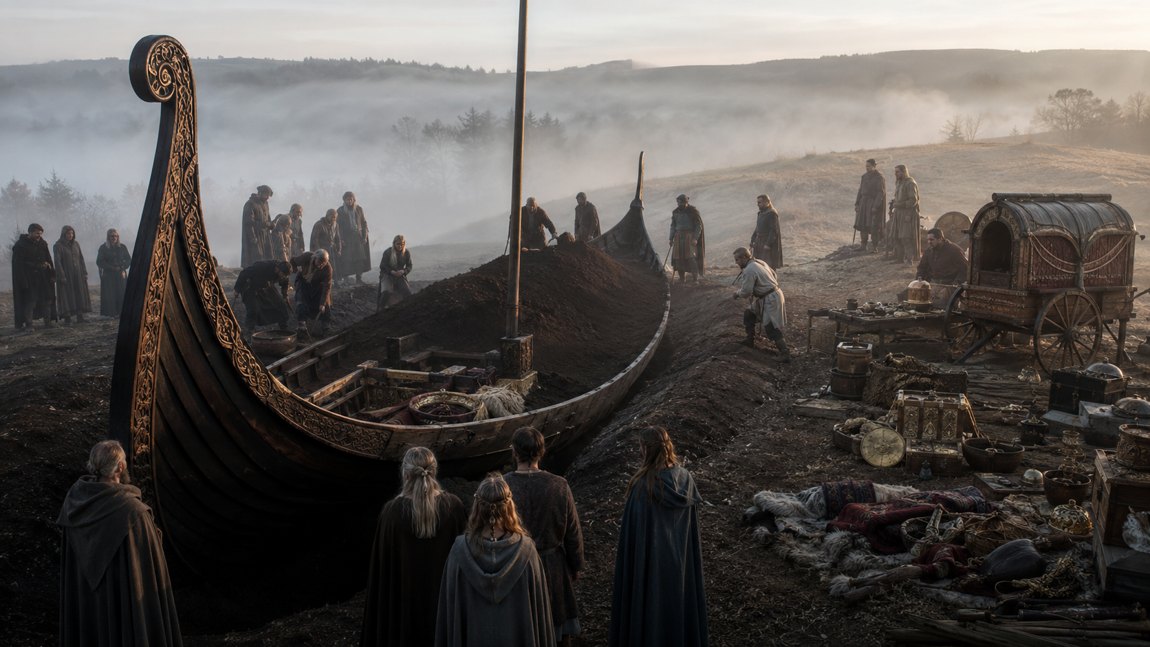
The find spot is the Oseberg mound near Slagen in Vestfold. According to lokalhistoriewiki the ship was discovered there on 10 August 1903, and the excavation followed in summer 1904 under Gabriel Gustafson, assisted by Haakon Shetelig. The ship engineer Fredrik Johannessen handled the ship-technical side (SNL). English Wikipedia gives the excavation as 1904–1905, citing Durham 2002. The dates differ slightly: fieldwork was in 1904, while recovery and follow-up ran longer.
On dating: a dendrochronological study of timbers from the burial chamber gave the autumn of 834, according to English Wikipedia (citing Bonde and Christensen 1993). The SNL puts the building of the ship itself around 820 on Norway's west coast. So the vessel was some years old when it became a grave. When the posts were carved is not answered by this. None of the sources consulted says that the 834 date applies to the posts. My position: they come from the grave inventory, they were made before the burial, and the date is unknown.
The grave held the remains of two women, along with clothing, textiles, household goods, a cart, sledges, beds and animals. English Wikipedia reports the skeletons of 14 horses, an ox and three dogs. Who the women were remains disputed; we cover that in our article on the Oseberg ship and deal here only with the posts. What matters for our topic: the grave goods stand in a visibly ordered relation to one another, and the posts belong to them.
The SNL notes that later movements of soil in the mound had crushed the finds and broken much of the equipment into small pieces. Recovery was therefore a jigsaw task. According to lokalhistoriewiki the ship was taken apart into a little over 2,000 pieces, marked according to a system devised by Johannessen.
The sources are not fully uniform on where the posts lay. Lokalhistoriewiki counts the five animal-head posts among the grave goods outside the burial chamber. Our page on the Oseberg ship names the fore part of the ship, where the cart, sledges, beds, barrels and draught gear stood. The two are compatible: the chamber lay amidships, the fore part is outside it. I cannot give more than this rough position, and I have seen no find plan placing each head individually.
A second point matters. The grave was opened and robbed in the Viking Age. English Wikipedia's article on Viking art says robbers probably removed many precious objects; Medievalists.net (2025) gives around the year 970 for the plundering, citing the archaeologist Hanne Lovise Aannestad. If the posts stayed in the grave, that suggests the robbers did not regard them as valuables. Whether they left them on purpose is interpretation. That cannot be shown clearly.
The most striking observation is in the World-Tree entry: on some heads a rope ran through the mouth, like reins, and all were found together with a rattle and a piece of rope. Jan Bill states in the abstract of his article that each head is combined with a rattling device that is "probably related to horse driving". That is the only statement about function I saw directly from a researcher, and only as an abstract. I have not read the full article.
What follows? A rope through an animal's mouth suggests horse tack, and a rattle suggests noise that steers animals or drives off harm. Bill derives a protective reading from this (below). Those who stress the vehicle aspect see the heads as parts of a team: they could have been attached to a cart or sledge. In favour is the fact that a cart, several sledges and draught gear lay in the ship. That is not proof, since grave goods also lie side by side without belonging together.
I have to draw a line here: how the heads were actually joined to ropes and rattles, whether pulled, shaken or planted, I have not looked up. Anyone who needs that must consult the museum's find description or Bill's article.
Stylistically the posts belong to the phase of Viking art named after the site. English Wikipedia says the Oseberg style marks the beginning of what is regarded as Viking art. In Arwidsson's 1942 system it corresponds to Style E, also known as the Oseberg/Broa style. Arwidsson had subdivided the animal styles II and III that Bernhard Salin set up in 1904 into Styles C, D and E. The page does not say exactly how the two systems interlock; I report it as I read it.
A hallmark of the style is the gripping beast: an animal whose paws clutch neighbouring animals or its own body. According to Wikipedia, the "Carolingian" animal-head post is decorated with gripping beasts, as are other grave goods from the ship. The text describes it as a snarling beast, possibly a wolf, with interwoven animals that twist, grip and snap. The hull itself, by contrast, shows a more traditional animal interlace without the gripping beast.
That several hands worked on these pieces is a widespread picture in the literature. Our Oseberg page says Shetelig and later scholars assigned posts and sledges to individual carvers and gave them nicknames such as "the Academician" and "the Baroque master". The names are in common use; I have not checked which post goes with which name, so I give no specifics. Claims that individual heads carry silver studs come from a reference work I could not confirm for this text, so they are left out.
Animal style is ornament in which animals are dissected, stretched and interlaced until they work as pattern. In Scandinavia it reaches far back before the Viking Age. Salin sorted Germanic animal ornament into three styles (I, II, III) in 1904; Arwidsson subdivided later. According to Wikipedia, Style C flourished in the seventh and into the eighth century and was then largely replaced by Style D, especially in southern Scandinavia. With its date of 834, Oseberg sits at the transition to what is usually called Viking art.
On this site we describe the later stages separately, including the development up to the Urnes style. Readers who want to see how the gripping beast changes through the Borre, Jelling, Mammen, Ringerike and Urnes phases will find that there. For the posts the point is: they are examples of an early phase, not predecessors of the later animal styles in the sense of a documented line.
The famous ceremonial cart stood in the fore part of the ship. None of the sources consulted documents a direct link between posts and cart. (An earlier version relied here on a Princeton page citing Graham-Campbell 2021; that could not be confirmed on re-checking and was removed.)
Why does the idea suggest itself anyway? First, because of the draught gear in the same part of the ship. Second, because of the ropes and rattles found with the heads. Third, because later Norse tradition links carts with gods. Those texts were written down centuries after the burial by Christian authors, and I have not worked through them for this article. They give no function for the Oseberg finds, at most a possible interpretive frame.
Against a firm assignment: I know of no documented reconstruction that puts posts, cart body and gear together. "Cart accessory" remains possible as a hypothesis; as a fact it is not secure.
The same reasoning applies to the four sledges in the grave. Researchers name individual sledges after their editors, such as "Gustafson's sledge" and "Shetelig's sledge" (labels from the literature, not checked at the source by me); this shows how long the wood has occupied scholars, and says nothing about the function of the posts. A link between rattles and horse-drawn sledges is plausible, since bells and rattles on harness are known from many cultures. Whether that was so at Oseberg cannot be shown clearly.
Bill himself ties the rattling device to horse driving in the abstract of his article. That he sees the heads mounted on sledges or carts is not stated there; I therefore report only what I read and draw no conclusion.
The SNL writes that the finds, including the animal-head posts, were "sannsynligvis" (probably) used in connection with religious ceremonies. This is a classification in a reference work by Frans-Arne Hedlund Stylegar and Ida Scott; the excerpt I could read gives no reasoning. "Probably" should be read here as a scholarly opinion, not the result of a proof.
Tied to the cultic reading is the question of who the women were. One line sees one of them as a völva, a seeress. Our page on the Oseberg ship links this view with Anne Stine Ingstad and supports it with procession scenes on the textile bands, the cart and the posts; there is no unambiguous seeress's staff. I took that from our own article and did not re-check it.
The thought also works without a völva: a grave in which carts, sledges, beds, textiles and animals were laid in quantity is a staged grave. That objects used in ceremonies were part of it is plausible. What kind of ceremony cannot be answered.
In 2016 Jan Bill published an article in the Cambridge Archaeological Journal (volume 26, issue 1) titled "Protecting against the dead? On the possible use of apotropaic magic in the Oseberg burial". According to the abstract, apotropaic magic, that is protective magic, offers a viable explanation for the puzzling rattling device on the heads. Bill also suggests that animal figures and animal style in the Viking Age may have been more closely tied to apotropaic beliefs than previously thought.
One support for the idea is an Icelandic law mentioned by Medievalists.net: it supposedly required ships to remove prow decorations when approaching land, so as not to disturb the land spirits. The report points to a twelfth-century law, and the source is a press article; I have not read the law in its original wording. It still shows that animal heads were seen as potent. Whether it may be projected back onto Oseberg is a question of method. The title of Bill's article asks whether the protection was directed against the dead. What ideas lay behind it remains interpretation.
This is a possibility, not proof, and it does not exclude the other readings. A head can have been both part of a team and a protective device.
Wood survives centuries only under special conditions; why it was preserved so well at Oseberg I did not look up in the sources I used. After recovery the wood had to be treated so that it would not dry out. According to lokalhistoriewiki the ship itself was treated with raw linseed oil and creosote and later steamed; its parts were marked with a system and reassembled from drawings at Horten.
For the small wooden objects, our Oseberg page says alum was used. The consequences, it says: alum does not penetrate deeply, the interior of the wood stayed weak, and in the 1990s alum-treated pieces were damaged. It continues that one animal-head post lost fine detail during treatment, that four animal-head posts and two other objects were therefore kept in water for almost fifty years until they could be treated with tertiary butanol and freeze-dried, and that a project called "Saving Oseberg" has run since 2007. The Museum of Cultural History's page "The long soak" confirms alum treatment (1904–1913), about 50 years in water until the mid-1950s, tertiary butanol and freeze-drying, and the loss of detail on the "Carolingian" head; I read it only as a summary. The same page lists the Baroque head no. 2 as destroyed in the 1940s; how that fits the five heads of the other sources I could not clarify. English Wikipedia supports the general picture: conservation of the wooden objects is "an ongoing problem", and in a 2004 replica project it was found that an earlier restoration had damaged some beams.
For judging the posts this means that what we see today is wood after more than a century of treatment. Surface detail, especially on the fine gripping-beast fields, may have changed since recovery. Anyone discussing style from photographs should bear that in mind.
On whether such heads occur elsewhere, I lack a reliable list of comparanda. The sources I could read name no parallels from other graves. That is a gap in this article, not evidence that none exist. Comparison with the animal heads on the ship's prow is also difficult: Wikipedia describes the hull as carrying a more traditional animal ornament than the posts, and Medievalists.net reports a serpent's head from the prow as "one of the finest artefacts found from Norway's Viking Age", as Jan Bill puts it. These are different groups of objects.
Anyone comparing must take care: objects with animal heads are plentiful, but not every one is a post, and not every one belonged to a vehicle. Without parallels the interpretation depends on the grave itself.
The finds are in the care of the Museum of Cultural History of the University of Oslo. According to lokalhistoriewiki the ship stood in a shed in the university garden in Oslo until 1926, was then moved to Bygdøy and shown in the Viking Ship Museum; lokalhistoriewiki gives 1932 for this, whereas Science Norway gives 1926 for the first display, so the sources differ. English Wikipedia reports that the then education minister stated on 3 May 2011 that the ship would not be moved from Bygdøy.
According to a Science Norway report (2025) the Oseberg ship could not be viewed because of work on the new Viking Age Museum; I do not know the present status or where the posts are shown. I have seen no museum statement on opening hours, building work or whether the posts are on display right now. Anyone planning a trip should check with the museum directly. That one head cannot be shown, according to the World-Tree entry, is another reason to ask first.
The posts show a craft that is rarely preserved: wood decays, and Viking-Age carving survives almost only in waterlogged soils. Oseberg is therefore an exception. It gives a view of a style we otherwise know mostly from metal and stone, and it shows that there were apparently several carvers with their own hands. How far they differed has been described by older specialists; I could not check the details.
The question of purpose touches a common observation in archaeology: we often know things better than their meaning. One voice from the period would be enough, and there is none. What remains is an interplay of find context, parallel and careful interpretation.
"Cattle die, kinsmen die, you yourself die likewise; one thing I know that never dies: the judgment on each dead man."
Hávamál, stanza 77 (numbering as on voluspa.org, where the Old Norse text “Deyr fé, deyja frændr, deyr sjalfr it sama, ek veit einn, at aldrei deyr: dómr um dauðan hvern” was inspected), own English translation
How many animal-head posts were found at Oseberg? The sources cited (SNL, lokalhistoriewiki, Bill 2016) speak of five. According to the World-Tree entry one is too damaged to display.
What were the posts for? That is not settled. Proposals include accessories for carts or sledges, use in religious ceremonies (SNL: "probably") and apotropaic magic (Bill 2016). No reading is documented by written sources.
Which style is it? The Oseberg style, Style E in Arwidsson's system, with gripping beasts. According to English Wikipedia the hull itself shows a more traditional animal ornament.
Where can they be seen? The finds belong to the Museum of Cultural History in Oslo; the ship was shown in the Viking Ship Museum on Bygdøy. According to Science Norway (2025) it was not accessible because of work on the new Viking Age Museum; I have not checked the present status.
The Oseberg ship and its grave goods · The art styles of the Viking Age · Viking woodcarving · Drawing the animal style · The Gokstad ship · The Urnes portal · Ships over land · Viking shipbuilding

The Oseberg ship & the two women · Viking-age art styles · Viking Woodcarving · The Gokstad Ship · The Urnes portal – the last animal style.
All History & Finds articles →
The Osismii lived in the far west of Brittany, where the ancient continent ran out into the Atlantic. They first appear …
Read more →The Eastphalians are the eastern part of the Saxons, beside the Angrians (Engern) and the Westphalians, and a name that …
Read more →The name "Ostrogoths" sounds like an ancient people that parted from the Visigoths on the Black Sea. The sources show …
Read more →Before the Vikings, Ireland had no towns. It had monasteries, royal seats and ringforts, but no place where thousands …
Read more →