When did the people of Jutland, the islands and Scania become "the Danes"? No single source answers that. The picture is assembled from one sentence in Jordanes, a raid in Gregory of Tours, an Old English epic, tree rings in the Danevirke and a rune stone at Jelling. This article lays the evidence side by side, separates attestation from interpretation and says plainly what I read in full wording and what only through summaries.
In modern usage the matter is simple: Danes live in Denmark. For the sixth century that is a projection backwards. There was no state of that name, no capital and no border one could draw on a map. There were groups in southern Scandinavia, some of which writers in the Mediterranean world and the Frankish kingdom called "Dani". Who exactly belonged to them, where they lived and what they called themselves, we do not know.
The word "Viking" does not fit this early period either. The first testimonies lie some three hundred years before the first raids on monasteries, and a Danish kingdom that can be touched in wood and stone takes longer still. In between lies a phase known almost entirely from outside sources: a Gothic historian in Italy, a Frankish bishop in Tours, an Anglo-Saxon poet, later Frankish court annals. All of them look at the Danes from outside. The first written statements by Scandinavians themselves are the rune stones of the tenth century.
This article follows the sources in their order, not the story told by the later chronicles. There is a reason: around 1200 Saxo Grammaticus and his predecessors supplied a gapless line of kings from Dan down to their own day, and that line still shapes popular images. Archaeology and the near-contemporary sources paint a messier and more interesting picture.
The earliest mention of the Danes under this name stands in the Getica of Jordanes, a history of the Goths written around 551. Jordanes condensed a lost work by Cassiodorus and added to it. In the third chapter he describes the island "Scandza", from which the Goths supposedly came, and lists its peoples. There the Dani appear. I could read the passage in Charles Mierow's public-domain English translation (1915) through a retrieval tool, but not the Latin in full.
"However, the Dani, who trace their origin to the same stock, drove from their homes the Heruli, who lay claim to preëminence among all the nations of Scandza for their tallness."Jordanes, Getica III 23, translated by Mierow (1915); the preceding sentence names the Suetidi as that "stock"
Three details deserve a closer look. First, "the same stock" refers to the Suetidi, whom Jordanes has just described as especially tall. So for him the Danes are related to the Swedes. Second, the statement carries no date. Whether the expulsion of the Heruli lay centuries back or happened shortly before Jordanes wrote, he does not say. Third, Jordanes writes in Italy, not in Denmark. He draws on knowledge at second or third hand, blends it with scholarly tradition about Scandinavia as a "womb of nations" and has a narrative interest in making the Goths come from there.
Which homeland is meant for the Heruli, and whether the expulsion was a historical event at all, is discussed in the article on the Heruli. Scholars are divided: some see in the passage a trace of real shifts of power in southern Scandinavia, others a literary topos. Roland Steinacher, for example, doubts a Scandinavian origin of the Heruli altogether. There is no settled answer.
At about the same time, in the sixth century, the Byzantine historian Procopius writes about the Heruli. In his account in the Gothic War (VI 15), part of them moved north after the Lombards had defeated them. He lists stages, among them the Slavs and an empty stretch of land, and says they "passed by the nations of the Dani" without suffering violence from the barbarians. Then they reached the ocean and sailed to Thule. Here too I saw the wording only in a compilation of early references, not in a full text, so I give the passage in paraphrase.
One name is missing from the older geographical literature: as far as I could check, Ptolemy's description of Scandinavia (second century) knows no people that can be read clearly as Danes. He names, among others, Gautai and Chaideinoi; those who argue for equations rely on similarities of sound that cannot be proved. That is a pointer, nothing more: the name may be older without any Roman or Greek author having written it down. But the silence is no evidence for a greater age either.
Between Ptolemy and Jordanes lie roughly four hundred years, during which the political map of the North probably changed. Anyone who thinks the "Dani" of 551 were an ancient, continuous people assumes more than the sources give. Archaeologists speak rather of groups whose identity was formed anew in the Migration Period. What core these groups go back to is open.
The second key passage is in Gregory of Tours, the bishop who wrote a history of the Franks in the sixth century. In Book III, chapter 3, he describes an attack in a few sentences. I have read the Latin chapter only through a summary of the retrieval tool; according to that source its heading is "Quod Dani Gallias appetierunt", that the Danes attacked Gaul.
The course of events, as that page gives it: the Danes arrive by ship across the sea with their king, whom Gregory calls Chlochilaich, devastate a district in the realm of the Frankish king Theuderic, take captives and plunder and load everything on their ships. The king stays behind on the shore while the fleet puts out. Theuderic sends his son Theudebert with a strong army. The son kills the king, defeats the enemy in a naval battle and restores the loot to the land. The closing clause reads in Latin: "interfectu rege, hostibus navali proelio superatis … omnemque rapinam terrae restituit", roughly "the king having been killed and the enemies defeated in a naval battle, … he gave all the plunder back to the land".
What is secure here is little and yet a lot. We have a written source of the sixth century, set down a few decades after the events, that names a Danish king with ships and a target in Gaul. Gregory gives no year. Scholars calculate from Theuderic's reign and his son's age and arrive at roughly 516 to 522; other calculations are possible. Gregory also does not say where exactly the raid took place. The Rhine does not occur in his account.
The Liber Historiae Francorum of 727 also tells the story, in similar words. How this later text names the raiders I could not settle: one account gives "Danes", another "king of the Goths". Only the Latin text can decide, and I have not read it in full, so I leave the point open.
This is where the Rhineland connection begins, and also the field where claims outrun evidence fastest. The Old English Beowulf features a king Hygelac, the hero's uncle, a ruler of the Geats. He dies on an expedition against Frisians and Franks, and the poet mentions it several times. In Francis Gummere's English translation (1910, public domain) we read that "Hygelac Geat, grandson of Swerting" carried a precious ring when he sought "feud with Frisians", and: "Fell the corpse of the king into keeping of Franks". I checked this text against the Gutenberg full text with the retrieval tool.
Since Nikolai Grundtvig in 1812 many have seen Gregory's Chlochilaich and Beowulf's Hygelac as one person. The sequence of events speaks for it: a northern king comes by sea and is killed among the Franks. The name form can be derived from a reconstructed Germanic *Hugilaikaz. Then there is the Liber Monstrorum, an early eighth-century text on marvels, which names a king "Hugilaicus" of the Gauts who was killed by the Franks. His bones, it says, are shown on an island at the mouth of the Rhine, gigantic in size. The Rhine mouth as a setting comes from this text.
Against this stands a problem that short summaries tend to drop: Gregory writes "Dani", while Beowulf and the Liber Monstrorum speak of Geats and Gauts. These are two different peoples, probably in what is now southern Sweden. More on them in the article on the Gauts. Either Gregory confused the raiders, or "Dani" meant simply "people from the North" in his usage, or the equation is wrong. All three explanations appear in the literature and none can be proved. The name form does not settle it: scholars argue over whether "Chlochilaich" is a Frankish garbling of a Nordic name.
The date stays open as well. Anyone reading "around 516 to 521" sees a calculation, not a source statement. Beowulf itself survives in one manuscript from around the year 1000, and scholars date the composition of the poem anywhere from the eighth to the tenth or eleventh century. That it preserves historical events of the sixth century is one possible reading. It serves as evidence only together with the independent source of Gregory. For what the Rhineland looked like in this period, see the articles on the Franks and on the Germanic peoples in the Rhineland.
Beowulf begins among the Danes. Its first part is set at the hall Heorot, where Hrothgar rules, a king of the Scylding line, plagued by Grendel. A Geat named Beowulf comes to help. So the Danes are the hosts and the Gauts the heroes. The poem knows a handful of further Danish names, among them Heremod, Hrothulf and Ingeld, and the poet takes it for granted that his audience knows their stories.
A second Old English source is Widsith, a catalogue of rulers and peoples recited by a wandering singer. It lists a Sigehere who "ruled the Sea-Danes for many years" and knows Hrothgar and Hrothulf, who kept peace together after defeating Ingeld's following; the fight is placed at Heorot. Offa also appears, as king of the Angles, who is said to have drawn his border against the Myrgings at the Eider. Whether the poem belongs in its core to the sixth, eighth or tenth century is as disputed as with Beowulf. It survives in the Exeter Book, a manuscript of the late tenth century.
For the question of who the Danes were, the poems give two things. They show that in Anglo-Saxon England a tradition about Danish kings and their feuds was alive, reaching back to events long before the Viking Age. And they supply names that return in later Danish sources: Hrothulf is, by a widespread view, equated with the Hrólfr of Norse tradition, called Kraki. Beyond that link little is secure. A poem is not a chronicle; that Heorot was a real building is a thesis, not a find.
The Danish chroniclers of the twelfth century answer the question of origin with a founder figure. In his Gesta Danorum (around 1200) Saxo Grammaticus makes the Danes descend from Dan; in his version Dan and his brother Angul are sons of a Humblus, and the Danes and the Angles are said to have their names from them. The anonymous Chronicon Lethrense (twelfth century) tells a divergent version in which Lejre plays a central part. For Sven Aggesen, a contemporary of Saxo, one account names Dan as the giver of the name; I have not read his list of kings myself and cannot confirm it. The article on Saxo Grammaticus explains his working method and why his early books are read as legend.
The figure Dan follows a pattern many peoples have: the name is turned backwards into an ancestor (the technical term is "eponym"). That does not explain the name; it describes how people in the High Middle Ages thought about origins. That a king Dan ever lived is not proved.
Lejre on Zealand is another matter. In the chronicles it is the seat of the early kings, and Thietmar of Merseburg describes sacrifices there. Since the 1980s archaeologists around Tom Christensen of the Roskilde Museum have been excavating large hall buildings. According to the information available to me, the settlement covers the period from about 550 to about 1000, with rectangular post-hole buildings of 50 to 60 metres in length and more. That Lejre was a centre of power already in the sixth century is therefore archaeologically plausible. That Hrothgar's Heorot stood here or that a Dan lived here is not: it is an old conjecture, not a find. The small silver figure known as "Odin of Lejre" is treated in the article on the Lejre figure.
The name "Dani" is a puzzle, and the scholarly literature offers several proposals that need not exclude each other. One group traces the name to a word for flat, low land or shore, which would suit a coastal and island region. Another thinks of a derivation from a river name, a third of a word meaning "people" or "warriors". Which interpretation is right is open; I have not checked the proposals one by one against the specialist literature and name only the directions, not a solution.
Better attested is the later use. The name Danmark contains "mearc", the border march. The word appears early with Ohthere (Ottar), a Norwegian trader who around 890 told of his voyages at the court of Alfred the Great, and whose account went into the Old English Orosius. He says "dena mearc" and means a land lying on his port side as he sailed south to Hedeby. According to the summary I could read, this is the oldest known written use of the name "Denmark". It must not be read as a kingdom with fixed borders. How far the land extended to the north is unclear.
The Danes of the early Middle Ages were not a closed block. Their area included the islands (Zealand, Funen, Lolland, Falster, Møn), parts of Jutland and Scania, today southern Sweden. That Scania was later part of Denmark, until 1658, is well known; how politically united it was in the sixth century is not.
The neighbours need to be told apart. The Jutes are named by Bede as one of the three peoples who came to Britain, alongside Angles and Saxons. They are linked by name with Jutland but are not the same as "Danes", and whether they were a closed people is disputed. The Angles lived in Angeln between the Flensburg Fjord and the Schlei, the Saxons farther west and south, and the Frisians on the North Sea coast. Until the sixth century, so the usual picture goes, Jutland held Jutes and Angles. That both later merged into the Danish kingdom is a process, not a date. This sequence cannot be proved from a single source; it comes from the interplay of names, finds and later reports. For an overview of northern rulers see Nordic kings.
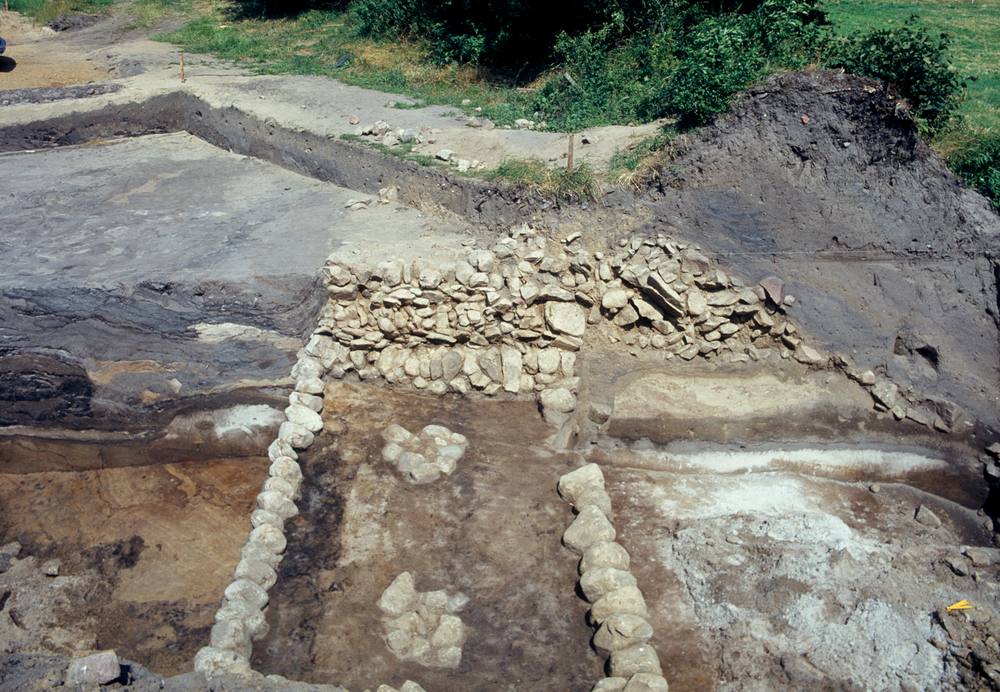
The first great undertaking of the North that archaeology can grasp is the Danevirke, a system of ramparts and ditches at the narrowest point of the peninsula near Schleswig. It was built in several phases. One phase with a palisade and timber front is dated by dendrochronology, that is, by the tree rings of the oak timbers, to the year 737; excavations by H. H. Andersen between 1969 and 1975 produced this. Later radiocarbon measurements suggest still older predecessors, whose age is given differently in the literature. That the expansion around 968 happened under Harald Bluetooth is likewise given with dendro dates in the Danevirke article on this site.
Whoever could muster so much timber and labour in 737 held political power. No source names the builder. Alcuin mentions in his life of the missionary Willibrord a Danish ruler Ongendus, whom Willibrord visited around 710; he is said to have given him thirty boys. Whether Ongendus or a successor stands behind the building of 737 cannot be proved. Scholars read Ongendus' description as "more savage than any beast" as the usual disparagement of a pagan ruler.
From 804 we are in the period when the Danes appear in Frankish court annals. The king is called Godofridus there, in English Godfred. In 804 he came to the border with fleet and cavalry but did not appear at the announced meeting with Charlemagne. In 808 he attacked the Obodrites, allies of the Franks, destroyed the trading place Reric and brought its merchants to Sliesthorp, probably on the Schlei. In the same year he completed a rampart that the annals describe as protecting the frontier. The usual equation with the Danevirke is interpretation, although a very probable one.
For 810 the annals report, in P. D. King's English translation (1987), that a fleet of 200 ships came from "Nordmannia" to Frisia, laid waste the islands off the coast and fought the Frisians three times; the Frisians had already paid 100 pounds of silver as tribute. Charlemagne was at Aachen and considered a campaign against king Godfred. Before it came to that, Godfred was killed by a man of his retinue. His nephew Hemming succeeded and made peace with the emperor. That is the secure part. That Godfred supposedly wanted to come to Aachen himself or aimed at rule over all Germany appears in Einhard and later tales, not in the annals.
The question of where the Danes had their trading place leads to Hedeby at the head of the Schlei. The annals do not give the name; the link between Godfred's measures and the growth of the place is an interpretation. In 826 the Danish king Harald Klak was baptised in the Mainz region, and the monk Ansgar accompanied him north; the mission reached Schleswig around 850, where according to Rimbert he was allowed to build a church. Rimbert wrote as Ansgar's pupil and successor, so his life is a Frankish-ecclesiastical view from outside.
Only in the tenth century do the Danes speak for themselves. On the great Jelling stone Harald Bluetooth has recorded for his parents that he "won for himself all Denmark and Norway and made the Danes Christian" (own translation). That is self-presentation. The runic archive of the University of Copenhagen dates the stone to about 965 to 970; the north mound at Jelling is dated by tree rings to 958/959. Gorm the Old was his father; Harald himself ruled until 986/87 and was overthrown by his son Sven. What his predecessors achieved is known only in part, and much that looks like "state formation" is Harald's own reading of history.
On the distinction between "Danes" and "Vikings": the Danes were part of the society that went raiding from the late eighth century. Not every Viking was a Dane, and not every Dane went to sea. The overview page on Harald Bluetooth describes his rule, and the page on Nordic kings places the royal lines.
When are the Danes first mentioned? Around 551 in Jordanes, at about the same time in Procopius, later in Gregory of Tours. I know of no earlier attestation; Ptolemy does not name them.
Did the Danes drive out the Heruli? Jordanes says so, without a date. Scholars disagree whether it was an event or a topos.
Was Hygelac a Dane? The poem calls him a Geat, Gregory calls the raiders Danes. The question is open.
Who built the Danevirke? Several generations. The phase of 737 has no known builder, Godfred continued a rampart in 808, Harald Bluetooth built around 968.
Did the Danes threaten the Rhineland? Gregory attests a raid into Theuderic's realm, and Godfred's fleet reached Frisia in 810. Aachen itself remained untouched.
Danevirke · Hedeby · Jelling · Harald Bluetooth · Gorm the Old · Heruli · Gauts · Jutes · Harald Klak

The Danevirke · Hedeby · The Jelling stones · Harald Bluetooth · The Jutes.
All History & Finds articles →
Danegeld is the name for the silver tribute late Anglo-Saxon England paid to Viking armies to make them leave – first …
Read more →Drive through Lincolnshire today and the road signs read Grimsby, Scunthorpe, Kirkby, Ingoldmells. That is neither …
Read more →The Danevirke (German Danewerk, "work of the Danes") is a system of ramparts, ditches, walls and a sea barrier near …
Read more →