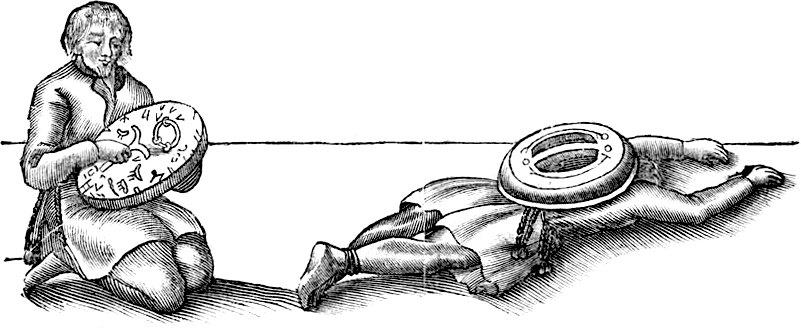
A birch-wood image, a hammer in its hand, an iron nail and a chip of flint driven into its head: that is how a seventeenth-century scholar describes the thunder god of the Sámi. Under the name Horagalles he has become known as the "Sámi Thor". The name very probably comes from Norse. Whether the god does is a different question altogether, and the reports everything rests on were written by men who wanted this religion gone.
Anyone who looks up Horagalles soon meets the phrase "the Sámi Thor". It hides two things. First, there was no single Sámi thunder god with one fixed name. Second, nearly everything we read about him comes from Swedish and Norwegian clergymen who wrote, between roughly 1670 and 1770, about a faith they regarded as the devil's work.
The Sámi live in Sápmi, a region stretching from central Norway and central Sweden across northern Finland to the Kola Peninsula. They speak several Sámi languages, some of them not mutually intelligible, and the thunder god's names vary accordingly. The Encyclopaedia of Saami Culture at the University of Helsinki lists him under the North Sámi name Bajánalmmái and adds Baján (a word connected with "above"), Dierpmis, East Sámi Tiermes or Tiirmes, Áddjá among the Ume, Pite and Lule Sámi, Äijjih among the Inari Sámi, and Horagállis in South Sámi. The historian of religion Louise Bäckman adds forms such as Baj'jan, Ajja and Juht'te.
Several of these are forms of address rather than proper names. Áddjá and Äijjih mean "grandfather" or "old man". Tiermes has a history of its own that owes nothing to Scandinavia: the Helsinki encyclopaedia calls it probably Finno-Ugric and derives it from the same word as Khanty Torem. The trail leads east, not towards the Norse world.
Horagalles is a name from the south of Sápmi. Bäckman, following the linguist Tryggve Sköld, states that it is confined to the South Sámi area. The key early witness is Johan Randulf, parish priest at Nærøy on the coast north of Trondheim from 1718 to 1727. In his treatise of 1723, known as the Nærøy manuscript, he writes "Hora Galles" and explains that this is the god the old Norwegian heathens called Thor. Older literature also has spellings such as Thora Galles and Thoragalles; the modern South Sámi spelling is Hovrengaellies.
That regional tie matters. The South Sámi had lived next door to Norwegian and Swedish farmers for centuries; a Norse god's name could travel most easily here. Using Horagalles as the name of "the" Sámi thunder god stretches a southern regional form across the whole of Sápmi.
The best-known explanation runs: Horagalles is Old Norse Þórr karl, roughly "Thor the old man" or "Thor fellow". The literature usually credits it to the Finnish folklorist Kaarle Krohn, who published "Lappische Beiträge zur germanischen Mythologie" in Finnisch-Ugrische Forschungen in 1906. I have not read the paper; the attribution comes from secondary literature, which also names E. O. G. Turville-Petre (1964). Åke Hultkrantz put it briefly in 1962, as quoted by Bäckman: Horagalles means "Thor the Old" and so represents the Nordic storm god.
The first element, hora-, corresponds to the name Þórr; the second, galles, belongs with Norwegian kall, "old man". According to Sköld, as reported by Bäckman, the word was apparently borrowed during the Viking Age or the early Middle Ages. A "Thor the Old" does not look out of place beside a "Grandfather" Áddjá: the Norse name slots into a Sámi naming pattern.
In the nineteenth century it was still unclear who had borrowed from whom; Jens Andreas Friis noted as much in 1871, according to secondary literature. The direction "from Norse into Sámi" won out because Þórr is firmly rooted in Germanic. The name simply means "thunder", as our article on Donar explains.
The Helsinki encyclopaedia grants a Norse influence on the form Horagállis but points to the South Sámi form Hovrengaellies, which can be explained differently – from a South Sámi word for making noise or thundering – and would then have nothing to do with Thor.
A paper by the linguist Lars-Gunnar Larsson on the earliest contacts between Scandinavians and South Sámi (in the journal Folia Uralica Debreceniensia, volume 20, 2013) shifts the question. Larsson examines the South Sámi thunder words in hovre(n)- and finds that they occur only in southern South Sámi: southern Jämtland, Härjedalen and the Røros district. For hovre itself he assumes a loan from the Scandinavian name of the thunder god, runic Swedish þor, þur, Old Norse Þórr.
The difficulty is the initial sound. A Norse þ ought to turn up in South Sámi as f-, not h-. Larsson's explanation: the regular form would have collided with another, widely spread loanword, the word for "whore". A god who was worshipped and feared could not be called that, so speakers moved to h-. Whether that holds is for specialists to judge. Even those who start from hovre end up, on Larsson's account, with Thor again – only by a different road than "Þórr karl". There is no settled consensus.
And even if the borrowing of the word were certain, a loanword is not a loan god. Bäckman draws the clearest conclusion. The god as such is not a loan, she writes; only the name is, and only in a certain area. In her view the many native names point to an independent Sámi thunder figure.
The oldest detailed account is in the Lapponia of the Uppsala professor Johannes Schefferus, printed in Latin at Frankfurt in 1673 and in English at Oxford in 1674. Schefferus worked from reports sent in by clergy in the "Lappmarks" of the time; in chapter ten, on the gods, he cites Samuel Rheen and Johannes Tornæus among others.
Schefferus does not know the name Horagalles. His thunder god is called Thor, by the "Laplanders" themselves Tiermes, which he glosses as "any thing that makes a noise", and Aijeke, "grand, or great-grand-Father". He compares him to thundering Jupiter (compare the Roman habit of interpretatio Romana). This Tiermes or Aijeke, he says, has power over the life and death, health and sickness of man. He drives off the demons that spoil hunting, fowling and fishing, and for that he is given a bow, called Aijeks dauge, and a mallet, Aijeke Wetschera, with which to dash out the evil spirits' brains.
Then comes the description of the image:
"they put a hammer into his right hand, which is as it were his ensign by which he is known. […] Into his head they drive a nail of Iron or Steel, and a small piece of flint to strike fire with, if he hath a mind to it."Johannes Schefferus, The History of Lapland, Oxford 1674 (anonymous English translation of the Lapponia of 1673), ch. X
The image, he says, was always made of wood, and always of birch, which is why the god is also called Muora Jubmel, "the wooden god". The head is made from the root of the tree, the body from the trunk. Schefferus offers his own reading of the flint: it may be an emblem of fire, which was worshipped in Thor together with the sun. That is his learned conjecture, not Sámi testimony.
Half a century after Schefferus, a systematic mission to the Sámi began in Norway. Its head was Thomas von Westen (1682–1727), from 1716 lector in Trondheim and leader of the mission, later called "the apostle of the Lapps". He made three missionary journeys and collected information on the old faith in order to fight it. His circle included Hans Skanke (1679–1739), who worked von Westen's material into a history of the mission, and Jens Kildal (1683–1760), missionary in Salten in the Lule Sámi area from 1721 and author of a tract with the telling title Afguderiets Dempelse, "The Suppression of Idolatry".
In January 1723 von Westen visited the parish of Nærøy. He and Randulf summoned the Sámi of the parish to the vicarage, questioned them and instructed them. Randulf's treatise on Sámi "idolatry" in Nordland, Finnmark, Namdal, Snåsa and Selbu grew out of that occasion. It was not printed until 1903, by Just Qvigstad; a copy is kept at the Gunnerus Library in Trondheim. Randulf does not always make clear whether he reports his own observations or von Westen's from other districts.
In Randulf, Hora Galles comes first; next after him comes a second great god, Waralden olmay, the "man of the world". That name too contains a Norse loanword (Old Norse verǫld, "world"), and for him too a Norse model has been sought, namely Freyr. Twice, then, a Norse word sits inside a divine name, and twice the question arises whether the cult came with it.
A Swedish court record of 1688 preserves the statement of a Sámi man named Lars Nilsson, who identifies his wooden images: the first is Thor or the thunder, the second Thor's or the thunder's angel. Pehr Högström, as summarised by Olle Sundström, speaks in 1747 of "Thor or Tiermes" and classes him as an idol. I have not consulted Knud Leem's description of the Finnmark Sámi from the 1760s, the treatise by E. J. Jessen appended to it, or Isaac Olsen's account; what is quoted from them I know only at second hand.
The Sámi drum – North Sámi goavddis, South Sámi gievrie – was a tool of the noaidi, the ritual specialist. Figures were painted on the skin: gods, animals, tents, places of sacrifice. Schefferus describes how the drum was also used to find the right offering. If the pointer came to rest on Thor's picture, he accepted the sacrifice; otherwise it was offered to the Sun or to "Storjunkar".
According to the Helsinki encyclopaedia, Horagállis holds a hammer in his left hand on the drums. Schefferus puts the hammer in the wooden image's right. Randulf's manuscript, as reported via Friis (1871), knows two hammers: a sledgehammer in one hand and a cross-hammer in the other, or two crossed hammers. With one the god makes thunder and lightning, with the other he draws them back so that people and animals come to no harm. I have not checked the wording in Randulf or Jessen.
One hammer or two, left or right – the discrepancies are themselves a finding. The drums were not standardised picture boards; each was painted and read by its owner. Take the South Sámi drum of Bendik Andersen Frøyningsfjell, interpreted in the 1720s. Its explained signs include "God the father", "God the son", "God the holy ghost" and "the devil". Whether the owner thought so or told the missionaries what they wanted to hear cannot be established with certainty.
For the comparison with Thor, the hammer is the strongest argument, and a difficult one. Thor's hammer is the Norse god's badge. A thunder god with a hammer next door, and "Thor" in his name: that looks like borrowing. Yet the Helsinki encyclopaedia regards the bow and flaming arrows as the Sámi thunder god's original weapons. On that view the hammer is a younger, south-western addition to an older idea of the divine archer.
The nail and the flint in the head of the wooden image have occupied students of myth for more than a hundred years, because the Norse world offers two striking counterparts. The first is a myth. In the duel with the giant Hrungnir, Thor's hammer shatters the giant's whetstone, and a fragment lodges in Thor's head – so Snorri tells it in Skáldskaparmál.
The second counterpart is a cult object. Eyrbyggja saga, in its fourth chapter, tells of Þórólfr Mostrarskegg, a worshipper of Thor who builds a temple in Iceland. In the high-seat pillars were nails called reginnaglar, "gods' nails". The saga, written down in the thirteenth century, says no more; Margaret Clunies Ross nonetheless thinks it plausible that it reflects pre-Christian practice.
Out of these three pieces – whetstone fragment, gods' nails, Sámi idol – a chain can be forged: the nail in the pillar stands for the stone in Thor's head, and together nail and stone served to strike fire, a ritual image of lightning. I could not establish who first proposed this reading; it stands here without a name and only as a hypothesis.
How strong is the chain? Each link is weak on its own. The Hrungnir myth stands in a thirteenth-century source. The reginnaglar are named once in a cult context, without explanation. The Sámi idol is known from a report of 1673. Centuries lie between the witnesses, and no source connects them explicitly. The connection cannot be proved. Nail and flint may just as well be an everyday strike-a-light, given to the lord of the fire from the sky with no Norse model at all.
On sacrifice the reports are comparatively concrete. According to Schefferus, behind the hut, about a bowshot away, stood a structure of boards set together "like a table", on which the images were placed and which served as an altar; boughs of birch and pine were set around it. Thor usually received a reindeer buck. The animal was stabbed through the heart behind the house, and the image was anointed with the blood. Behind the image they laid the skull, feet and antlers of the victim. Of the birch wood, he says, they make as many idols as they have sacrifices.
The Helsinki encyclopaedia sums up further reports. In Norway reindeer and wooden mallets were offered to the thunder god. Among the Lule Sámi his image with a hammer was set on a platform. For Áddjá the sacrificial tree had to be a birch set up upside down, roots uppermost; the encyclopaedia reads the inversion as ambivalence: the tree points to the underworld, as in a sacrifice to the powers below. That is a modern interpretation.
The cult apparently lasted longest in the north-east. On the rocky island of Äijih-sualui in Lake Inari, which the encyclopaedia translates as "Thunder Island", people were still leaving reindeer antlers and metal objects in a cave into the late nineteenth century. According to the encyclopaedia, Äijih's wife was called Akku.
The Helsinki encyclopaedia describes him as an ambivalent figure – kindly and dangerous at once, hence the sacrifices. He cleansed the air of disease, sent rain and protected the reindeer from predators. He struck down evil spirits but could also hit people and sacred places. Among the Skolt Sámi he taught the first humans to build lodges, and in East Sámi belief his flaming arrow will one day end the world. In present-day Kildin Sámi the rainbow is called "the bow of Tiermes". The fight against demons and the fertilising rain recall Thor, as Olof Pettersson noted, according to Bäckman. But a storm god who slays monsters and brings rain is known to a great many cultures, from the Baltic to the Celtic Taranis. Similar duties do not prove descent.
Sámi and Norse were no strangers. As early as the ninth century the chieftain Ohthere of Hålogaland describes the Sámi as trading partners and tribute payers, and the sagas are full of meetings, marriages and deals (see the Sámi in Norse sources). Between such old neighbours, words, things and ideas travel both ways. Norse words entered Sámi, such as the word for "world" in the name of the world-man and, very probably, Thor's name. In the other direction, Old Norse texts credit the "Finnar" – their word for the Sámi – with special skill in magic. Whether that reflects real borrowing or a label pinned on the neighbour is disputed.
Older scholarship liked to read Sámi religion as an archive preserving what vanished in the north with Christianisation. Today's scholars are more careful. Bäckman turns the view around: a Sámi thunder figure of its own, with many names, took on a Norse name in the south and perhaps a Norse attribute. Which view is right in a given case cannot be decided from the sources.
All the written evidence comes from outsiders, most of it from opponents. The missionaries asked about "gods", "sacrifices" and "idols" and got answers within that grid. They looked for the familiar: Schefferus finds Jupiter, Randulf finds Thor, Skanke believed he recognised the Trinity in groups of Sámi gods. Skanke himself called the Sámi faith of his day a "patched-together religion", and Bäckman points out that some terms were shaped by the questioners rather than by those questioned. Those questioned were under pressure: drums were confiscated, burned or ended up in European collections.
Then there is the late date. By 1700 the Sámi had lived beside Christian neighbours for centuries. The reports record a religion in the middle of enforced change, not an untouched primeval faith. The historian of religion Håkan Rydving studied that change among the Lule Sámi in his dissertation The End of Drum-Time (1993); I have not consulted the book. I am not aware of any archaeological find that can be securely tied to Horagalles, such as a surviving wooden image with nail and flint.
What does the name Horagalles mean? On the most widespread reading it contains Old Norse Þórr karl, "Thor the old man". Another derivation starts from South Sámi hovre, which is itself explained as a loan of the name Thor. Neither is certain.
Is Horagalles the same god as Thor? No. He shares with Thor a probably borrowed name, the hammer and the fight against monsters. Beside these stand traits Thor lacks, and the equation itself comes from missionaries.
How do we know about him at all? From reports by Swedish and Norwegian clergy between 1673 and the 1760s, from court records and from the pictures on surviving drums. Sámi testimony in their own voice is almost entirely lacking for this period.
Did the Sámi thunder god have one hammer or two? The statements vary. Schefferus names one hammer in the right hand, the Helsinki encyclopaedia one in the left for the drum pictures, and Randulf, according to secondary literature, two.
Is Horagalles still believed in today? The old religion was suppressed by force in the seventeenth and eighteenth centuries. The Sámi today are a living indigenous people; how individuals relate to their religious heritage is their own affair and admits no blanket answer.
The Sámi in Norse Sources · Thor · Thor's Hammer · Thor versus Hrungnir · Donar.
All Gods & Goddesses articles →
Interpretatio Romana is the Roman habit of calling foreign gods by the names of their own: a Germanic god who looked …
Read more →Loki is the giant's son who lives among the Æsir in Norse mythology: Odin's blood brother, a shape-shifter and …
Read more →Magni and Móði are the sons of the thunder god Thor, and their great moment comes after the end of the world: according …
Read more →In the North the moon is a man: Máni, son of Mundilfari and brother of the sun. He steers the moon's course, governs …
Read more →