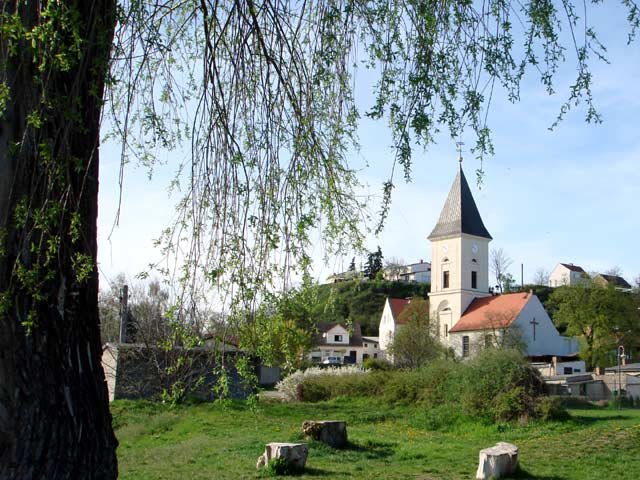
Look up "Lebus" in a history book and you will soon meet Thietmar of Merseburg, said to describe the siege of a fortress called Lebus on the Oder in the year 1012. The passage is real, but the identification no longer holds: Thietmar's Liubusua is now mostly sought near Meissen on the Elbe. For the Oder country, the time before 1100 leaves two lines by a cleric in Bremen, a hill fort above a ford and, after 1120, a bishopric set up by Duke Bolesław III. This article separates what belongs to the Lebusians from what was only attached to them.
"Lebus" hides at least four different things, and many misunderstandings come from mixing them up. First, there is the people's name: the Leubuzzi (also Lubuzzi, Polish Lubuszanie), a tribe on the middle Oder that the written sources mention only in passing. Second, there is the fortress and later town of Lebus, Polish Lubusz, on a steep bank of the Oder north of Frankfurt (Oder) in present-day Brandenburg. Third, "Lebus Land" (Latin terra Lubucensis, Polish Ziemia Lubuska) means a historical landscape on both sides of the Oder that becomes visible with the bishopric and the castle districts of the 12th and 13th centuries. Fourth, since 1999 a Polish voivodeship has been called Lubuskie.
Two traps come on top of that. One is Thietmar's Liubusua, discussed in a moment. The other is Leubus, Polish Lubiąż, a well-known Cistercian monastery in Lower Silesia that has nothing to do with the Oder country and merely sounds similar. Anyone asking about the Lebusians should first decide which of these spaces and which era is meant. This article deals with the tribe and the land on the middle Oder, with the fortress and town as its centre, and with the bishopric as the institution that first brings the land into dense written sources.
The only contemporary mention of the people's name comes from Adam of Bremen. Around 1075/76 the cleric wrote a history of the archbishops of Hamburg-Bremen, which also describes the Slavic lands east of the Elbe. There he lists the peoples between the Elbe and the Oder and names the Lebusians among them:
Sunt et alii Sclavaniae populi, qui inter Albiam et Oddaram degunt, sicut Heveldi, qui iuxta Habolam fluvium sunt, et Doxani, Leubuzzi, Wilini et Stoderani cum multis aliis.
"There are other peoples of Slavia, too, who live between the Elbe and the Oder, such as the Heveldi, who dwell by the river Havel, and the Doxani, Leubuzzi, Wilini and Stoderani, with many others."Adam of Bremen, Gesta Hammaburgensis ecclesiae pontificum, book II, ch. 21 (older numbering: ch. 18); Latin wording after the standard editions (spelling varies), English translation our own
That is all there is. Adam does not say where exactly the Leubuzzi lived, how large their territory was, what they called their strongholds or whether they obeyed a ruler. He puts them in a list and then singles out the Redarii as the central and mightiest of all. The neighbours he names at least help with placing them: the Hevelli sit on the Havel, the Stoderani are regarded as their relatives or as part of them, since Thietmar of Merseburg writes for 996/97 that Stoderania is also called Hevellun. The Redarii belong to the Lutici, and elsewhere Adam equates the Lutici with the Wilzi. So the Lebusians stand in the eastern part of this league area, close to the Oder.
A second witness seems to confirm the entry: Helmold of Bosau, who wrote his chronicle of the Slavs around 1170, names the Leubuzi in the first book in an almost identical list of peoples. Polish scholarship points out, however, that Helmold here repeats Adam almost word for word. These are not two independent witnesses but one, copied by a later author. The written existence of the Lebusians as a people therefore rests on a single note.
From this thin base arises a debate openly conducted in Polish medieval studies. The historian Jan Natanson-Leski put it sharply: even if there were Leubuzzi, the "Lubuszanie" of modern handbooks are first of all a product of historiography. Other scholars, mainly archaeologists, reply that the finds along the middle Oder do show a coherent settlement area. Both positions are interpretation, and both have reasons. We keep them apart here.
The name of the fortress and the tribe is spelled in different ways: Leubuzzi in Adam, later Lubus, Lubucz or Lubuz in Latin and Polish texts, German Lebus. What is certain is only that the name is Slavic. How it is to be explained, whether from a personal name or from a word stem, is not settled. In local literature one occasionally reads that the fortress goes back to a Wilzi prince named Liubus who ruled the Wilzi at the start of the 9th century. The literature names no source for this person; it is a modern explanation that links the name to a ruler, as happens with many fortress names. It cannot count as fact.
More important is that the name has two functions. It designates a place and, derived from that, a region. Latin Lubus in the 12th and 13th centuries usually means the fortress with its district, terra Lubucensis the land. Whether an earlier tribal name Leubuzzi existed that named the region, or whether Adam's outside label was formed from the fortress name, cannot be decided from the sources.
For the year 963, Widukind of Corvey reports in the third book of his Saxon History on the fight of the Saxon Wichmann against the Polish ruler Mieszko and names a people called Licicaviki who stood under Mieszko. Some Polish scholars have suspected a corrupted spelling of the Lebusians behind it. That would be the oldest mention of the name, a good century before Adam. The identification is a hypothesis based on similarity of sound, however, and it remains disputed. We treat it as a possibility, not as evidence.
If it held, a coherent picture would emerge: Mieszko I would have had contact with the peoples of the middle Oder by about 960 and drawn the land into his realm. Regional history does name this period, but considers a conquest around the turn of the millennium just as possible. No text that explicitly describes the incorporation of the land into the Piast state survives.
Correction of a widespread error: Thietmar of Merseburg, the chronicler of the years up to 1018, is named in many accounts as the first witness for the fortress of Lebus on the Oder. This is very probably wrong. Thietmar tells of a fortress Liubusua that King Henry I is said to have destroyed in 932, that Henry II inspected in January 1012 and that Bolesław Chrobry took in August 1012. The report for 1012 describes a large complex with twelve gates, a smaller fortress next to it, a garrison of about 1,000 men and an Elbe flood that prevented relief. There is no mention of an Oder ford.
Since the 19th century the location of this fortress has been disputed. Ludwig Giesebrecht looked for it at Lebusa in Lower Lusatia in 1843; others named Lebus on the Oder, Löbau, Lübben and many more places. More recent research, including a study by Kerstin Gebuhr from 2005 in Namenkundliche Informationen, links Liubusua with Löbsal at the "Rough Ford" of the Elbe south of Meissen. Even that is not undisputed, since critics object that the area is too small for 1,000 defenders and that the twelve gates find no counterpart. Supporters read Thietmar's numbers symbolically. For our subject the finding suffices: the identification with Lebus on the Oder is no longer the standard reading. Anyone who reads of a "siege of Lebus in 1012" in older texts is looking at this error.
A second error concerns the first Polish chronicle. Gallus Anonymus wrote the Gesta principum Polonorum around 1112 to 1118 and describes in detail the wars of Bolesław III Wrymouth, including the siege of Głogów in August 1109, when King Henry V stood in Silesia. According to Polish scholars, however, Gallus does not mention Lebus. Cosmas of Prague and the Annalista Saxo are likewise silent on Lebus in this context.
The consequence is uncomfortable: for the whole 11th century and the first decades of the 12th, no narrative source describes Lebus on the Oder beyond doubt. What is claimed for the years 960 to 1120 comes from archaeology, from later tradition and from inference. That is exactly what makes the history of the Lebusians an instructive case.
Where writing is missing, spade and measuring tape speak. The Lebus castle hill is a steep bank above the Oder valley on which settlement can already be shown for the Late Bronze Age around 1000 BC. A bronze hoard of more than a hundred axes, discovered in 2003, belongs to this early layer. After a gap in the Iron Age, a new fortification arose at the latest at the beginning of the 9th century, which scholars attribute to immigrating Slavs. Whether this fortress was the main stronghold of the Leubuzzi is a plausible interpretation: the site commands the Oder, but a source for that role is missing.
Wilhelm Unverzagt had the hill excavated in the years before and during the Second World War, and later the GDR's archaeological research unit continued the work into the 1970s. The excavations show several building phases, on which the medieval tripartition rests: a partition treaty of 1249 names an upper, a middle and a lower castle. That is the fortress as the Ascanians and Magdeburg once divided it among themselves, not that of the Lebusians of the 9th century. The layers have to be kept apart: far less is known about the Slavic early period than about the time of the bishops and margraves.
The position explains the rank. Regional history calls the ford at Lebus one of the best crossing points on the middle Oder, and the fortress thereby controlled important routes. That is an assessment based on the later importance of the place, not a measured statement about the time of the Lebusians.
Lebus did not stand alone. The Polish archaeologist Jarosław Lewczuk has collected the excavation results of the 7th to 13th centuries in today's Lubuskie Voivodeship and finds that the number and density of settlements and strongholds of the Lebusians matched those of Greater Poland. There were wooden bridges over lakes, and technical development was hardly behind that of the Polans. Some strongholds show traces of burning, which he reads as signs of a violent takeover around the turn of the 10th to the 11th century. He names his own reservations: sharp tribal borders cannot be drawn, similar objects, houses and burial customs occur in several neighbouring regions, and many sites are dated only by surface pottery.
Places named in Polish research include Lossow, Reitwein, Neutrebbin, Buckow, Lemierzyce, Ownice, Sulęcin and Ośno Lubuskie. The distribution says something about settlement and fortification, not about language or self-image. Anyone who says "Lebusians" assumes that the people saw themselves that way. A testimony for that is missing.
The land probably came to the Piasts as early as the 10th century, by a widespread view around 960 under Mieszko I, by another opinion only around the turn of the millennium under Bolesław Chrobry. Regional history credits Mieszko or Bolesław with rebuilding and strengthening the fortress. No text reports this; the statement rests on layers and inference. What is secure is that in the 12th century Lebus was both a castle seat and a bishop's seat within a Polish duchy.
In the castle districts of Polish princes, castellans were in charge of defence, dues and jurisdiction. Lebus too was such a centre. Polish research describes the Ziemia Lubuska of the 12th and 13th centuries as a castellany that later also included the lands of Küstrin and Kienitz. This shape is therefore younger than the tribe. Some Polish medievalists consider it inadmissible to project the divisions of the fragmentation period back onto a supposed tribal area of the 9th century. The argument weighs heavily, because the "Lebus Land" we know from charters only becomes visible with the bishopric of 1124/25.
A much-repeated episode concerns the year 1109. At that time King Henry V marched into Poland with an army, besieged Głogów without success and withdrew. The Greater Poland Chronicle, which arose a good two centuries later, additionally claims that the king stormed "the great fortress of Lebus" because he thought it easy to take, and afterwards gave it to the church of Magdeburg. Gerhard Köbler states in his regional history that Henry V transferred the fortress to the archbishop of Magdeburg in 1110.
Whether that is true is open. Gallus Anonymus, the contemporary, mentions nothing of the kind; Cosmas and the Annalista Saxo are silent too. A Polish researcher concludes that the Germans probably appeared before Lebus but did not take the fortress. Magdeburg's later interest in Lebus is a fact. That it rests on a donation of 1109/10 is a claim made by a late work.
The great date of Lebusian history is the founding of the bishopric. When exactly it happened, nobody knows. Polish scholarship names the years 1123/24 and links the foundation with the stay of the papal legate Aegidius of Tusculum in Poland. Other accounts say "around 1124" or "around 1125". The oldest surviving mention is placed around 1133. Anyone giving a founding year should say "1124/25" and add that it is inferred.
Duke Bolesław III Wrymouth thus created a bishopric on the Oder that was meant to underline his duchy's claim to both banks of the river, also against Emperor Henry V and the archbishopric of Magdeburg. It was subject to the archbishopric of Gniezno. The cathedral was dedicated to Saint Adalbert of Prague and probably stood on the castle hill. The diocese reached from the middle Oder into the area of the Spree and the Warta; it bordered the bishoprics of Brandenburg, Cammin and Meissen and held estates in Silesia, Greater Poland and Lesser Poland. According to the diocesan literature, the first bishop was a Bernhard mentioned around 1133. With due caution: the names of the early bishops come from later tradition.
The bishopric arose at a time when Bolesław III was extending his power to the Baltic coast. The mission in Pomerania, for which he invited Bishop Otto of Bamberg in 1124, belongs to the same years. Whether Lebus was meant as a base for missions or mainly as a political signal, the sources do not say. Some accounts speak of a wish to convert resistant Lutici; there is no evidence for that, and the Lebusians themselves probably belonged to the Polish sphere of rule long before.
The dispute over church law is certain. Magdeburg laid claim to the land and contested its assignment to Gniezno. The bishopric nevertheless remained a Gniezno suffragan until in 1424 it was subordinated to the archbishop of Magdeburg. That was the ecclesiastical end of the Polish tie, at a time when the land had long been Brandenburgian.
After Bolesław III's death in 1138 the realm broke into partial principalities. From then on the Lebus Land belonged to the Silesian Piasts. Henry I the Bearded granted the place town rights in 1226 or earlier. In his shadow came the first fights over the land, in which Lebus became a plaything of its neighbours. In March 1209 the Wettin Conrad II, margrave of the Eastern March and Lower Lusatia, besieged the fortress. The Greater Polish duke Władysław III Spindleshanks tried to relieve it and, according to the Polish account, was beaten; many of his men drowned in the night crossing of marshy ground. Lebus fell, and the defenders are said to have been hanged.
The success was short-lived. Conrad died in May 1210, and between August 1210 and March 1211 Henry the Bearded won back the lost territories, among them Lebus and Guben. What comes together in this account rests mainly on the research of Marek Smoliński and on Meissen sources; details such as the execution of the defenders belong to the narrative of this late tradition and are not certain. What is certain is the change of rule: in quick succession, Piasts, Wettins and Piasts again stood on the Oder.
After 1241, when Henry II the Pious had fallen at the Battle of Legnica, his son Mieszko received Lebus as a district of his own. He died in 1242 without heirs. His brother Bolesław II the Bald handed the land in 1248/49 to Archbishop Wilbrand of Magdeburg and the Brandenburg Ascanians; sources and accounts speak of sale or pledge. The first territories passed to the Ascanians in 1249, who at first ruled jointly with Magdeburg. From 1287 the margraves of Brandenburg were sole lords of fortress and land. The literature dates the term "Lebus Land" for a Brandenburgian territory only to this period.
The archaeological trace of these fights is tangible: excavations in 2009 found in the fortress a warrior grave with four people buried at the same time, from around 1200 to 1250. It is linked with the attack of Archbishop Wilbrand of Magdeburg in 1239. That is an interpretation based on the find and its dating, not proof.
For the Ascanians Lebus was less a goal than an obstacle. In 1253, close by and in competition with Lebus, they founded the town of Frankfurt on the Oder and hardly promoted Lebus any more. The place quickly sank into insignificance. The bishopric moved to Göritz (Górzyca) in 1276 and was destroyed there in 1325 after conflicts with Brandenburg. From 1354 the bishop resided in Lebus again, where a new cathedral arose north of the fortress, and moved on to Fürstenwalde between 1373 and 1385, although the diocese kept its name. The land had been ravaged by Polish and Lithuanian troops in 1326.
The Hussites did the rest. After the Battle of Müllrose a detachment of some 1,000 to 1,500 men plundered Lebus on 14 April 1432 and, according to regional history, destroyed the place completely. In the 16th century Bishop Georg von Blumenthal introduced the Reformation. With the death of the last Catholic bishop, Jan Horneburg, in 1555 the old bishopric ended; in 1598 it was regarded as dissolved. The fortress fell into ruin.
A regional thread is worth following: Adam of Bremen wrote his description of the Slavic lands in northern Germany, at the seat of the archbishopric of Hamburg-Bremen, which claimed the mission in the north and east. His list of peoples between the Elbe and the Oder is among the oldest testimonies we have for this landscape. The Oder itself leads through Szczecin and the lagoon to the Baltic, and at its mouth lay trading places such as Wolin. The river thus links the coast of the Pomeranians with the interior, and further east begins the territory of the Polans, who later carried the Piast state.
That Lebus was part of a trade network reaching to the coast is plausible but not proven. Readers interested in the Baltic world of the period will find further leads in our articles on the Vikings on the Baltic and on amber. For Lebus itself no source names long-distance traders using the ford; the picture of a trade route follows from the map.
Since 1999 a Polish voivodeship has borne the name Lubuskie, in German Lebus. It is not the Lebus Land. The town of Lebus, the namesake, lies today in Germany, on the western bank of the Oder. The voivodeship covers large parts of the former eastern Neumark as well as areas that used to belong to Silesia and Greater Poland. Its administrative seat is split between Zielona Góra and Gorzów Wielkopolski. The name was taken over in 1945 for the territories assigned to the Polish state, at first as Ziemia Lubuska, and stayed on as a link to the medieval landscape.
Polish commentators describe this choice of name as a pragmatic compromise: the aim was not to make any of the region's rival towns the namesake, so the historical name was used. It is an example of how a name travels. The medieval Lebus Land, the Brandenburg landscape between the Oder and the Barnim, the Polish stretch of land after 1945 and today's voivodeship are four different spaces that happen to carry the same word. Keeping them apart avoids the commonest mistakes in encyclopedias and travel guides.
The Lebusians are a textbook example of how little a name reveals when it falls only once. Adam names them, Helmold copies, Thietmar speaks of another fortress and Gallus is silent. In between lies a castle hill whose earliest Slavic phase is archaeologically tangible, a landscape of dense settlement and a bishopric founded by Duke Bolesław III around 1124/25. Everything beyond that, whether tribal league, tribal border or conquest by a particular prince, is inferred.
That there were so many fights over this land shows the value of the Oder ford more than that of a people: Piasts, Wettins, Ascanians and archbishops of Magdeburg quarrelled over Lebus in the 13th century until the Ascanians held it entirely in 1287. The people Adam called "Leubuzzi" had long vanished by then, if it ever existed as a closed group. Its name survived, on a fortress, in a bishopric and, since 1999, on an administrative map. Whoever reads it today should know which layer lies before them.

The Hevelli · The Liutizi · The Wilzi · The Pomeranians · The Polans · Wolin & Jomsborg · Vikings on the Baltic · Amber – the gold of the North.
All History & Finds articles →
It is not two centimetres tall and weighs nine grams – and yet it set off one of the most exciting debates in Norse …
Read more →Ask for Poland in Budapest and you hear Lengyelország; in Vilnius it is Lenkija; in Persian the country is Lahestān …
Read more →