Lusatia owes its name to a people of whom we have little more than a number in a list of peoples, two chronicle passages about campaigns and a series of timbers that can be dated to the year. That is little and at the same time surprisingly much: rarely can an early medieval fortification be fitted into history as precisely as in Lower Lusatia. This article introduces the Lusici, separates evidence from interpretation and explains why the equation "Lusici equals Sorbs" is an assignment made by modern scholarship and not a sentence from a source.
The Lusici (Latin Lusici or Lusizi) are regarded as a Slavic group that lived in Lower Lusatia in the 9th and 10th centuries, the area around the Spreewald, Lübbenau, Vetschau and Cottbus in the south of present-day Brandenburg. There are no self-testimonies: no inscription, no letter, no Lusician who tells us what he called himself. What we know comes from outside: from a few written mentions, from hillforts whose oak timbers can be dated by their tree rings, and from a landscape whose place names still sound Slavic today.
Each of these traces says something different, and only side by side do they form a picture. Beyond figures and tree rings that picture consists of interpretations, and where we mark them as such, it is not pedantry: the Lusici are a lesson in how much weight a name has to carry. Their neighbours to the south, the Milceni of Upper Lusatia, and the larger subject of the Sorbs have articles of their own; here we deal with the north of this region.
The oldest mention stands in the so-called Bavarian Geographer, a terse Latin enumeration of peoples north of the Danube (Descriptio civitatum et regionum ad septentrionalem plagam Danubii). For each people it gives the number of its civitates, meaning fortified places or castle districts. In the second list the entry reads, in the usual reading:
The Lunsizi: thirty strongholds. Right after them come the Milzane, likewise thirty.Bavarian Geographer, second list: "Lunsizi, ciuitates XXX" and "Milzane, ciuitates XXX"; English rendering our own, paraphrasing the usual reading of the edition
That is the whole statement. The text does not say where the Lunsizi lived, who ruled them, what a civitas was in their land, a ringwork, a settlement with a palisade or merely an administrative district, or whether the number rests on a count, an estimate or hearsay. For comparison: the Prissani are credited with 70 strongholds, the Besunzane with two. To infer power or population from such figures is risky; they show above all how densely fortified a land appeared to the author or his informants.
The origin of the text is also open. The list consists of two parts which may have been compiled between the middle of the 9th and the early 10th century; the part with the Lunsizi is considered the younger by some. The "Bavarian" Geographer is named after the place where the manuscript is kept, the Bavarian State Library in Munich, not after a secure place of origin.
The form in the Geographer is Lunsizi, not Lusizi. That both mean the same name is taken for granted in research, and the equation is very probably right; strictly speaking it is not proven, because no source says: the Lunsizi of the list are the people Thietmar later calls Lusici. The equation rests on the similarity of the names and on position: the list places them directly beside the Milzane, and the Milceni are well located in Upper Lusatia.
Later chroniclers write the name in several variants. According to the overview accounts, Widukind of Corvey in the 10th century names the Lusiki, and Thietmar of Merseburg, bishop from 1009 to 1018, writes Lusici or Lusizi, occasionally Luzici or Luidizi. The variation is normal: Latin scribes rendered foreign names by ear and had no spelling for them. It also shows that we are working with a name fixed in writing by outsiders.
The name of Lusatia is usually traced to the Old Sorbian word *luža, meaning "swamp", "puddle" or wet meadow. The present-day forms follow from it: Lower Sorbian Łužyca, Upper Sorbian Łužica, Polish Łużyce, Czech Lužice. In German pronunciation the u became au, while Latin (Lusatia) and most neighbouring languages kept the original vowel. By this derivation the Lusici would be "the people of the swamp land".
This fits well with a landscape shaped by the Spreewald and its channels, which is why the explanation is gladly repeated. It remains a linguistic hypothesis. No text of the period explains the name, and a people's name need not tell us anything about the land where it arose: it may have been given by neighbours, may go back to a domain or a group of strongholds, not to a landform. Whoever presents "swamp dwellers" as a secure self-designation reads more into the root than it yields.
Whoever looks for Lusici in the Frankish royal annals will not find them. The Annales regni Francorum report for the year 806 a campaign against the Slavs who are called Sorbs and live on the Elbe, and the death of their duke Miliduch; the Fredegar chronicle of the 7th century also knows a duke Dervan who ruled a people of Sorbs. Both passages concern Sorbs in the west and on the Saale, in the borderland of the Frankish realm. That they have anything to do with the Lusici is nowhere attested; the Lusici appear in the sources only later and only on the margin, and compared with the Franks the news about them comes from the Ottonians.
This is a frequent error: because "Sorbs" occurs in the Frankish sources and "Sorbs" today designates the Lusatian Slavs, news about one group is transferred to the other. The word has shifted over time. The article on the Sorbs examines this more closely; here it is enough to record that the Frankish sources provide no evidence for the Lusici.
For Lower Lusatia there is more archaeology and less text, and in recent decades archaeology has thoroughly overturned an older picture. For a long time the small ringworks of the region, called the Tornow type after the hillfort of Tornow, were taken to be installations of the 7th or 8th century, dated by pottery. Then came the tree rings. Sebastian Brather summarises in an essay that not a single one of the roughly 25 examined sites was built before the last third of the 9th century. The building phases cluster around 890, between 910 and 930, in the 940s and around 960.
That is a strong finding, because dendrochronology can be accurate to the year: oak trunks carry a pattern that can be matched against reference series, and where the waney edge survives the result gives the felling year. The Slavs themselves were in Lower Lusatia earlier. The oldest dendro date known there so far, a plank wall beneath the hillfort of Lübbenau, is placed around 700 (according to an overview account; we have not seen the primary publication). Between settlement and stronghold lie thus about two centuries in which people lived here without our knowing any fortifications.
Brather links the phases with the conflicts described by Widukind and others, such as the campaigns of Henry I and Gero's attack in 963. This link is an interpretation: the timbers tell when people built, not why. That external pressure prompted the strongholds is plausible, but not the only possible explanation for the building boom.
The same work asks a second question that matters for the picture of the Lusici. Were the Tornow strongholds, 20 to 50 metres across, residences of an upper class or places of refuge for the population? Brather rejects the alternative as too simple: the organisation of the building probably lay with a leading group, but in his assessment the sites were not noble seats in the later sense but refuges built in crises and used in varying ways afterwards. He reads the high number of sites in a small area as a sign of fragmented authority, unlike regions with a few large princely strongholds.
This fits what the Geographer's "thirty strongholds" suggests: no central realm but a land of many small places. Whether the thirty civitates of the list were in fact such ringworks is, however, an equation and not a finding. The list is probably older than most of the dated ramparts, and what it counted we do not know.
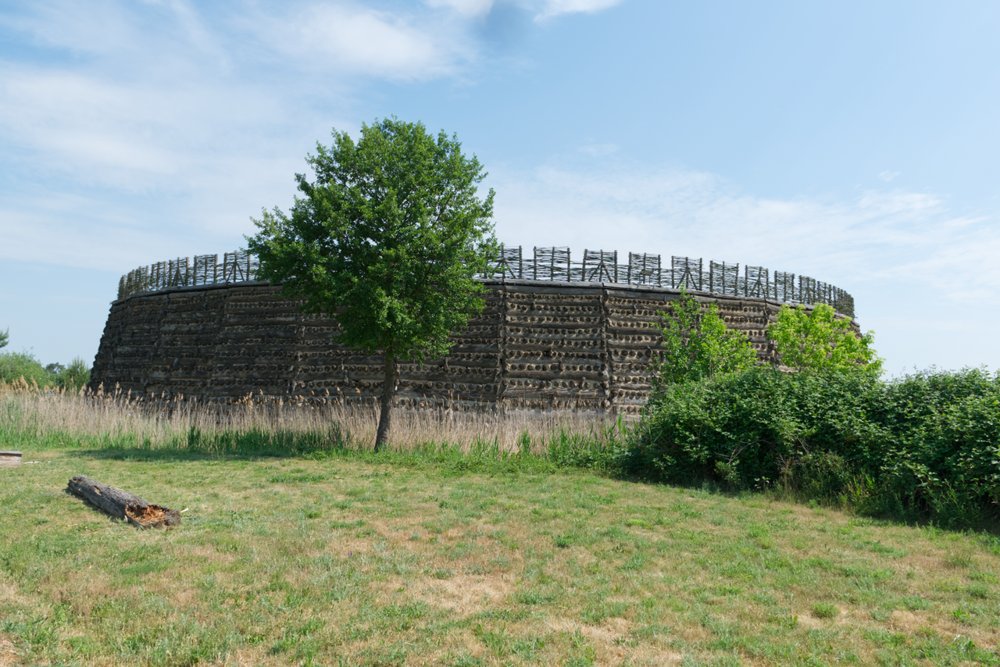
Whoever wants a picture goes to Raddusch near Vetschau. The Slavic fortress there is the best-known site in the region, and it shows well both the strength and the limit of reconstruction. The hillfort was investigated between 1984 and 1990 in rescue excavations connected with lignite mining, carried out by archaeologists of the Academy of Sciences of the GDR. Its foundation is placed around 880 on the dendro dates. The rampart was built in the log-crib technique, with oak beams laid alternately lengthwise and crosswise and filled with earth and stones; according to the excavation findings it had to be renewed every 40 to 50 years because the wood rotted. The interior at first measured about 35 metres across and later became narrower, while the rampart grew from about ten to about twenty metres in width.
Among the finds is a wooden idol, the "Idol of Raddusch", whose oak was felled around 926 according to dendro dating. What the post meant we do not know; cult image, gate post or something else are interpretations. The present fortress was built between 1999 and 2003 with a concrete shell faced on the outside and houses a museum. It is thus a reconstruction based on findings, with modern materials, and renders height and appearance only approximately: whether the rampart was really so high and how the gate looked is partly inferred.
The written sources begin with the Ottonians. Widukind of Corvey tells in his history of the Saxons (composed around 968 to 973) of the campaigns of King Henry I against the Slavs. According to research, the campaigns of 928/929 against the Hevelli and Daleminzi were followed in 932 by a campaign against the Lusici, in which Henry took their main stronghold, which appears in the sources in a form like Liubusua. With the Hevelli and the Daleminzi the Lusici were thus among neighbours who came in turn within a few years.
How secure are the details? The year 932 comes from the reconstruction of research, not from Widukind himself, who gives no years. Where Liubusua lay is disputed; the name resembles Lebus on the Oder, but that is a mere resemblance, and the stronghold has, as far as we know, nothing to do with the Lebusians. That the stronghold was taken stands in Widukind; whether it remained permanently under Saxon rule afterwards is another question, for the tribute duty of the Slavs was always brittle in this period.
Margrave Gero, whom Otto I had entrusted with the eastern frontier, subjected Slavs between the Elbe and the Oder in the 950s and 960s. Thietmar sums this up in Book II: Gero subjugated Lausitz and the Selpuli and even obliged Duke Mieszko of Poland and his people to pay tribute to the emperor. That is the view of a bishop writing a good half century later. In research, Gero's campaign of 963 is connected with building phases of the hillforts around 960.
It must be added how thin the connection is. Both findings, the written and the dendrochronological, speak for a time of unrest; whether a particular rampart belongs to a particular campaign cannot be read from them. What the sources likewise do not support is the notion that Gero "destroyed the Lusici". That the leading stratum was displaced or replaced in the course of the 10th century, as some accounts write, is a summarising interpretation. A named person who is reported killed in a chronicle is missing for us.
Thietmar of Merseburg, who lived from 975 to 1018, experienced the years between 1002 and 1018 as a contemporary. According to the usual accounts the Polish duke Bolesław Chrobry conquered the marches of Lusatia and Meissen in 1002; the war ended in 1018 with the Peace of Bautzen, and in the following decades the allegiance of the land alternated between Poland and the Empire until Lower Lusatia remained anchored in the Empire, around 1031. The Poles and their Piasts are introduced in the article on the Polans.
What matters is what happens to the name in these years. The Lusici as a group vanish from the texts, the land remains: the people's name becomes a land's name, Lausitz, which later becomes official as the March of Lusatia. Even in the second half of the 12th century, when German eastern settlement founded new villages, Slavs lived in the land; Lower Sorbian is spoken in the region to this day. That the population of the 12th century were descendants of the stronghold people of 890 is probable, without name lists proving it.
Books often state without qualification: the Lusici were a tribe of the Sorbs. That is a convention of research. The sources know the Lunsizi and the Milzane as separate entries on a list; the Frankish sources know Sorbs in the region of the Saale and Elbe. Modern scholars group the peoples between the Elbe, the Saale and the Lusatian Neisse under the name "Sorbs" because they were closely related in language and culture and because their descendants are so called. This assignment is reasonable, well founded and useful. It remains an assignment of the present which we bring to the sources: whether a Lusician of the year 900 understood himself as a Sorb, we do not know.
Behind this lies the question whether the tribes of the early Middle Ages were communities capable of acting with a fixed name at all, or labels given by outsiders. For the Lusici even the talk of a "tribe" would be an intermediate step: the sources show a name, an area and a number of strongholds. Everything beyond that, the borders, the rulers, the religion, the self-designation, is inferred or not yet found.
The Lusici are a name that still shapes a landscape today, with a text that barely fills a line. The picture that emerges is nonetheless not arbitrary: a densely fortified, politically fragmented land in the late 9th and the 10th century, which came under pressure on the fringe of the Ottonian realm and afterwards became part of marches. Whoever wants to know more must trust the datings of the timbers more than the slogans of handbooks, and must not be deceived in the field: a reconstructed rampart is a good aid to the imagination but no source. New excavations and new dendro dates can shift individual lines, at Raddusch as elsewhere.

The Sorbs · The Milceni · The Daleminzi · The Hevelli · The Liutizi · The Polabians · The Sprevane · The Lebusians.
All History & Finds articles →
In the autumn of 844 foreign ships sailed up the Guadalquivir, and for a week Seville was theirs. The people of the …
Read more →