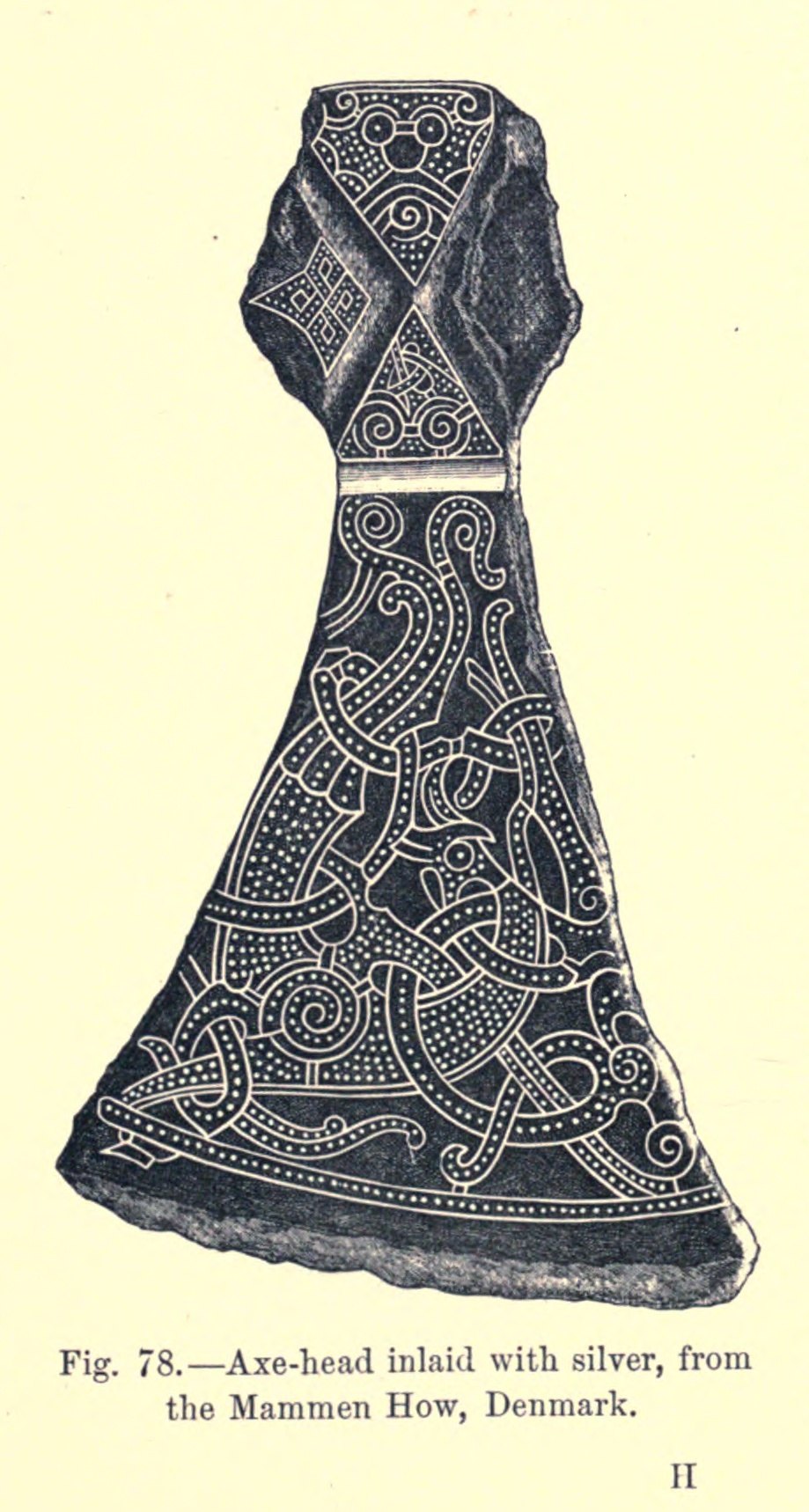
A whole style of Viking Age art is named after a village near Viborg in Jutland, and it owes the name to one object: an iron axe head with silver wire worked into its faces to form a bird and a spreading plant. The axe lay in a timber burial chamber whose wood can be dated to the year. This article starts from the find: what happened at the Bjerringhøj mound in 1868, what the axe shows, which works scholars set beside it, and where description turns into interpretation.
The Bjerringhøj mound at Mammen, about four metres high according to the 2021 study, belonged to a man called Laust Pedersen Skomager. In 1868 he had soil removed from it to fill a hollow nearby. The farmers doing the work realised they had hit a burial. They dug out the central grave, took the finds and shared them out among themselves.
Only then did someone with training arrive. Arthur Feddersen of Viborg Cathedral School collected what was left and questioned the farmers. He also recorded bones and textiles. A few days later the architect Frits Uldall visited, examined what remained of the structure and drew it. The recovered objects went to the National Museum of Denmark in Copenhagen, which still holds the axe.
The museum itself says the finds were badly damaged and the recovery did not meet modern standards. Where each object lay is known from the finders' statements and the notes of those two men, not from a recorded excavation.
According to the National Museum, the dead person lay in a coffin that stood inside a wooden chamber. Archaeologists call this a chamber grave: a timber room under a mound, used in the Viking Age for people of high rank. The body rested on down cushions. Two axes lay at the feet, one of them the famous one. On the coffin lid stood a bronze bucket and two wooden buckets, along with a large wax candle.
The museum page names no sword, shield or riding gear. Whether such things were never there or went missing in 1868 cannot be decided from what I have seen. The museum offers a cautious social reading: the furnishings suggest the dead person belonged to the circle around King Harald Bluetooth. That is an inference from wealth, date and place; no source records a name.
In 1986 the chamber was uncovered a second time, now as a planned excavation. The 2021 study names Jens Vellev and Mette Iversen as its directors. It produced chamber timber suitable for dendrochronology. The method matches the sequence of ring widths in a sample against wood of known age. If the outermost rings survive, it gives the felling year, and in good cases the season.
The National Museum states the result as the winter of 970/971. Strictly, the figure dates the felling of the trees. That the burial followed soon after is the assumption behind the museum's "buried in winter 970–71".
Two radiocarbon dates support it. The bones, after correction for a marine diet, gave cal AD 893–990, and an embroidered textile gave cal AD 892–993 (both at 95.4 per cent probability). Both ranges are far wider than the tree-ring date but contain it. It was made before that; how long before, no tree ring can tell.
The axe head is iron. Its images are inlaid: fine silver threads were hammered into prepared grooves or roughened areas of the iron, so that bright silver stands out as a drawing against dark metal. The National Museum calls it a ceremonial axe and one of the most magnificent finds of the Viking Age. Its pages give no dimensions, so neither do I.
Each face carries its own picture. One shows a large bird. English Wikipedia describes it as follows: the body is filled with pellets, the eye is circular, neck and wing are interlaced, and the tail ends in a triple tendril with open, hook-like tips. The art historian Andrea C. Snow, in her survey, points out the bird's spiral hip joint. The other face has no animal but a spreading foliate design: pelleted tendrils growing out of spirals at the base.
Two smaller motifs sit at the top of the blade. The same description names an interlaced knot on one side and a triangular human mask on the other. The National Museum's text on the axe does not mention the mask. I give it after Wikipedia, whose reference list includes Signe Horn Fuglesang's 1991 paper on the axe head; I have not read that paper myself.
The National Museum heads its page on the axe "An axe with double meaning". The motifs, it says, can be read as pagan or as Christian. The plant may stand for the Christian Tree of Life or for the world tree Yggdrasil. The bird is perhaps the rooster Gullinkambi, whose name means "golden comb", or the phoenix, a symbol of rebirth.
The museum's own "perhaps" should be taken literally. There is no name on the axe. Nothing in the image forces us to see a rooster and no other bird. The museum page says Gullinkambi sits at the top of Yggdrasil. Völuspá does not say that. Stanza 43, in the numbering of our source archive, says only that Gullinkambi crows "of ásum", among the Æsir, and wakes the heroes at the Father of Hosts'. The world tree is not mentioned there.
Around 970 a tree with a bird could carry both meanings. The sources give no more than that possibility: no text of the period explains the imagery of the axe.
"Mammen style" is a label of modern scholarship. No craftsman of the tenth century knew the term. Art historians grouped works with shared formal traits and named the group after a find that shows them well. The surveys I read describe the traits in much the same way:
Substantial bodies. The animals are no longer narrow ribbons, as in the older Jelling style, but have area and weight. Their outline is often drawn double.
Pelleting. Body surfaces are filled with rows of small dots or beads. On the axe's bird this is the most striking feature.
Spiral hips. Where a leg or wing joins the trunk there is a spiral.
Tendrils. Shoots grow from tail, neck and crest and end in loose curls. There is also foliage recalling acanthus, the lobed leaf of classical ornament. The World History Encyclopedia suspects English influence here and compares the Anglo-Saxon Winchester style; it names no authority for this.
Restless layout. Compositions are asymmetrical and do not keep strictly to the axis of the surface. Some background stays visible between the forms, unlike the tightly packed Borre style.
All six styles side by side are covered in the overview of Viking art styles; how to construct such an animal is explained in the guide to drawing in the animal style.
The figures differ. A style does not begin on a set day; the date ranges are conventions built from a few dated pieces and a great many stylistic comparisons.
The National Museum says, with restraint, that the style arose in the 900s and survived until around 1000. The World History Encyclopedia puts the start at about 950, speaks of a few decades and has it largely over by about 1000. Snow gives the 960s to 1000/1025. The differences mostly concern the end, where Mammen passes into Ringerike without a sharp break.
Only one point in that span is fixed: the Bjerringhøj chamber, winter 970/971. A second anchor is the great Jelling stone, tied by its inscription to the reign of Harald Bluetooth.
The lower boundary is soft as well. Snow calls the older Jelling style (often spelled "Jellinge" in the literature to separate it from the place) malleable and hard to tell from its neighbours, since it shares features with both Borre and Mammen. Mammen, she writes, exaggerates traits of its predecessor, such as the small geometric segments at the animals' joints.
The best-known work assigned to the Mammen style is not metalwork but a boulder. The large runestone at Jelling has the text on one side, a large four-legged animal entwined with a snake on the second, and on the third a figure of Christ with outstretched arms, bound in bands and tendrils that end in leaf shapes. Whether the animal is a lion is interpretation; the World History Encyclopedia says "a griffin or lion", many authors simply "the great beast".
"King Harald had these monuments made for Gorm, his father, and for Thyra, his mother – that Harald who won for himself all Denmark and Norway and made the Danes Christian."Great Jelling stone (DR 42), own translation from the transliteration of Danske Runeindskrifter: haraltr : kunukR : baþ : kaurua kubl : þausi …
The stone ties the style to a patron. Harald Bluetooth had it raised, and Snow explicitly calls the Mammen style this king's court style. None of the sources I saw claims that axe and stone came from the same workshop.
The stone's date is given differently. The runic archive of the University of Copenhagen, as cited in our Jelling article, puts it at about 965–970; Snow's caption has "970 and c. 986". Who designed the stone and who cut it is the subject of the article on the master of the Jelling stone.
The finest work in the Mammen style has survived not in graves but in churches far south of Scandinavia. Three containers come up again and again in the surveys.
The Bamberg casket is dated to about 1000, is made of oak with ivory according to Snow, and is in the Bavarian National Museum in Munich. The museum lists it as the Casket of Empress Cunigunde (inv. no. MA 286), gives oak, ivory, bronze, iron and rock crystal as materials and Denmark as its origin. For centuries, it says, the box was venerated in a Bamberg church treasury as that of the sainted empress; Snow names St Stephen's in Bamberg. It entered the museum in 1860 with the collection of Martin Joseph von Reider. The German name "Kunigundenkästchen" thus records a tradition of veneration. It does not show that Kunigunde, who died in 1033, owned it.
The Cammin casket was made in southern Scandinavia around the year 1000, according to English Wikipedia. It held the relics of Saint Cordula of Cologne and stood until the Second World War in the Cathedral of St John in Cammin in Pomerania, now Kamień Pomorski in Poland. The original has been missing since the war. English Wikipedia links the loss to a fire in the church; I found no specialist source confirming that and leave it open. Copies survive; Snow notes a replica in the Archaeological Museum Hamburg. The year usually given, 1945, does not appear in the sources I read.
The third piece is a container in the treasury of San Isidoro in León in northern Spain. Snow describes it as the only known Viking object found on the Iberian Peninsula and refers to a 2019 study by Nancy L. Wicker.
How the three pieces reached their churches, whether as gifts, trade goods or plunder, I cannot establish from the sources read. Their survival has a simple cause: church treasuries keep what decays in graves.
The textiles from Bjerringhøj matter almost as much as the axe. According to the National Museum the dead person lay on a blue woollen cushion with red embroidery. He probably wore a woollen tunic and a woollen cape lined with marmot fur. A blue gauze-like fabric may be what is left of the breeches. There are also many tablet-woven bands, some of lilac wool, others of lilac silk with gold and silver thread woven in. How the bands sat on the costume is uncertain.
Tunic and cape were embroidered in red, blue and yellow. The museum lists leopards, four-footed animals, bird masks and acanthus leaves as motifs. This is the imagery of the axe and the Jelling stone: large animal, mask, foliage. The style was not bound to metal; it appears in silver on iron, in stone, in ivory and in wool thread.
Silk and gold thread did not come from Jutland. The museum page does not say where they came from. For the routes that brought silk north, see the article on the Vikings and the Silk Road; for dress in general, the article on Viking Age clothing.
The bones were thought lost for more than a hundred years. Searches in 1986 and 2009 found nothing. Then researchers from the project "Fashioning the Viking Age" came across them in the National Museum while reassessing Viking Age textiles. The bones were in a box labelled with the name of another site: Slotsbjergby. The mix-up, the study says, happened between the 1950s and 1984.
Charlotte Rimstad, Ulla Mannering, Marie Louise S. Jørkov and Marie Kanstrup published the find in the journal Antiquity in 2021. Three things secure the identification. The bones match an anatomical description of 1872. Textile remains adhere to them that fit the Bjerringhøj fabrics: an embroidered wool twill, two rolls of an openly woven wool cloth originally dyed blue, and a tablet-woven band with silk and metal threads, along with down, fur and dried skin. And the radiocarbon dates agree with the tree-ring date.
Eleven identifiable skeletal elements survive, mostly from the lower body. The authors estimate an adult, possibly over 30, with a stature of 1.71 to 1.78 metres. The femoral measurements point towards a man; by their own account this is not certain. Healed inflammation on the shin and calf bones and the muscle attachment sites indicate a physically active person, possibly a rider. Two bones are more slender than the rest and may come from a second, younger individual.
One detail matters for the history of dress. Woven cuffs sat at the ankles, probably sewn to long trousers. Long trousers, the authors note, are known from images of men. That supports reading the burial as a man's without proving it, and the two more slender bones leave room for a second person.
The National Museum answers briefly: it is not known whether the dead person was Christian or pagan. Each side has evidence, and none of it settles the matter.
The large wax candle on the coffin lid is, the museum says, probably a Christian symbol. Against it stands the burial itself: a mound, a chamber, buckets, weapons. The axe allows both readings.
The dates explain the blur. Harald Bluetooth's baptism is placed around 965, a few years before the winter of 970/971. A man of his circle could have been baptised and still buried as his rank required; he could just as well have been unbaptised. Both are assumptions. For the wider background see our article on the Christianisation of the Germanic peoples.
Near the chamber grave a second find came to light during gravel quarrying; the museum page gives no year. According to the National Museum this hoard contained two harness bows for carriage horses, made of wood with fittings of gilded bronze. Such bows lay on the draught animal's back and guided the reins. There were also several copper dishes, a model for making jewellery, and the gilded fittings of a wooden casket whose wood has perished.
Grave and hoard are two separate find spots. They are easily mixed up because both are called "Mammen". The museum page gives no date or style for the harness bows, so I leave that open.
The Mammen style was short-lived. By about 990, according to the World History Encyclopedia, the Ringerike style had developed from it; it stayed popular until about 1050 and is named after memorial stones from the district of Ringerike north of Oslo. Large animals, snakes and tendrils remain. What changed is the order. Ringerike designs are set on an axis, the tendrils are tauter and more evenly curved, and plant ornament takes up more room. Double contour and spiral hip remain, Snow writes, while the beading disappears.
The last step in the sequence, the Urnes style, is described in the article on the Urnes portal.
This gives a simple test. A heavy, pelleted animal body with a spiral hip and short tendrils that trail off loosely belongs to Mammen. If the tendrils are ordered tightly around an axis and the pelleting is gone, it is Ringerike. In our laser-engraved motifs we do not mix the two.
Why is the style named after Mammen and not Bjerringhøj? Bjerringhøj is the name of the burial mound, Mammen that of the village where it stood. Art history settled on the village name; archaeologists often use the mound's name. Both mean the same find.
Where can the axe be seen today? The finds of 1868 went to the National Museum of Denmark in Copenhagen, which presents the axe on its Viking Age knowledge pages.
How exact is the date 970/971? It is a tree-ring date for the wood of the burial chamber, and so as exact as an archaeological date gets: felling year with season. It dates the building of the chamber, not the making of the axe, which may be older.
Is the Jelling stone Mammen style or Jelling style? The place Jelling has given its name to two things. The Jelling style is named after a small silver cup from the North Mound there. The beast and tendrils of the great runestone are usually assigned to the Mammen style. The boundary between the two is fluid.
Is there Mammen ornament on wood? Little survives, because wood decays. The Bamberg casket of oak and ivory shows the style as carving, and the Bjerringhøj embroideries show it on cloth. That it was common on wood is likely, but hard to demonstrate.
Viking art styles: Oseberg to Urnes at a glance
The Borre style: ring-chain and gripping beast
Jelling: two runestones, two mounds, one royal seat
Who made the great Jelling stone?
Harald Bluetooth: claim and reality
The Viking axe: types, construction and use
Drawing the Norse animal style
The Urnes portal
Viking Age clothing
Gullinkambi: the rooster with the golden comb
Viking-age art styles · The Borre style: ring-chain and gripping beast · The Jelling stones · Drawing Animal-Style Ornaments · The Urnes portal – the last animal style.
Few questions reach our workshop as often as this one: „Is that symbol really old?" We love engraving Norse signs – but …
Read more →A clean Norse animal ornament is neither an accident nor generic "Viking scribble". Behind it stand six clearly …
Read more →The triquetra is an interlaced knot of three pointed arcs, and its honest meaning is this: it is an ancient, widespread …
Read more →The troll cross, Swedish trollkors, is not a Viking symbol on current evidence but a modern piece of jewellery: an iron …
Read more →