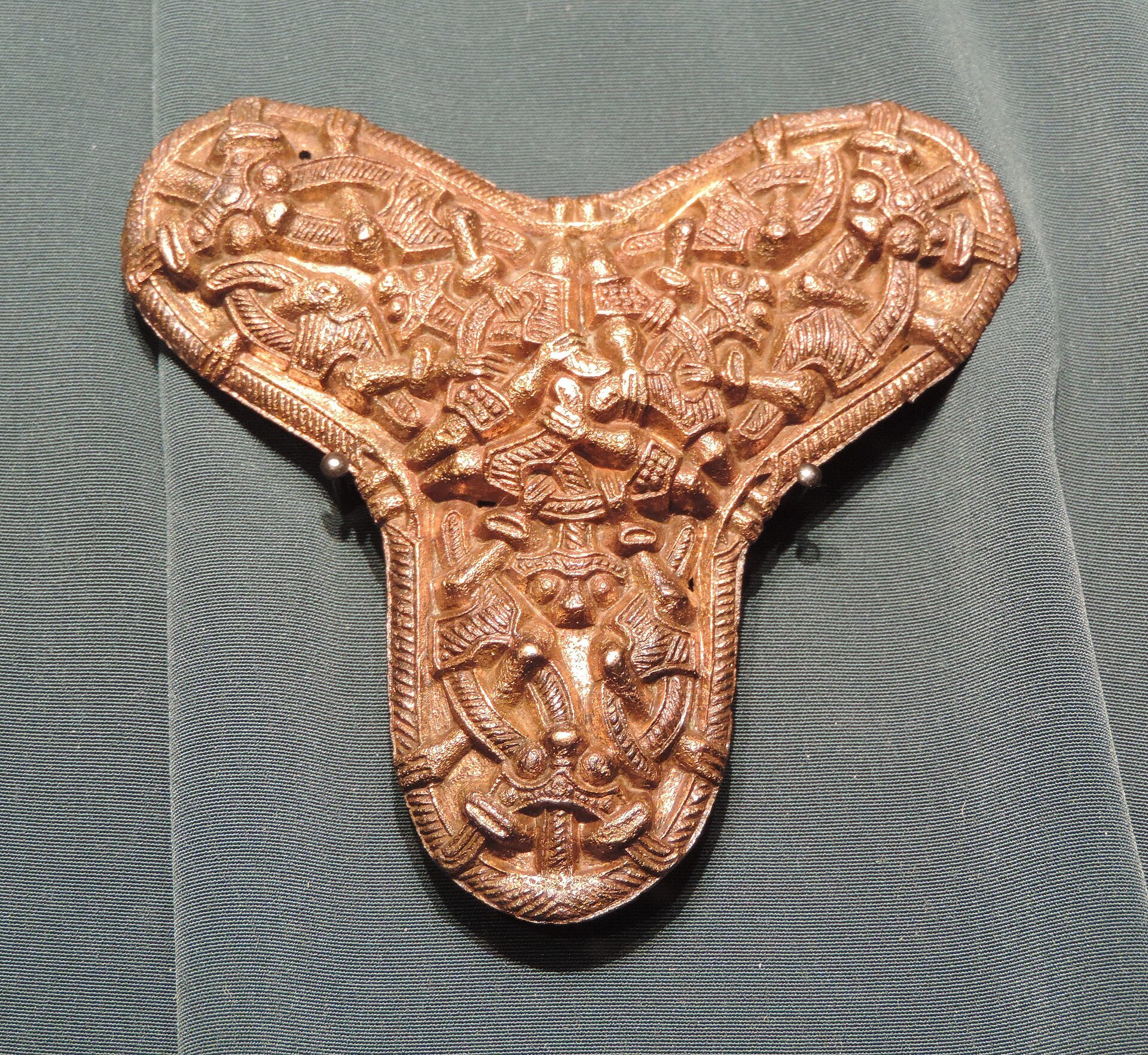
An art style found from the British Isles to the Dnieper carries the name of a mound that road workers used as a sand pit. Among the things they dug out at Borre on the Oslofjord were gilt mounts from a horse harness, covered with a band of rings and with small animals that hold on to everything within reach. This article shows how to recognise the Borre style, how scholars date it, where it occurs, and where the published figures disagree.
Nobody in the Viking Age ever spoke of a “Borre style”. The name is a label of modern archaeology, taken from the find spot of the pieces on which the design language was first described. All the style names of the period work this way. Our overview of the art styles of the Viking Age covers the whole sequence; this article looks at one link in the chain, in more detail.
Borre lies in the north of Vestfold, near Horten on the western shore of the Oslofjord. Large burial mounds stand close together there, and one of them held a ship. That mounts from a horse harness gave their name to a style found mainly on jewellery is an accident of research history.
The division of Viking art into style phases builds on the Swedish archaeologist Bernhard Salin, who classified the older Germanic animal ornament in 1904. According to the English Wikipedia, the framework in general use today goes back to the book “Viking Art” by David M. Wilson and Ole Klindt-Jensen (1966). I have not consulted it myself and pass the attribution on as given.
Even the year of discovery is not reported uniformly. The Store norske leksikon (SNL), the main Norwegian encyclopedia, gives 1852 in the heading of its article on the Borre mounds; the body text is more precise and says that road workers came upon the ship grave in 1851 while removing fill, and that the investigation followed in 1852. The English Wikipedia speaks of first investigations in 1851–1852, which fits: discovered in 1851, examined in 1852.
What remained of the grave was examined by the antiquarian Nicolay Nicolaysen, the same man who decades later excavated the Gokstad ship. The SNL names Rudolf Keyser beside him. There was not much left to save. According to the SNL the mound measured 38.5 metres across and consisted mostly of sand. Little of the ship survived as a result; the encyclopedia describes it as a clinker-built vessel 17 to 20 metres long. Clinker-built means that the planks overlap and are riveted together. The three-metre range shows how uncertain the reconstruction is.
Grave goods did survive. The SNL lists gilt harness fittings for driving and riding, remains of a saddle and a sledge, five stirrups, weapons, a glass beaker, and the bones of at least three horses and a dog. More on such grave goods can be found in our articles on Viking horses and on boat burial.
Who lay in the ship is unknown. I found no statement about human remains in the texts I evaluated. The finds belong to the Museum of Cultural History of the University of Oslo. The English Wikipedia names the Viking Ship Museum in Oslo as the place of display; I have not checked the present state of the exhibition.
The mounts from Borre carry the pattern that became the best-known feature of the style: the ring-chain. It is a symmetrical band of interlocking links. The English Wikipedia describes it as symmetrical and double-contoured, meaning that a second line accompanies each edge of the band. The illustrator Jonas Lau Markussen, who has worked through the Viking styles in a freely accessible compendium, breaks the pattern down into basic geometric shapes: circles and lozenges set tightly against each other. The band often ends in an animal head that faces the viewer.
The SNL describes the same motif slightly differently, as interlace in circles and lozenges ending in masks seen from the front. The encyclopedia lists it as the first of three main motifs of the style.
The gripping beast is older than the Borre style. It already belongs to the preceding Oseberg style: a small, compact creature whose paws clutch the frame, its neighbours or its own body. The carvings of the Oseberg ship are full of them. In the Borre style, according to Markussen, this animal becomes the principal animal form, while the older ribbon animal, an elongated creature with a band-shaped body, almost disappears and survives only as the terminal of a band.
What does the Borre beast look like? Markussen lists a forward-facing triangular head, round or almond-shaped eyes, protruding ears, an oval snout, a short, squat body and slim, elongated legs. Often the animal is curled into a knot resembling a pretzel and holds on to its own limbs and to a circular frame with all four paws.
The SNL distinguishes two animal motifs. One is a single standing beast with a triangular mask seen from the front. The other is a more naturalistic animal in profile that turns its head back. For this backward-looking animal the encyclopedia assumes a Scandinavian origin.
According to Markussen, one detail is new and will be taken up by later styles: the spiral at the hip joint. He regards it as inspired by the vegetal scrollwork of continental Europe. That is an inference from comparing forms. In the Mammen style the spiral hip then becomes a main feature of the large animals.
Motifs alone do not make a style. There is also the way a surface is treated, and here the Borre style is very clear. The English Wikipedia notes that the designs fill the available space tightly and leave hardly any background. Markussen describes the same thing as very tight interlacing with the ground almost invisible. Every field is occupied.
The lines are of even width and do not taper. Circular curves are preferred, bands often run in double or triple strands, and the whole stands in high relief: the forms rise from the ground instead of being merely incised.
A rule of thumb: geometrically built, tightly packed, sculptural. Drawing exercises are in our article on drawing Norse animal ornament.
On the origin of the main motif, the two most thorough of the accounts I evaluated give different answers. The SNL considers the interlace of circles and lozenges with mask terminals to be probably of Anglo-Saxon origin. Markussen writes that the ring-chain may be a Scandinavian innovation; the geometric frameworks could have developed from those of the older Broa and Oseberg styles.
Both positions are phrased cautiously, with “probably” and “may”. The objects themselves can hardly settle the question: a pattern can be adopted, rebuilt and passed on without any inscription recording it.
Markussen states that he relies on James Graham-Campbell’s “Viking Art” (2013) and on Signe Horn Fuglesang’s paper “Early Viking Art” (1982). I have read neither work myself.
An ornament carries no date. What is dated is the context in which it lies: a grave whose timbers can be fixed by their tree rings (dendrochronology), or a hoard in which decorated pieces were buried together with coins. Markussen calls the Borre style the first phase of Viking art that can be dated more accurately in this way, and points to coins in hoards.
The English Wikipedia lists the fixed points on which the dating rests: Borre around 900, Gokstad 900 to 905, Tune 905 to 910, the Danish fortresses of Fyrkat (980) and Trelleborg (980/981), and coin-dated hoards. For Gokstad and Tune it cites the tree-ring study by Niels Bonde and Arne Emil Christensen, published in Antiquity in 1993. What the figure “around 900” for Borre itself is based on does not emerge from the text. The Gokstad grave also contained Borre-style mounts; the Tune ship belongs to the same years.
These anchors produce date ranges, and the ranges vary from author to author:
Almost a century and a half separates the earliest start from the latest end. None of the sources is at fault: a style has no cut-off date, workshops go on using old models, and heirlooms reach the grave late. The only defensible wording is something like: middle of the 9th to the second half of the 10th century, with well-dated examples around 900.
According to the SNL the Borre style grows out of the Oseberg style and refines its animal ornament with some new motifs. Markussen stresses the break more strongly: Oseberg had already renewed traditional Norse animal ornament, and Borre departs from it almost completely in many respects. The gripping beast remains, but it becomes a single figure within a geometric framework.
In time, Borre overlaps with the Jelling style, which Markussen places at about 900 to 975 and which prefers slender, ribbon-shaped animals in profile. The two styles do not succeed one another. They run side by side for several decades. More on the name-giving site can be found in our article on Jelling.
That the very count of styles is a convention is shown by the Nottingham text, which divides Scandinavian art of the Viking Age into five styles, beginning with Borre, and leaves out Oseberg. Our overview counts six.
The Borre style is a style of metal. The SNL names jewellery and fittings in bronze, gold and silver as its main carriers. The finest pieces are of gold or silver, some gilded and decorated with niello, a black inlay of metal sulphide that sets off bright surfaces. Cruder versions of the same patterns occur on cast bronze. The same ornament was thus available in an expensive and in an affordable version.
Which object types are involved? Our article on Viking jewellery notes that the style is very common on oval brooches and strap fittings. Oval brooches are the domed fasteners worn in pairs on the women’s strap dress. Markussen cites a penannular brooch from Birka which, by his description, unites all the features on one piece: ring-chains, knots, gripping-beast heads and tiny ribbon-animal heads. From the English material the Nottingham project lists an equal-armed brooch, a disc brooch, a strap-end and buckles. Trefoil brooches, three-armed fasteners, occur as well: the same project’s finds database lists a trefoil brooch from Leicestershire whose Borre-style interlace assigns it to a type of its own (Maixner’s type E).
One gap is striking. According to the SNL, no sword and no spear with Borre-style decoration has been found so far. This describes the present body of finds and may change with the next discovery.
According to Markussen, the Borre style is the earliest Viking Age style to appear outside Scandinavia. The Nottingham text says the style reached England with Scandinavian settlers from the late 9th century. Its author, Cassidy Croci, relies on a datasheet by Jane Kershaw (2010) and distinguishes two groups of finds: pieces with purely Scandinavian ornament and pieces in a hybrid style that adapts Norse features to insular habits. For the historical setting see our articles on the Danelaw and on Jórvík, Viking Age York.
One detail separates imports from local work: Scandinavian disc brooches, Croci says, are domed and hollow at the back, English ones of the period flat. A gilded disc brooch from Cossington in Leicestershire was therefore probably brought from Denmark.
The biggest change concerns the material. Stone sculpture hardly existed in Scandinavia at this time, whereas it was common in the British Isles. Local and immigrant carvers took the pattern over into their crosses, and it changed in the process: on British stones, Croci writes, the ring-chain appears in a “vertebral” form, with a central rib and side loops, recalling a backbone. The best-known example is the shaft of the Gosforth Cross in Cumbria, whose images we discuss in our article on the stone crosses of Gosforth and Kirk Andreas. Croci also names the Isle of Man, Yorkshire and a stone from St Mary’s Church at Bakewell in Derbyshire.
On the Isle of Man the pattern has even been given a name. Markussen speaks of “Gaut’s ring chain”, a variant widely used in the Norse-settled regions of the British Isles. Gaut is the carver who names himself on a rune-inscribed cross at Kirk Michael and claims to have made “this and all in Man”. Whether the variant really was his invention cannot be clearly demonstrated.
According to the SNL the style occurs throughout Scandinavia and in the Scandinavian settlement areas of the British Isles, the Continent and the Baltic region as far as Russia. It is said to be strongest in the east. The encyclopedia names Birka in Lake Mälaren, Novgorod, Gnezdovo and Værne kloster in Norway as find places.
Gnezdovo lies on the upper Dnieper near Smolensk in Russia (the SNL wrongly places it in Ukraine); we describe the site, with its stronghold, settlements and graves, in our article on the route from the Varangians to the Greeks. Which individual pieces from Gnezdovo are assigned to the Borre style, and how many there are, I have not seen in any of the sources evaluated.
What does a Borre mount on the Dnieper prove? At first only that an object got there. Jewellery travels by trade, gift and plunder. The SNL reports a more far-reaching interpretation: during the peak of Scandinavian expansion the style may have served as a marker of Norse identity. The encyclopedia adds that Borre is the last Viking Age style whose distribution roughly matches that of Norse religion. Both are modern interpretations; no text of the period says what a gripping beast on a brooch meant.
The site has been laid out as a park since 1932. Counts of the mounds differ. The SNL gives nine large mounds, 19 smaller ones and two large cairns for 1852, and more than 50 known monuments today. The English Wikipedia speaks of seven large and 21 smaller mounds; at least two mounds and one cairn are said to have been destroyed in modern times. According to the SNL the large mounds measure 34 to 45 metres across and stand up to seven metres high; Wikipedia says up to six.
More important than the number is the age. Excavations in the late 1980s, which Wikipedia connects with the archaeologist Bjørn Myhre and the years 1989 to 1991, showed that the oldest of the large mounds was raised around 600, long before the Viking Age. According to the SNL the site was in use for about 300 years. Smaller mounds, investigated in 1927 (Wikipedia says 1925), contained simple cremation graves. Since 2007, ground-penetrating radar has revealed the outlines of three large halls, along with indications of chamber graves and of another possible ship grave, reported in 2019. The Midgard Vikingsenter, part of the Vestfold museums, opened at Borre in 2000.
There is also a written tradition about Borre. Ynglingatal, a praise poem on the ancestors of a Norwegian king which Snorri Sturluson quotes in his Ynglinga saga, names the place as a burial site:
Ok buðlung á Borrói sigrhafendr síðan fálu.
“And the prince the victorious then laid to rest at Borre.”Ynglingatal, end of the stanza on Hálfdan inn mildi, preserved in Snorri Sturluson’s Ynglinga saga, ch. 52 in the edition of Linder and Haggson (heimskringla.no); other editions number differently; our own translation
The Norwegian archaeologist Anton Wilhelm Brøgger therefore linked the cemetery with the Vestfold kings of the Yngling line. Myhre, according to the SNL, read Borre differently: as an older, mythically charged centre of power where members of different ruling lines were buried to support their claims. When the poem was composed is disputed, and in any case it does not say which king lies in which mound. The mounts do not prove a royal grave, and the poem does not date the mounts.
A style name is a sorting tool. It allows a brooch from Leicestershire, a pendant from Sweden and a mount from the Dnieper to be placed side by side with the remark: same design language, similar time. It does no more than that. It says nothing about the wearer’s language, belief or origin, and many objects carry features of Borre and Jelling at once.
There is also a problem of record. The pieces from Borre come from a grave destroyed by sand digging before anyone could draw a plan. The description of the style has therefore long rested on many other pieces from graves and hoards as well.
For work with the ornament today, one simple rule follows: anyone who draws a Borre-style motif or has it laser-engraved should be able to name a specific find as the model.
How do I recognise the Borre style at a glance? By three things: a chain band of rings and lozenges, a small animal with a triangular face that grips with its paws, and a surface on which no background is left free.
When was the Borre style in use? The figures vary. The Norwegian encyclopedia SNL gives about 830 to 950, other accounts the late 9th to late 10th century. Well-dated anchors are the ship graves of Gokstad and Tune from the years just after 900.
How does it differ from the Oseberg style? Both know the gripping beast. In the Oseberg style many animals fill lively carved fields; in the Borre style a single animal sits within a geometric framework, and beside it stands the ring-chain, which Oseberg does not have.
Can the mounts from Borre be seen? The finds belong to the Museum of Cultural History of the University of Oslo. Whether and where they are currently on display I have not checked; look at the museum’s website before travelling. The cemetery itself is open as a park, and the Midgard Vikingsenter is also at Borre.
Is the ring-chain the same as a Celtic knot? No. It is a distinct, strictly symmetrical chain pattern from Scandinavian metalwork. In the British Isles it was carved in stone in a modified form, for example on the Gosforth Cross and on the crosses of the carver Gaut in the Isle of Man.
Viking-age art styles · Drawing Animal-Style Ornaments · The Mammen style: the Bjerringhøj axe and a grave from the winter of 970/971 · The Oseberg ship & the two women · The Urnes portal – the last animal style.
A whole style of Viking Age art is named after a village near Viborg in Jutland, and it owes the name to one object: an …
Read more →Few questions reach our workshop as often as this one: „Is that symbol really old?" We love engraving Norse signs – but …
Read more →A clean Norse animal ornament is neither an accident nor generic "Viking scribble". Behind it stand six clearly …
Read more →The triquetra is an interlaced knot of three pointed arcs, and its honest meaning is this: it is an ancient, widespread …
Read more →