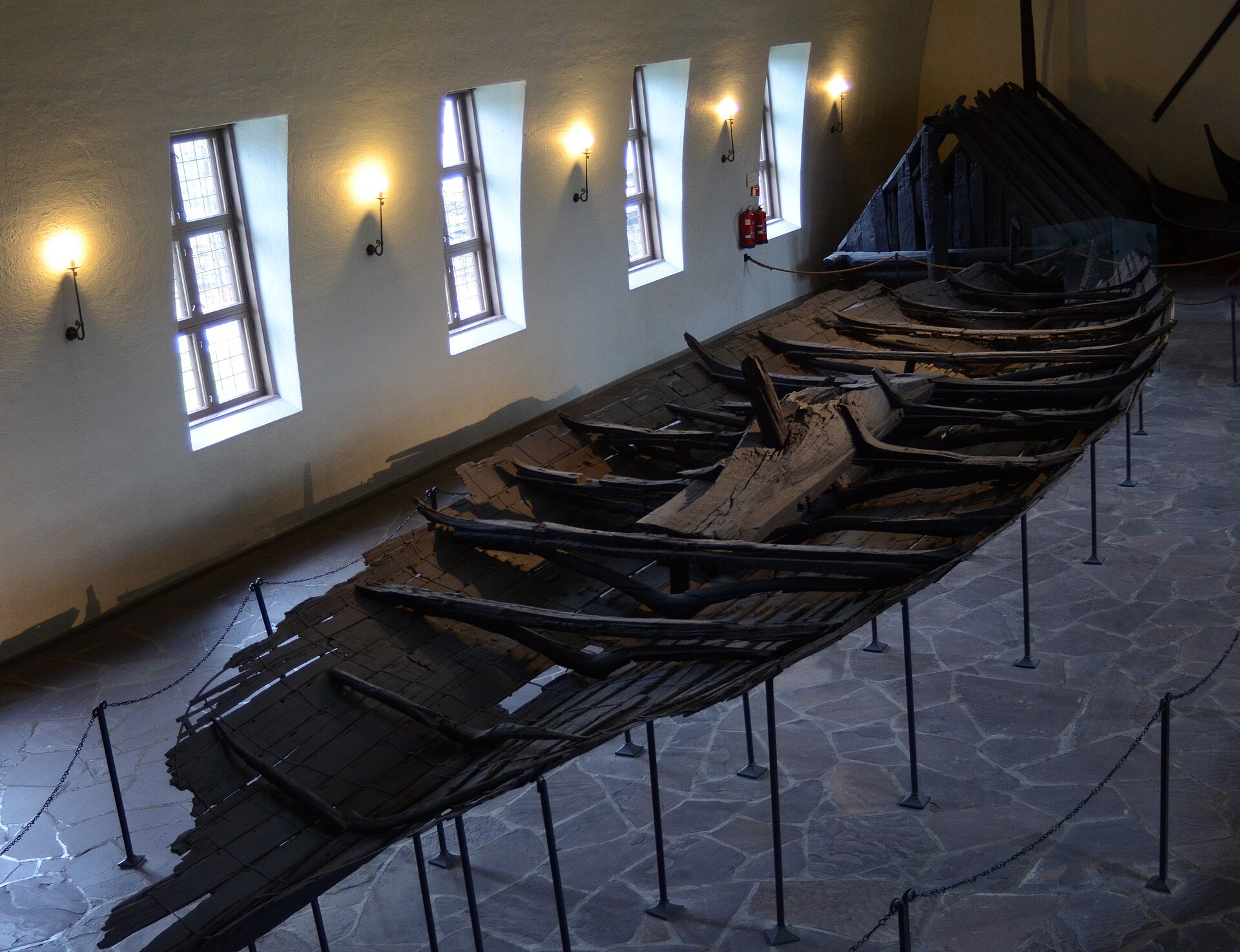
Next to Oseberg and Gokstad it looks like a wreck: a shallow ship's bottom of dark oak, no stems, no carved tendrils. Yet Norwegian ship archaeology starts here. In the autumn of 1867 the Tune ship was lifted out of a burial mound on the island of Rolvsøy in Østfold, thirteen years before Gokstad. The excavation lasted only a few weeks, the records are thin, and almost every figure comes in two versions. This article sorts out what the find, the tree rings and recent survey work can support, and says plainly where the record of the dig has gaps.
The site lies on Haugen farm on Rolvsøy, an island that now belongs to the municipality of Fredrikstad in Østfold. Local people called the mound “Båthaugen”, the boat mound.
How large the mound was can only be stated roughly. The Norwegian encyclopedia Store norske leksikon gives a diameter of about 60 metres and a height of about 4 metres. The Norwegian Institute for Cultural Heritage Research (NIKU), in a news item from 2020, says 4 metres high and 80 metres across; the Museum of the Viking Age says “up to 40 to 80 metres”. I could not establish which measurement each figure goes back to. The mound was in any case far from intact in 1867. According to the encyclopedia, the farm's owner, Ole Arvesen, had started carting soil out of it before 1867 for use on his land. A large part of the mound was gone before any archaeologist saw the place.
That an investigation happened at all is credited by the same source to a man named Hans Bassøe. He had the digging stopped and brought in Fortidsminneforeningen, the Norwegian society for the preservation of ancient monuments.
The excavation was led by Oluf Rygh. According to Store norske leksikon it was the first archaeological investigation he ever led. It took only a few weeks and was finished around 1 October 1867.
That brevity explains nearly every problem the Tune ship still poses. In 1867 there was nothing to copy. Nobody in Norway had excavated a Viking ship before, or knew how to lift wet, soft oak out of clay. The encyclopedia puts it soberly: the documentation does not meet modern standards. NIKU calls it minimal. Anyone who wants to know exactly where an object lay depends on Rygh's short report and on what the timber itself still shows.
Rygh also gave the find its name. He called the ship after the parish of Tune, to which the farm then belonged.
After the excavation the ship was taken by raft to Kristiania, today's Oslo, and put on display in the university garden. That is what Store norske leksikon says. How the hull was raised from the mound is not described in the sources I could reach.
According to Store norske leksikon, the ship moved in 1929 to the Viking Ship House (Vikingskipshuset) on the Bygdøy peninsula, the building that also housed Oseberg and Gokstad. Unlike its two famous neighbours, Tune was never built up into a complete hull. In February 2026 the director of the present museum, Aud V. Tønnessen, told the news agency NTB that it is the “most authentic” Viking ship in the collection, because it has hardly been altered since 1867. Put plainly: what lies in the museum is essentially what came out of the mound.
What survives is mainly the lower part of the hull. The ship is built of oak in the clinker technique: the planks overlap like roof tiles and are riveted together along the overlaps. How that method works, and why it made ships light and flexible, is explained in our article on Viking shipbuilding.
Several sources single out the mast step, the heavy timber on the ship's bottom in which the mast stood. The NTB report of 2026 calls it especially sturdy and infers a large sail of up to 100 square metres. That number is a reconstruction, not a find: nothing of the sail itself survives. What can be known about Viking Age sails at all is covered in our article on sails and textiles.
The ship had 11 or 12 pairs of oars. That “or” already shows how much is missing higher up. The oar ports sit in the upper part of the side, and that is exactly the part that is poorly preserved. The NTB report says there was room for 26 men.
Look up the length of the Tune ship and you will find at least three answers.
Store norske leksikon (as of April 2026) gives a length of “up to 22 metres” and a beam of 4.35 metres. The NTB report of February 2026 speaks of about 19 metres in length and a good 4 metres in width. The smallest figure is the museum's own: the Museum of the Viking Age's page on the Tune ship (as of 12 October 2026) gives about 18.7 metres in length, a beam of 4.2 metres and room for around 26 men.
The reason for the confusion is simple. Both stems are missing, so the ends of the ship have to be supplied. Any overall length is the result of a reconstruction, and depending on how steep and how tall the stems are drawn, the ship comes out shorter or longer. The beam is uncertain for a similar reason: after a thousand years under earth and almost a century on supports, the hull has sagged and spread.
As a rule of thumb: a good 4 metres wide, just under 19 metres long according to the museum, and up to 22 metres on the most generous figure. That makes Tune the smallest of the three Oslo ships. The Gokstad ship measures roughly 23 to just under 24 metres with a beam of a good 5 metres, and has 16 pairs of oars.
The age rests on dendrochronology, tree-ring dating. Matching the ring sequence of a timber against a reference curve can, in favourable cases, give the year the tree was felled. Niels Bonde and Arne Emil Christensen examined the three ship burials of the Oslofjord in this way and published their results in the journal Antiquity in 1993. I was not able to consult the paper itself for this article and rely on how Store norske leksikon reports it.
According to the encyclopedia, the burial at Tune was constructed around 910 or somewhat later, and the ship was still relatively new at that point. The NTB report sums this up as “probably around 910”; the English Wikipedia gives a building date of about 900. I found no building date exact to the year confirmed in these sources.
The order of magnitude is enough to place the find. The Tune burial is only a few years later than Gokstad, whose burial is dated to about 900 to 905, and a good two generations later than Oseberg, which dates to 834. One difference stands out. By the tree rings, the Gokstad ship was already a good ten years old when it was buried, the Oseberg ship about fourteen. At Tune a fairly new ship went into the mound.
Behind the mast, in the after part of the ship, stood a wooden burial chamber. In and near the chamber were remains of a human skeleton and horse bones. The human bones have not been preserved, so no modern study of age, illness or origin is possible. That the dead person was a man rests on the weapons, not on a skeletal analysis.
Store norske leksikon lists the following finds: two glass beads, remains of textiles, four small carved pieces of wood, parts of a ski, and badly rusted iron. In the iron, traces of a sword, a spearhead and a shield boss could be made out. There were also the skeletons of several horses; NIKU says three. The encyclopedia further lists a spade and a second oak implement, which the English Wikipedia calls a handspike, that is, a lever bar, and the remains of a barrel. Whether the tools date from the building of the mound or were left by someone who opened it later, the sources I consulted do not say.
Compared with Oseberg, that is little, but it does not follow that the burial was poor. The mound had been dug into, the excavation was short, and the chamber had probably been opened earlier. What is missing may never have been there, or may have been taken.
No written source mentions the grave on Rolvsøy. There is no rune stone at the site and no saga passage that can be tied to this mound with any confidence. Who was buried here is unknown.
Store norske leksikon names Shetelig, Brøgger and Steinnes as researchers who linked the dead man to the “Alvheim kin”, a ruling family spoken of in later Icelandic narratives. Such identifications follow the same pattern as equating the Gokstad man with Olaf Geirstaðaálfr or the Oseberg woman with Queen Åsa: a name is taken from thirteenth-century tradition and laid over a find of the ninth or tenth century. It cannot be proved. Some three hundred years of oral transmission lie between the burial and the texts.
Snorri Sturluson himself shows how far text and soil can diverge. In Ynglinga saga he has Odin lay down the burial customs of the North:
“He ordained that all dead men should be burned, and their possessions carried onto the pyre with them; he said that everyone would come to Valhalla with such wealth as he had had on the pyre.”
Snorri Sturluson, Ynglinga saga, ch. 8 (Old Norse text after heimskringla.no, as quoted in this site's article on Ynglinga saga); own translation
The same chapter says that a mound should be raised in memory of men of standing. The mound fits Tune; the pyre does not. The dead man of Rolvsøy was laid unburnt in a chamber, with horses, weapons and an entire ship. Snorri wrote in the thirteenth century, as a Christian, about a time he knew only from poems and stories. His rule describes an idea of heathen custom, not a record of practice. The real variety of graves, from cremation in a boat to a chamber grave in a ship, is set out in our overview of boat burial.
Rygh was not the first into the mound. Store norske leksikon considers it possible that the grave was opened as early as the late tenth century. That would be the same period in which the mounds at Oseberg and Gokstad were broken into. For those two, Jan Bill and Aoife Daly dated the spades the intruders left behind and proposed a political reading; the details are in our Gokstad article. As far as I know, no such proof has been produced for Tune. The evidence supports no more than a “possibly”.
There is a second, more recent layer of disturbance. For the 150th anniversary of the excavation, the Norwegian journal Viking published a paper entitled “Skipsgrav eller skipsgraver på Rolvsøy?”: one ship grave or several on Rolvsøy? I know it only from its English abstract. According to that, there are reports from 1755 and 1823, as well as oral tradition that reached Rygh in 1867, about earlier sightings of a ship on the island. From these, at least three different ship burials had been inferred.
The paper examines the excavation reports, the old notices and land-register records and arrives at a more cautious result. There are convincing indications that the Tune ship was dug into at least once before 1867. All three notices may refer to the same event at the same place. And a change in how the plot was assigned in the land register may explain part of the confusion. Whether several ships lay on Rolvsøy, or whether people were always talking about one, remains open. The abstract also notes that the burial ritual at Tune differs from that at Oseberg and Gokstad, and that the relationship to other rich graves of the period on Rolvsøy needs further study.
For a long time Tune stood in the shadow of its two big neighbours and was treated as a smaller, less informative ship. The work of the Norwegian ship archaeologist Knut Paasche has changed that. He documented the hull afresh and reconstructed its shape, publishing the results as “The Tune Viking Ship Reconsidered” in the International Journal of Nautical Archaeology. NIKU, Paasche's institute, reported on it in March 2020. I have not read the paper itself, only that report.
Two points matter. The first concerns method. The ship was recorded by laser scanning; according to NIKU this was the first time the technique had been used on a Norwegian heritage object and the first time in ship archaeology at all. A scan captures the present, distorted shape of every timber, from which the original hull form can be worked back.
The second point is the result. According to Paasche, the Tune ship has a different ratio of length to beam and a flatter bottom than Oseberg and Gokstad. He concludes that it “must have been a fast sailer that also worked serviceably as a rowing ship” (as quoted in Store norske leksikon), according to the NIKU item a quick courier ship built to move many men at speed. The NTB report of 2026 accordingly speaks of a fast warship for long voyages.
How firm is that? The hull form is evidence as far as the timber goes. Everything above the surviving planks, the height of the sides, the stems, the mast and the sail area, is inferred. A word such as “fast” rests on comparing hull lines and on experience with replicas of other ships, not on a measured trial with a Tune replica. I do not know of a full-size sailing replica; none is mentioned in the sources I consulted. What replicas can show in general, and where their evidence ends, is discussed in our article on Viking ship replicas.
In the literature Tune is often called a “karvi”, an Old Norse word for a smaller, general-purpose ship. That is a modern assignment; no text says which find was a karvi. The type names are explained in our article on Viking ship types.
According to NIKU, only three well-preserved Viking ships are known from burial finds in Norway: Oseberg, Gokstad and Tune. All three are clinker-built in oak, all three lay under large mounds by the Oslofjord, and all three had a burial chamber behind the mast.
Oseberg is the oldest: built around 820, buried in 834, with 15 pairs of oars and richly carved stems. Two women lay in the grave, with a wagon, sledges and weaving equipment. Gokstad was built around 890 and buried around 900 to 905 with a man; it is the largest and best preserved of the three, with 16 pairs of oars. Tune follows around 910 or somewhat later. It is the smallest and the worst preserved, and its grave inventory is the leanest.
The series is still valuable for the history of technology, precisely because the three ships were built in the same region within less than a hundred years. They show that there was no such thing as “the” Viking ship. As early as about 900, the builders of the Oslofjord were producing different hulls for different jobs. The split into slender warships and beamy cargo carriers that becomes visible a century later in the wrecks from Skuldelev has its prehistory here. The older stages can be seen in the Nydam boat, an Iron Age rowing vessel without a mast, and in the still older Hjortspring boat.
The old Viking Ship House on Bygdøy has been closed since 2021. On the same site, with a large new building right beside the old one, the University of Oslo is creating the Museum of the Viking Age (Vikingtidsmuseet). The ships have already moved: Oseberg in September 2025, Gokstad in October 2025, and Tune last, in February 2026. According to the NTB report of 24 February 2026, it was brought into the new building on that Tuesday, and the whole operation took several days.
The ship cannot be seen at present. According to the same report, the opening was planned for November 2027. The museum's page on the Tune ship (last changed 12 October 2026) says only that a new museum is being built and gives no date; on 16 November 2026 I could not confirm whether November 2027 still holds. Norwegian media reported in 2026 on open questions about the funding of the museum's operation; I know the state of that debate only from headlines. Anyone planning a trip should check the museum's own information shortly beforehand. What Oslo offers on the Viking Age in the meantime is covered in our article on Vikings in Oslo.
For us, a small workshop that laser-engraves Norse motifs, Tune is a useful yardstick: a find with no carving and no glamour that still shows how closely one has to look.
When and where was the Tune ship found? In the autumn of 1867 in the burial mound Båthaugen on Haugen farm on Rolvsøy, now in the municipality of Fredrikstad in Østfold, Norway. Oluf Rygh led the excavation, which ended around 1 October 1867.
How old is the Tune ship? By tree-ring dating, the burial was constructed around 910 or somewhat later. The ship was relatively new at the time.
How big was the ship? A good 4 metres wide (4.2 to 4.35 metres depending on the source) and, because the stems are missing, between 18.7 and 22 metres long depending on the source; the museum gives 18.7 metres. It had 11 or 12 pairs of oars and a mast.
Who was buried in the Tune ship? That is unknown. The finds included remains of one person, which have not been preserved, along with horse bones and traces of a sword, a spear and a shield. The weapons point to a man of high rank; no name has come down.
Can the Tune ship be visited? Not at present. Since February 2026 it has stood in the new building of the Museum of the Viking Age in Oslo, which has not yet opened. The opening was planned for November 2027 (according to a report from February 2026).
The Gokstad ship · The Oseberg ship and the two women · The Gjellestad ship burial · Boat burial · Viking shipbuilding · Ship types · The Skuldelev ships · The Nydam boat · The Hjortspring boat · Vikings in Oslo
The Gokstad Ship · The Oseberg ship & the two women · Viking Shipbuilding · Boat burial – the burning ship · The Skuldelev ships.
All Ships & Seafaring articles →
From Norway to Iceland, on to Greenland, and finally to the coast of Newfoundland: Norse ships crossed the North …
Read more →No piece of Viking-Age equipment shaped history like the ship. It carried traders to the Volga, settlers to Iceland and …
Read more →The Viking ship has become the emblem of an entire age – usually a slim hull with a dragon head and shields along the …
Read more →The Gokstad ship is the largest surviving Viking ship in Norway: a roughly 23-metre oak vessel built around 890, buried …
Read more →