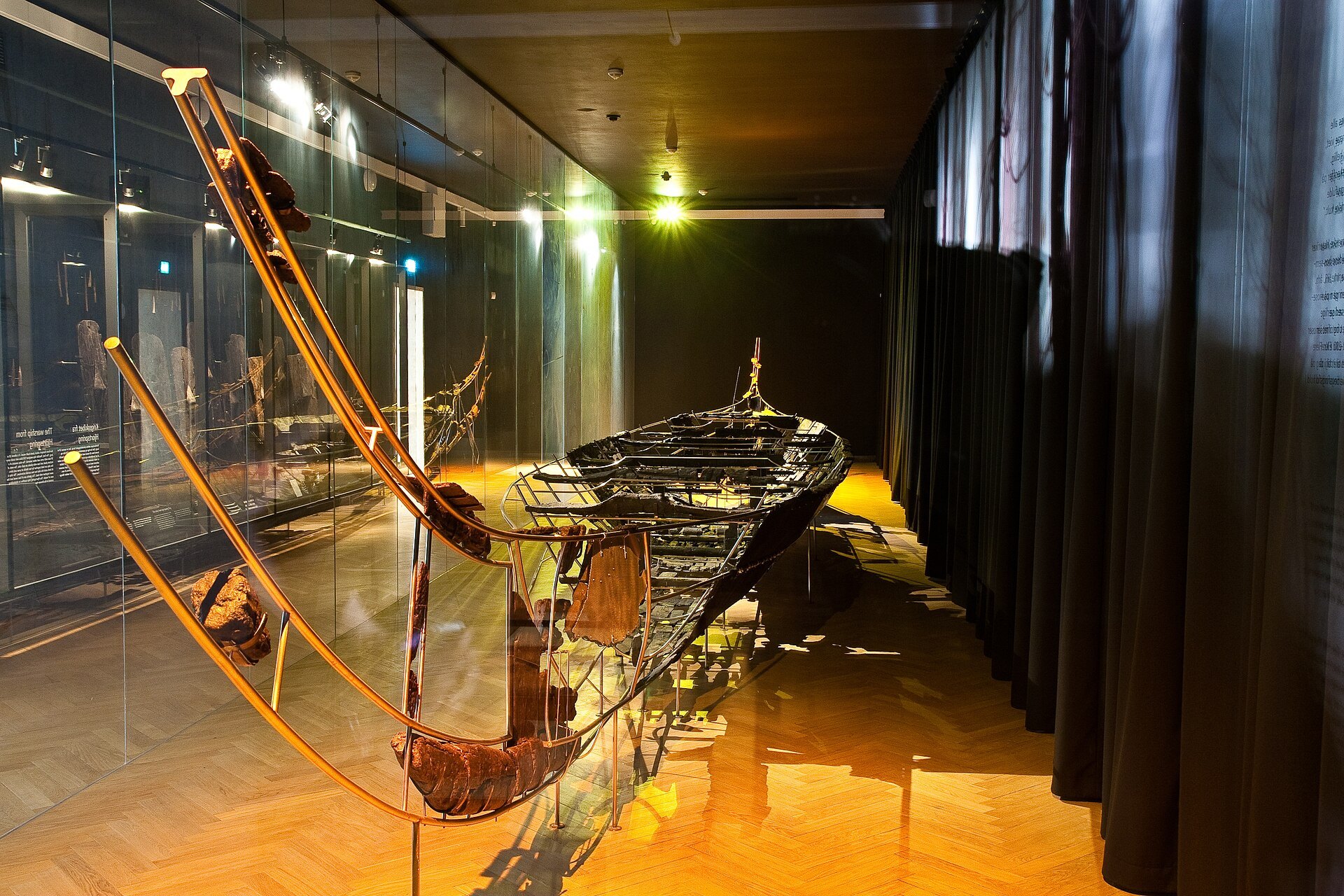
Not a single iron nail holds this boat together. Five thin planks of lime wood, sewn with bast cord and sealed with pitch, and at each end two curving “beaks”: that is the oldest plank-built boat found in Scandinavia so far. It lay in a bog on the Danish island of Als, together with shields, spears and swords for far more men than the boat could carry. This article sets out what the excavation of 1921–22 produced, where museum, replica guild and reference works give different figures, and what a 2025 study of the cordage and caulking has added.
Trace the history of Nordic shipbuilding backwards and you move from the longships of the Viking Age to the Nydam boat of the Roman Iron Age. Beyond that the evidence thins out. Then, centuries earlier, comes a single vessel: the boat from Hjortspring bog on Als, an island off the east coast of southern Jutland. The National Museum of Denmark calls it northern Europe's oldest plank-built vessel; the replica guild, more carefully, speaks of Scandinavia's oldest plank-built vessel found to date.
Both phrasings have the same limit. This is the oldest surviving boat of its kind, not the first ever built. The National Museum puts it this way: the boat shows a shipbuilding tradition with roots in the Bronze Age.
The find belongs to the pre-Roman Iron Age. That is northern European archaeology's term for the centuries in which iron was worked but Rome had not yet reached the North. Vikings were a long way off: more than a thousand years separate the Hjortspring boat from the start of the Viking Age.
Archaeologists did not discover the boat. According to the account given by the 2025 study, peat cutters came upon the remains in Hjortspring bog in the 1880s; a formal investigation only began in 1920. In 1921 and 1922 Gustav Rosenberg excavated the find for the National Museum in Copenhagen.
The same account says about 40 per cent of the original boat was recovered, enough to reconstruct its form. All later work rests on Rosenberg's description of the find and on the excavation drawings; the replica guild states that it built on these too.
According to the guild and the 2025 study, the boat has been on display since 1937. In 1965 it was taken out of the exhibition, dismantled, conserved again and packed away. Lack of funds delayed its reinstallation until 1988. Since then boat and finds have stood again in the exhibition on Danish prehistory in Copenhagen, the fragile original pieces mounted on a metal frame that traces the original shape.
The conservation had a consequence that only mattered a century after the dig: treated wood can no longer be radiocarbon dated. Dating the boat requires material the chemicals never touched.
The hull consists of remarkably few parts. The National Museum describes one bottom plank and two wide planks on each side, sewn together with bast, plus two blocks that hold the ends together. The guild lists the same elements and calls the vessel a keelless, round-bottomed canoe.
The planks are lime wood and very thin. The guild gives about 3 centimetres at the bottom and 1.5 centimetres at the rail.
Everything is held together by stitching. According to the English Wikipedia the planks overlap at bevelled edges, much as in later clinker building. For the cord, older summaries list lime bast, spruce root or rawhide side by side. The guild speaks of lime bast cord, and the 2025 study examined surviving cordage made of lime bast. There is no metal in the hull. The guild adds locking strips and nails of oak, that is, wooden nails.
Inside sit ten frames, the transverse ribs of the hull. The guild says lime, ash and hazel were used for them. The English Wikipedia describes the principle more closely: hazel rods as ribs, lashed to cleats that were left standing when the planks were hewn out. A cleat is a small block of wood projecting from the plank to take the lashing. Each plank therefore had to be carved from a much thicker piece. I have seen this detail only in the encyclopaedia summary, not in the excavation report.
The most striking feature is at the ends. The National Museum describes two curving extensions at each end. None of the sources I have seen says what these “beaks” were for.
Almost every measurement of the Hjortspring boat comes in several versions. A boat that is 40 per cent preserved has to be reconstructed, and different institutions measure differently.
Length: the National Museum writes “almost 20 metres”, the guild “over 19 metres”. The interior is much shorter: about 13 metres according to the guild, 13.6 metres according to the English Wikipedia. The beam is about 2 metres, the height amidships 0.7 metres on the guild's figures.
Weight: the National Museum gives 530 kilograms, the guild about 500 for the hull and 550 for its replica during the trials. Loaded with 22 people and their gear, the guild reckons with about 2,500 kilograms and a draught of only some 30 centimetres.
The figures for the crew differ most. The National Museum speaks of 24 men with weapons and equipment. The guild reckons with 22 in one place (19 paddlers, captain, helmsman, drummer) and 20 in another (18 paddlers, helmsman, skipper). The English Wikipedia counts ten thwarts, or cross-benches, with room for two people each and arrives at a minimum of 20. A little over 20 people is the firm order of magnitude.
The Hjortspring boat was paddled. Rowers sit with their backs to the direction of travel and pull a long oar that pivots on the boat's side; paddlers face forward and hold a short blade freely in both hands. Paddles of maple wood lay at the site, as the National Museum notes.
A paddled boat depends on a practised crew working in time. The guild therefore includes a drummer in its crew count. No drummer is attested in the find; he belongs to the reconstruction. The boat has neither mast nor sail.
In and around the boat lay weapons and gear in quantities that do not fit a single boat.
The numbers agree best for the spears: 138 iron spearheads and lance heads and 31 of bone or antler, 169 in all. So say the guild and the English Wikipedia. Citing Flemming Kaul, the guild adds that there may have been more than 180.
There are eleven swords, all single-edged. Two of them, according to Wikipedia, were deliberately bent. The National Museum stresses that no two swords and no two lances are alike: these are personal weapons, not standard issue.
On the shields the sources diverge. The English Wikipedia gives 131 shields “of Celtic type” and 33 shield bosses. The guild writes that 50 shields were measured and that the fragments point to 60 to 80, perhaps 100. I cannot resolve this contradiction; the counting methods may differ. On the substance the sources agree: these are wooden shields, elongated, rectangular to oval with rounded corners, of lime wood according to the guild, and in the guild's words the largest shield find in European prehistory. In shape they have nothing in common with the round shield of the Viking Age.
Then there is everyday equipment. The National Museum lists turned wooden containers, clubs, the tube of a bellows, wooden spoons, round wooden plates and axe helves. The guild points out that tools, cooking gear and personal kit were present for one boat only, while the weapons would serve several. Bows and arrows are absent. Many stones also lay in the bog, perhaps ballast or sling stones, the guild suggests.
The most disputed group of finds can hardly be seen. During the excavation Rosenberg observed a light, ochre-coloured layer of rust which, in the guild's summary, covered about 10 to 12 square metres, and he read it as the remains of dissolved mail. From impressions of small iron rings, mostly 0.6 to 0.8 centimetres across, he inferred 20 to 24 mail coats. Elsewhere the guild gives 10 to 20 and adds that Rosenberg took them for imports from central Europe.
The guild notes that later researchers regarded the layer as a mere ochre deposit, names no one, and has not itself reconstructed any mail. The National Museum says the sword bearers “possibly” wore mail; the English Wikipedia writes without qualification of several mail coats. On what I have seen, the question is not settled. For the history of this armour see our article on mail.
A boat for a little over 20 people, weapons for four times as many: the usual interpretation grows out of that mismatch. The National Museum reckons with 10 to 12 officers who carried swords and about 80 ordinary warriors with spear, lance and shield. The guild and the authors of the 2025 study draw the same conclusion: the weapons would equip about 80 men, which means four boats of the Hjortspring kind.
The story runs like this. A force of strangers landed on Als in several boats and was beaten. The victors sank the captured equipment, with one of the boats, in the bog as thanks for the victory. Weapons were bent or broken before they were deposited, as the guild also notes for the much later offering sites at Nydam and Illerup Ådal. According to Wikipedia a dismembered horse lay beneath the boat, along with a lamb, a calf and two dogs.
It remains a reconstruction. No text reports this battle. That attackers lost, rather than locals offering their own weapons, is an inference from later finds. The guild also mentions the idea that this was a merchant vessel, but adds that it found no professional archaeologist who argues for it.
Going by the bibliographies, the fullest treatments are Klavs Randsborg's “Hjortspring: Warfare and Sacrifice in Early Europe” (1996), Flemming Kaul's “Da våbnene tav” (1988) and the volume edited by Ole Crumlin-Pedersen and Athena Trakadas (2003). I have not consulted these works and report no individual arguments from them. The wider context is covered in our articles on army offerings in bogs and ritually destroyed weapons.
Many texts, the guild's among them, say “about 350 BC”. That figure is a convention, not a measurement to the year.
For a long time the boat could not be dated directly, because the conservation chemicals distort the result. The team led by the archaeologist Mikael Fauvelle of Lund University therefore searched the archives for untreated cordage, and found some. The calibrated measurement gave a range of 381 to 161 BC (95.4 per cent probability). The authors conclude that the boat was most likely in use in the 4th or early 3rd century BC; according to the reports this agrees with earlier dates from wood at the site.
“About 350” lies near its older end and cannot be proved more closely from the measurement alone.
The study appeared in PLOS One in December 2025 and produced two further results. I have used the open-access paper and the reports on it only through a retrieval tool, not read them line by line.
First, the caulking. Chemical analysis showed that the seams were sealed with a mixture of animal fat and pine pitch. According to the authors, pine was very rare in Denmark at that time and more common further east along the Baltic. From this they infer that boat and crew most probably came from the Baltic region. As possible areas of origin they name Blekinge, Bornholm, Gotland or what is now northern Poland, and they present this as a hypothesis for further testing.
The authors raise the obvious objection themselves: pitch can be traded. They consider an eastern origin more likely; it is not proven. Flemming Kaul of the National Museum, a co-author, is reported as hoping that the place of origin can one day be confirmed. If they are right, the force crossed open water, which in the authors' view points to a planned, well-organised attack.
Second, the team found a partial human fingerprint on a fragment of caulking. The researchers believe it was left during a repair after the boat was built, perhaps by a member of the crew.
The double ends recur in Scandinavian rock carvings. The English Wikipedia notes that thousands of ship images of the Nordic Bronze Age closely resemble the Hjortspring boat. The National Museum points to an example nearer in time: rock carvings from Hammersholm on Bornholm, which it dates to the pre-Roman Iron Age, show a ship built like the Hjortspring boat.
The boat from Als was therefore no one-off but a late representative of a type built in the North over a long period.
A surviving boat of the 4th or 3rd century BC does not prove that a much older picture means the same thing in every detail. Whether Bronze Age boats were also sewn, of lime and equally light cannot be read from lines cut in rock. The likeness of outline is an observation; identical construction is an assumption. How the ship image lived on in stone in the North is the subject of our article on stone ships.
Centuries after the Hjortspring boat, the Roman author Tacitus describes in his “Germania” the ships of a northern people, the Suiones:
The form of their vessels is peculiar in this respect, that a prow at either extremity acts as a forepart, always ready for running into shore. They are not worked by sails, nor have they a row of oars attached to their sides; but, as on some rivers, the apparatus of rowing is unfixed, and shifted from side to side as circumstances require.Tacitus, Germania, ch. 44, translated by A. J. Church and W. J. Brodribb
The comparison with the Hjortspring boat holds up to a point: alike at both ends, no sail, no fixed oars. Tacitus writes about a different time and a different people. His text shows that double-ended boats without sails counted as a peculiarity of the North in his day; it says nothing about the boat from Als.
In 1991 the Hjortspringbådens Laug, the Guild of the Hjortspring Boat, was formed with the aim of building as accurate a copy as possible. It was launched in 1999 and named Tilia, the Latin word for the lime tree; its full name is Tilia Alsie.
According to the National Museum, the trials around Als covered acceleration, speed, stopping distance, turning circle and stability. The guild has documented trials from late August and early September 2000; the test leader was Max Vinner.
With a crew of guild members and a local club, Tilia reached 5.5 knots over a measured course of 1,148 metres with a flying start. Then twenty dragon-boat paddlers took their places. At a total weight of 2,230 kilograms and 62 strokes a minute they covered the same course in 4.9 minutes, an average of 7.6 knots. In a short sprint the GPS showed up to 8.2 knots. The National Museum sums this up as “around 8 knots” with an experienced crew, a little under 15 kilometres an hour.
More revealing than the top speeds is a run in bad weather in Als Fjord. Eighteen paddlers kept up 55 strokes a minute for two hours. On flat water the boat made about 6 knots; with a wind of 12 metres per second and waves of 20 centimetres, 4.8 knots; with waves of 75 centimetres, 3.5 knots; straight into the wind, 2 knots. With waves of one metre and wind of 14 to 16 metres per second the crew turned back. The National Museum calls the boat “highly seaworthy”; against a strong wind, as the figures show, it makes little headway.
The trials have limits. They measure a replica based on the reconstruction of an original that is 40 per cent preserved, with present-day athletes at the paddles. They show what such a boat can do, not what its crew actually did with it. On the method, see our article on Viking ship replicas.
The Hjortspring boat is often called the ancestor of the Viking ship. Some features that later mark Nordic shipbuilding are present here: overlapping planks, identical ends, shallow draught, low weight.
Other things are missing entirely: iron rivets, keel, oars, mast and sail. The English Wikipedia names Halsnøy, Nydam, Sutton Hoo and Kvalsund as later boats in this tradition and notes that the younger finds show metal rivets and simplified one-piece stems. Only the ships of the Viking Age, as described in our article on Viking shipbuilding, combine clinker hull, keel and sail.
Between Hjortspring and the next well-preserved boat lie centuries from which little survives. A straight line of development joins a few points across wide gaps. In our workshop we pay attention to the shape of the stems in laser-engraved ship motifs for that reason: they show which period a boat belongs to.
How old is the Hjortspring boat? Radiocarbon dating of unconserved bast cordage gave 381 to 161 BC. Researchers speak of the 4th or 3rd century BC; the often-quoted “about 350 BC” is a rule-of-thumb figure within that range.
How big was the boat, and how many people did it carry? Museum and guild put the overall length at a little over 19 to almost 20 metres, the beam at about 2 metres and the weight at roughly 500 to 530 kilograms. Crew figures of 20, 22 and 24 are given.
Why was the boat sewn rather than nailed? None of the sources I have seen says. Only the observation is firm: the planks are sewn with bast cord and no metal was used in the hull, although the crew carried iron weapons.
Whose weapons were they? On the usual reading, those of an attacking force of some 80 to 90 men that was defeated on Als. The victors are thought to have sunk the equipment as an offering. Nothing of this is recorded in writing; the reading rests on the find itself and on comparisons.
Is there a working replica? Yes. Tilia Alsie was launched in 1999 by the Hjortspringbådens Laug. In trials with trained paddlers it averaged 7.6 knots and touched 8.2 knots in a sprint.
The Nydam boat · Army offerings in bogs · Offering bogs of the North · Illerup Ådal · Ritually destroyed weapons · The Suiones in Tacitus · Viking shipbuilding · Replicas and experimental archaeology · Stone ships · The Tune ship
The Nydam Boat: a warship given to the lake · Viking Shipbuilding · The bog army-offerings · Stone ships – ships of stone · Viking Ship Types.
All Ships & Seafaring articles →
Some 23 metres of oak, held together by iron rivets and lashings, built for oarsmen and not for the wind: the Nydam …
Read more →The Oseberg ship is a richly carved oak vessel, roughly 21.5 metres long, in which two women were buried near Tønsberg …
Read more →The Skuldelev ships are five 11th-century Viking ships that were filled with stones and deliberately sunk in the …
Read more →A stone you hold up against an overcast sky that tells you where the sun is: it is one of the finest stories told about …
Read more →