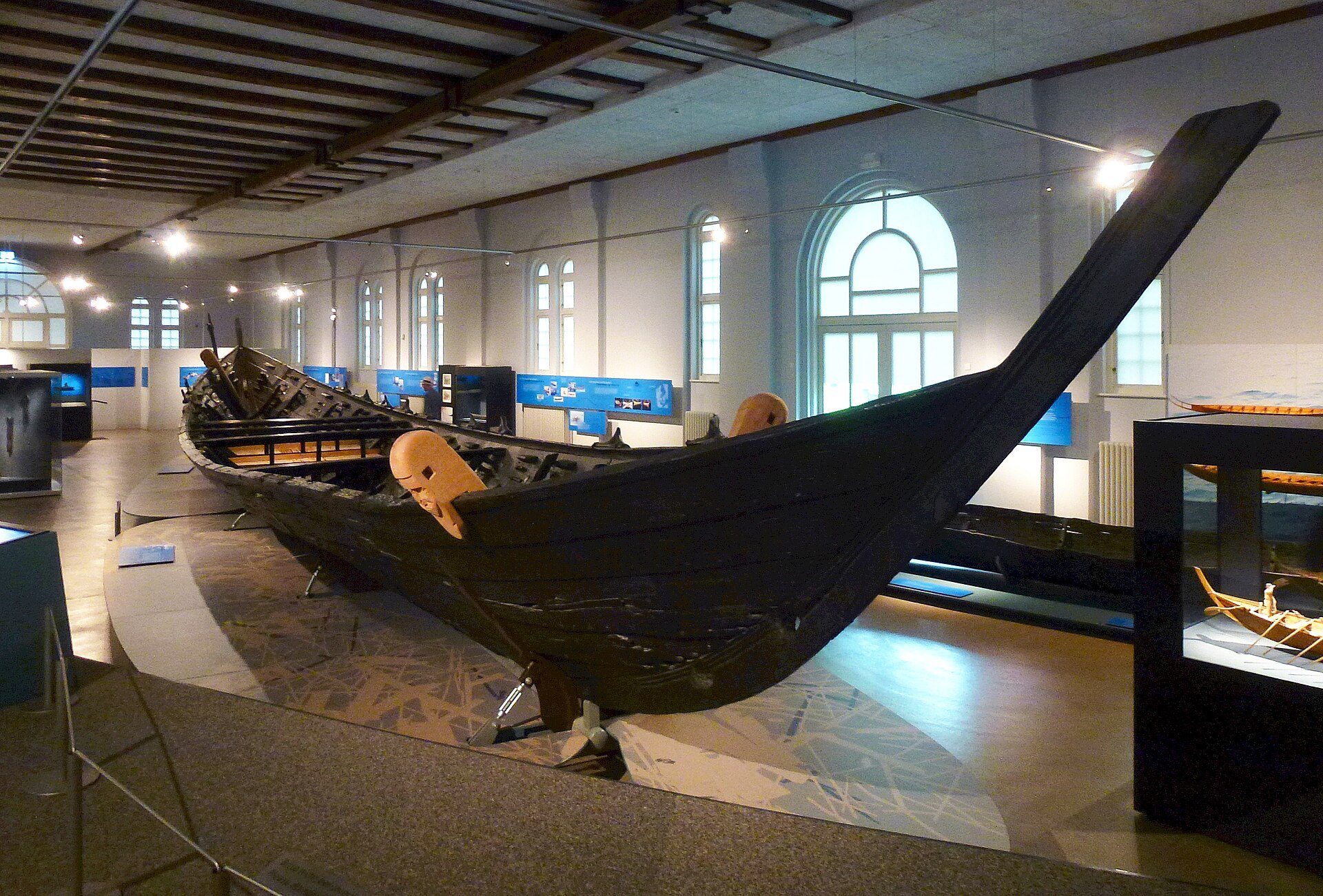
Some 23 metres of oak, held together by iron rivets and lashings, built for oarsmen and not for the wind: the Nydam Boat is the oldest large clinker-built vessel of the North to survive almost whole. It dates from the early fourth century, close to half a millennium before the first Viking voyages. It was found in 1863 in what is now southern Denmark and stands today in Schleswig, Germany. This article sets out what museum, excavation and tree-ring dating can tell us, where the figures disagree, and what the boat says about shipbuilding before the Vikings.
At first sight the Nydam Boat looks like a Viking ship. The hull is long and narrow, the planks overlap, both ends sweep up to a point. Its timber was felled between AD 310 and 320, in the late Roman Iron Age, long before anyone in the North spoke of Vikings.
That is why the boat matters. It shows how far northern shipbuilding had come and what it still lacked. Clinker construction, in which each plank overlaps the one below, is already there. Mast, sail and a load-bearing keel are not. Some six hundred years of development separate this boat from the ships of Tune, Gokstad and Oseberg, and Nydam is the best-preserved point at the start of that line.
The boat is not a wreck. It was sunk on purpose in a lake, together with weapons and equipment. The background is covered in our overview of the bog deposits of army equipment; here the vessel itself is the subject.
Nydam Mose, Nydam Bog, lies at Øster Sottrup on the Sundeved peninsula, about eight kilometres from Sønderborg. Today the spot is a green meadow. In the Iron Age it was open water. The Nydam Society, the local research association, describes the sequence: a first lake silted up around 6000 BC, a lake formed again around the birth of Christ, and sediments built up in it until about AD 400. After that, peat grew over it.
That sequence explains the preservation. The weapons lie in the upper lake sediments or in the lowest peat, where hardly any oxygen reaches them. A few spear shafts sit deeper; they appear to have been thrust into the lake bed during the rites.
Scholarly work begins with Conrad Engelhardt, a Danish archaeologist who had already excavated the Thorsberg bog in Angeln. He worked at Nydam between 1859 and 1863. The National Museum of Denmark, introducing its own research volume, names three campaigns: 1859, 1862 and 1863. They produced lances, spears, bows, arrows, round shields, tools and remains of clothing.
Engelhardt came upon the great oak boat, by the commonly given date, on 17 August 1863. It was assembled within the year and displayed in Flensburg. Early in 1864 war broke out between Denmark on one side and Prussia and Austria on the other, and the excavation stopped.
Nydam Bog held three boats. The famous one is the large oak boat, the only one that still exists. Beside it Engelhardt found a second, well-preserved boat of pine. It was smaller, “perhaps 19 metres” long. This pine boat was lost in 1864. The usual account says soldiers chopped it up for firewood. Its timbers certainly disappeared in the turmoil of war; what we know of it rests on Engelhardt's records and on parts recovered later.
Beneath these two lay a third boat, also of oak. It had been hacked to pieces, and that had happened in the Iron Age. Whoever sank it destroyed it first; a separate article deals with ritually destroyed weapons.
Three boats need not mean three events. The Nydam Society dates the material to AD 250–550, other summaries speak of use between 200 and 450. The lake was evidently visited again and again, and the National Museum's project made a point of telling individual depositions apart.
How big is the boat? The most precise figure, found in several specialist summaries, is 22.84 metres in length with a maximum beam of 3.26 metres. Popular accounts give “about 23 metres” and a beam of 3.5 or even 4 metres. The weight is put at more than three tonnes.
The number of oars varies even more. One reads of 14 pairs, of 15 pairs, and of 36 oarsmen in a crew of 45, which would make 18 pairs. A Dutch heritage database of ship finds says 15 pairs were established “with some certainty”, one pair perhaps added later. The modern replica has room for 30 rowers.
Where do such differences come from? In 1863 the boat was put together from separate parts without firm knowledge of its original shape. The wet timber dried and shrank. Later surveys measure the present state; reconstructions calculate back to an assumed original. The crew of about 45 is an estimate in any case.
The backbone of the hull is not a keel in the later sense. It is a broad bottom plank cut from a single oak trunk. It measures 14.3 metres in length, is 57 centimetres wide amidships and tapers to about 20 centimetres at the ends. The stems at bow and stern join on to it. Above it sit five strakes, or runs of planking, on each side, broad and long. Recent study has shown that most of the planks consist of two parts joined by an overlapping scarf.
The planks overlap along their edges and are fastened there with iron rivets. That is the heart of clinker construction, which later marks every Viking ship; see also the article on ship rivets. The seams were made tight with woven woollen cloth and a tarry mass.
The way the frames, the cross-ribs of the hull, are fixed is striking. They are not nailed to the planks. The builders left cleats standing on the inner face of the planks, small blocks with a hole, and lashed the frames to them. On the keel plank and the first four strakes there are two cleats per frame, on the fifth strake one sturdy cleat that also holds the top of the frame and the thwart, the rowing bench. This costs a great deal of timber but gives a hull that yields in a seaway. The same technique is still found on Viking Age ships.
The Nydam Boat had no mast. No seating for a mast foot was found, and the narrow hull with its flat keel plank would have suited a sail poorly. It was driven by oars resting in rowlocks made from naturally grown forked branches. These were lashed to the top strake and variously decorated. The oarsmen sat facing aft.
The later excavations produced parts of the gear: oars 2.2 to 3.4 metres long, an anchor stock and a complete side rudder 1.8 metres long. The boat was thus steered with a rudder on the side of the hull, as in the Viking Age.
A Roman author described northern ships that seem at first to match. Writing about AD 98, Tacitus says of the Suiones:
“The form of their ships differs in this, that a prow at either end always presents a front ready for landing. They are not worked with sails, nor are the oars fastened in a row along the sides. The rowing gear is loose, as on some rivers, and shifts from one side to the other as need requires.”Tacitus, Germania 44, own translation from the Latin
Two things fit the Nydam Boat: the hull with two like ends and the missing sail. There the agreement stops. Tacitus speaks of the Suiones, usually sought in what is now central Sweden, not of people on the Flensburg Fjord. He writes a good two hundred years before the boat was built and never saw the North. And his remark about loose oars suits paddles, such as the older Hjortspring boat had, better than the firmly lashed rowlocks of Nydam. The passage shows that Rome knew of sail-less ships in the North. It is not a description of the Nydam Boat.
The age of the boat is known from dendrochronology. The method compares the sequence of annual rings in the wood with dated series, which shows when a tree was felled. For the timbers of the oak boat this gave a felling date in the years AD 310 to 320. The origin of the wood could only be narrowed down roughly: Denmark, Schleswig-Holstein or Scania.
When the boat was sunk is a second question. The usual figure is 340 to 350; some accounts say simply “about 340”. The boat would then have been in use for two to four decades. I could not check in the specialist literature what the date of sinking rests on.
The date 310–320 therefore refers to the building, not to the sacrifice, and it applies only to the large oak boat. I found no dates for the other two boats.
A boat of this size represented a great deal of labour: felling oaks, splitting planks, carving cleats, smelting and forging iron for the rivets. All the same it was hauled a short way over land and sunk in a freshwater lake. With it lay weapons and equipment in large numbers, much of it bent, broken or hacked.
Research reads such sites as offerings of war booty. An army attacks, is beaten, and the victors hand the equipment of the defeated to a higher power. The model rests on the make-up of the finds, on the systematic destruction and on comparable sites such as Illerup Ådal. The National Museum, too, speaks cautiously of “presumably war booty”. No text from the North of this period explains what happened at the lake, and which deity received the gifts is unknown.
For the boat this means that it was probably the craft of attackers who came by sea and lost. Who they were the timber does not say; the provenance of the oaks leaves the whole south-western Baltic open.
Engelhardt set the boat up in Flensburg in 1863. After the war of 1864 the boat and other pieces of the Flensburg collection passed into Prussian hands. In 1877 it went to Kiel, to the Museum für vaterländische Alterthümer, where it was displayed in the attic.
In 1920 North Schleswig voted for Denmark. From then on the find spot lay on Danish soil, while the boat stayed in Kiel. Denmark asked for its return after both world wars, without success.
During the Second World War the boat was evacuated. In 1941 it was taken out of Kiel and spent the rest of the war on a barge on a lake at Mölln. It came through undamaged. In 1946 it travelled by water to Schleswig: through the Kiel Canal, across the Baltic and up the Schlei to Gottorf Castle. It has stood there ever since.
From May 2003 to March 2004 the boat was on loan to the National Museum of Denmark in Copenhagen, in a hall built for the purpose.
After Engelhardt the bog was dug several times, but never systematically. The Nydam Society was founded in 1983 and pressed for a new start. In 1989 the National Museum of Denmark began fresh investigations. The project ran until 1999; the final volume, edited by Sandie Holst and Poul Otto Nielsen, carries the years in its title: “Excavating Nydam. Archaeology, Palaeoecology and Preservation. The National Museum's Research Project 1989–99”.
Older summaries give other dates, such as 1984 to 1997. Simply finding Engelhardt's trench again was regarded as the first difficulty. Flemming Rieck is named as leader of the boat excavation.
The finds included more swords, spears, bows and arrows, as well as belt buckles, brooches and ornate fittings. There were also many wooden parts of the boats, including remains of the lost pine boat. According to the National Museum the project concentrated on the geology of the bog, on separating individual depositions and on the conservation of the wooden finds.
Two objects stand apart: carved wooden posts ending in heads. The details differ. One summary speaks of posts 1.3 metres long with heads about 40 centimetres high, found in 1997 near the place where a stem had lain. Another gives 1.4 metres and the year 1993. The posts are often called bollards for making ropes fast. The Nydam Society writes that the museum's investigations point to a position on the gunwale at the bow, and has mounted copies there on the replica.
The boat in Schleswig is a nineteenth-century assembly. Engelhardt and his helpers put together what they had recovered and filled gaps as best they could. When the National Museum surveyed the hull at Gottorf again and combined the measurements with the newly found boat parts, the picture changed in several respects, according to the Nydam Society.
The prow rose higher. The keel plank was more curved. The cross-section had a deeper V and the boat drew more water. The framework of ribs and thwarts proved more developed, with supports for floorboards. And bow and stern were swapped when the boat was set up in the 19th century. What stands at the front of the hall was originally the back.
Anyone using older literature should know that its line drawings show the state of knowledge before these investigations. I have not read the specialist publication.
The Nydam Society and its boat guild, Nydambådens Laug, wanted to rebuild the boat using the old techniques. The society names the National Museum, the Viking Ship Museum in Roskilde and the museum at Gottorf Castle as partners.
The work was done in two stages. First, as a feasibility study, two sections were built: a midship section 2.3 metres long and the stern. They were made together with the Guild of the Hjortspring Boat at its yard, the “Lindeværft” at Holm near Nordborg on northern Als; completion was announced for 2005. The second stage was the full boat, built on Sundeved as close to the bog as possible. According to a press report dated 18 August 2013 it was launched the day before at Sottrupskov: Princess Marie named the boat and Prince Joachim cut the ribbon. I have not seen the guild's own statement of the date.
The replica is called “Nydam Tveir”. The Danish tourist board describes it as a 1:1 replica: a clinker-built oak ship 23 metres long, 3.4 metres wide, weighing 4.4 tonnes, with room for 30 rowers. It is kept in a boathouse at Sottrupskov on Als Sund.
I found no measured results of the sea trials in the sources available to me and give none. On such experiments see the article on replicas of Viking ships. A replica tests whether a reconstruction floats and can be rowed. It does not prove that the original looked exactly like that.
The Nydam Boat counts as the oldest ship find of its kind: a large, clinker-built plank vessel with iron rivets. In December 2021 UNESCO placed Nordic clinker boat building on its list of intangible cultural heritage.
Much of what makes a Viking Age longship is already present at Nydam. The hull is double-ended, the planks overlap and are riveted, the frames are lashed to cleats, and steering is by a side rudder.
What is missing is just as clear. In place of a projecting keel the boat has a flat bottom plank. It has no mast. The oars lie open in rowlocks on the gunwale. When the sail took hold in the North is treated in the article on sails and textiles. Nydam supplies one fixed point: around 320 a large warship without a sail was built on the western Baltic.
This does not make a straight line, for few finds lie between Nydam and the ships of the ninth century. A contemporary boat of similar build was found in 1896 on Halsnøy in western Norway; the ship of Sutton Hoo, of the early seventh century, was likewise a rowed clinker vessel with no mast foot attested. Nydam is a forerunner in the sense that it shows the same way of building at an earlier date. It does not follow that later ships descend from exactly this type.
Most secure is the object itself: species of wood, method of construction and felling date can be measured. Less secure is whatever depends on the recovery of 1863, since the war cut Engelhardt's work short. The reading as a war-booty offering rests on comparison with other sacrificial bogs and remains an interpretation of objects with no native written source. Any link between the boat and named peoples is without evidence. This article draws on summaries by museums, societies and reference works, not on the major specialist volumes; diverging figures are therefore given side by side.
Where can the Nydam Boat be seen? In the Museum für Archäologie Schloss Gottorf in Schleswig, in a hall of its own beside the castle. The castle itself is closed for renovation according to the museum's website (as checked in November 2026); check opening times before a visit. The find spot near Øster Sottrup is now a meadow with a small information house. The replica Nydam Tveir is kept at Sottrupskov on Als Sund.
How old is the Nydam Boat? According to tree-ring dating the oaks for it were felled between AD 310 and 320. By the commonly given figure the boat was sunk around 340 to 350.
How many men rowed it? That is not clear-cut. Figures of 14, 15 and 18 pairs of oars are given. Fifteen pairs, that is 30 oarsmen, is regarded as fairly well founded and is what the replica uses. The whole crew is estimated at about 45.
Did the boat have a sail? No. No seating for a mast was found, and the shape of the hull argues against one. It was rowed and steered with a side rudder.
Why is a boat found in Denmark kept in Germany? When it was recovered in 1863 the area belonged to the Danish monarchy, and the boat went to Flensburg. After the war of 1864 it passed into Prussian hands, went to Kiel in 1877 and to Schleswig in 1946. The border of 1920 put the find spot in Denmark; the boat stayed where it was.
Viking Shipbuilding · Viking Ship Types · The Hjortspring boat: a sewn war canoe from the pre-Roman Iron Age · The bog army-offerings · The Angles.
All Ships & Seafaring articles →
The Oseberg ship is a richly carved oak vessel, roughly 21.5 metres long, in which two women were buried near Tønsberg …
Read more →The Skuldelev ships are five 11th-century Viking ships that were filled with stones and deliberately sunk in the …
Read more →A stone you hold up against an overcast sky that tells you where the sun is: it is one of the finest stories told about …
Read more →A stone ship, or ship setting, is a grave or memorial made of upright stones arranged in the outline of a ship …
Read more →